human rights & intervention 3
 Call Kai
 Learn
Learn Practice Test
 Spaced Repetition
 Match
Match Flashcards
 Knowt Play
1/18

There's no tags or description
Looks like no tags are added yet.
Name | Mastery | Learn | Test | Matching | Spaced | Call with Kai |
|---|
No analytics yet
Send a link to your students to track their progress
19 Terms
geopolitical interventions
aim to address human development and human rights issues by providing:
Development aid
Trade embargoes
Military aid
Indirect and direct military action
development aid and example
Financial aid given to developing countries to promote human rights
The UK announced a £100 million 3 year package of ODA in 2022
Designed to support the most vulnerable parts of the Ukrainian economy and reduce Ukraine’s reliance on gas imports
trade emargo and example
is a ban that restricts trade with a particular country
It encourages a country to change its actions as the country will find it more difficult to sell its goods, resulting in a lower GDP
After the Russian invasion of Ukraine in 2022, the EU imposed an arms embargo
The sanctions prohibited any involvement in the supply of arms and services to Russian military
military aid and example
Countries provide money, weapons or military training to help stop human rights abuses
The military aid (One aid package, worth $775 million) aims to help Ukraine defend itself over the long term
direct military
Armed forces from one country engage in conflict in another country
in 2003, the USA and UK were among a coalition of countries who sent troops and carried out airstrikes in Iraq against the government of Saddam Hussein
IGO intervention
Putting conditions on aid or withholding aid
Imposing trade embargoes
Expressing disapproval of human right abuses
Human rights NGOs aim for peaceful interventions by
Monitoring the status of human rights globally
Campaigning for the protection of human rights
Petitioning and lobbying of authoritarian governments e.g. to free protestors imprisoned unfairly
Encouraging IGOs and governments to intervene in human rights abuses
how western govs try to improve aspects of human rights in other states
Offering aid with attached conditions e.g. improve the education of women and girls
Negotiating trade agreements e.g lowering import tariffs
Military intervention for the most serious breaches of human rights
Libya 2011
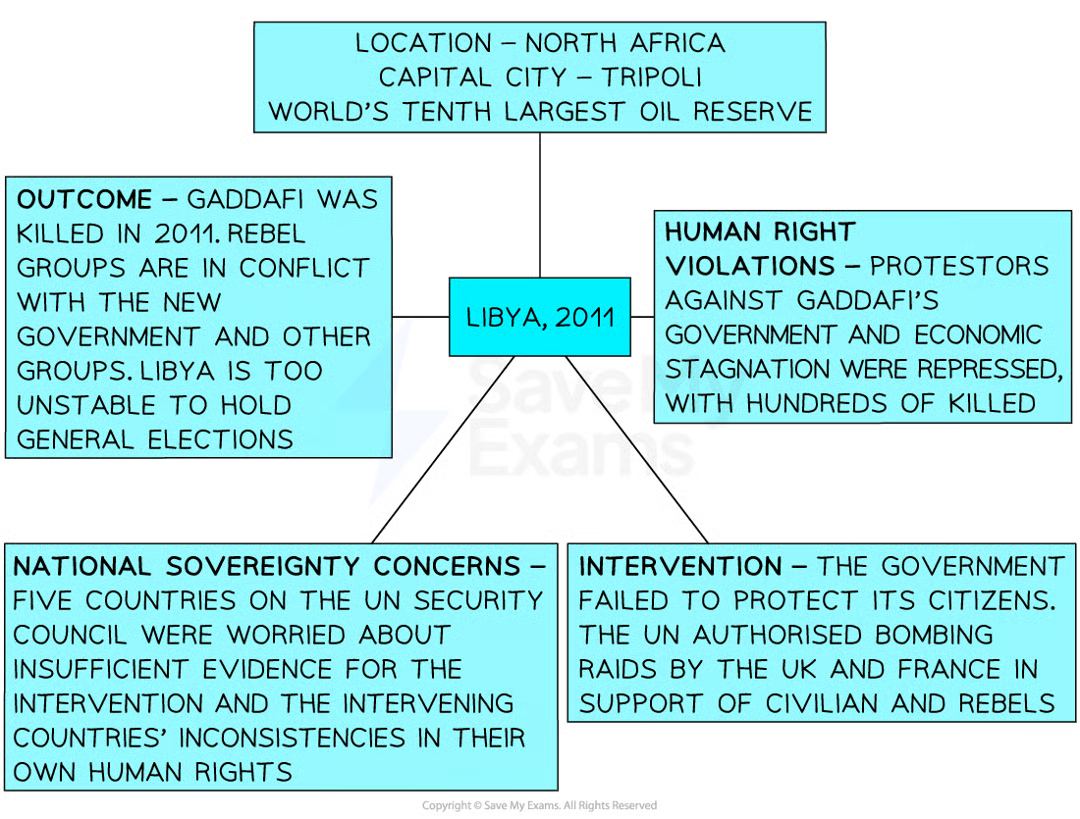
why some forms of intervention are favoured more then others
different types of intervention are favoured by different groups for different reasons
intervention ranges from peaceful interventions to economic and political interventions
Human rights NGOs often seek to avoid any human rights abuses
local NGOs in Afghanistan to try to improve education for women and girls
Superpowers are more likely to favour military interventions in order to stop human rights abuses and protect the interests of Western powers
France and the UK, directed by the UN, performed airstrikes on the Libyan government in 2011 to protect civilians
development aid in Haiti
In 2010, an earthquake hit Haiti leading to over 220,000 deaths
1.5 million people became homeless, having to live in emergency camps (tent cities)
People in these tent cities suffered an outbreak of cholera, killing more than 9,000 people
Within months, over £12 billion of aid was pledged by governments, members of the public, IGOs (the UN) and NGOs (the Red Cross and Oxfam)
The money raised was used in a number of ways e.g. to provide emergency shelters and restore access to clean water
HOWEVER
Two years after the earthquake, 500,000 people were still living in temporary shelters without electricity, plumbing or sewerage
Half of the money pledged should have been spent within 18 months (a condition), but only 40% of this had been spent
impacts of development aid
deal with life threatening conditions- malaria- saharan africa fell by 25% 2000-2020
achieve gender equality- maternal mortality rates fallen, more girls in schoool
dependency- leave countries at risk if aid stops- used by political leit and can repress citizens
corruption- kenya and haiti
oil in the niger delta- tncs ruin human rights- env degradation
About 40 million litres of oil are spilled every year across the Niger Delta
Mangrove forests and rainforests are regularly damaged
Conflict over the oil reserves led to human rights abuses
Around 1,000 Ogonis were killed
30,000 people were made homeless as villages were burnt down
land grabbing in Kenya
Land grabbing in Kenya became popular in the 1980s to use as a resource for bribes
Important government officials still continue this practice of land grabbing
The land is used for cash crops for export, biofuel crops and the production of renewable energy
85% of Kenya’s population relies on agriculture for its livelihood, so land grabbing puts huge pressure on the land and creates tensions between different ethnic groups
Land grabs increase the chance of food insecurity and puts Kenya’s population at risk
Military interventions justified
CLAIMING THEY ARE DEFENDING HUMAN RIGHTS
In 1995, an attack on Bosnian Muslims by Bosnian Serbs led to 8,000 deaths
This led to a NATO operation, involving an air and bombing campaign against the Bosnian Serbs
There was a strong human rights justification (genocide, torture), which led to war crimes arrests among Bosnian Serb military leaders
UK IN SIERRA LEONE SUCCESSFUL IT HELPED BRING AN END TO CIVIL WAR
British soldiers helped disarm the rebel group trying to overthrow the government
They trained the Sierra Leone Army
A ceasefire was agreed and upheld
how DONOR countries argue military aid should help human rights
A strong military could help enforce human rights within a nation
Attaching conditions to the aid may force recipient countries to stop human rights abuses
Stopping aid could threaten national interests, such as access to valuable resources
critics claims military aid can affect human rights by
Further human rights abuses may be committed using the weapons provided
Supporting a government that represses its people undermines the main principle of human rights
Ignoring human rights violations condones it
UK military aid in Saudi arabia affecting human rights
Started in 2015, since this date the UK has supplied Saudi Arabia with $23 billion in weapons
Has led to serious human rights violations, such as bomb attacks on civilians
Has led to the deaths and injuries of more than 17,500 civilians
More than 20 million people in Yemen are experiencing food insecurity; 10 million of them are at risk of famine
war on terror
After 9/11
The USA justified sending troops into Afghanistan and Iraq as it claimed that these countries supported terrorists
The invasions of Afghanistan and Iraq were not approved by the UN, but the USA justified the invasion stating that it was:
To fight terror
To defend the USA
To protect human rights
Iraq’s dictator, Saddam Hussein, was responsible for human rights’ violations - using chemical weapons on the Kurdish ethnic group

