Sports Med test (Ch. 1,2,4)
 Studied by 4 people
 Call Kai
 Learn
Learn Practice Test
 Spaced Repetition
 Match
Match Flashcards
 Knowt Play
1/82

There's no tags or description
Looks like no tags are added yet.
Name | Mastery | Learn | Test | Matching | Spaced | Call with Kai |
|---|
No analytics yet
Send a link to your students to track their progress
83 Terms
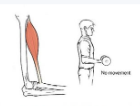
What is the name of this muscle contraction?
Isometric (Muscle contracts to produce tension but the length does not change)
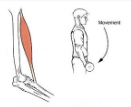
What is the name of this muscle contraction?
Eccentric (Negative contraction, muscle lengthens, more force than concentric, should take 2-4 seconds)
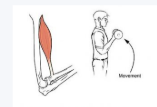
What is the name of this muscle contraction?
Concentric (Positive contraction, muscle shortens, fatigues faster than eccentric, should require 1-2 seconds)
What is going to affect how much force a muscle is capable of generating?
The position of the tendon attachment
List the 2 determinants of strength
1) neuromuscular efficiency
2) biomechanical factors
What is the “core”?
The lumbo-pelvic-hip complex
29 muscles that engage with the core to keep stable and neutral
Center of gravity
Where all movement begins
What does the core improve?
Posture
Dynamic functional strength
Neuromuscular efficiency
Acceleration, deceleration, and stabilization during any body movement
What happens to muscles when they don’t experience overload?
Muscles may maintain and build endurance
List the 7 types of resistance training
Isometric exercise
Progressive resistance exercise
Isokinetic exercise
Circuit training
Plyometric exercise
Body weight exercise
Functional strength training
Isokinetic exercise
Focuses on the speed at which resistance can be moved; very uncommon training method
Circuit training
Athletes move quickly through 8-12 stations comprised of various combinations of weight training, flexibility, body weight training, and aerobic exercises for a specified amount of time depending on the goal. The circuit is repeated 3 times.
Plyometric exercise
Explosive movement over short periods of time by rapid eccentric and concentric muscle contractions; likely to cause muscle soreness
Bodyweight exercises
Uses gravity as aid or a force of resistance; these exercise should be moved through quickly with minimized rest. Some exercise are isometric
Functional strength exercises
For muscular strength and neuromuscular control; trains muscles to work eccentrically, concentrically, and isometrically simultaneously to better prepare for realistic sport demands
Significant muscle growth depends on
testosterone
Why do women plateau before men in terms of building muscle?
Lack of testosterone in women
TRUE OR FALSE: Men have a higher percentage of bodyweight than women
False: women have a higher percentage
A healthy body fat percentage for women ranges from
25-31%
A healthy body fat percentage for men ranges from
18-24%
Healthy body fat percentages do not take into consideration factors like
age or athletic status
The greater the intensity of the activity, the greater the
oxygen demand
Cardirespiratory fitness
The body’s ability to transport and use oxygen efficiently to improve performance and reduce fatigue while performing whole body, large-muscle activities for extended periods
Maximum aerobic capacity
Greatest rate at which oxygen can be taken in and used during 1 minute of maximal exercise
Maximum aerobic capacity is largely determined by (______) muscle fibers.
slow-twitch
Why do athletes with slow-twitch fibers fatigue slower than fast-twitch athletes?
Slow-twitch athletes use oxygen more efficiently, meaning they have a higher maximum aerobic capacity
Aerobic exercise
Continuous, long-duration exercises
Less intense50-85% maximum heart rate
3-6 times/week
20-60 minutes
Less risk to sedentary or older individuals
Anaerobic exercise
Explosive, short-duration, burst exercises
More intense
85-100% maximum heart rate
3-4 times/week
10 seconds- 2 minutes
Used in sports and team activities
When measuring maximum aerobic capacity, what is used as an common indicator?
Your heart rate
How do I improve my maxmimum aerobic capacity
Continuous Endurance Training
High-Intensity Interval Training
Fartlek training
Fartlek training
Swedish translating to “speed play”, however speed and pace are not actually identified
Instead, athletes run for a specified period on changing terrain (uphill, flat, downhill, around trees/rocks) to cause speed surges
For improvement, heart rate must reach at least 60-85%
Best used as an off-season workout or change-of-pace activity to counteract boredom of the same continuous routine
High intensity interval training
Alternating intense work with active recovery
Athlete works at at least 80% of heart rate then drops to 60-70% heart rate
Allows for more work at higher intensity for longer periods of time than continuous endurance activities
Can improve cardiorespiratory fitness in as little as 2 weeks
Sports often involve short bursts, followed by active recovery, making HIIT to be a more sport specific workout
Overload principle is applied by increasing intensity
What is fitness?
It is vital to be an athlete
- an athlete who is not fit and fatigues quickly is more susceptible to injury
Improving flexibility, muscular strength, endurance, power, and cardiovascular endurance reduce likelihood of injury
Increasing the length and intensity of training can increase risk of injury simply due to increase of exposure but overall, increased fitness decreases injuries
- Developing fitness takes time
Sports conditioning has evolved to being year round Includes:
off-season, pre-season, and in-season
Periodization cycles the what?
- intensity, volume, and specificity of training to allow athletes to reach optimal performance for competition while minimizing the risk of injury due to overuse
Training sessions change from what?
high-volume, low-intensity, non-sport-specific activity to low-volume, high-intensity, sport-specific training
What are the periods?
transition, preparatory, and competition
Cross Training
- Substituting alternative activities that have some carryover value to the specific sport
- Helps athletes maintain fitness and avoid boredom in the post and off-season
SAID principle
Specific Adaptation to Imposed Demands
- When the body is exposed to stress and overload, it will adapt to overcome whatever demands are placed on it, and reduce risk of injury in doing so
warm up
Gradually stimulates cardiorespiratory system to increase blood flow to musculoskeletal systems. Increased blood flow increases muscle temperature and allows it to contract and relax more quickly
Static vs Dynamic?
A dynamic workout is continuous movement using hopping, skipping, and bounding activities to stimulate the nervous system through coordination and motor ability.
- It should be between 5-20 minutes and the sport activity should not begin more than 15 minutes after the warm up
Cool Down
An activity post sport/workout to gradually decrease metabolism back to a resting level. It may be followed by stretching.
- Cool downs should last 5-10 minutes.
Flexibility
Lack of flexibility can create uncoordinated or awkward movement patterns resulting from lost neuromuscular control
"Loose-jointed" athletes
(those with too much slack) are at as much risk as tight-muscled athletes
- Strain or constant tension on a tight band of muscle can create a trigger point. Pressure on a trigger point creates a twitch or jump reaction and is painful when the muscle is stretched.
Agonist Muscles
The prime mover
Antagonist Muscles
The opposite action of the prime mover
Active (range of motion)
When the athlete voluntarily contracts their muscle to move it
Passive (range of motion)
When an athlete's muscle is moved by an external force
- Passive range of motion begins at the end of and continues beyond active range of motion.
ballistic stretching
Repetitive bouncing movement to push the muscle beyond its normal range of motion.
Risk of injury.
Dynamic Stretching
Controlled flow of movements through a full range of motion to prepare for activity. Considered more functional for the types of activities athletes engage in.
Can result in Delayed Onset of Muscle Soreness (DOMS).
Static Stretching
Effective way of passively stretching by placing the muscle at its maximum stretch and holding it there for 15-30 seconds, 3-4 times. More controlled than dynamic stretching (preferred for unfit individuals to reduce risk of overextension).
PNF (proprioceptive neuromuscular facilitation)
Stretching method often used in clinical rehabilitation settings to improve flexibility and range of motion by alternating 10 second pushing phase and 10 second relaxation phase, repeated at least 3 times.
There are two variations.
Best performed with a partner but a wall can be used.
How Does Flexibility Relate to Strength?
one compliments each other
- When strength training is not properly done, it can impair movement
- If someone bulks enough for a muscle to become too large, the muscle itself may prevent a normal range of motion
Muscular Strength
The ability of a muscle to generate force against some resistance
- As muscular strength increases, muscular endurance increases
Muscular Endurance
The ability to perform repetitive muscular contractions against resistance for an extended period of time
Power
Exhibiting strength with speed
- Most movements in sports are explosive and require power, making power arguably more important than strength or endurance.
isometric contraction
Muscle contracts to produce tension but the length does not change
concentric contraction
Positive contraction
Muscle shortens
Fatigues faster than eccentric
Should require 1-2 seconds
Eccentric Contraction
Negative contraction
Muscle lengthens
More force than concentric
Should take 2-4 seconds
Determinants of Strength- Size of Muscle
The bigger the muscle, the more muscle fibers, the more force it can generate. Muscles increasing in size is called hypertrophy. Decrease in muscle size is called atrophy.
Determinants of Strength- Number of Muscle Fibers
Strength is a function of the number and diameter of muscle fibers. People with more fibers hypertrophy more. The number of muscle fibers is hereditary but anyone can increase through exercise
Determinants of Strength- Neuromuscular Efficiency
Muscular system requires efficiency from the nervous system.
Nerve impulses must be transmitted from the nervous system to the muscular system to contract the muscle. The more contractions, the more muscle growth/strength.
Determinants of Strength- Biomechanical Factors
Bones, muscles, and tendons operate like a system of levers and pulleys. The position of tendon attachment is going to affect how much force a muscle is capable of generating.
Determinants of Strength: Fast-Twitch vs Slow-Twitch Muscle Fibers
Fibers that make up a muscle are either fast-twitch or slow-twitch.
Every muscle is comprised of both but the exact ratio varies person to person.
Determinants of Strength- Level of Physical Activity
People who are continuously active, maintain strength. Strength training aids in endurance, flexibility, and cardiorespiratory health; and slows increase of body fat that occurs with age
Determinants of Strength- Overtraining
Overtraining has negative psychological and physiological effects.
- It can cause musculoskeletal injury, chronic fatigue, sickness, apathy, loss of appetite, indigestion, weight loss, and inability to sleep or rest properly.
Determinants of Strength- age
Strength can increase through puberty and adolescence, reaching a peak around age 20-25. After about 25, a person loses about 1% of their strength per year.
What is the "core"?
The lumbo-pelvic-hip complex
29 muscles that engage with the core to keep stable and neutral
Center of gravity
Where all movement begins
How Does it Function?
Improves:
-posture
-Dynamic functional strength
-Neuromuscular efficiency
-Acceleration, deceleration, and stabilization during any body movement
- Extremities can be strong but without a strong core, movement will not be efficient, and will be more prone to injury
Resistance Training types
Functional strength training
Isometric exercise
Body weight exercise
Isokinetic exercise
Progressive resistance exercise
Circuit training
Plyometric exercise
what is overload?
For a muscle to improve in strength, it must be forced to work at a higher level than it is accustomed. This is called overload.
- Without overload, muscles may maintain and build endurance
Isometric Exercise- what and why?
- Contracts the muscle statically without changing its length
- Muscle should contract at maximum against an immovable force for 10 seconds, 5-10 times/day
- Used when an athlete is rehabilitating strength but has an injury that prevents full range of motion
Isometric Exercise- Limitations
Strength is only increased at that specific joint angle because there was no length change or functional movement
- Potential to produce spike in blood pressure from holding breath and increasing pressure. This is called the Valsalva effect and can be life threatening.
Progressive Resistance
Strengthen muscles through exercises that overcome resistance from equipment (dumbbells, therabands, etc.)
Isotonic exercise= force is generated while the muscle changes length
Isotonic contractions can be concentric or eccentric
Free Weights
Requires neuromuscular control to keep weights in the correct direction. This decreases the amount of weight an athlete can lift compared to machines that do that for the lifter.
Isotonic
Machine Weights
Safer (don't need a spotter; can drop weights without fear of injury)
Simple way to add or subtract weight on the machine (simply moving the weight key)
Isotonic
Exercise Tubing (Bands)
Exercise can be done in more functional movements
Isotonic
Closed Chain Kinetic Chain Exercises
Hand or foot is in contact with ground or another object and is weight bearing
More common in strength and conditioning programs because it's more functional
Open Chain Kinetic Chain Exercises
Hand or foot is not in contact with another surface
Isokinetic Exercise
Focuses on the speed at which resistance can be moved
Very uncommon training method
- Biking and treadmill (especially at incline), and rowing machine may be the only common uses
Circuit Training
Athletes move quickly through 8-12 stations comprised of various combinations of weight training, flexibility, body weight training, and aerobic exercises for a specified amount of time (ex. 1 minute each) depending on the goal. The circuit is repeated 3 times.
Plyometric Exercise
Explosive movement over short periods of time by rapid eccentric and concentric muscle contractions
Likely to cause muscle soreness
3 sets of 6-8
Body Weight Strengthening Exercises
Uses force of gravity as resistance
You can use gravity as an aid or
Move against gravity
2 or 3 sets of at least 10 reps
These exercises should be moved through quickly, minimizing rest
Some exercises are isometric (holding the contraction for 6-10 seconds, 1-3 times)
Functional Strength Exercises
For muscular strength and neuromuscular control
Trains muscles to work eccentrically, concentrically, and isometrically simultaneously to better prepare for realistic sport demands
 Note
Note  Flashcards (46)