Unit 7.4 - Political and Legal change
 Call Kai
 Learn
Learn Practice Test
 Spaced Repetition
 Match
Match Flashcards
 Knowt Play
1/39

There's no tags or description
Looks like no tags are added yet.
Name | Mastery | Learn | Test | Matching | Spaced | Call with Kai |
|---|
No analytics yet
Send a link to your students to track their progress
40 Terms
3 main types of anti-competitive behaviour competition law prevents
- Anti-competitive agreements
- Abuse of dominant market position
- Merger control
Anti-competitive agreements
Competition Law prevents agreements or arrangements which prevent, restrict or distort competition and effect trade within the UK or EU
Type of arrangements that are prohibited included:
- Fixing purchase or selling prices or other conditions such as as discounts or rebates
- Limit or control production, markets, technical development or investment
- Sharing markets or sources of supply
- Applying different conditions to similar transactions on different one party to disadvantage them over others
Abuse of dominant market position
Competition law prevents businesses with significant market power unfairly exploiting their market power
Examples:
- Imposing unfair trading terms, such as exclusivity, where only one suppliers products can be displayed
- Excessive, predatory or discriminatory pricing
- Refusal to supply or provide access to essential facilities
- Requiring a buyer who wishes to purchase one product to also purchase other products
Merger control
-a merger, acquisition or joint venture can be subject to review by UK or EU competition authorities to assess whether it will reduce competition in the market to a significant extent
Cartels
Business collude and make agreements in order to control the market or make trading conditions better by not competing , for example on price and discounts. Consumers and the economy lose.
UK legislation on competition
Don't need to memorise the laws per say, but understand the impact these could have on businesses
- Fair Trade act, 1973
- Competition act, 1998
- The competition commission
- Enterprise act, 2002
- Competition and Market authority (CMA)
- The Financial conduct Authority (FCA)
Competition act, 1998
- Prohibited anti-competition agreement such as cartels
- Prohibited abuse of dominant market positions
- Allows fines of up to 10% of turnover
Competition act, 2002
- More transparent and accountable decision making by competition authorities
- Criminal sanctions to deter cartels
- More opportunities for victims of any-competitive behaviour to gain claim back losses
- Strengthened consumer protection measures
Regulation
enforcement or principles or rules that result from the passing of a law or series of laws.
Role of regulators
Support those they regulate to comply with the rules in a variety of different business activities, it's an attempt to protect the consumer.
financial service regulators
- Prudential regulation authority (PRA): controlled by the Bank of England to establish a stable finance system, promoting the safety and soundness of these financial services
- The financial conduct authority (FCA) - separate of BoE to ensure that financial markets operate effectively and there's acceptable amounts of competition
Financial services
any products which are financial in nature and include those supplied by banks, insurance companies and financial advisors.
Privatisation
process of transferring an organisation that is state owned, to the private sector
Why some industries are heavily regulated
closely regulated because of the potential to act against the interest of consumers, their ability to damage the economy or the importance of the good or service to basic standard of living
Examples of highly regulated industries
- Financial services: Due to systemic risk and ability to impact economy (i.e 2008 financial crisis)
- Utilities (Gas, electricity, water): Essential to standard of living and could dominant manipulate market position after being privatised
- Other privatised businesses that had dominant market position as a result
Examples of regulators
- Ofwat (Water)
- Ofcom (Communications i.e television, radio)
- Ofgem (electricity and gas)
- PRA (finance)
- FCA (finance)
How can regulation create free and fair competition
- Imposing 'windfall' taxes - taxes on excessive profits and incur for businesses with too much market power
- Controlling prices - limiting price rises in line with inflation
- Restricting rates of return on capital invested by businesses - can't set excessively high prices, could lead to higher prices as no incentive to reduce costs
- Unbundled access - allows new entrants to market access to the facilities of existing producers to encourage competition
Impact regulation can have on UK business
- Stops them maximising profits by charging higher prices
- Adverse publicity if fined or other sanctions
- Take a range of functional and strategic decisions to reduce the impact of any threat - make lower risk decisions
- Opt out of tightly regulated markets
- Provides a stable long term environment to operate
- Can facilitate investment - more certain future
- Reduces barriers to entry - provides competitive opportunities for new entrants
Monopoly
Exists where there is a single supplier is a market
Why may consumers need protecting against Monopolies
They have the most dominant market position possible therefore could:
- Charge excessively high prices
- Restrict supply of products
- Offer lower quality good or services
- Offer potentially harmful products if it reduces their costs
Infrastructure
physical and organisational structure required to allow both society and an economy to operate efficiently e.g roads and communication networks
Why infrastructure is important to business
they could not supply goods and services if there was no infrastructure. If infrastructure is provided effectively and cheaply, this can reduce operating costs for a business and make them more competitive.
Government aims for international trade
The UK government will want to encourage international trade - UK businesses exporting
- overseas companies to work with and in the UK in a positive way
- Will want to have the correct balance of imports and exports
- Protect domestic businesses where needed
- Increase standard of living through competitiveness and import of cheaper goods/supplies for businesses
Policies on international trade (Free trade agreements)
This was formerly covered by being part of the EU - the UK will still seek trade agreements across the globe
These are agreements with other countries that allows for good to be bought and sold between nations with none or limited restrictions such as tariffs and quotas
Benefits of international trade
Easier with a free trade agreement
- More Revenue and employment
- Easy to sell abroad if in a trade agreement
- Access to larger markets
- Economies of scale
- Offshoring - lower costs
- Easier access and mobility of factors of production
- More intense competition can encourage efficiency and innovation
Drawbacks of international trade
- Takeovers may be more likely
- More competition
- Relies on reduced barriers to trade
- Customers may not know your product / increased advertising spending
- Need to comply with more and different regulation
Policies on international trade (reducing trade)
Protectionism:
Tariffs - tax on imports
Quotas - Limit on amount of imports for a certain good
Regulation and standards - only allowing certain quality of goods to be imported
used to protect domestic industries or consumers against harm
Enterprise
Process by which new businesses are formed as well as new products created and brought to market. Is also the development of skills needed to make new ideas work
- Entrepreneurs and entrepreneurialism
Why does the government wants to encourage enterprise
An environment that supports enterprise supports people who take opportunities and risks, can lead to
- Improved productivity (of individuals and overall economy)
- Encourage prosperity and growth in the economy
- Increase innovation which could mean new technologies and practises further improving productivity
- New products increasing standard of living
- Increased competitiveness which improves efficiency in markets, drives improved quality
Ways government support enterprise
- Reducing the number of regulations which constrain business activity
- Department of business, innovation and skills is working with HMRC to offer support to new and small businesses by reducing the tax they pay on any profits and also the cost of employing people
- Supporting innovation through funding
- Range of schemes to develop new products and processes
- Recruits young business owners to volunteer as enterprise champions
- Works directly with schools and colleges to encourage the use of schemes
Past regulation on enterprise (British business bank)
support for smaller businesses to gain access to finance (EST 2012 and in 2013 it gave £660m lending and investment)
Enterprise allowance: two parts (loan and £1,284 grant over 6 months)
Funding for lending: allows banks to borrow from BofE at cheaper rates to give back to small businesses
Enterprise finance guarantee: loan guarantee scheme. It allows all banks and other lenders to offer smaller businesses a normal commercial loan without a proven track record.
This is mainly financial support
Past regulation on enterprise (government growth voucher)
Government growth voucher: offers funding, guidance and advice
- Finances and cash flow
- Recruiting and developing staff
- Improving leadership and management
- Marketing, attracting and retaining customers
- Making the most of digital technology
This is mainly non-financial support
UK legislation on labour (Employment legislation)
Aims to ensure employees and employers act fairly in dealing with each other by defining their rights and obligations
Some areas employment law covers
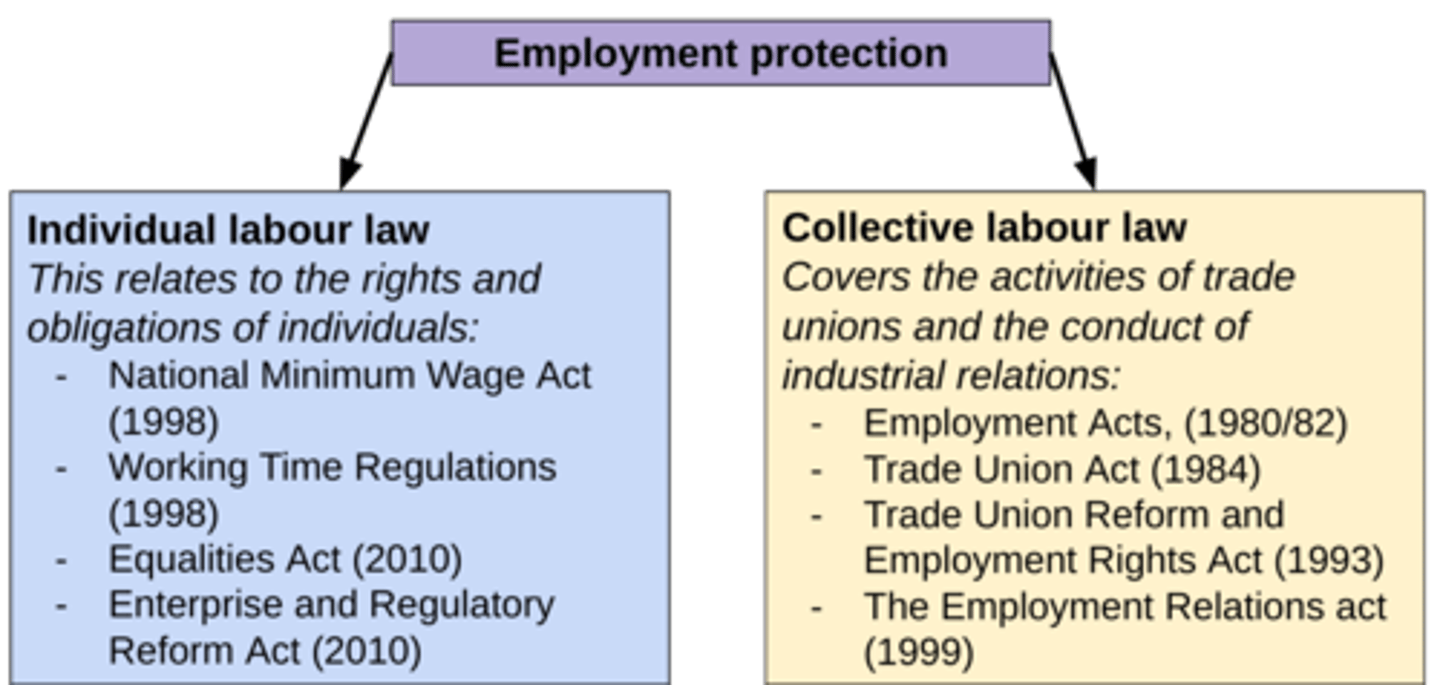
- Discrimination (equalities act, 2010)
- Pay (national minimum wage)
- Working conditions (working time regulations, health and safety)
- Contract of employment and employer-employee relations (Employment act, 2008 and trade union laws)
- Dismissal
Some employment laws (image)
When can an employee be dismissed fairly
Where a job no longer exists - redundancy
Gross misconduct
Failing to carry out duties in a satisfactory manner
Ending of a contract
Environmental laws
Aim is to ensure businesses are responsible for their use of resources and impact on the natural world, includes issues to do with air, water and land
Regulators: Environmental agency, local authorities
Some areas environmental laws cover
- Pollution and emissions (Environmental act, 1990 and 1995)
- Waste creation and disposal (Waste and emission trading act, 2003)
- Carbon footprint ((Climate change act, 2008)
Impact of employment law (labour market) on businesses
- Can increase costs to pay higher wages or comply with health and safety
- Can slow down efficiency and productivity if certain procedures must be followed
- Can improve employer employee relations and motivation - improved productivity, absenteeism, less strike days
- Improve recruitment as best person selected due to equalities act
- Improved diversity
- Framework for decision making on recruitment, selection and workplace practise
Impact of environmental laws on businesses
- Certain increase in costs
- May slow down efficiency and productivity if certain procedure must be followed
- Improved decision making around environmental impacts may improve reputations and promotion of goods and services
- May encourage more long-term planning and prevent shortism - ensure sustainable business
- Will Impact certain industries more than others

