Social Dynamics and Trust
 Call Kai
 Learn
Learn Practice Test
 Spaced Repetition
 Match
Match Flashcards
 Knowt Play
1/37

Earn XP
Description and Tags
These flashcards cover key concepts regarding trust, cooperation, social dynamics, and the factors influencing prosocial behavior.
Name | Mastery | Learn | Test | Matching | Spaced | Call with Kai |
|---|
No analytics yet
Send a link to your students to track their progress
38 Terms
Trust
An evolutionary advantage that facilitates cooperation and forgiveness of unintentional errors.
Social Dilemma
A situation where individual rationality leads to collective irrationality, often requiring strategies to encourage cooperation.
Machiavellianism
A personality trait involving manipulation and exploitation of others, often correlated with defection in social dilemmas.
Social Reciprocity Norm
The expectation that people will respond to each other in similar ways, such as returning favors.
Bystander Effect
A phenomenon where individuals are less likely to offer help in an emergency when others are present.
Tragedy of the Commons
A situation where shared resources are overused and depleted due to individual self-interest.
Often times, we are greedy because we don’t think people deserve things that we deserve, like the same grade
The unfairness makes us feel bad about it
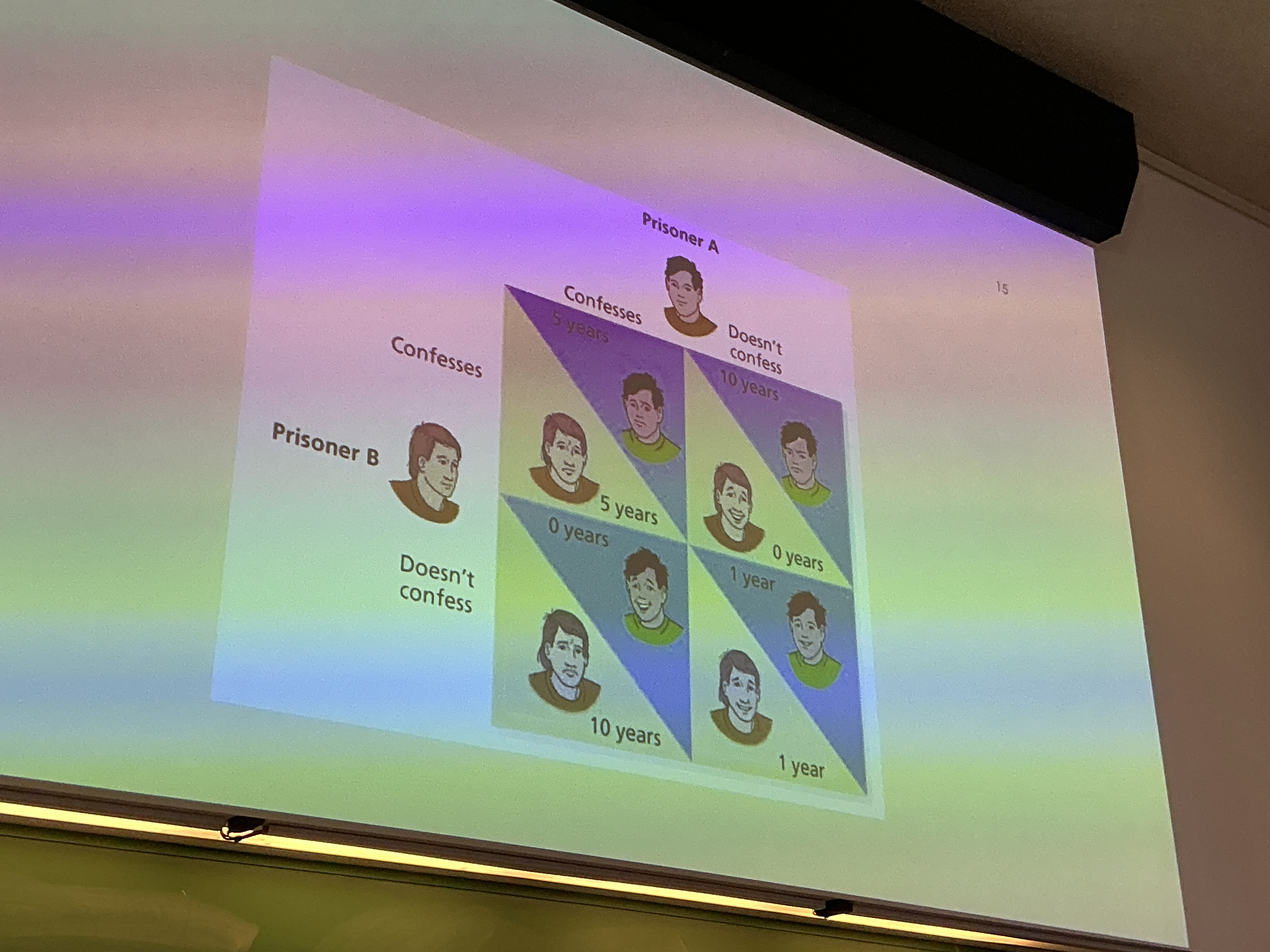
Prisoner's Dilemma
A scenario in which two individuals must choose between cooperation and defection, with varying outcomes based on mutual choices.
Tit for Tat Strategy
A strategy in game theory where a player responds to cooperation with cooperation and defection with defection.
Norm of Social Responsibility
The expectation that individuals should help those who depend on them.
Elevation
A feeling of gratitude and love experienced after observing acts of kindness or courage.
Collective Action Problem\n\n
A challenge where individuals must work together to achieve a common goal but may not cooperate due to self-interest.
Altruism\n\n
Selfless concern for the well-being of others, often leading to cooperative behaviors that may benefit the group.
Groupthink\n\n
A psychological phenomenon where the desire for harmony in a decision-making group leads to irrational or dysfunctional outcomes.
Social Identity Theory\n\n
A theory that suggests a person's identity is shaped by their membership in social groups, influencing behavior and attitudes.
Diffusion of Responsibility\n\n
A phenomenon in which individuals are less likely to take action when they believe others will, often seen in emergencies.
Do we want to be more trusting?
Evolutionary advantage of trust
Required for cooperation
Allows for forgiveness of unintentional errors
How do different perceptions influence group conflict strategies?
Some percieve cooperation as obvious strategy, others defection
Why is it important to reframe problems in group conflicts?
Reframing helps avoid an all-or-nothing mindset.
- Encourages collaborative solutions rather than confrontational ones.
How do we avoid/resolve social dilemmas?
Keep the group small - If you have a group of 4 ppl, you are personally accountable and less anonymous
Regulate community action - morally or legally
Enable communication - having the situation explained, talking about the problem helps people cooperate
Change the payoff - make the cooperative strategy more attractive by adding incentives
Appear to altruistic norms
Hi vs. lo mac - personality variable
both extremes are bad
Golden balls example - high mac
Machiavellianism
Measures the degree to which people believe others can be manipulated
manipulator gets more of some kind of reward than they would have gotten without manipulating, while someone else gets less, at least within the immediate context
Correlated with defection on prisoner’s dilemma
Lawyers, psychiatrists, and social psychologists are more Machiavellian than accountants, surgeons, or natural scientists
Because Lawyers, etc. have to know people and recognize their patterns well, they like to make new rules and break them
Hi Machs more likely to come from urban backgrounds
Less familiar w ppl around them
Who teaches us to trust?
Parents, friends, partners
Society and media
At Rice, normal to leave things in places
Heritability of Trust
15% Heritable
Must be adaptable to situations, no sense for it to be highly heritable
Higher social cost of betrayal
Why did the toilet paper crisis occur during COVID?
Normative influence - ppl are grabbing it so it must be good
Why are prisoner’s dilemmas worth studying?
Experimental realism
These experiments are similar to the real world - they apply well outside the lab
We create our own environments, and we can change this
behavioral confirmation
Some people perceive cooperation as the obvious strategy
Some perceive defection as better strategy
Those who initially choose cooperation, encourage cooperation
ppl who choose defection elicit defection
Best Prisoner’s dilemma strategy is tit for tat
• ⁃ Maximizes team payoff/individual payoff
Prosocial behavior
action intended to benefit another, whether rewarded or not
Benevolence
Action to benefit another, no external reward
Pure altruism
Action to benefit another, no external or internal reward, doesn’t really exist in humans
pluralistic ignorance
nobody else is acting, so must not be big deal
ambiguous interpretations
is it really an emergency?
evaluation apprehension
we don’t want to overreact, use others as informational influence
Environmental conditions of helping
Ppl more likely to help when they’re feeling good
Chain of events for intervention:
Notice the event
selective attention
Perceive a need
emergencies are unusual, unexpected, sudden
clear threat of harm
harm will increase without intervention
victim can’t help themselves
effective intervention is possible
Take personal responsibility
influencing factors:
verbal commitment: “I will help”
Means of accountability
Real or implied leadership
Feelings of competence in situation, ex: CPR training
Weight costs and benefits
Decide how to help
Why did that guy jump on the train tracks to save a stranger? Why is this even more surprising?
He has expertise on track safety, electrical engineer.
He left his children unattended to save the stranger
Smoke-filled room experiment
Experimenters filled a room with smoke and had confederates not do anything
subjects stayed in the room until they literally couldn’t see their paper
How does time pressure play into people’s likelihood to help?
more likely to help when not under time pressure
Darley and Batson study:
split priests into those who primarily wanted to help ppl, and those who didn’t
Split each group into those who were “late”, “on time”, and “early” to something across campus
The situational variable, late vs early, predicted helping
late ppl helped far less,
early ppl helped far more
How does population density play into helpfulness?
ppl living in dense urban environments pay less attention to those around them, and are closer with them
What can I do in an emergency situation?
Take responsibility - help or call an expert
Be aware of “power of situation”
Point out “helpers” - “you, call 911”
Be courageous: you can earn people’s trust back, but you can’t save a dead person’s life.

