Upper Respiratory Passageways: Comparative Anat. and Structure/Function Considerations (Week 1, Mod 9)
 Studied by 0 people
 Call Kai
 Learn
Learn Practice Test
 Spaced Repetition
 Match
Match Flashcards
 Knowt Play
1/13

There's no tags or description
Looks like no tags are added yet.
Name | Mastery | Learn | Test | Matching | Spaced | Call with Kai |
|---|
No analytics yet
Send a link to your students to track their progress
14 Terms
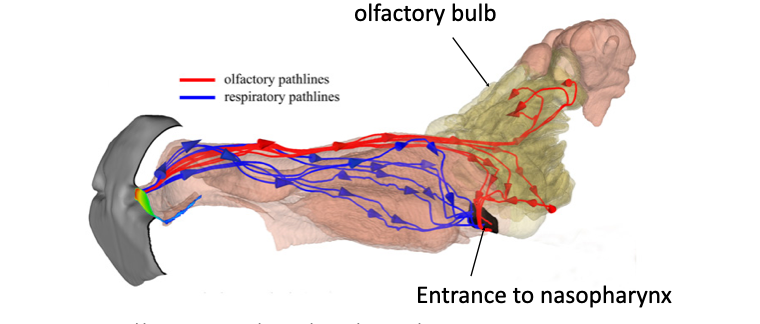
There are 2 nasal passageways… how do they modify and regulate the volume of inspired air? (hint: one does most of this, the other is just for smell)
Respiratory pathway (blue) - respiratory epithelium
Warms the air via rich blood supply of nasal lining
Protects lower respiratory tracts
Moistens the air- glandular secretions → mucus
Goblet cells and glands produce mucus that adds moisture to inspired air
Cleanses the air- mucus and cilia
Mucus traps dust and particles
Cilia move the mucus toward the pharynx to be swallowed or removed
Regulates airflow- blood vessel congestion or constriction
Blood vessels can swell (CONGESTION) or constrict, altering airflow
EX: constrict during exercise to increase air flow
Olfactory pathway (red) - olfactory epithelium
Runs alongside the respiratory pathway and is responsible for detecting smells
Where in the respiratory passageways is it NOT lined by respiratory epithelium?
Ethmoidal and middle conchae
Vomeronasal gland
What is the histological classification for “respiratory” epithelium, and how does its structure relate to its function?
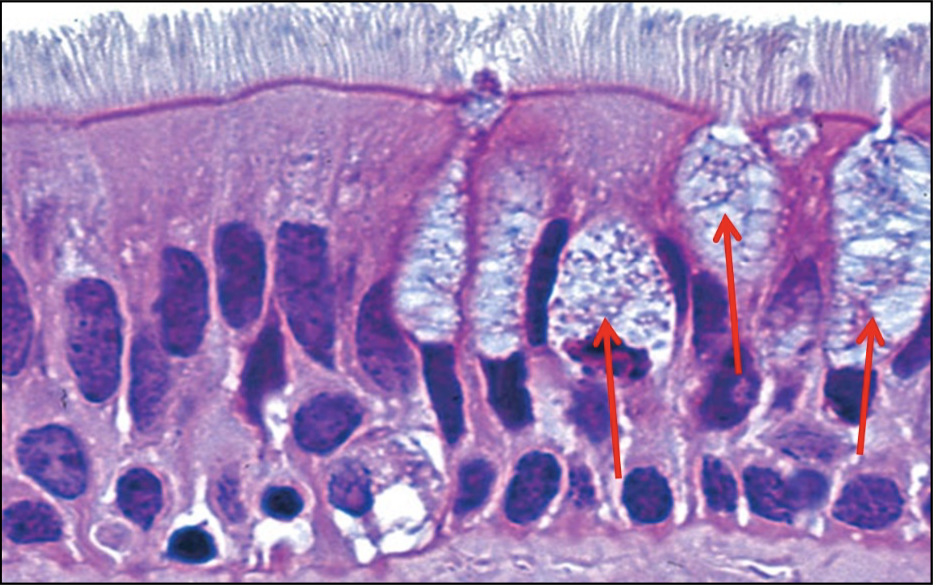
Histological classification: Pseudostratified columnar ciliated epithelium with goblet cells
5:1 ratio of epithelial cells to goblet cells
Function: “air conditioning”
Mucus sheet
Produced by goblet cells and sub-mucosal glands
Moistens air
Traps particulate matter
Cilla
Motile- beat in concert
Mucus and trapped particulate is wafted towards pharynx where it is swallowed or expectorated
Submucosa is also highly vascular (bvs)
Warms the incoming air
Acts like an erectile tissue
Congestion- disrupts airflow
Vasoconstriction- allows increased airflow during exercise
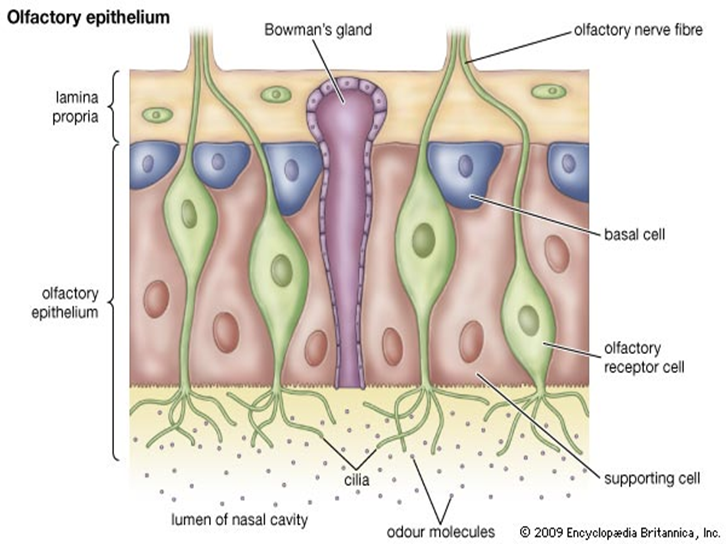
What are the 4 main cell types found in olfactory epithelium? Describe their structure and function.
Olfactory receptor cells (green)
Bipolar neurons - apical pole carries a non motile cilia with specific odorant binding receptors
Unite to form an olfactory nerve which passes through the cribriform plate to terminate in olfactory bulb
Bowman’s gland (purple)
secretion solubilizes incoming odorants and washes away excess
Supporting cells (red)
Provide metabolic and physical support to olfactory cells
Basal cells (blue)
stem cells- can differentiate and replace olfactory receptor cells
How many olfactory receptors do canines have in their nose? How does the structure of their nose overall enhance their smell?
Dog’s sense of smell is their PRIMARY sense
Have 300 million olfactory receptors
Olfactory bulb also 40 times larger than a human; means dogs can distinguish and remember more smells than we can
Structure for smell:
Have a wet nose, that helps them determine the direction of the air current containing the smell.
Have slits in their noses that allow them to exhale air separately from the inhaled air, unlike humans who use the same passageways for both.
This means that dogs can keep the scent molecules in their noses longer and avoid washing them out with the exhaled air.
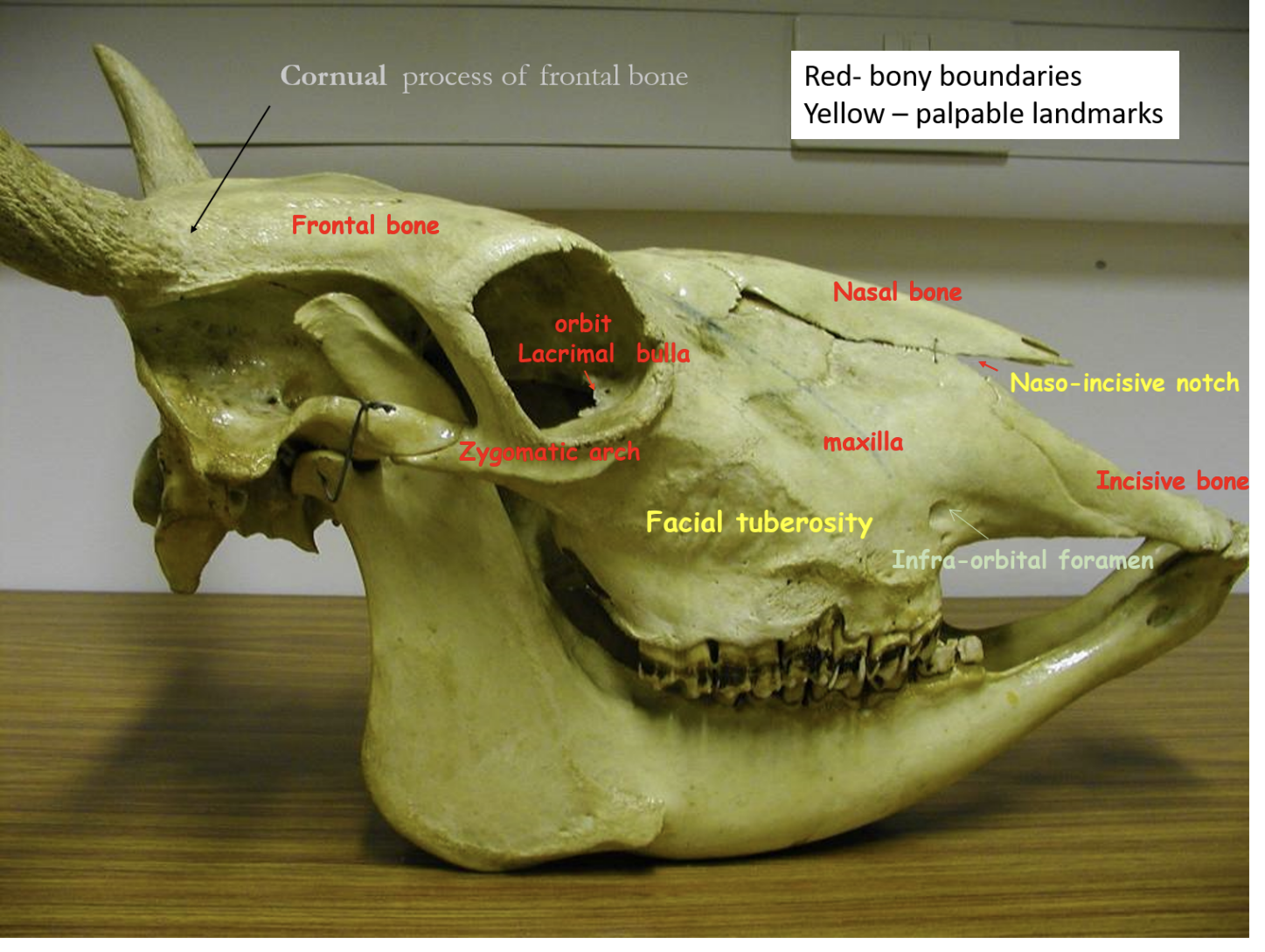
What are the palpable bony landmarks on the bovine skull?
Naso-incisive notch
Facial tuberosity
Cornual process of frontal bone (right by horn)
How are the nasal cavities of the ruminant different from that of the carnivore?
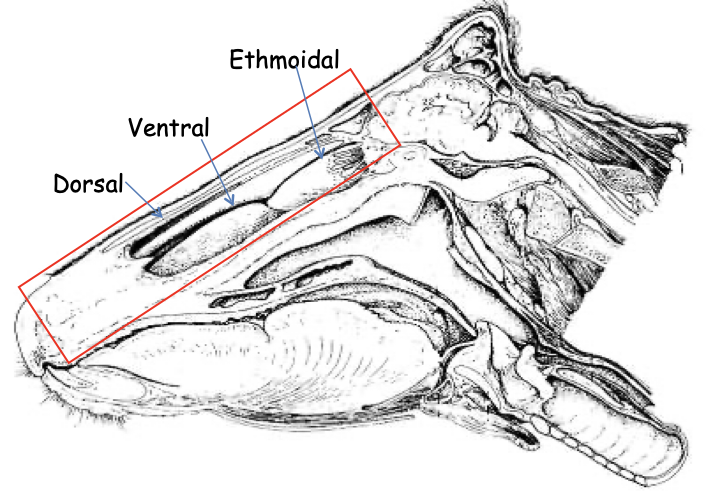
Conchae are LESS COMPLEX compared to the carnivore, less scrolled (doesn’t look like a wrinkled prune)
Has dorsal, ventral, and ethmoidal conchae… middle conchae is VERY small, not significant
Dorsal and ventral conchae are both scrolled ROSTRALLY, but form a sinus CAUDALLY
How are the frontal sinuses of the LARGE ruminant different from that of the carnivore? Structurally and functionally?
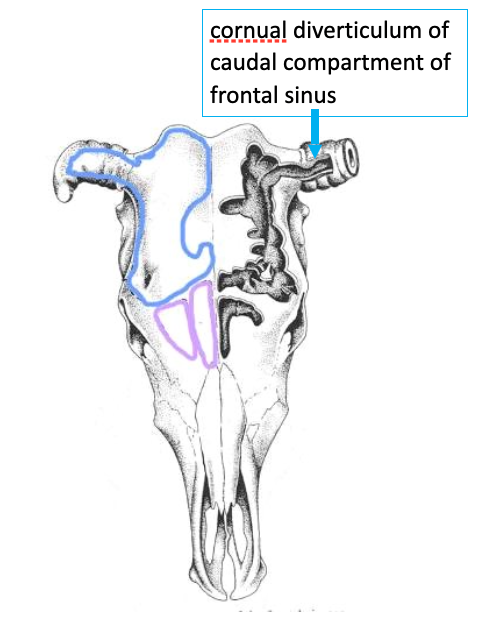
Frontal sinuses are extensive in adult
Give rise to adult head conformation
Each frontal sinus consists of Rostral & Caudal compartments
Invade the cornual process @6 months (has implications for dehorning & fracture)
The cornual diverticulum is the part of the CAUDAL COMPARTMENT of the FRONTAL SINUS that extends into the horn (see image)
This is why disbudding is recommended instead; performed BEFORE the frontal sinus invades cornual process
FUNCTION:
Drainage :
Poor; drain directly into nasal cavity via Ethmoidal meatuses, worse when mucosa inflamed
Protection:
Protects the cranial cavity… is a target for euthanasia in cattle
Describe the maxillary sinus in ruminants… why is it so important compared to the maxillary recess of the carnivore? What are 2 factors of clinical significance of the maxillary sinus?
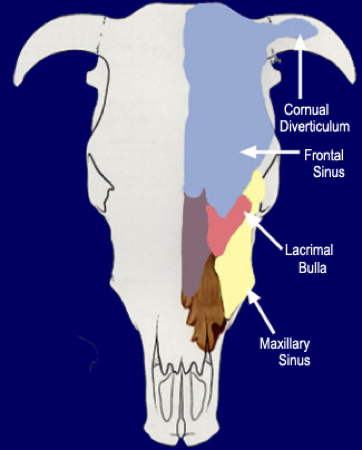
Is a large sinus of major clinical importance
Extends medially to form the palatine sinus and caudally to form the lacrimal bulla, which protrudes into the orbit
Communicates with the nasal cavity via the nasomaxillary opening*, positioned dorsal to the main sinus compartment
Clinical significance: sinus infections are difficult to drain because the drainage opening* is high (dorsal) relative to the sinus floor (1)
Roots of the upper cheek teeth project into the ventral floor (Sinus enlarges with age, increasing dental association)… so the cheek teeth are WITHIN the maxillary sinus (2)
Dental disease is the the MOST FREQUENT cause of secondary sinusitis
So basically, maxillary sinus can become infected by dental disease, and the infection won’t be able to drain due to the position of the nasomaxillary opening
Describe the nasopharynx of the ruminant… what are 2 features of the nasopharynx that are unique to ruminants?
Contains auditory openings and the pharyngeal tonsil like carnivores, but ALSO has:
Pharyngeal septum - partially divides nasopharynx; is where the pharyngeal tonsil is located
Tubal tonsil - found close to the entrance of both auditory tubes
What is Oestrus ovis, and how does it effect the frontal sinus of small ruminants?
Oestrus ovis → Adult Sheep Nasal Fly / Sheep Gad Fly
Cause NOSE BOT in their larval stage
Deposited by adult fly in or around the nostrils of the host.
Larvae migrate into the nasal cavity and the frontal and maxillary sinuses, where they feed on the mucous membrane and grow for several weeks or months
When mature, the larvae are expelled by sneezing and pupate in the soil.
How is the pig nose different from other species? What do they have that others don’t?
Thickened skin over rostral plate
Strengthens the snout region
Allows for rooting behavior
Also has rostral bones UNDERNEATH the plate, strengthening it
Describe the frontal sinuses of the porcine…
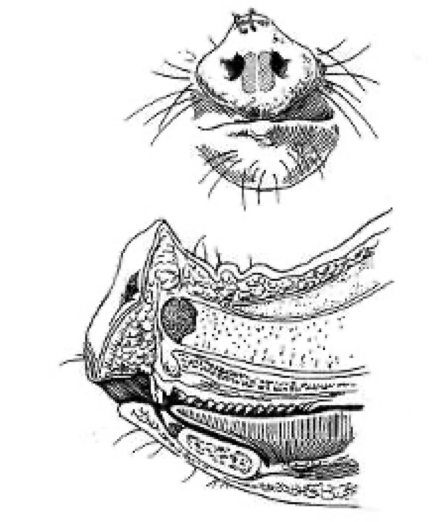
Frontal sinuses
Excavates entire dorsal surface of the skull
Cranial cavity 5cm below skull
Difficult to stun reliably and humanely by mechanical bolt
Maxillary sinus also extensive
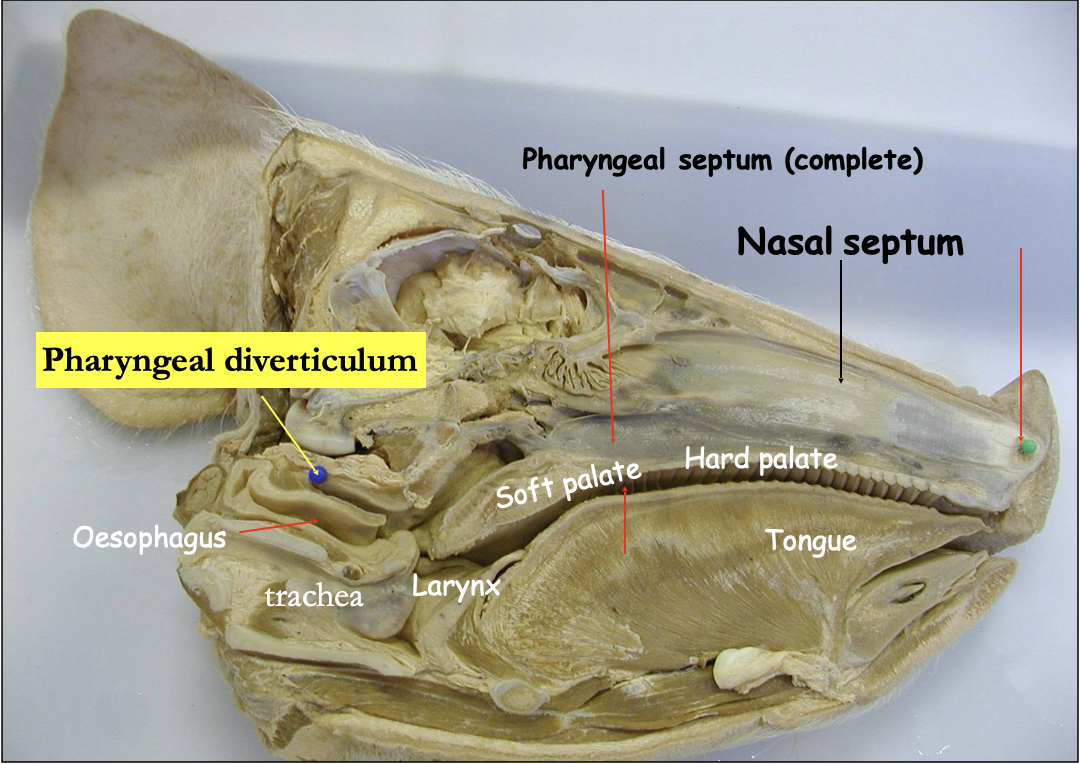
What is the pharyngeal diverticulum, and what species is it ONLY found in?
ONLY FOUND IN PIGS
Is a pouch-like structure that extends from the roof of the nasopharynx
Most prominent in piglets
Functions:
Supporting the nasopharyngeal tonsil (immunity for resp. system)
Helps to create negative pressure to allow auditory tubes to open
CAN BE AN ISSUE WHEN TUBING PIGLETS
Tube goes there instead of esophagus… leads to meds/nutrients not getting to piglet AND aspiration
Can become ulcerated / damaged, leading to secondary infections of the resp. system
 Note
Note  Flashcards (97)