Mass Movement, weathering
 Call Kai
 Learn
Learn Practice Test
 Spaced Repetition
 Match
Match Flashcards
 Knowt Play
1/32

There's no tags or description
Looks like no tags are added yet.
Name | Mastery | Learn | Test | Matching | Spaced | Call with Kai | Chat |
|---|
No analytics yet
Send a link to your students to track their progress
33 Terms
What is mass movement?
The movement of weathered particles down slope under the influence of gravity.
What is scree?
The substantial accumulation of fairly coarse material at the foot of steep slopes.
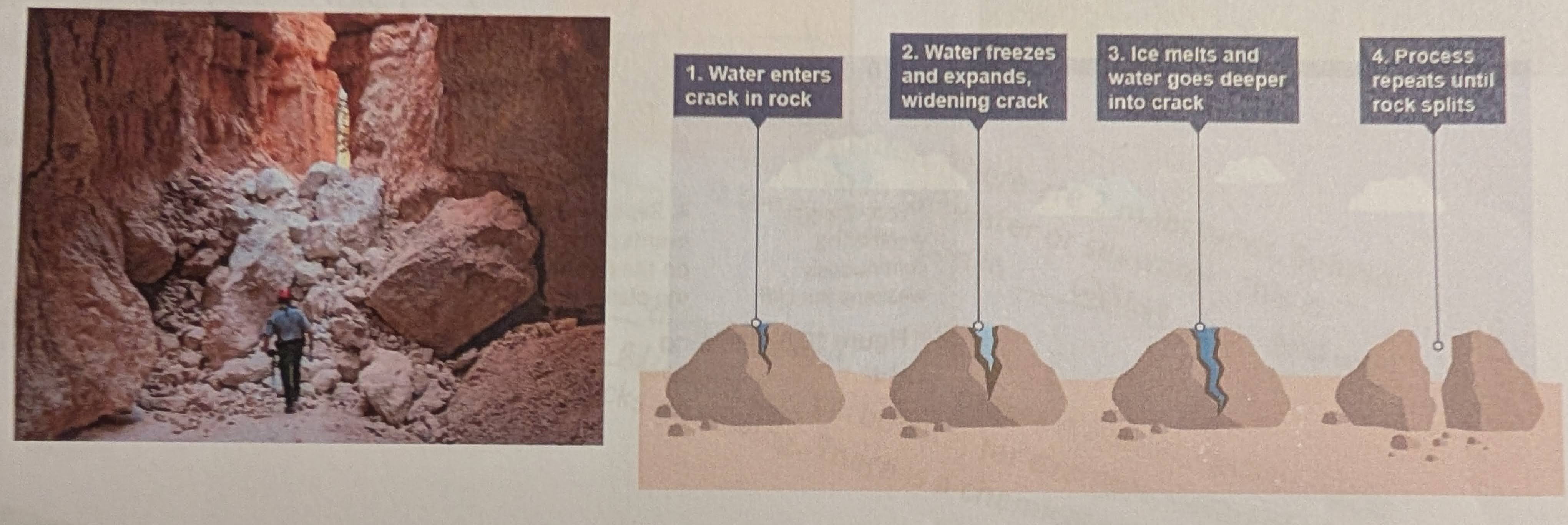
Describe Rockfalls (formation and features.)
They occur on slopes of more than 40 degrees.
They are made up of individual blocks.
They are caused by extreme weather on cliffs, usually freeze-thaw weathering.
Features include broken fragments which fall to the bottom of a slope where there will be an accumulation, forming a scree slope. The cliff above will be almost vertical.
Describe an example of a rockfall.
In January 1999, Beachy Head, Sussex.
A single cliff retreat of 17m occured with over 50,000 tonnes of chalk falling, producing a scree slope.
Individual pieces of rock were up to 4m across.
Describe a slide/landslide (formation and features).
Occurs on steep hills.
Land moves rapidly under the influence of gravity.
Many occur through lines of weakness that are weakened by water flowing through joints.
These can lubricate layers, and cause it to slide along a straight ‘slip plane’ and rock falls as ‘block’ which maintains contact with the cliff.
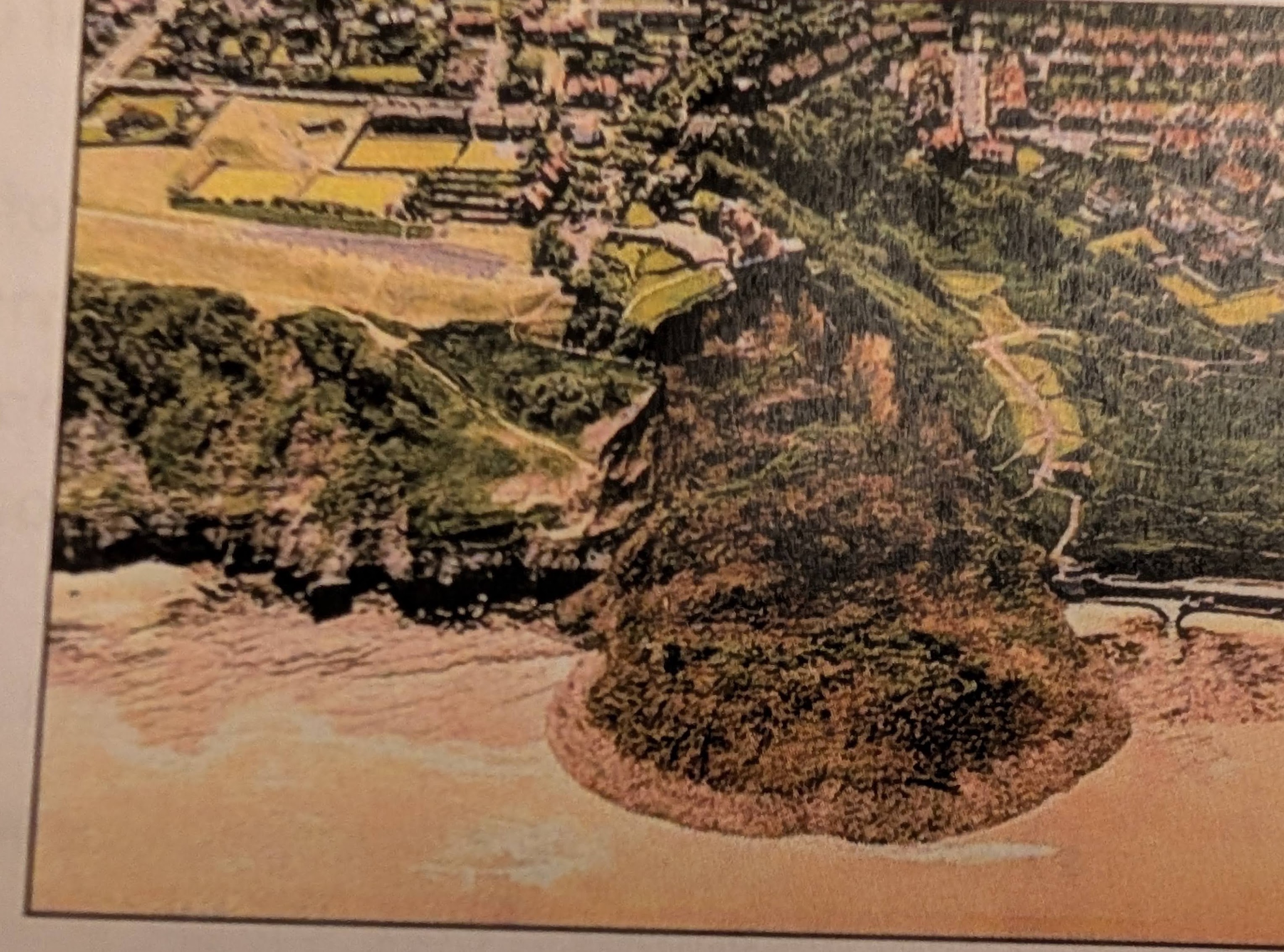
Describe an example of a slide / landslide.
June 1993 Holbeck Hall Hotel, Scarborough, North Yorkshire, UK.
In early hours, the hotel’s lawn dropped 20 metres.
At 7.30am the hotel was evacuated.
Soon after, the whole land area slipped down the slope, pushing over the sea wall at the bottom of the cliff.
8pm the hotel was on the edge of a new cliff and within hours fell off.
Describe a mudslide/ mudflow (formation and features).
Mudflows have a high water content, and very rapid movement.
They are caused by heavy rainfall and steep slopes over 10 degrees with bare slopes.
Describe an example of a mudslide / mudflow.
May 1989, Naples, Italy.
Days of heavy rainfall caused a flow that killed 350 people and buried 6 towns under 3m of debris.

Describe a rotational slump (formation and features).
Characterised by a mass of weathered material moving along curved shear planes.
It occurs when material is saturated and gains weight, lubricating the lines.
Slumps occur where permeable materials (ie sands) overlie relatively impermeable rocks such as clay.
Features: slumps are a tilting, slumped mass which exposes a steep, curved scar behind and pushes a thinner ‘toe’ out in front.
Usually there will be over one, leading to a ‘stepped’ profile.
Give an example of a rotational slump.
This has occured in Dunwich, suffolk on a large scale.
Large sections of the coast have been taped off from the public as it is considered too dangerous.
What is weathering?
The break down of rock ‘in-situ’ (meaning where it is.
Processes of weathering affect rocks exposed at the coast.
Mechanical weathering is sometimes also known as physical weathering. It is the breakdown of rock without changing its chemical composition.
The main type of weathering affecting the coast is freeze-thaw.
Its particularly effective of the rock is porous and permeable.
What is freeze thaw weathering?
A type of mechanical weathering.
Sometimes known as frost shattering.
It happens when temperatures alternate anbove and below zero degrees (the freezing point of water.)
Water gets into rocks that have cracks.
The water freezes and expands, which puts pressure on the rock.
When the water thaws, it contracts which releases the pressure.
Repeated freexing and thawing widens the cracks and causes the rock to break up and detach.
This may end up at the bottom of the slope known as rocks scree.
Describe chemical weathering.
The breakdown of rock by changing ots chemical composition.
There are 2 main types: solution and carbonation.
Solution is where some minerals and rocks dissolve in rainwater or seawater.
Carbonation is where rainwater, having carbon dioxide in it, makes a weak carbonic acid. Carbonic acid reacts with rock that contains limestone or chalk. This leads to the rocks dissolving.
What is hydraulic action?
The relentless force of destructive waves pounding the base of the cliffs.
This causes repeated changes in air pressure as water is forved into and out of faults.
The ‘forward’ movement of water compresses air into the cracks and as the wave retreats, there is an ‘explosive’ effect casing the rock to break up.
The rate of erosion will be higher where the coastline is exposed to a large fetch (distance - greater distance propells waves overseas). Strong winds blow for a long time and create destructive waves.
What is abrasion?
Also called corrasion.
Where destructive waves have enough energy to ‘throw’ sand and shingle at the cliff.
These scratch and scrape at the cliffs surface.
Abrasion is concentrated between high and low water marks and is very effective in high energy conditions.
The rate of erosion will be higher where an area has no beach to act as a buffer between the sea and the cliffs.
What is attrition?
The ‘grinding down’ of individual particles.
During deposition, pebbles collide with each other.
Over time this wears away jagged edges to make smooth, rounded pebbles.
They will also break down into bigger pieces than also become smoother over time.
The rate of erosion will be higher where there are soft rocks, as they erode faster.
Longshore Drift Diagram
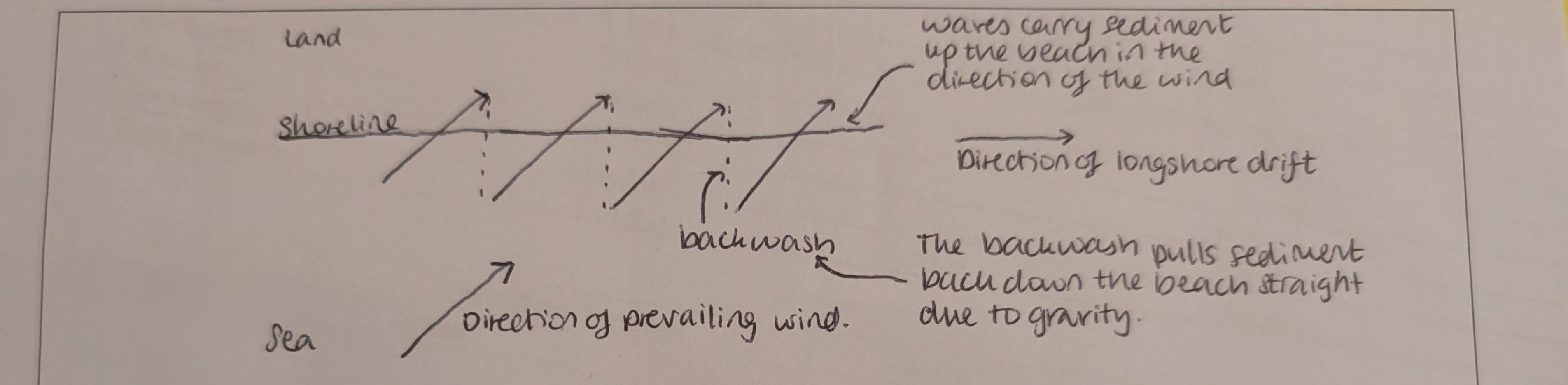
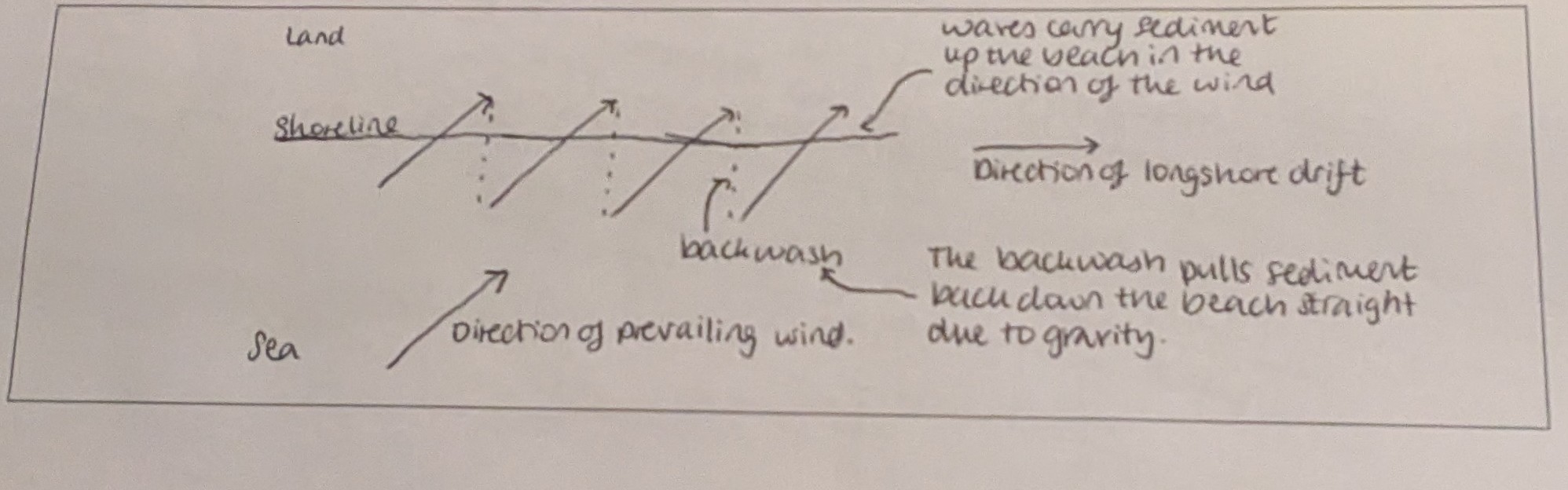
Describe longshore Drift.
Where sediment is carried by the waves.
The larger and heavier the load, the greater the velocity needed to transport it.
The heaviest ones are rolled onto the beach through traction and small pebbles are bounced onto the beach through saltation, whereas the lightest ones are held in suspension.
Load is transported along the beach by longshore Drift.
The direction it moves depends on the direction of the prevailing (most common) wind.
What is wave length?
The horizontal distance between 2 successive crests.
What is a fetch?
The distance the wave travels across open water.
What is a trough?
The bottom/base of a wave.
What is sawsh?
The movement of waves up the beach.
What is a crest?
The top of a wave.
What is wave height?
The vertical distance from trough to crest.
What is backwash?
The movement of waves back down the beach.
What is wave frequency?
The number of waves breaking per minute.
What causes waves?
Waves are caused by wind blowing over the surface of the sea and creating friction.
As waves approach the coast, the bottom is slowed down by friction with the sea bed, whilst the top is still moving forward faster. This makes the wave bigger and causes it to ‘break’ or tople over.
How does speed of wind affect the strength of the wave?
Strong winds result in stronger waves because more energy is transferred into waves from friction on the surface.
How does the time the wind has been blowing affect the strength of the wave?
The longer the wind has been blowing, the more friction and energy.
How does fetch affect the strength of the wave?
The longer the fetch, the more area for the wid to blow over the waves creating friction and transferring energy.

Describe constructive waves.
Long wave length
Low (under 1 metere) height
Feequency of 6-9 times per minute
Strong swash
Weak backwash
The process is deposition
Its common in summer, and creates sandy beaches.

Describe destructive waves.
Short wave length
High wave height (over 1 metre)
Ferequency of 10-15 times per minute
Weak swash
Strong backwash
Process is erosion
Common in winter, on a pebbly beach.
Compare the features of a concordant and discordant coastline.
Both coastlines are formed through alternating bands of hard and softer rock, such as Limestone (hard) and clay (soft).
However, discordant coastlines run at right angles to the coast.
Whereas concordant coastlines run parallel to the coast