Cognitive Psychology Chapter 1
 Studied by 0 people
 Call Kai
 Learn
Learn Practice Test
 Spaced Repetition
 Match
Match Flashcards
 Knowt Play
1/13

There's no tags or description
Looks like no tags are added yet.
Name | Mastery | Learn | Test | Matching | Spaced | Call with Kai |
|---|
No analytics yet
Send a link to your students to track their progress
14 Terms
Mind
Creates and controls mental functions
Creates representations of the world
Cognitive Processes Examples
Perception
Attention
Memory
Decision Making
Conceptual Knowledge
Visualizing
Language
Problem Solving
How are mental processes studied in research?
Inferred from behavior
Donder Button-Pushing Experiment
Had participants push a button when they saw a light
Then, had them choose between pushing a button on either the left or right, which took a tenth of a second
Thus, Donder inferred decision-making takes a tenth of a second
Wundt and Structuralism
Experience is determined by combining basic elements of experience called sensations
Studied via analytic introspection: participants were trained to describe their thoughts and experiences in response to stimuli
Ebbinghaus Memory Experiment
Participants learned a list of words, and then tried to learn them again after a time delay
Measure savings= amount of time needed to learn something the first time, minus the amount of time needed to learn something after the delay
Sharp decline of memory within a week, but flattened out over time
Why did the study of cognitive psychology decline?
Focus on behaviorism
First, Watson’s classical conditioning: Pavlov’s dogs
Then, Skinner’s operant conditioning: punishments/rewards
Behaviorism later fell out of favor for failing to answer why people responded differently to different stimuli
Tolman Rat Maze Experiment
Rat explores maze to find cheese
When the rat is put in a different spot, it was able to return to the same spot to find cheese
Rats had a cognitive map: representation of the maze that helped them navigate
Theories of Language Acquisition
Skinner argued speech is learned by imitating the speech of others
Correct speech is rewarded, bad speech is punished
Chonsky: children say things that they have not heard before, also say incorrect things, and have not been rewarded
Thus, speech has in-born, biological elements
Information Processing Approach
Mind as processing info through stages
Input → Input Processor → Memory Unit → Arithmetic Unit → Output
Limits to Information Processing
We can’t hold more than 7 (give or take 2) things in our minds simultaneously, as highlighted by Miller
Memory Types
Episodic: events
Semantic: facts
Procedural: step-by-step
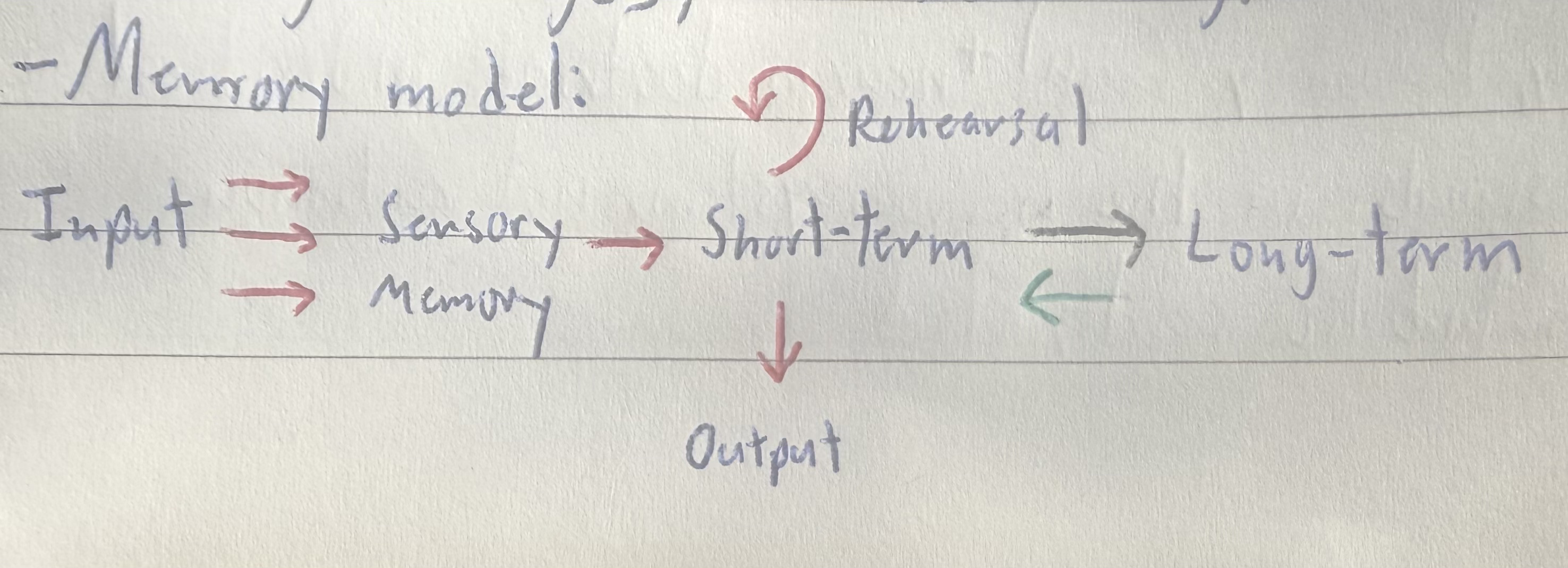
Memory Model
Research Models
Structural: representation of a physical structure
Process: represent steps involved in mechanisms
Resources: focus on mental effort
 Note
Note  Flashcards (62)