Management and Organizational Structure: Key Principles and Models
 Studied by 0 people
 Call Kai
 Learn
Learn Practice Test
 Spaced Repetition
 Match
Match Flashcards
 Knowt Play
1/168

There's no tags or description
Looks like no tags are added yet.
Name | Mastery | Learn | Test | Matching | Spaced | Call with Kai |
|---|
No analytics yet
Send a link to your students to track their progress
169 Terms
What are the four functions of management?
Planning, Organizing, Leading, Controlling.
What is the primary role of managers today?
To be collaborative and emphasize team building.
What does planning in management involve?
Setting organizational goals, developing strategies, determining resources, and setting standards.
How do managers empower employees?
By giving them independence to make informed decisions.
What is the difference between leaders and managers?
Leaders inspire and motivate, while managers focus on organizing and controlling tasks.
What is a mission statement?
An outline of an organization's fundamental purposes, including self-concept, philosophy, and customer needs.
What is the purpose of a SWOT analysis?
To analyze an organization's strengths, weaknesses, opportunities, and threats.
What is the significance of a vision in planning?
It explains why the organization exists and where it aims to go.
What are objectives in the context of management?
Specific, short-term statements detailing how to achieve the organization's goals.
What does the organizing function of management include?
Allocating resources, assigning tasks, and establishing procedures.
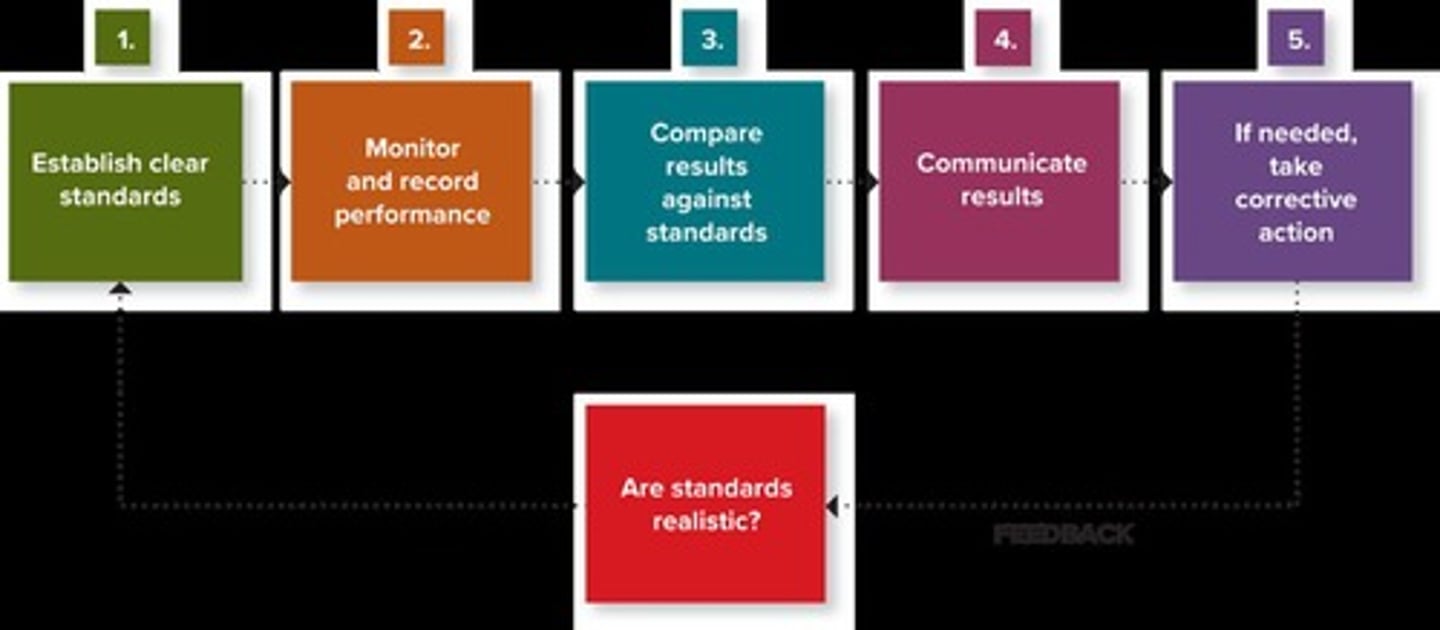
What are the five steps of the control function of management?
Measuring results, monitoring performance, rewarding performance, taking corrective action, and ensuring standards are met.
What is the role of a CEO in an organization?
To provide leadership and ensure the organization meets its goals.
What skills do modern managers need?
Skilled communication, teamwork, and global preparedness.
What is the importance of team building in management?
It fosters collaboration and improves overall organizational effectiveness.
What does controlling in management ensure?
That the organization is meeting its objectives and standards.
What should managers do to guide employees effectively?
Provide clear assignments, explain routines, and give feedback on performance.
What is the role of a manager in decision making?
To set the organization's vision and make strategic decisions to achieve goals.
How do managers respond to changes in the business environment?
By adapting their planning and operational strategies accordingly.
What is the significance of leadership styles in management?
Different styles can influence employee motivation and organizational culture.
What is the importance of recruiting and training in organizing?
To ensure employees are placed effectively and are equipped to meet organizational goals.
What are core competencies in management?
Key strengths that give an organization a competitive advantage.
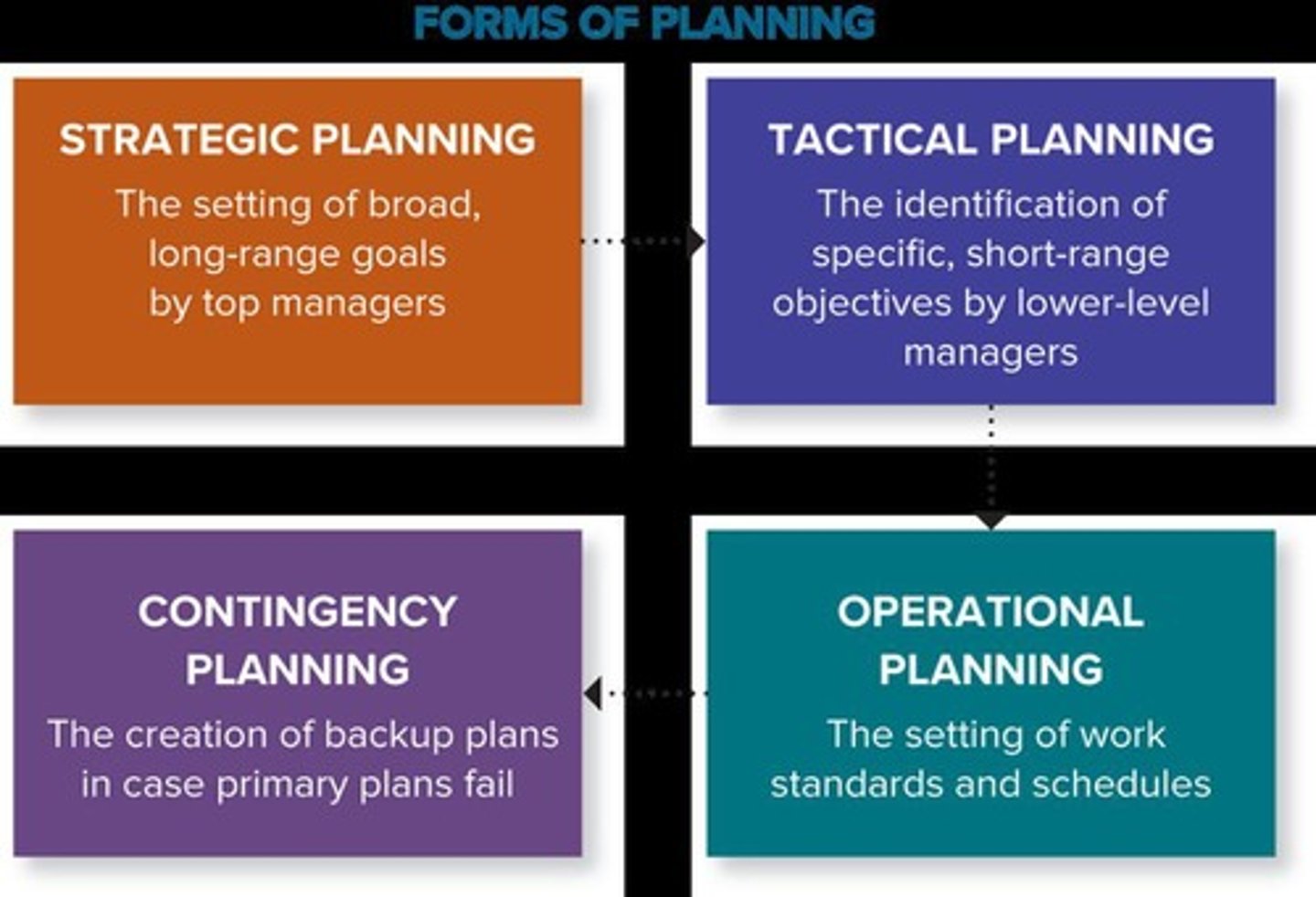
What does strategic planning involve?
Long-term planning to achieve major organizational goals.
What is tactical planning?
Short-term planning that outlines specific actions to achieve strategic goals.
What is operational planning?
Day-to-day planning that focuses on the execution of tactical plans.
What is contingency planning?
Preparing alternative plans to address potential future scenarios.
What is strategic planning?
Determining the major goals of the organization and the policies and strategies for obtaining and using resources to achieve those goals.
What are potential internal weaknesses in an organization?
No clear strategic direction, obsolete facilities, subpar profitability, lack of managerial depth and talent, weak market image, too narrow a product line.
What are potential external threats to an organization?
Entry of lower-cost foreign competitors, rising sales of substitute products, slower market growth, costly regulatory requirements, vulnerability to recession and business cycles, changing buyer needs and tastes.
What is decision making?
Choosing among two or more alternatives.
What are the steps in the rational decision-making model?
1. Define the situation. 2. Describe and collect needed information. 3. Develop alternatives. 4. Decide which alternative is best. 5. Do what is indicated. 6. Determine whether the decision was a good one, and follow up.
What is problem solving?
The process of solving everyday problems that occur; less formal than decision making and usually calls for quicker action.
What is brainstorming?
Coming up with as many solutions as possible in a short period of time with no censoring of ideas.
What does PMI stand for in decision making?
Plus, Minuses, and Implications; a method for evaluating solutions.
What skills should a CEO have?
Clear communication, collaboration, open-mindedness, approachability, transparency, growth mindset, ethics, decisiveness, creativity and innovation, fearlessness.
What is the difference between goals and objectives?
Goals are broad, general intentions, while objectives are specific, measurable steps to achieve those goals.
What is the role of top management?
Developing strategic plans and consisting of the president and other key company executives.
What is the role of middle management?
Responsible for tactical planning and controlling, including general managers and division managers.
What is the role of supervisory management?
Directly responsible for supervising workers and evaluating their daily performance.
What are technical skills in management?
The ability to perform tasks in a specific discipline or department.
What are human relations skills?
Skills that enable managers to work through and with people, including communication and motivation.
What are conceptual skills?
The ability to picture the organization as a whole and understand the relationships among its various parts.
How does gratitude affect employee performance?
Gratitude increases performance, job satisfaction, and can lead to better business results.
What is the impact of expressing gratitude in the workplace?
It can increase job satisfaction, performance, and create a culture of appreciation.
How can artificial intelligence impact management?
AI could streamline administration tasks, making middle management positions particularly vulnerable.
What is complacency among rival firms?
A lack of competitive pressure that can allow a company to expand product lines and grow due to increased market demand.
What are the implications of falling trade barriers?
They can open attractive foreign markets for businesses to expand their product lines.
What is the significance of a weak market image?
It can be a potential internal weakness that affects a company's competitiveness.
What does a SWOT analysis evaluate?
It analyzes an organization's strengths, weaknesses, opportunities, and threats.
What is the primary focus of staffing in a company?
Hiring, motivating, and retaining the best people to accomplish the company's objectives.
What significant change in work life did the COVID-19 pandemic bring?
An increase in telecommuting and remote work.
What is one way managers can attract and retain workers in the new normal?
By creating an ideal work environment.
What does transparency in a company refer to?
The clear presentation of the company's facts and figures to all stakeholders.
What does Satya Nadella believe is the key to organizational success?
Company culture.
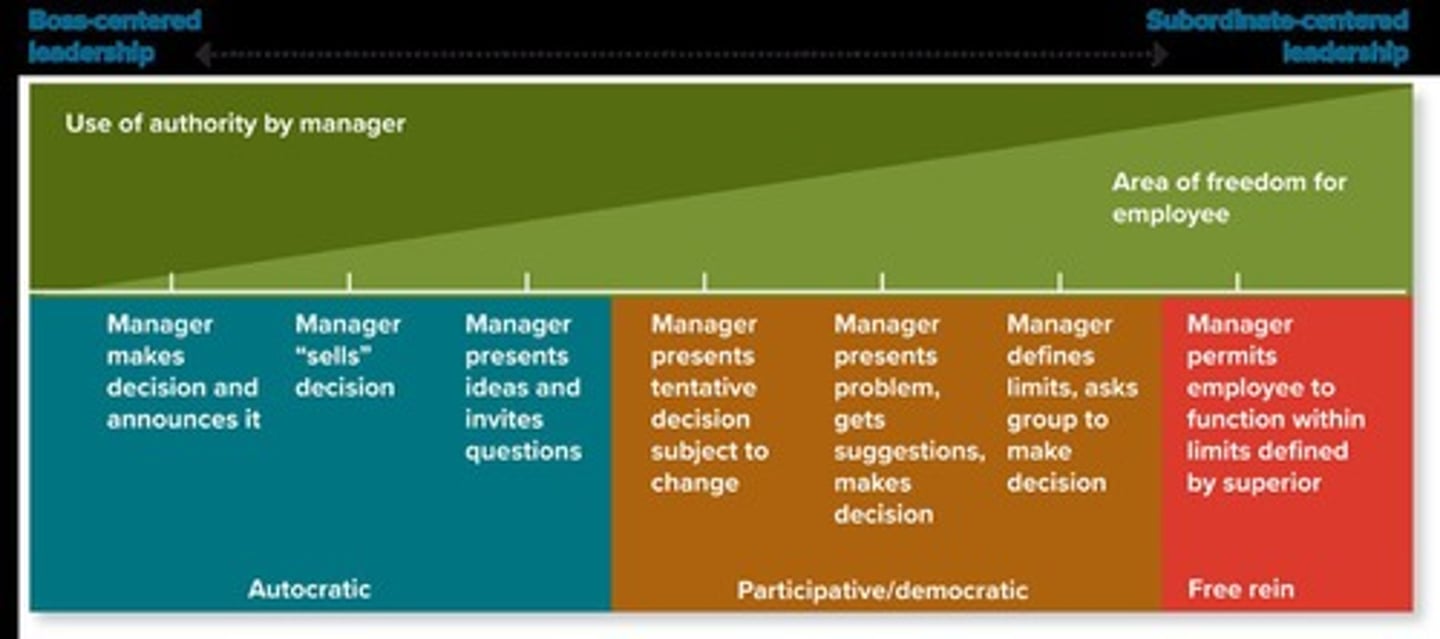
What is autocratic leadership?
A style where managers make decisions without consulting others, effective in emergencies or with unskilled workers.
What is participative or democratic leadership?
A style where managers and employees work together to make decisions, usually increasing job satisfaction.
What is free-rein leadership?
A style where managers set objectives and employees have the freedom to accomplish those objectives.
What is empowerment in the context of leadership?
Giving employees the authority to make decisions on their own without consulting a manager.
What is the role of enabling in empowerment?
Providing workers with the education and tools they need to make decisions.
What is knowledge management?
Finding, keeping, and making information accessible to everyone in the firm.
What are the three main functions of the control process?
Measuring performance, rewarding good work, and taking corrective action.
How do colleges and universities measure their performance?
By tracking the number of students who complete their degrees or graduate within a certain time frame.
What are signs of micromanagement?
Not delegating work, constant monitoring, excessive meetings, and requiring minute-by-minute accountability.
What is the difference between external and internal customers?
External customers buy products for personal use, while internal customers are individuals or units within the firm that receive services from others.
What is the impact of the 'Great Resignation' on staffing?
Millions of workers did not return to work, leading to challenges in hiring and retention.
What is the significance of corporate values in leadership?
They establish the ethical framework and guiding principles for the organization.
What is the importance of accountability in leadership?
It ensures that leaders and employees are responsible for their actions and decisions.
How does a leader embrace change?
By promoting adaptability and encouraging innovation within the organization.
What does it mean to dissolve traditional workplace boundaries?
Creating a more flexible work environment that encourages collaboration and innovation.
What is the role of a manager in an empowering environment?
To act more as a coach rather than a boss.
What is the relationship between corporate ethics and leadership?
Leaders must promote corporate ethics to build trust and integrity within the organization.
What is the significance of measuring customer satisfaction?
It is crucial for understanding success beyond financial metrics.
What is the effect of big data on knowledge management?
It requires organizations to determine what information is most important and relevant.
What does it mean to enable workers?
Providing them with the necessary resources and training to make informed decisions.
What are the basic principles of organizational management?
Creating a division of labor, job specialization, departmentalization, resource allocation, task assignment, establishing procedures, and developing an organization chart.
Who are two influential thinkers in organizational theory?
Henri Fayol and Max Weber.
What is the principle of 'unity of command' in Fayol's principles?
Each worker should report to only one manager.
What does 'centralization' refer to in organizational structure?
Decision-making authority is maintained at the top level of management.
What is 'decentralization' in an organization?
Decision-making authority is delegated to lower-level managers.
What is the significance of 'job specialization'?
It involves dividing tasks among workers to improve efficiency.
What does 'departmentalization' entail?
Setting up teams or departments to organize tasks and responsibilities.
What is an organization chart?
A visual device that shows relationships among people and divides the organization's work.
What is 'bureaucracy' in an organizational context?
An organization with many layers of managers who set rules and regulations.
What is the 'chain of command'?
The line of authority that moves from the top of the hierarchy to the lowest level.
What are the advantages of centralized authority?
Greater top-management control and simpler distribution systems.
What are the disadvantages of centralized authority?
Less responsiveness to customers and less empowerment of lower-level managers.
What are the advantages of decentralized authority?
Better adaptation to customer wants and faster decision making.
What are the disadvantages of decentralized authority?
Less top-management control and potential for interorganizational conflict.
What principle emphasizes clear communication channels?
Fayol's principle of clear communication.
What is 'equity' in Fayol's principles?
Fair treatment of employees within the organization.
What does 'esprit de corps' refer to in organizational management?
The spirit of teamwork and unity among employees.
How did Max Weber view the management of less-educated workers?
He believed they should be managed with strict rules and regulations.
What is the impact of mass production on organizational design?
It led to complexities in organizing businesses and the need for structured management.
What does 'subordination of individual interests to the general interest' mean?
Prioritizing the organization's goals over personal interests of employees.
What is the role of middle managers in Weber's organizational structure?
They implement the orders of top managers.
What is the importance of written rules and decision guidelines according to Weber?
They ensure consistent procedures and policies within the organization.
What is the relationship between economies of scale and production costs?
Companies can reduce production costs by purchasing raw materials in bulk as production levels rise.
What are the changing customer expectations in modern organizations?
High-quality products with fast, friendly service at low costs.
What is the significance of adapting to change in organizations?
Organizations must adjust to evolving business environments and customer needs.
What did Claudia San Pedro achieve at Sonic Drive-In?
She enhanced the mobile app and contactless payment capabilities, leading to increased sales.
What is the span of control?
The optimum number of subordinates a manager supervises or should supervise.
 Note
Note  Flashcards (56)