Animal Ecology 3435 - Module 3
 Call Kai
 Learn
Learn Practice Test
 Spaced Repetition
 Match
Match Flashcards
 Knowt Play
1/42

There's no tags or description
Looks like no tags are added yet.
Name | Mastery | Learn | Test | Matching | Spaced | Call with Kai |
|---|
No analytics yet
Send a link to your students to track their progress
43 Terms
Lecture 10
Abiotic factors strongly influence animal ecology
Animals are strongly affected by abiotic conditions such as:
Temperature
Moisture
Salinity
pH
Nutrient concentration
Physical structure of the environment
Abiotic conditions influence:
Where animals can live
When they are active
Reproduction and movement
Energy allocation
Population distributions
Examples:
Biomes are shaped by temperature and rainfall
Reproductive timing depends on benign vs harsh seasons
Endotherms spend energy coping with temperature
Sometimes animals also modify abiotic conditions themselves.
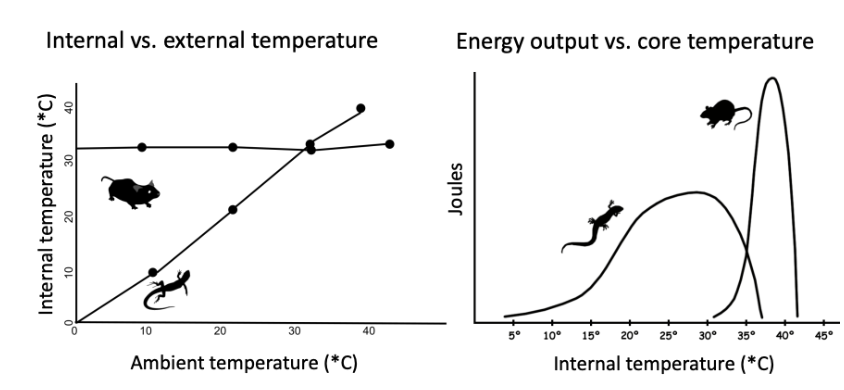
Endotherms and ectotherms respond differently to temperature
Ectotherms
Internal temperature changes with environmental temperature
Broad range of internal temperatures
Performance strongly depends on body temperature
Endotherms
Maintain a relatively constant internal temperature
Narrow range of tolerated internal temperatures
Use metabolism to stabilize body temperature
Thus, the same ambient temperature can have very different consequences for the two groups.
Ectotherms are not “cold-blooded”
Ectotherms do not simply match the environment passively.
They:
Generate some heat metabolically
Seek out optimal body temperatures
Perform best within a specific internal temperature range
Higher temperatures speed up:
Gas exchange
Nerve transmission
Enzyme activity
Muscle contraction
Which leads to faster:
Movement
Digestion
Perception
Response to prey
Thus ectotherms actively regulate body temperature behaviorally (not by internally generating heat)
How ectotherms regulate body temperature
Behavioral regulation
Examples:
Lizards move between sun and shade
Fish seek preferred water temperatures, swimming decisions seek best thermal environment, autonomous response to sensors on body
Metabolic heat generation
Ectotherms can generate heat through metabolism.
Example: Glanville fritillary butterfly
Basks in the sun before takeoff
Wings absorb heat
Heat transferred to thorax and flight muscles
Thus, ectotherms can temporarily warm the body parts needed for activity.
Ectotherms can overheat and die
Biological processes only function within a limited temperature range.
Above the optimum:
Small increases in temperature become very dangerous
Heat injury occurs
Eventually death occurs
Therefore ectotherms must actively avoid overheating, often by:
Seeking shade
Burrowing
Reducing activity
5 Strategies ectotherms do when it is too cold
When temperatures are too low, ectotherms cannot function normally.
Strategies include:
1. Live in thermally buffered environments
Oceans vary less than terrestrial environments
2. Cold hardiness through life stage
Example:
Holometabolous insects overwinter in cold-tolerant stages
3. Use buffered microhabitats
Examples:
Burrowing frogs
Turtles, salamanders, snakes underground
4. Freeze avoidance
Supercool body fluids
Eliminate ice-nucleating agents
Use antifreeze proteins
5. Freeze tolerance
Permit body water to freeze
Restrict ice to spaces outside cells
Some species tolerate 50–80% frozen body water
Temperature affects ectotherms over multiple time scales (short, medium, long)
Short-term
Reversible changes in performance:
Slower movement
Slower foraging
Less frequent reproduction
Medium-term
Changes over days to seasons:
Slower development
Reduced reproductive activity
Changes in pheromone signaling
Long-term
Evolutionary changes:
Larger body size
Longer lifespan
Changes in egg size and number
The timescale matters because some responses are reversible and others are not.
Endotherms maintain body temperature through BLANK therefore….
Endotherms generate heat internally through catabolism.
Therefore:
Internal body temperature stays relatively constant
Animals can remain active over a wider range of ambient temperatures
However, maintaining this stable temperature is energetically expensive
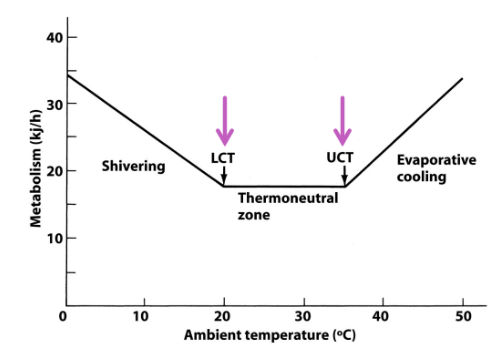
Thermal Neutral Zone (TNZ), UCT, and LCT
Thermal Neutral Zone (TNZ)
Range of ambient temperatures where the animal uses the least energy
No active thermoregulation required
Lower Critical Temperature (LCT)
Below this, the animal must generate extra heat
Upper Critical Temperature (UCT)
Above this, the animal must actively cool itself
Outside the TNZ, metabolic rate increases rapidly.
How endotherms respond to cold (short term, seasonal, long term)
Short-term responses
Behavioral changes
Seek shelter
Fluff insulation
Goosebumps
Increase heat production
Shivering
Seasonal responses
Thicker insulation
Metabolic acclimation
Lower thermostat in winter
Example:
Willow ptarmigan reduces the energetic cost of winter
Long-term responses
Larger body size
Hibernation
Heterothermy
Migration
Costs of cold in endotherms
Lethal costs
Death if body temperature drops too far
Sub-lethal costs
Common and cumulative:
More energy needed
Lost opportunities to forage or reproduce
Time spent huddling or warming up
Opportunity costs are important because time spent coping with cold cannot be used elsewhere.
How endotherms respond to heat (short term, seasonal and long term
Short-term responses
Behavioral avoidance
Evaporative cooling:
Sweating in mammals
Panting or throat cooling in birds
Redirect blood flow to surface
Seasonal and long-term responses
Reduced insulation
Lighter coloration
Same general principle as cold, but reversed
Examples:
Gular fluttering in birds
Vultures urinate on legs for evaporative cooling
Costs of heat
Sub-lethal responses often progress in stages:
Wing-fanning
Clustering
Salivating
Panting
If these fail:
Extreme heat causes mortality
Example:
Extreme heat killed nearly one-third of Australia’s spectacled flying foxes
Why heat is often a bigger problem than cold
Two reasons:
Endotherm body temperatures are already close to lethal temperatures
Heat causes protein denaturation (“cooking” proteins)
Thus, there is often less margin of safety above normal body temperature than below it.
Body size and thermal biology (small and large animals)
Small animals:
Higher mass-specific metabolic rate
Higher internal temperature
Higher conductance
Lose heat faster
Large animals:
Lower mass-specific metabolic rate
Lower conductance
Better buffered from the environment
Conductance depends strongly on surface area : volume ratio.
Small animals have more surface area relative to volume, so they exchange heat faster with the environment.
Bergmann’s Rule
Animals at higher latitudes tend to be larger.
Reason:
Larger animals lose heat more slowly
Helps reduce heat loss in cold environments
Thus larger body size is often an adaptation to colder climates
Why endotherms do not get smaller than ~2 g
Very small endotherms:
Lose heat extremely quickly
Need extremely high metabolic rates
Already have very high body temperatures
Eventually:
Heat loss becomes too great
Metabolic rate cannot increase enough
Body temperature approaches dangerous limits
Thus there appears to be a minimum size (~2 g) for endothermy.
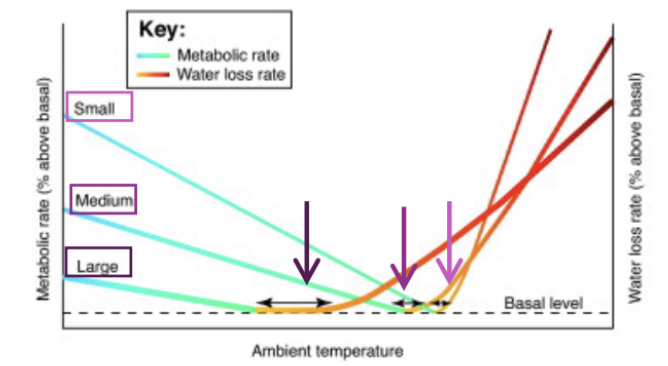
Thermal tolerance, body size, and water balance are linked
Endotherms cool themselves through evaporation.
Therefore:
To avoid overheating, they must lose water
Small animals are especially vulnerable because they:
Generate more heat
Gain and lose heat faster
Lose water more rapidly
Thus body size, heat tolerance, and water balance are tightly linked.
Wind increases conductance
Wind increases the rate of heat exchange between an animal and the environment.
Thus wind:
Makes animals lose heat faster when cold
Can increase cooling when hot
Wind therefore strongly changes the energetic costs of thermoregulation
Thermal niches link physiology to distributions
Animals have thermal niches:
Specific ranges of temperature where they survive and reproduce best
Thermal niches influence:
Population growth
Geographic distributions
Habitat use
Thermal tolerance depends on ecological context.
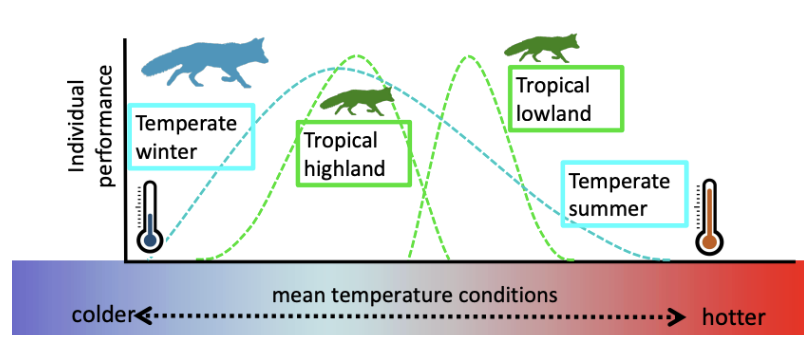
Temperate vs tropical thermal niches
Temperate animals
Experience large seasonal variation
Therefore tend to have broader thermal niches
Tropical animals
Experience less variation
Therefore expected to have narrower thermal niches
This makes tropical animals especially vulnerable to climate change because they already live near their thermal limits.
Lecture 11
Three ways to define a niche - Grinnellian, Eltonian, Hutchinsonian
Grinnellian niche
Based on habitat and abiotic conditions
Focuses on where a species can live because of physical conditions
Eltonian niche
Based on food, enemies, and other species
Focuses on a species’ role in the community
Hutchinsonian niche
Modern view
A niche is the multidimensional set of environmental conditions and resources required for survival and reproduction
Includes both:
Abiotic factors
Biotic factors
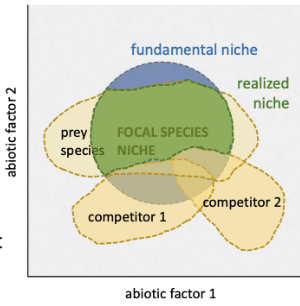
Fundamental vs. realized niche
Fundamental niche
Based only on abiotic tolerances
Describes all places a species could theoretically live
Examples of abiotic limits:
Temperature
Rainfall
Salinity
Oxygen
Realized niche
Subset of the fundamental niche
Includes effects of biotic interactions:
Competition
Predators
Prey availability
Fundamental niche = where a species could live
Realized niche = where it actually lives
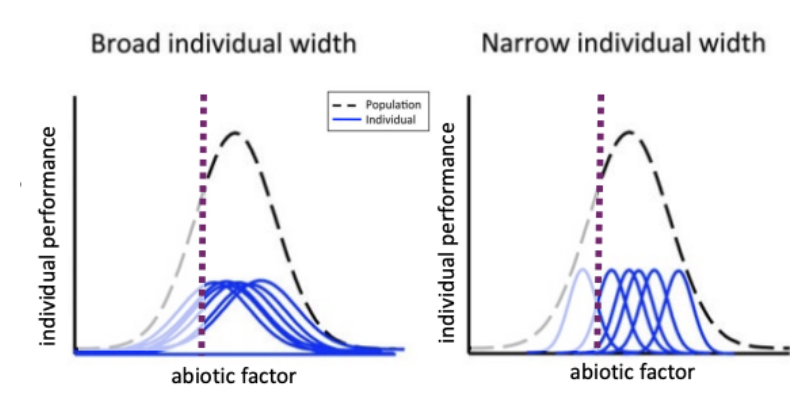
Individual tolerances shape species-level niches
Fundamental niches are built from the tolerances of individuals.
Two species can have the same total niche breadth, but differ in how individuals vary:
Some species have individuals that each tolerate a broad range
Others have specialized individuals that together cover the full range
Why this matters:
Species with more individual variation may cope better with environmental change
If conditions shift:
Species made up of highly specialized individuals may be more vulnerable
Fundamental niches have many axes
A niche is multidimensional:
Temperature
Oxygen
Light
Humidity
Rainfall
Salinity
Sulfur
etc.
But it is difficult to visualize more than 2–3 axes at once.
For animals, the most important and most commonly studied axis is: Temperature
Thus thermal niches are usually the focus
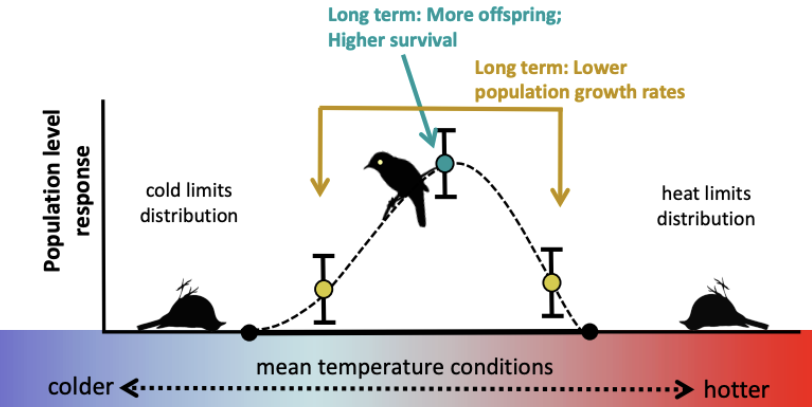
Thermal niches are based on individual thermal tolerances
Individuals perform best at an optimal temperature.
Away from the optimum:
More energy is spent on thermoregulation
Less energy remains for:
Growth
Reproduction
Survival
At the limits:
Individuals die
Thus individual responses to temperature scale up to determine:
Population growth
Species distributions
Populations near the edge of a species’ range often:
Perform worse
Show more variability
Other important axes of the fundamental niche - Oxygen (O₂)
Insects depend on passive diffusion of oxygen through spiracles and tracheae.
Therefore:
Oxygen availability limits body size
Larger insects require more oxygen
This explains why giant insects existed 250–300 MYA:
Atmospheric oxygen was much higher
Temperature and oxygen also interact:
Warm temperatures increase oxygen demand
Thus low oxygen becomes more limiting at higher temperatures
Other important axes of the fundamental niche - Light
Species differ in the light conditions they require.
Examples:
Diurnal species
Nocturnal species
Human impacts alter light conditions:
Light pollution at night
Human activity during the day
Because humans are mostly active during the day:
Diurnal mammals are declining most strongly
Thus light is an important niche axis
Other important axes of the fundamental niche - Humidity and rainfall
Humidity and rainfall strongly affect:
Thermoregulation
Water balance
Survival
Example: cave beetles
Live in cool, stable, humid caves
Climate change is increasing temperature and decreasing humidity
Cave beetles have narrow humidity tolerances
High humidity and temperature together can become deadly
Rainfall matters for endotherms too
Rainfall influences the distributions of birds and mammals
Example:
Lance-tailed Manakin occurs only on the drier side of a rainfall gradient, despite no physical barrier.
Too little rain can matter because:
Direct effects
Dehydration
Harder to cool body by evaporation
Indirect effects
Lower food availability
Fewer insects
Changes in predators
Too much rain can matter because:
Direct effects
Less time for foraging
Flooding or storm mortality
Wet fur/feathers increase thermoregulation costs
Indirect effects
More disease/pathogens
Lower prey activity
Less plant growth and productivity
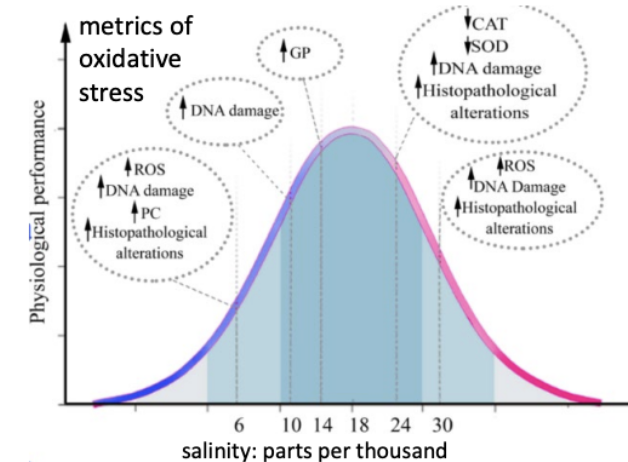
Salinity is an important niche axis in aquatic systems
Many aquatic species have a specific range of salinity they can tolerate.
Performance usually:
Peaks at an optimal salinity
Declines if salinity is too low or too high
Example:
Mediterranean mussels
Different physiological mechanisms explain why performance declines outside the optimum
Cool critter: Sulphur mollies
Live in sulfur-rich spring streams in southeastern Mexico
Most animals die immediately in hydrogen sulfide (H₂S)
Sulphur mollies tolerate both:
Normal water
Sulfur-rich water
They evolved:
Physiological detoxification
Adaptations to avoid sulfide toxicity
No physical barriers separate sulfur and normal streams, yet the fish remain in sulfur streams.
This has major ecological consequences:
Environment in sulfur streams:
Low oxygen
High predation from birds
Low food
Adaptations:
Surface air breathing
Coordinated “wavemaking” behavior to reduce bird predation
Eat sulfur bacteria mats
Consequences for life history:
Smaller body size
Delayed maturity
Fewer offspring
Lower metabolic rate
Why niche breadth matters (broad vs narrow)
Niche breadth = range of conditions a species can tolerate.
Broad niche breadth
Larger geographic range
Larger population size
Lower extinction risk
Better ability to survive changing conditions
Narrow niche breadth
More specialized
Higher extinction risk
More tightly packed species → potentially more species coexistence
Broad-niched generalists often give rise to narrower-niched specialists through evolution
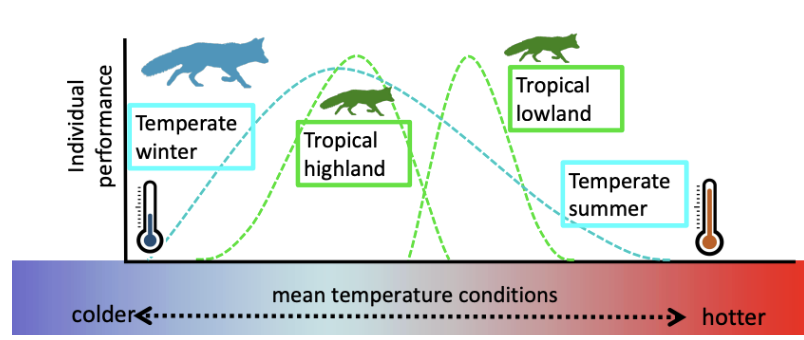
Why niche breadth may be smaller in the tropics
General expectation:
Tropical species have narrower niches
Why?
Tropical climates are more stable over the year
Temperate climates vary greatly seasonally
Thus:
Temperate animals must tolerate both hot summers and cold winters
Tropical animals usually experience a narrower range of temperatures
Therefore tropical species are expected to evolve narrower thermal tolerances.
Example:
Tropical mountain species may tolerate only a small temperature range
Evidence for tropical vs. temperate niche breadth
Prediction:
Tropical endotherms should have narrower thermal niches
Evidence so far:
Mixed
Some tropical species clearly have very narrow tolerances, especially at high elevations.
But not all species fit the prediction.
How ecological niche modeling works - Mechanistcs vs Correlative
Two main approaches:
Mechanistic / process-based
Use experimentally measured fitness responses to abiotic factors
Most accurate
Rare because data are lacking
Correlative
Determine where a species occurs
Measure climate in those places
Use correlations to predict other suitable areas
Correlative approaches make up >95% of studies
Why niche modeling is useful
Main uses:
Predict where rare species may occur
Predict future changes in distribution
Can be used for:
Conservation
Invasive species
Climate change responses
Niche Modeling Application 1: Finding rare species
Example: Sabaleta
Rare freshwater fish in the Colombian Andes
Hard to survey directly
Researchers:
Collected known occurrence points
Identified abiotic conditions associated with them
Used those conditions to predict other suitable areas
Important variables included:
Rainfall
Open water
Minimum temperature
Result:
Model predicted a much larger suitable range than official conservation maps
Thus niche models can improve conservation planning
Niche Modeling Application 2: Predicting future spread
Example: Emerald Ash Borer
Native to East Asia
First found near Detroit/Windsor in 2002
Kills nearly all ash trees
Researchers used climate conditions from:
Native range
Invaded range
To predict where it could spread next.
Combined models best predicted its future expansion.
This shows how niche modeling can help anticipate invasive species spread

