Managing Human Resources Exam 2
 Call Kai
 Learn
Learn Practice Test
 Spaced Repetition
 Match
Match Flashcards
 Knowt Play
1/135

There's no tags or description
Looks like no tags are added yet.
Name | Mastery | Learn | Test | Matching | Spaced | Call with Kai |
|---|
No analytics yet
Send a link to your students to track their progress
136 Terms
What is the primary goal when selecting an employee for a Level 3 supervisor job?
To evaluate candidates based on job description and characteristics such as educational background, supervisory experience, technical experience, and diversity goals.
What are the key criteria for a successful selection method?
Reliable information, valid information, generalizability, high utility, and legal compliance.
What does reliability in the selection process refer to?
The extent to which measurement is free from random error and generates consistent results.
How do organizations determine the reliability of their selection measurements?
By using statistical tests like correlation coefficients to compare results.
What is validity in the context of employee selection?
The extent to which performance on a measure relates to what the measure is trying to assess, such as job performance.
What are the three ways to measure validity?
Criterion-related, content, and construct validity.
What is criterion-related validity?
It shows a substantial correlation between test scores and job performance scores.
What are the two types of research used in criterion-related validity?
Predictive validation and concurrent validation.
What does content validity ensure?
Consistency between test items and the kinds of situations or problems that occur on the job.
What is construct validity?
It establishes that a test accurately measures an abstract quality or construct that is associated with job success.
What is the ability to generalize in the selection process?
The selection method should be applicable to other contexts, organizations, jobs, and applicants.
What does practical value refer to in selection methods?
The selection method should produce beneficial information that outweighs its costs.
What are the two broad categories of employment tests?
Aptitude tests and achievement tests.
What do physical ability tests assess?
Different aspects of physical ability including power, endurance, flexibility, balance, and coordination.
What do cognitive ability tests measure?
Verbal skills, quantitative skills, and reasoning ability.
What are job performance tests and work samples used for?
To test specialized skills needed for a job through practical demonstrations.
What are the rules for administering drug tests?
Test all applicants for the same job, use testing for safety-related jobs, keep results confidential, and respect applicants' privacy.
What are the 'Big Five' personality traits often assessed in personality inventories?
Extroversion, Adjustment, Agreeableness, Conscientiousness, and Inquisitiveness.
What is a nondirective interview?
An interview where the interviewer can choose which questions to ask each candidate.
What is a structured interview?
An interview with a predetermined set of questions for the interviewer to ask.
What is a situational interview?
An interview where the interviewer describes a job-related situation and asks how the candidate would respond.
What is a behavior description interview (BDI)?
An interview where the candidate describes how they handled a specific type of situation in the past.
What are the advantages of interviews?
They provide evidence of candidates' skills, personalities, and allow for checking the accuracy of information.
What are some disadvantages of interviews?
They can be unreliable, low in validity, biased, costly, and subjective.
What advice do experts give for conducting effective interviews?
Make interviews focused, structured, and standardized.
What factors should be considered when promoting employees?
Factors to consider include the employee's performance, commitment to the job, work-life balance preferences, and any legal implications related to discrimination.
What is the legal significance of Title VII of the Civil Rights Act?
Title VII prohibits employment discrimination based on race, color, religion, sex, or national origin, affecting hiring practices and employee selection.
What are the advantages of interviews in the hiring process?
Interviews provide insights into candidates' skills, personalities, and interpersonal styles, and allow verification of information on resumes.
What are the disadvantages of interviews?
Interviews can be unreliable, low in validity, biased, costly, and subjective.
What is the Four-Fifths Rule?
The Four-Fifths Rule is a guideline used to determine if there is adverse impact in hiring practices, indicating that a selection rate for a protected group should be at least 80% of the rate for the most favored group.
What are permissible interview questions?
Permissible questions include inquiries about the ability to meet job requirements and work schedules, without delving into personal or discriminatory topics.
What are impermissible interview questions?
Impermissible questions include those about religion, marital status, age, and other personal characteristics that could lead to discrimination.
What must women prove in a discrimination case under Title VII?
Women must demonstrate that the hiring practices had a discriminatory impact on them and that the employer's selection criteria were not job-related.
What must a company do to defend against a discrimination claim?
The company must show that its hiring practices are valid, necessary for the job, and that the selection criteria are not discriminatory.
What are the advantages of internal hiring?
Advantages include reduced recruitment costs, improved employee morale, and the retention of institutional knowledge.
What are the disadvantages of internal hiring?
Disadvantages may include limited diversity, potential for internal conflict, and the risk of promoting someone who may not be the best fit for the role.
What concerns exist regarding HR automation and data analytics?
Concerns include potential biases in algorithms, over-reliance on technology, and the risk of overlooking qualified candidates due to automated filtering.
Is using social media information in hiring useful?
Using social media can provide insights into a candidate's personality and fit for the company culture, but it raises ethical concerns regarding privacy and fairness.
Is using social media information fair to applicants?
It can be considered unfair if it leads to bias or discrimination based on personal information that is not relevant to job performance.
What are the implications of promoting employees with family obligations?
Promoting employees with family obligations may raise questions about work-life balance and the fairness of promotion criteria.
What is the role of structured interviews?
Structured interviews help ensure consistency in the hiring process, reducing bias and increasing the reliability of candidate evaluations.
What legal issues arise from promoting only one candidate based on personal circumstances?
Legal issues may include claims of discrimination if the promotion criteria disproportionately affect a protected group.
What is the significance of the Age Discrimination in Employment Act?
This act protects employees 40 years and older from discrimination based on age in hiring, promotion, and other employment practices.
What is the Americans with Disabilities Act?
This act prohibits discrimination against individuals with disabilities in all areas of public life, including jobs, schools, and transportation.
What is the primary purpose of training employees?
To acquire job-related knowledge, skills, abilities, and behaviors.
What dilemma do organizations face regarding employee training?
Deciding when to 'make' (train) versus 'buy' (hire) employees.
What is needs assessment in the context of training?
A process to evaluate the organization, individual employees, and tasks to determine training needs.
What are the three questions answered by needs assessment?
1. Is it consistent with organizational strategy? 2. Who needs training? 3. What subjects should training cover?
What does organization analysis evaluate?
The appropriateness of training by assessing the organization's strategy, resources, and management support.
What is person analysis in training?
Determining individuals' needs and readiness for training by assessing who needs training and their performance deficiencies.
What is task analysis?
Identifying the tasks, knowledge, skills, and behaviors that training should emphasize.
What are the principles of learning in training?
Employees learn best when training links to current tasks, allows practice, and provides feedback on success.
What is the objective of orientation training?
To familiarize new employees with rules, policies, and procedures.
What is onboarding in the context of employee training?
An ongoing process that prepares new employees for full participation in the organization.
What is the significance of linking training to organizational needs?
It ensures that training programs effectively contribute to achieving organizational goals.
What factors should be considered in the training investment dilemma?
The potential for increased turnover costs and the need to combine training with employee retention strategies.
How can training effectiveness be measured?
By evaluating whether the training helps employees perform their tasks better and achieve organizational goals.
What are some common training methods?
Formal classes, one-on-one mentoring, on-the-job training, and remote training.
What is a key benefit of effective training programs?
They help employees remember content and apply what they have learned.
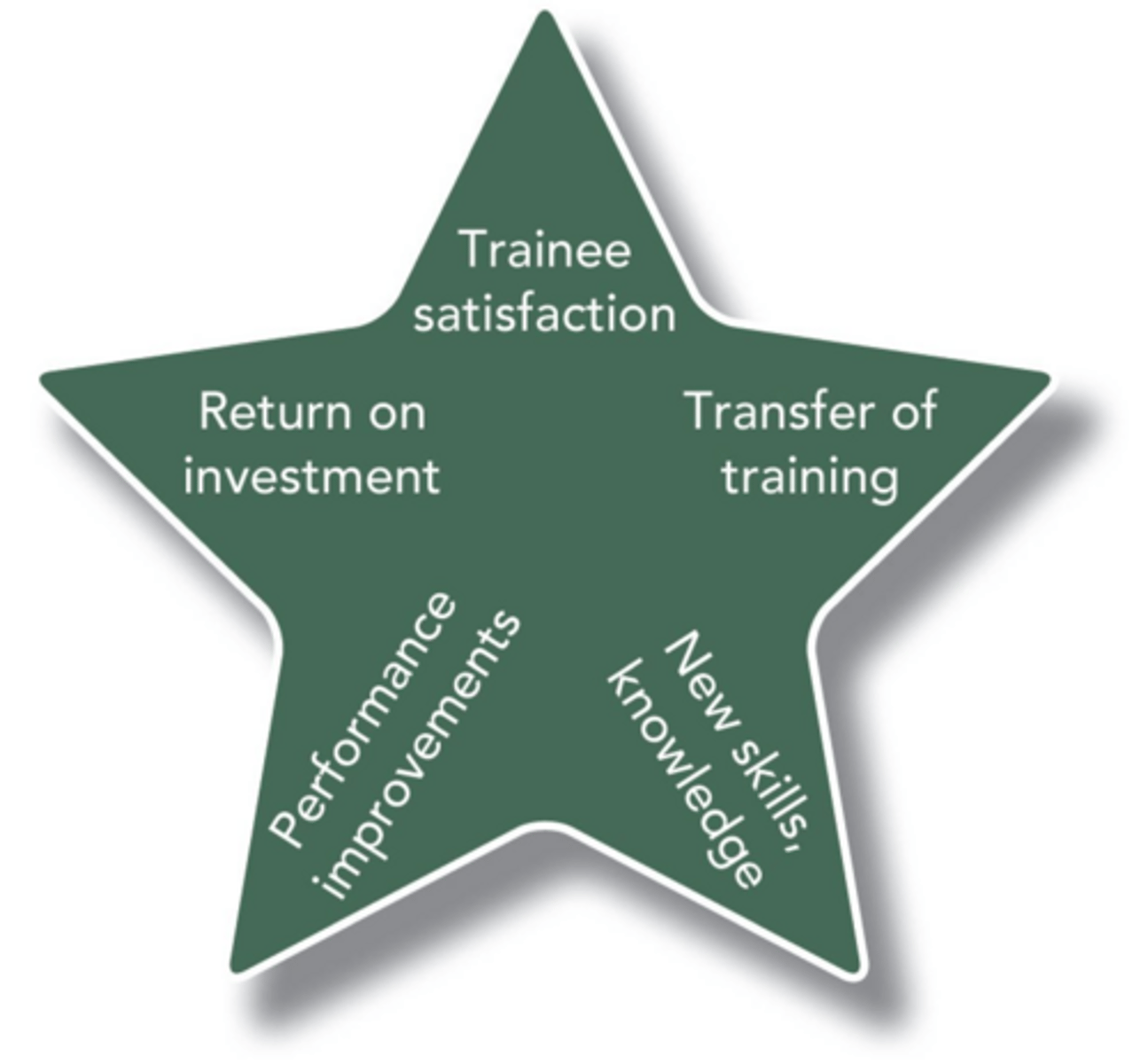
What should be the focus of task analysis?
Tasks that are important, frequent, and difficult to perform.
What is the role of management support in training?
Convincing managers that training is worth the investment and aligning it with organizational goals.
What is the relationship between performance and training?
Performance equals ability times motivation times opportunity to perform.
What is the importance of demonstrating learned skills in training?
It reinforces learning and helps employees apply new skills effectively.
What should training programs be linked to?
Organizational needs and strategic goals.
What is the impact of high turnover on training investments?
It increases the cost of training as employees may leave after being trained.
What is the goal of evaluating training needs?
To ensure that training is relevant and addresses specific organizational challenges.
What is the significance of effective onboarding?
It helps new hires connect with the employer and prepares them for their roles.
What is the administrative purpose of performance management?
Providing information for day-to-day HR decisions such as raises, promotions, training, and discipline.
What is the developmental purpose of performance management?
Serving as a basis for developing employee knowledge and skills by providing feedback on performance and improvement.
What is the legal purpose of performance management?
Providing a legal basis for a company to defend its administrative HR decisions.
What is the strategic purpose of performance management?
Directing employee behavior to help the organization achieve its business objectives.
What are the three main ways to improve performance appraisal processes?
Improve appraisal formats, select the right raters, and train raters to understand errors.
What are two examples of relative judgment appraisal methods?
Ranking and forced distribution.
What is the behavioral approach to performance appraisal?
Using methods like BARS (Behaviorally Anchored Rating Scales) to evaluate performance.
What is the outcomes approach to performance appraisal?
Management by objectives (MBO).
What is a distributional error in performance measurement?
When a rater uses only a limited part of the rating scale.
Define the leniency rating error.
When a reviewer rates everyone near the top of the scale.
Define the strictness rating error.
When a reviewer favors lower rankings for employees.
Define the central tendency rating error.
When a reviewer rates everyone in the middle of the scale.
What is the purpose of calibration meetings?
To minimize political bias by having managers discuss ratings and provide evidence to eliminate intentional errors.
What are the five common sources of performance ratings?
Supervisors, peers, self, customers, and subordinates.
What is the most effective way to schedule performance feedback?
As a regular, expected management activity that occurs frequently to avoid surprising the employee.
What should be the focus of a performance feedback session?
Specific behaviors and outcomes rather than personality.
What is the recommended approach for conducting a feedback session?
A 'problem-solving' approach where the manager asks questions and listens rather than just 'telling and selling'.
What are the four questions used in Deloitte's performance assessment system?
Questions regarding compensation/bonus, team placement, risk of low performance, and readiness for promotion.
Why is leniency bias considered one of the most difficult errors to correct?
Because it is often tied to the rater's personal goals or political behavior.
What is a major trade-off in performance management systems?
The conflict between the goal of employee development/feedback and the goal of identifying high/low performers for administrative decisions.
What is the trait approach to performance appraisal?
Evaluating employees based on personal characteristics, such as leadership, using a standards rating scale.
Why is it important to build on strengths during feedback sessions?
To motivate employees and ensure they know they are on the right track, rather than focusing solely on criticisms.
What is the definition of performance management?
The process through which managers ensure that employees' activities and outputs contribute to organizational goals.
What is the administrative purpose of performance reviews?
Providing information for day-to-day HR decisions such as raises, promotions, training, and discipline.
What is the developmental purpose of performance reviews?
Developing employees' knowledge and skills by letting them know how they are performing and how to improve.
What is the legal purpose of performance reviews?
Providing a legal basis for a company to defend administrative HR decisions.
What is the strategic purpose of performance reviews?
Directing employee behavior to help the organization achieve its business objectives.
What are three common problems that hinder performance appraisals?
Poorly defined performance metrics, poor measurement, and poor feedback.
What does 'validity' mean in the context of performance measures?
The measure accurately assesses what it is intended to measure.
What does 'reliability' mean in the context of performance measures?
The measure yields consistent results over time.
What is the 'relative judgment' approach to performance appraisal?
A method that compares employees against each other, such as ranking or forced distribution.
What is the 'trait approach' to performance appraisal?
Evaluating employees based on personal characteristics like leadership using a standards rating scale.
What is the 'behavioral approach' to performance appraisal?
Evaluating employees based on specific behaviors, often using Behaviorally Anchored Rating Scales (BARS).

