Ethics Test 1 - Extensive Notes
 Call Kai
 Learn
Learn Practice Test
 Spaced Repetition
 Match
Match Flashcards
 Knowt Play
1/73

Earn XP
Description and Tags
Covers, at length, what we have discussed in class thus far.
Name | Mastery | Learn | Test | Matching | Spaced | Call with Kai |
|---|
No analytics yet
Send a link to your students to track their progress
74 Terms
Epicureanism (Modern)
Stoicism (Modern)
Skepticism (Post-Modern)
These three schools are part of Hellenistic Ethics.
They lead back to a Pre-Socratic form of ethics.
Those who subscribed to these beliefs disassociated from the greater society.
Socrates, Plato and Aristotle were rather optimistic in their views. Hellenistic Ethics focused more on the self, believing that there was no hope in achieving happiness or fulfillment through society.
What were the three main schools of Hellenistic Ethics?
Which are modern ethical theories, and which are post-modern ethical theories?
False
Epicurus didn’t like the hierarchical nature of Plato’s philosophy (Philosophy Kings, Auxiliaries and Business Class). He believed everyone was on equal playing field; a collective.
Epicurus created a school called The Garden, in which he invited his friends to learn Pre-Socratic philosophy.
Slaves, women and men ate together and talked philosophy alongside one another in The Garden. This was very controversial.
Epicurus did not believe in politics or systems (religion, education, etc.).
Epicurus also believed philosophy involved the human soul; however, unlike Socrates and his students, he did not believe it could be constructed into a system like Plato’s utopia.
Epicurus agreed with one of Aristotle’s sentiments; only contemplation brings you happiness.
True or False: Epicurus admired the work of Socrates, Plato and Aristotle, and his ethics were greatly inspired by their philosophy.
More interested in the study of nature.
Pre-Socratic philosophers were mostly interested in cosmology, the beginning and the substance of the universe, but the inquiries of these early philosophers spanned the workings of the natural world as well as human society, ethics, and religion. They sought explanations based on natural law rather than the actions of gods. (Wikipedia)
Socrates was more interested in the human soul and psychology.
What are characteristics of pre-socratic ethics?
Democritus pioneered the idea that the world was comprised of atoms. He coined the term ‘atom’.
Once you understand that the world is made out of atoms, that then suggests things philosophically.
Epicurus wanted to take the concept of atomistic philosophy and create a branch of ethics from it.
What are characteristics of atomostic philosophy?
If there was no consistency to nature, how could we study it? Knowledge requires some kind of consistency and logic.
What is ‘regularity of nature’?
No overarching structure, or system.
Democritus and Epicurus; They believed no one should be in charge. Everyone should be in charge of themselves.
What is ‘political anarchism’?
True
Philosophy is not an academic distinction. It is a lifestyle. When you live that lifestyle, you will find happiness.
True or False: Philosophy is NOT an academic distinction.
Pleasure is the highest good. Not only is it an internal good, but it is the ONLY internal good that truly matters.
Philosophy’s role is to weed out what is and isn’t pleasurable.
Society for Epicurus was so rotten, that too many focus on the external goods, and not enough on the internal goods.
Epicurus believed only bodies and space exist; a physicalist thing.
All objects and events are nothing more than physical interactions between indestructible things; atoms. The movement of those atoms are random. Therefore, if everything is random, we can’t know anything about anything. Democritus did not believe in science. He did not believe it was measurable.
Your being is contingent. You did not have to be, and you will not have to be. For Epicurus, he believed there was no real guaranteed future- no afterlife, and no Gods.
Maybe the Gods do exist, but they don’t care about us at all. Fluctuates between Athiesm and Agnosticism.
The best way then to achieve happiness, is to avoid pain and suffering and chase pleasure. Live your life as simply as you can.
Pleasure is the absence of pain and suffering, physically and mentally. That is the highest good. It is not to simply do whatever you feel like.
What are characteristics of epicurean philosophy?
Freud thought that a lot of people do things because they fear death. For Epicurus, this was irrational- this creates pain; when all you have is the now and nothing exists once we die, you should not fear death, but chase pleasure in life.
Only pleasure and pain can make life better or worse.
You need sensation to feel pain; dead people have no sensation, so death cannot be worse. Nothing can harm you when you are dead.
The irrational fear of death can cause you harm in life.
When you die, nothing is causing you pain- because there is nothing.
Some people would argue that the purpose is to live as long as you can; Epicurus believed that the quality of living is not dependent on the amount of time you exist- it is entirely reliant on how you live. A short life can have a higher sum of pleasure than a long life. Life has the highest value when you have the highest pleasure.
Measuring your pleasures and pains in the life that you have; be selective and prudent. We have to condition ourselves through habit to make the best choices for ourselves; pick the best pleasures, not the most pleasures.
Many pleasures are intellectual pursuits. Being wise, thinking and pursuing wisdom will lead to the highest pleasure. In the end, a happy life is a virtuous life.
What is the basis for epicurean ethics?
Love, lust
What does the Greek word ‘eros’ mean?
Fear of death
What does the Greek word ‘thanatos’ mean?
False.
Aristotle said the best way to do Philosophy is to do it with friends. He believed that learning together was the way to better society. Epicurus didn’t intend to, or care to, better society. He was all about bettering oneself.
True or False: Epicurus was striving to create a better society.
True.
Epicurus was interested in de-schooling, and dismantling systems.
Morality and ethics has no role in developing laws for a society.
For Plato, philosophy contributes to the justice of the individual and the state. For Epicurus, laws do not come from ethics. He believes laws are instrumental, or tools.
Instrumentalism says the laws have no connection to peace, or natural order- it is merely an exercise of control and power.
Epicurus believed in a minimal state; a state that has the least power possible (some/minimal order). What happens to a state with too much power? It becomes invasive. Epicurus is not for a welfare state; he does not want government to get involved in the happiness of its people.
The only role of a state is to ensure there is no violence.
Epicurus says “we must free ourselves from the prison of public education and politics. Political power is unnecessary and meaningless; it is more harmful to us.”
Aristotle says “politics is the way through which wise men find peace and happiness. It is the highest art.”
Freedom is the greatest fruit of self-sufficiency.
The goal of philosophy and ethics is the same: to be in charge of your own life, and as happy as you can be. To be self sufficient.
For Epicurus, by definition, being part of a system will make you unhappy.
True or False: Epicurus believed in a minimal state.
The ideal person is able to avoid pain. They don’t exactly know what pleasure is, but they understand pain.
Your ethical “job” is to understand how to avoid pain. However, in life, pain is unavoidable. Thus, resistance is futile. To avoid pain increases your pain, your anxiety.
Epictetus (a slave): What disturbs men’s minds is not events, but rather their judgements on events. Let your will be that events should happen as they do, and you should have peace.
Don’t let your judgements control you. Focusing on your circumstance traps you in your own pain and misery. Try to avoid pain by avoiding reflecting on your pain.
Stoical means peace of mind. What it means in common terms is “unemotional; dispassionate.”
Stoical means exercising control of mind. What you ought to do is avoid desiring what is not in your direct control. That will make you avoid pain.
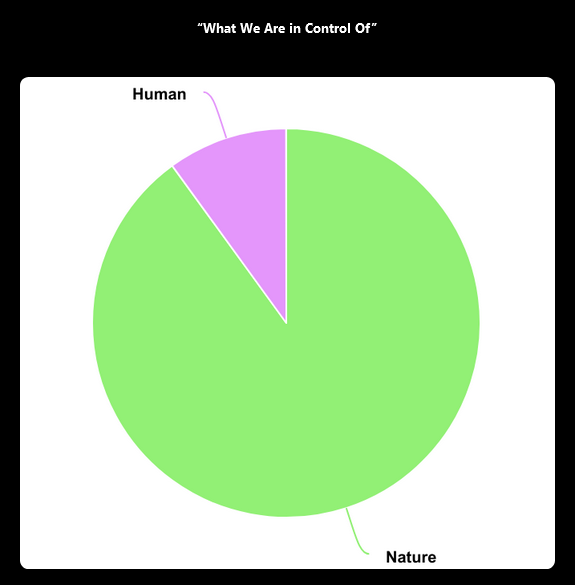
If you try to avoid what is natural and inevitable, you will be worse off. Simply accept what is, and move on.
What are a stoic’s general views on pain?
True.
Stoics find an order in nature. Rather than chaos, there is cosmos. Unlike Democritus and Epicurus, who found chaos in nature.
Your will is not to try and control nature, but to conform to nature. This will influence a lot of subsequent ethical theories.
True or False: A stoic’s drive is to conform to nature, not to try and control it.
What you think is true might not be; what really is “truth”?
In skepticism, we know nothing. We can know nothing.
A suspension of belief; there is no such thing as knowledge.
“Truth” is whatever you can argue.
What are a skeptic’s general views on knowledge?
Back in Plato’s time, there were skeptics; these were paid teachers in classical Athens, who taught people how to speak and how to think. They taught the rich how to speak publicly; primarily to persuade and influence the public, like politics.
Rhetoric was the art of speaking in public to sell an agenda.
The rich were taught how to get richer.
Skeptics → Rhetoric
Skeptics didn’t care about truth or virtue. The only “truth” was what they could persuade people to believe.
When arguing a point, they would teach how to both argue in favour of, and against, said point, then judge a person on their ability to argue something they don’t believe in.
Socrates declared that no one ever paid him to teach, he did so for the good of Athens.
What did skeptics do in Plato’s time period?
Skeptics themselves may have had beliefs, and may have lived virtuously- but ultimately, none of that mattered. All that mattered was persuasion.
Most of your pain comes from your belief system. If you’re going to live and die, what is the point of believing anything at all?
Quietude: in matters of opinion and moderate feeling with respect to things unavoidable.
You have to suspend your beliefs and opinions to avoid pain. A person should therefore determine nothing, nor should you pursue those things.
Conventionalist: ethics means giving up your judgements about what acts are good and what acts are bad. There’s no such thing as “right” or “wrong”, just what society says so.
Skepticism argues that there is no universal right and wrong, only localized traditions and beliefs. Custom or agreement is the right basis for action.
What is normative is based on what is found in the larger culture.
What were skeptics’ general thoughts about belief?
Replaces Christian faith with science and technology. The aim was to control nature.
Scientific discovery starts unraveling religious beliefs, superstition and older sciences. They then try to replace it with modern science and stabilize people’s understanding.
They believe in progress. With continued discovery, science improves.
More institutions; bigger, better institutions. Big government. Nation stages. Economies of states.
Modernism is about mass scale; mass everything. Today, people are disconnected from these systems and are rebelling. You are basically a number. It is all about numbers.
Like it or not, we are moving towards post-modernism. If modernism built the house, post-modernism aims to tear it down.
What does post-modernism aim to do to modernist traditions and beliefs?
Emmanuel Kant
Who is the father of human rights?
Only will is good or bad without exemption or qualifications
The only thing we should willingly follow is reason.
Humans are natural beings with reason, therefore they are inherently deserving of respect.
Because we are rooted in reason, we all have basic moral intuitions → content of moral experience. However, this is not a justification of right and wrong, or good and bad. We need to have reasoning.
Once we uncover the moral laws of the universe, we have to exercise our own will to act in accordance.
Human reason should dictate how we live, not power or authority
Good will is structured by moral law.
Natural law is consistent and unchanging (ex: gravity). The same goes for moral law.
Rightness or wrongness is not judged by consequence. Kant was NOT a Consequentialist. He was a Deontologist.
Kant wants to build up a moral community; it is hard to be a good person and do the right things on your own. Only rational and autonomous beings (self-legislative beings) are members of the moral community.
What are characteristics of Kant’s philosophy?
A priori: the prior (before) → normative (what ought to take place. The basis of ethics.)
A posteriori: the posterior (after) → descriptive (what people do, what societies do. Changes all the time.)
Ethics come prior to our experiences, not from our experiences. They come from prior obligations and duties.
Moral truth comes from moral obligations. Experiences don’t justify anything.
What is a priori? What is a posteriori? What is the difference?
Deontos = duty.
Logos = reason of; logic.
Deonotology = the logic of duty.
What does ‘deontology’ mean literally?
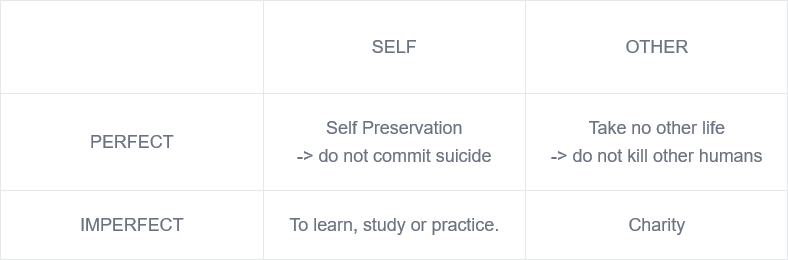
If you were not to do it, you would engage in a logical contradiction. Therefore, it must always be obeyed without exception. (ex: do not commit murder)
What is a ‘perfect duty’?
You don’t have to follow it all the time; it doesn’t always result in a logical contradiction, but rather, a contradiction of will. (ex: charity) Not as strict as perfect duties.
What is an ‘imperfect duty’?
You wouldn’t want to live in a world without it.
What is a ‘contradiction of will’?
Actions done to oneself
What is a ‘duty of the self’?
Actions done to others
What is a ‘duty of others’?
Doing the right thing doesn’t always dictate moral worth. Doing an action based on will, on respect of the moral law, dictates moral worth.
Ex: Taking your grandmother to her doctor’s appointments because you were asked to. You don’t want to do it, you dread doing it, but you do it out of obligation. That is not a morally worthy act, because there was no will.
Ex: A shopkeeper who decides not to cheat his customers because it would be bad for business is not conducting a morally worthy act, because it was not done out of respect for the moral law. However, a shopkeeper who decides NOT to cheat his customers because it is wrong to cheat and lie is conducting a morally worthy act, because it was done out of respect for the moral law.
Only actions done out of respect for the moral law have moral worth.
What kind of action has moral worth?
To be virtuous.
What is Aristotle’s ethical method?

To be rational, logical, and have good will.
What is Kant’s ethical method?
Formulate a maxim. Ex: I will cheat on my next test.
Take said maxim, and universalize → all rational moral agents would abide by that law.
Think; will this law work in society? Ex: everyone will cheat on their next test.
Would it be logical? Would it be rational? Ex: It would not be logical. Test-taking would become ineffective.
What is Kant’s four step mathematical process of ethics?
A guiding principle of action. (ex: I should never tell a lie)
What is a ‘maxim’?
Absolute; no exceptions
A command of reason without any exception. You MUST follow this law.
What is a ‘categorical imperative’?
Applies only conditionally. (ex: if [the condition] you want an A on a test, study hard! [the imperitive])
What is a ‘hypothetical imperative’?
Act only according to that maxim by which you can at the same time will that it should be a universal law.
What is ‘the universal law of formula’?
Act in such a way that you treat humanity, whether in your own person or in the person of any other, always at the same time as an end, never merely as a means to an end
What is ‘humanity formula’?
It tries to bring a universal objective approach to morality
Focuses a lot on equality and respect for other moral agents.
Focuses on things that other theories fail to address. (ex: consequentialism does not talk about duty)
Simple, but not simplistic.
Kant’s theory avoids indecision and apprehension. Allows us to come more quickly to a decision.
Kant’s work led to the understanding of basic human rights.
What are six pros of Kant’s theory?
Some would argue that this theory leaves out moral aspects that should be included. (ex: consequence, compassion and empathy).
He argues that every moral situation can be argued from an objective universal perspective. Sometimes a situation is unique, and different from one another’s.
What happens when you have conflicting duties? Ex: You have an elderly mother in Toronto, but an elderly father in Windsor. You can’t possibly take care of both simultaneously, so what do you do?
What is considered to be apart of the moral, rational realm? Ex: animals.
An intelligent person can twist their maxim any which way to justify their thoughts and actions, which undermines the whole system. Maxims require facts and language- if you’re clever enough, you can manipulate that in order to appear more moral.
What are five cons of Kant’s theory?
A moral theory that says every situation is so unique, there are no moral laws.
What is ‘situationism’?
Kant and Deontology
What was utilitarianism founded to oppose?
Act Utilitarianism founded by Jeremy Bentham (1738 - 1832)
Refined/revised by J.S. Mill (1805 - 1873), who developed Rule Utilitarianism
Bentham is also the godfather of Mill
Bentham was a legal genius. He used philosophy and jurisprudence to define and develop his ethics, Act Utilitarianism.
J.S. Mill was also a genius, having learned Greek and Latin by the age of 8, and worked with the East Indian Company as an accountant. He served as a Member of Parliament. He fought for women’s rights to vote.
Who founded act utilitarianism? Who founded rule utilitarianism?
The judges in England were very harsh, who gave very harsh sentences for very light crimes.
Bentham wanted to reform the British justice system.
The English were afraid of the radicalizing of their people in the wake of the French Revolution
They were reformers, but not radicals. They did not want to overturn British traditions. They acknowledged flaws in Britain, but still did not want to see revolution.
Bentham wanted to reform social and political institutions.
Britain was slowly moving towards parliamentary democracy. The people were beginning to have more power- not too much, but more than before.
What are characteristics of utilitarianism?
“Kant is nonsense on stilts”, said Bentham
Utilitarianism is a branch of Consequentialism.
Bentham was a Consequentialist, but acknowledged its complexities and shortcomings.
Only the consequences of utility matter in Utilitarianism.
Sometimes you are asked to do an act that makes you yourself unhappy. But, if it makes the most people happy, then it is right to do it, still.
“The greatest net balance of happiness over unhappiness., for the majority.”
Bentham was trying out a mathematical approach to ethics.
Bentham’s method: Utility calculus
You ought to do the action that leads to more pleasure than suffering, and ought not to do the action that brings more suffering than pleasure.
Positive utility vs. negative utility
What are characteristics of act utilitarianism?
There is no action that is good or bad, right or wrong, in itself. The action is judged by its consequence.
What is ‘consequentialism’?
The greatest good (happiness and pleasure) for the greatest number.
What is ‘utility’?
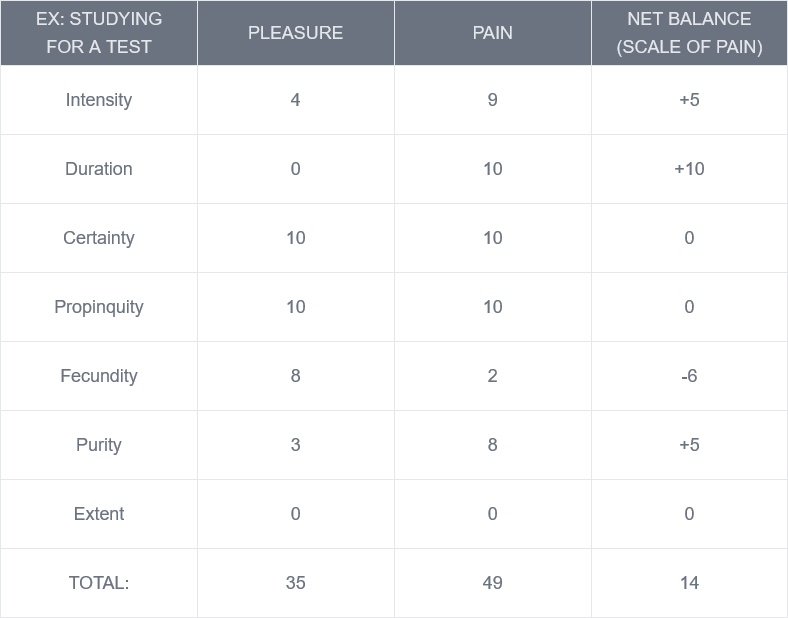
Intensity: How strong will the pleasure or pain be?
Duration: How long will the pleasure or pain last?
Certainty: How certain will the pleasure or pain be? How likely will it occur?
Propinquity: How near (soon) or far away is that pleasure or pain?
Fecundity: How much pleasure or pain will be produced from that action? How fruitful will this be?
Purity: How pure is the pleasure or pain? Is it mixed with the inverse? (ex: an act that brings pleasure but also brings pain)
Extent: How many people get to experience this pleasure or pain?
This is not yet applied ethics. This is purely abstract. It is Bentham’s personal method.
Example: studying hard for a test.
According to Bentham, you ought not to study for the test.
What are the 7 criteria of utility calculus?
An action is required if, and only if, it is dictated by a rule that if followed by everyone, would produce the most happiness
He is NOT saying actions should not be calculated. He is saying we must also look at rules.
Rules are public actions, they direct the actions of groups.
Rule Utilitarianism modifies Act Utilitarianism by bringing a focus back to rules and implications on the greater society
Importing Kant back into Utilitarianism
There may be a discrepancy between ideologies.
What are characteristics of rule utilitarianism?
Act Utilitarianism: Babies and disabled people are unable to row the life raft, therefore they serve less people than the others. To ensure the greatest amount of good for the greatest amount of people, they would be left behind.
Rule Utilitarianism: Captains have rules on the ocean- the captain goes down with the ship. The captain should ensure everyone else gets on, putting himself last.
Example: A ship crashes. They have one life raft, but only four of the six passengers can fit. The captain has to decide who lives and who dies.
Using logic of act utilitarianism, who would be left behind?
Using logic of rule utilitarianism, who would be left behind?
Pro: Connects with most people’s conventional understanding of morality.
Pro: It tries to be objective; impartial. It tries to consider everyone.
Pro: Provides a relatively simple method for making moral decisions.
Sometimes, it allows our basic moral principles to be overturned. (ex: lying for the greater good, i.e. to protect someone)
Pro: Kant says he is not dealing with consequences, only rules. At the end of the day, Kant is still importing consequences into his theory. Kant’s ideas consider consequences without explicitly saying so. Bentham’s theories explicitly and transparently centralize the idea of consequences.
Pro: Utilitarianism does not accept the concept of rights. For Kant, animals do not have rights; only “rational beings” with free thought. For Bentham, animals also do not have rights, nor do people. However, because he focuses so much on pleasure and suffering, he actually factors in welfare indiscriminately, which includes animals. Animals can suffer, so why should the law neglect to protect them as they do human beings?
“The time will come when humanity will extend its mantle over everything that breathes.” - Bentham
What are five pros of act utilitarianism?
Con: The process is too lengthy. It cannot be used on a whim, so how can one act in the heat of the moment? It is not practicable.
Con: Kantians ask, is there nothing you would not do? This theory does not rule out anything. It is unprincipled.
Con: Punishment theory- a lot of innocent people have been wrongfully accused and convicted because of Bentham’s belief. The haste to protect the most people leads to one person having to suffer the consequences of a false guilty sentence. Leads to injustice.
Con: What happens to the minority groups in society? The greatest good for the greatest number entirely disregards marginalized populations.
Con: This theory is simply too complex. It can’t account for all consequences, like Consequentialism.
Con: You are required to only do the action that produces the greatest amount of good for the greatest amount of people. However, it is subjective; arbitrary. It is imprecise.
Con: It’s impossible to determine in advance what the consequences are going to be. If you can’t calculate the consequence, how can you factor that in to the calculation of your action?
Con: Which consequence should be weighed more? Immediate, or future? Short-term, or long-term. This theory is impractical and impracticable. It simply can’t work.
Con: If the greater good is happiness, can it be different for different people? We don’t all have one form of happiness, so it is impossible to measure the most greatness for the greater good.
Con: Is all happiness good? Is all happiness deserved? You have to differentiate that. Sometimes, happiness may come from immoral activity.
Con: Bentham makes no distinction between higher pleasures and lower pleasures. “To suppose that life has no higher end in pleasure makes people like swines.”
What are eleven cons of act utilitarianism?
Pro: Avoids the worst problems of Act Utilitarianism.
Pro: Act Utilitarianism allows everything; under Mill’s version, there were certain rules against certain actions. Certain things were forbidden and condemned. It’s far more comprehensive, and focuses more on morality.
What are two pros of rule utilitarianism?
Con: Some people think it isn’t Utilitarianism at all. It inserts Kant right back into the very theory that was constructed to oppose his philosophy.
Con: Rule Utilitarianism is demanding. You have to not only be informed of the rules, but have the will to follow them, sometimes sacrificing your own pleasure. It is more challenging intellectually, and morally demanding.
Con: You cannot privilege your family over others when you are forced to always act for the greatest good of the greatest number. If a rule is to care for your children, the demand to appease the greatest number becomes contradictory.
Con: This theory was dominant in English history. It influenced much of Britain and Canada in their policies and law, understanding of society, and insurance.
Mr. Scrooge is a Utilitarian. Charles Dickens wrote the character in opposition of the theory.
What are four cons of rule utilitarianism?
Thomas Hobbes (1588 - 1679)
Hobbes was a Utilitarian before Bentham formulated the theory. Bentham got many of his ideas from Hobbes.
Hobbes was writing at the end of the English Civil War, where Charles I was beheaded.
However, modern social contract theory starts with Socrates
Socrates had a contract with his society. It raised him, it educated him, so he felt indebted to Athens, so much so that he declined offers to help him avoid his death sentence.
Who was the father of modern social contract theory and modern social psychology?
“In a state of nature, there will be a war of all against all, in which the life of man is solitary, poor, nasty, brutish and short.” - Hobbes
Hobbes argues everyone is motivated by self interest, and is therefore rational- they follow what is in their own interest, and one is only rational acting in said self-interest, even at the expense of others. To go against that is irrational.
To maximize self interest, one must ensure others are worse off. Zero-sum.
We need to have a civil/social contract to ensure the inclusion of everyone’s benefit, and avoid the natural state of war.
Rules cannot be rules that are going to eliminate human nature (self-interest, rationale, competition). Rules can shape and coerce it instead.
His social construct theory was a justification for a monarchy. Only a strong person who is above everyone else can push down the competition and self-interest and redirect it towards the good of many.
He was not in support of a hereditary monarchy. He wanted a monarch who had merit. He was in support of an absolute monarchy, without rules and limitations. AKA, a dictator.
What are characteristics of social contract theory?
John Rawls liked Hobbes’ ideas about human nature, how humans act in self-interest, are rational and competitive, but disliked prospect of a monarch. He wanted to reconstruct the idea of a social construct.
During this period, America was stronger than ever before. There were more revolutions happening worldwide, as well, especially surrounding race and gender.
Rawls saw free rational people with more competition and therefore felt that society needed new rules; a new social contract.
Critical Social Justice is the new social contract.
Pluralist democratic society → valueless/neutral ethics. Shifted away from normative ethics to descriptive ethics. People avoided taking a stance.
Rawls wrote his book A Theory of Justice on normative ethics as a direct attack on valueless descriptive ethics and Utilitarianism.
Not laws or monarchy, rooted in justice
His work was so influential that it influenced Canadian social culture. Canada’s liberalism is a product of Rawls’ thinking.
How did John Rawls adapt social contract theory to suit the climate of America in the 1960’s - 1970’s?
Every individual born has freedom.
The individual is prior to the state; they are more valuable than the state. The only job of the state is to protect individual freedom.
The state respects diversity and freedoms, does not impose any kind of lifestyle or value system on an individual.
What are characteristics of classical liberalism?
Some believe the greatest threat to freedom is interference by other people, and interference by the state- negative liberty/freedom.
Others believe the greatest threat is an unjust distribution of resources, and excess wealth- positive liberty/freedom
What is the difference between positive liberty/freedom and negative liberty/freedom?
Karl Marx
The greatest threat to the individual is an unjust distribution of wealth, resources and opportunities. (ex: black people were threatened by an unjust lack of education in their community)
Freedom from (something)
Freedom to (do something)
Sometimes, an unjust distribution of resources comes from an unjust state.
Social justice includes legal justice, but extends far beyond it.
Which philosopher did John Rawls share views with?
Ruled by the rich, who create rules for the rich.
What is a ‘plutocracy’?
Classic (Negative) Liberalism → John Locke; 17th century
Modern Liberalism → John Rawls (“Theory of Justice”, 1971), Marx; late 19th century, early 20th century
Liberalism:
Liber = Freedom
Values freedom for the individual
The state is the greatest threat to individual freedom
What are the two types of liberalism?
The United States has more of a classical liberal system of freedom than Canada does.
Ex: OHIP. The government are in control of your healthcare. In a classical liberal state, one could see their own doctors, and write their own prescriptions, etc.
American founders were inspired by Locke and classic liberalism when writing the constitution.
What nation has more of a classic liberal system, America or Canada?
Modern Liberalism views an unjust distribution of resources as the greatest threat to individual freedom
Rawls believes that justice is a distribution of resources and opportunities; maximizes individual liberty
When your structures are just, you have social justice
Social movements like feminist, anti-war, environmental and anti-racist movements advocate for changing the basic structures of society which oppose individual liberty for all → social justice. Rawls supported these movements in the 60’s and 70’s.
Egalitarianism, Real Democracy; Rawls’ theory of justice sought radical equality
What are characteristics of modern liberalism?
Assign rights and duties to individuals in a non-arbitrary manner
Ex: Taxes → a duty; what someone owes. In Canada, tax is 26%.
Progressive taxation: the more you make, the more you pay.
In the 80’s, Conservatives reduced Canada’s ten tax brackets to just three tax brackets.
Arbitrary Taxation: It is arbitrary that the top percentile make the bottom percentile pay more in taxes. According to Rawls, this is unjust.
Even how you earn your money changes your taxes, your duties. Who decides that? The government does. The way the strongest members of society decide to impose burdens on the weakest members of society is unjust.
Properly distribute the benefits and burdens of social cooperation.
What are the two things that should be done by the principles of justice?
The Original Position
Rawls got this idea from Hobbes.
Hobbes was the father of Modern Social Contract Theory. If you leave everything to a state of nature, everyone will pursue their own self-interest even at the expense of others. Human nature is self acquisitive.
Hobbes’ theory was rooted in monarchy.
For Hobbes, you can never really suppress human nature, only confine it.
We move beyond brutish nature into a civil society if we embrace and accept a monarchy.
Rawls wants a social construct. He agrees we need to move beyond human nature, but he wants a social construct rooted in a democracy, not a monarchy.
The “original position” is prior to a social contract
A social contract is an unwritten agreement among all members of society that places them out of nature and chaos and into a civil society.
Rawls’ main idea is that the principles of justice for the basic structure of society are the object of the original position. From the original position, you want to form a social contract. One that is just and fair for all people.
The original position isn’t just a competitive state of nature, it is also questioning the state of nature and seeking society. A person enters a social contract, not because they’re trying to be virtuous or just, but rather to protect themself.
Not the greatest good for the greatest number (Utilitarianism), but for one’s self-interest.
A social contract comes out of the original position from mutual self-interest.
Rawls is a modern Kantian.
What was John Rawls’ ethical method?
Veil of ignorance: hides reality.
The original position a philosophical or ethical social experiment. Imagine yourselves not knowing anything about yourself. Not your gender, not your race, not your intelligence or beauty. Suspend these pieces of knowledge of yourself. Under this veil of ignorance, no one knows anything about you, not even you.
Reason/Rationality: the most effective means of reaching your goals.
Mutually disinterested: you don’t care about if anyone else is good. All you care about is your own good. You have no interest in another’s self-interest.
Equality: there is a radical equality among all individuals in society among the original position. (This is Kant’s humanity formula.)
We all have the same rights, because we are all members of society. Therefore, we all can contribute equally to the formation of the social contract. We can all submit proposals for justice. We can achieve social justice.
By way of contrast, imagine you are a wealthy, well-connected, highly competitive, highly intelligent person. You will be presented better opportunities, better resources. If that’s the person you are, what kind of social principles would you choose? You will put barriers in place of your competition. Impose taxes, make education expensive and inaccessible.
Imagine if you are poor and poorly-educated, but intelligent- you will make principles that benefit the poor and disadvantage the rich.
According to Rawls, you have no way of dictating your future. You don’t even have a concept of how you are now. Therefore, in the social contract, you are going to create principles that do not advantage anyone over anyone else.
Everyone who is rational and self-interested will choose principles of justice that create equal opportunity, equal benefits, equal resources, democracy and freedom.
Fairness is the basis of his theory. The principles we agree upon in a social contract should be rooted in fairness. Justice is fairness.
What are four features of the original position?
The liberty principle: value individual freedom. Everyone who is rational will choose freedom. Liberty is a foundational justice principle. If you don’t have freedom, you cannot pursue your self-interest.
The most important principle.
Each person is to have an equal right to all basic liberties.
Political liberty (the right to vote, the right to hold public office, freedom of speech, freedom of assembly, freedom of conscience, freedom of religion, freedom from harm, the right to hold personal property, etc.)
First principle makes Rawls look like a classical liberal.
The distributive justice principle: the distribution of social and economic advantages.
If 5% of the population controls 99% of society, that is arbitrary and unfair.
What is the first principle in a social contract? (Two components)
Social and economic inequalities are to be arranged so that they are both:
a) the difference principle: to the greatest benefit of the least advantaged
Ex: preferential hiring - picking one group over another based on some set of characteristics.
Preferential hiring is an attempt to make reparations for the injustices of the past. This, however, breeds resentment from the group that is now being looked over.
A drawback of modern liberalism is social resentment.
What does it mean to be the “least advantaged”? You can use statistics to find out.
However, numbers don’t tell the whole story. That is quantitative measurement, and lacks qualitative measurement.
Rawls considers the “least advantaged” to be those measured by numbers.
Any inequality that doesn’t work to benefit the worst-off people in society is contrary to the principles of justice.
b) the equal opportunity principle: attached to offices and positions open to all under the conditions of fair equality of opportunity
You can have social and economic inequalities, under the condition that it benefits the worst off in society.
We may allow some inequality now, if it moves towards creating greater equality in the future.
Ex: doctors can make $400,000 a year and have their education paid for, so long as they help disadvantaged groups, like the homeless.
What is the second principle in a social contract? (Two components)
The government ought to create the conditions of equality. From the 1970’s and onward, most Western governments followed Rawls’ prescription, which led to preferential hiring.
Rawls recognizes that there is no perfect solution.
Governments are the agents of social justice.
Starting in the 1980’s, Conservative governments started to unravel modern liberalism.
For classic liberalism, the state is the enemy. For modern liberalism, the state is the solution.
With the unraveling of modern liberalism, the result has been more social justice movements.
What does John Rawls suppose the government ought to do?
The solution is not to undermine the natural talents of people. However, he thinks the structures of society privilege certain people with certain natural lottery. All we can do is measure what those people deserve for having natural talents by having natural lottery- do they deserve better opportunities? Rawls would say no.
Ex: Transgenerational wealth is easier if someone has it to begin with. If you’re born into a family with more wealth, more of that wealth is passed down. That doesn’t mean you deserve more privileges or benefits than someone who did not have that natural lottery.
Rawls isn’t saying the natural lottery doesn’t matter, or should be eradicated- instead, he believes it should be used to better the circumstances of others in society.
What does Rawls say about overcoming the natural lottery?
Pro: A clear, scientific and philosophical justification for what the moral/ethical rules should be. Why? Because the moral rules are rooted in nature, self-interest and reason.
Pro: Justifies why the government should impose “punishments” upon certain groups of people.
Pro: Provides equal opportunity to those who have been intentionally left out of the material and social progress of society.
What are three pros of Rawls’ modern liberalism?
Con: Does not include everyone in the social contract.
a) What happens if you are not a member of the original contract? Kant excludes animals and the environment from his theory because they are not rational, intelligent beings. So any person who is not a member of that original social contract are not granted rights and protections, because they are not contributing to the principles and functions of society, therefore granting them no inclusion in that society. (ex: children, animals, people with cognitive or physical disabilities, etc.)
b) What happens if you don’t believe in this theory of justice, and therefore do not want to agree to this contract? The environment is considered outside of the contract.
Con: Pits the environment against the people. The environment is considered “outside” of the social contract, therefore it is not privileged.
Con: Lacks good ecological ethics. The self-interest of people comes at the expense of the environment, and it is justified by doing what is “best” for one’s self.
Con: Moral values and civil social disobedience.
Rawls believes that once we have the principles of social justice, once we have perfected society, once we have perfected the social contract, we’d never protest. If you create the perfect conditions, why would you have to complain? Why would we have competition? However, is that a good thing? Disobedience is a good thing. How does society move forward if not for competition and criticism?
Con: His notion of social justice is a liberal notion of social justice. He assumes the existence and value of social capital social order. He believes in the co-existence of capitalism and social justice. His assumption is that the more wealth you create in a society, the more justice you create. The legacy of capitalism is more injustice than justice.
Con: R. Nozick wanted to cut back government. He argued that if you took Rawls’ difference principle, it requires constant intervention of an invasive government. That undermines Rawls’ own principle of liberty and freedom. He has created a contradiction within his own theory.
Con: The Social Contract Theory has kept women out of the social contract despite the aim to be more inclusive and egalitarian. The white male patriarchy has excluded women from the social contract from the beginning. It feels patronizing to emphasize the inclusion on minority groups without actually acting on benefiting said groups.
What are seven cons of Rawls’ modern liberalism?
Rather than just relying on government intervention, we need to understand why they need government intervention in the first place. People are afraid of socialism and communism without having an understanding of what they mean. Social justice should be changing how people organize their affairs, such that people aren’t poor, and aren’t needy. Social justice is not top-down through the state, but how we organize our affairs, our people.
Expansionist Social Justice Policy: the more capitalism you have, the better off society will be.
Classical Liberalism believed the state should be small, only enough to enforce social order. Modern Liberalism believes the government is in charge of social justice. The bigger the state, the bigger the justice. He implies that the economy is the agent of social justice.
Welfare systems are top-down. People whose families start on welfare typically stay on welfare through the generations.
Why do we need a more “radical understanding of social justice”?
Libertarianism says the government has no role to play. Classic Liberalism says there is some small role (military, police, judges, little tax). Modern Liberalism says it is necessary to have a big government for social justice.
Chomsky believes government is all about promoting capitalism. He is a leftist libertarian. He believes the government perpetuates racism, sexism, etc. and that supporting such control supports that oppression. What a left libertarian wants is more individual control over their own affairs.
According to Chomsky, what do leftist libertarians want?

