Lecture 11 (evolution of land plants) + 12 (Bryophytes and seedless vascular plants)
 Call Kai
 Learn
Learn Practice Test
 Spaced Repetition
 Match
Match Flashcards
 Knowt Play
1/16

There's no tags or description
Looks like no tags are added yet.
Name | Mastery | Learn | Test | Matching | Spaced | Call with Kai |
|---|
No analytics yet
Send a link to your students to track their progress
17 Terms
Compare and contrast aquatic with terrestrial environments in terms of the
advantages and disadvantages each provides for photosynthesizing organisms
Aquatic advantages:
Surrounding water constantly replenishes nutrients, removes toxins, wastes
Light and CO2 is plentiful near surface of water (CO2 diffuses in)
No need to invest in structure because water provides buoyancy and support
water supports the organism’s body so less energy making structures like stems, wood, etc.
Coastline:
complex
turbulent (wash the algae away)
wet/dry alternating tidal environment (can dry out or get UV damage)
less constant nutrients.
Terrestrial habitat:
lots of CO2 in air
soil provides nutrients and water, but is limited.
not much light if there is canopy shading from other plants.
need to evolve structures to grow tall in air, anchor and penetrate the soil.
Initially, there would have been lots of light (open rock)
Discuss the principal new traits that ancestral open water algae had to evolve to
successfully grow, survive and reproduce in the shoreline environment, and then in the terrestrial environment
Traits in organisms in open water:
small size because don’t need heavy support structures, gives them high surface area to volume ratio.
Quick to grow because lots of nutrients, light, and can focus energy on growth (not structures)
Fragile/fast nutrient recycling because less structural tissue to decompose.
Lots of things eat them (herbivory) because small, soft food.
Low autotrophic biomass b/c grow and die quickly without much tissue.
Adaptations needed for open water —> shoreline:
multicell form with thallus (shoot) and anchoring organs (so they can’t be swept away)
Specialised meristems —> lets them localize growth to shoots or blades that grow towards light
Cell walls made of cellulose —> provide rigid support (because now theres no water to support, need more structure)
Conducting tissues (tissues that can transport water to photosynthetic parst, sugar to non-photosynthetic cells to support them) b/c multicellular means not all cells do everything.
mucilage = resist dessecation when dry.
Adaptations needed for shore —> terrestrial
specialized structures (Stems, roots, leaves)
cell walls
localized growth towards light sources
multicellular and tall to get light.
Conducting tissue to supply sugars to nonphotosynthetic parts
cuticle to prevent water from leaving.
Traits now in terrestrial habitats:
slow decay after mortality (because so many more structures)
less herbivory (bc more structures to digest)
More biomass.
Slow growth (to make structures)
Explain the evolutionary selection pressures promoting colonization of land by
ancestral aquatic algae
Selection pressures (what caused the move onto land?)
Lots of unoccupied space on land for potential colonization and not much competition yet. Water getting crowded and lots of competition for anything.
Not many herbivores or pathogens yet. In water, there are many predators that are evolved to target many types of aquatic plant.
Pull to stay in water:
land is hot + dry, not always water to cool them down.
Limited nutrients
Eventually these factors got bad enough to push some plants to take a chance. Not always successful, but when they were, it was great for them.
“tree of life has been heavily pruned”
lots of attempts to colonize, but many died before one finally stuck.
Describe what early land plants looked like
Small
Just a green stem that did photosynthesis (no leaves evolved yet)
If they had traits that worked in the environment, they could spread.
Short because they had weak support tissues (thin cell walls, needed turgor/water pressure inside cell to keep their shape) that would collapse/flop over if they got too tall.
Discuss the principal new traits that early land plant species had to evolve to
successfully grow, survive and reproduce while competing with other land plant
species for light, soil water and nutrients, and new habitat for colonization
New specialized tissues (traits) arising from evolutionary selection pressures:
roots
for obtaining water and nutrients.
for anchorage/to hold in place
Lignin to support tissues and grow higher (allows apical dominance)
out-compete for limited light, good because they can’t move.
Xylem and phloem
to transport water and minerals up and sugar and organic compounds down
Stem Thickening
to help with stem buckling
Bark
to protect against pathogen entry, prevent water loss
but this means barked stems can’t photosynthesise…
Leaf formation
to increase SA for light to be absorbed for photosynthesis, good because they can’t move to get light.
Cuticle + stomata on leaves
Reduces water loss in leaves. Stomata regulates gas exchange.
How did plants grow/develop these traits? Modular (repeated building block) growth units (buds) inside 3 different meristems.
Auxiliary meristem = buds builds outwards branches and leaves
Apical meristem = buds build upwards and downwards (shoots upwards and roots downwards)
Lateral meristems = buds contribute to secondary stem thickening
Note:
Roots: root hairs, mycorrhizae to increase SA/V ratio + maximize nutrient + water uptake
Stems: Zylem and Phloem for transport, thick stems
Leaves: mesophyll, epidermis, cuticle, stomata: maximize sugar output, minimize water loss, allow gas oout
Outline the overall phylogeny of Kingdom Plantae and summarize the trend in
development of evolutionary adaptations within land plants in terms of relative
focus on plant structural and sexual reproduction features
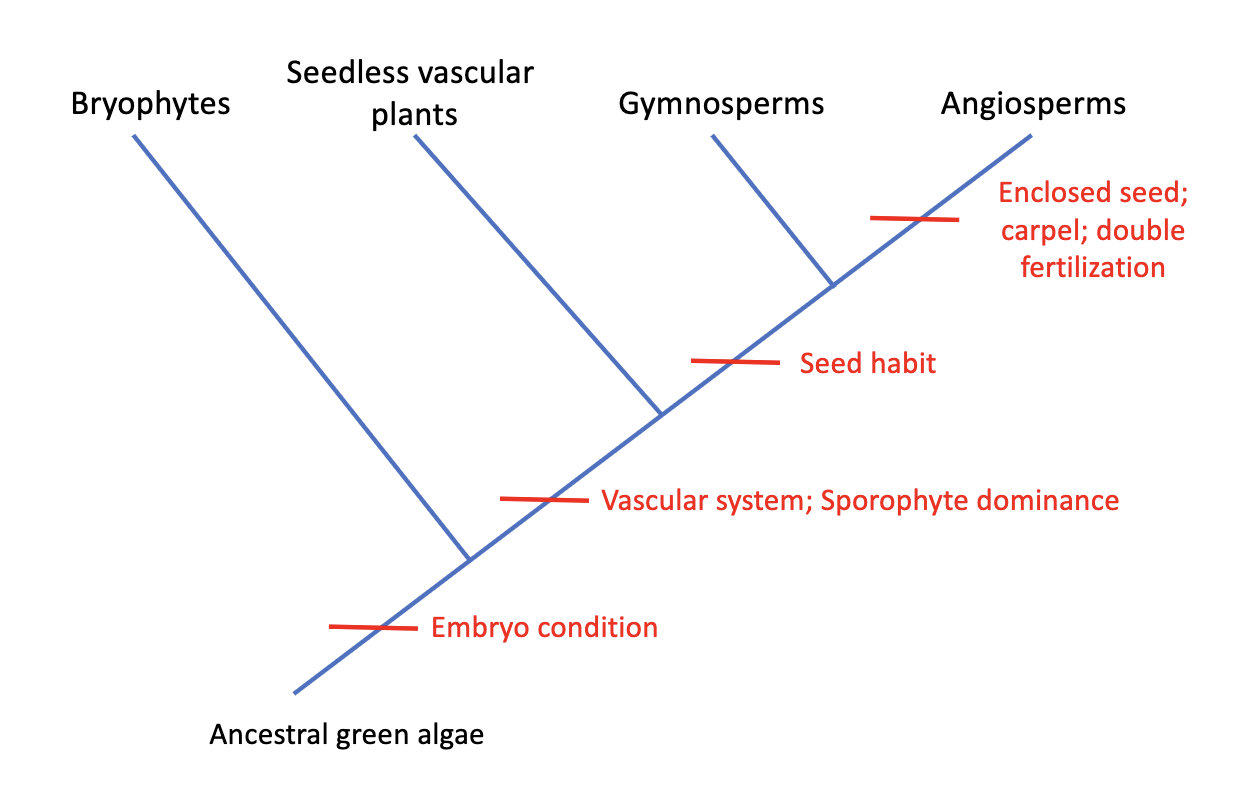
Trend: evolution of taller + stronger stems to elevate photosynthetic tissue into places of max sunlight, and make more and stronger roots for anchorage and nutrient/water uptake.
Structural: for the race to the canopy + race for soil resources. (as above)
Evolutionary trade offs: Adaptive traits that are beneficial in addressing one selection pressure can often be disadvantageous against another...... ‘Evolution’s Balancing Act’
Sexual reproduction features trend towards:
alternation of generations, multicellular, dependant embryos, walled spores in sporangia
Embryo was likely critical + essential first-step to colonization of land.
Phylogeny of kingdom plantae:
origin of land plants (liverwort, moss, hornwort, lycophytes, ferns, gymnosperms, angiosperms)
origin of vascular plants (ferns, lycophytes, gymnosperm, angiosperm
origin of seed plants (gymnosperm + angiosperm)
Explain why all land plants have multicellular embryos directly connected to and dependant on surrounding parental tissue
fertilization within maternal plant (female gametophyte)
diploid embryo kept within tissue of female gametophyte
nutrients can get transferred from parent to embryo through placental transfer cells.
Which evolutionary selective forces have been most important in generating such structural and functional diversity in the Kingdom Plantae?
Niche adaptation:
diifferent abiotic environmental features and biotic pressures (competition, herbivory, pathogens, symbionts)
Resource aquisition:
belowground: water + nutrient aquisition
Aboveground: enhancing light availability, promoting traits that grow tall.
Dispersal: transport over land
seed dispersal.
Bryophytes: Explain their principal biological features, and the typical niches that they occupy
Bryophyte = non-vascular and seedless plants
like mosses
Niches:
live in the boundary layer (forest floors, rock surfaces, tree bark)
close to ground,
low wind (won’t dry them out), high humidity (water for photosynthesis)
high CO2 (not much air mixing so CO2 accumulates from respiration of oganisms on the ground) - good for photosynthesis
stable climate
BUT: terrestrial, so how do their gametes meet if they’re seedless + can’t move + no water for gametes to swim?
Features:
Soft, no woody tissue
No vascular system like xylem/phloem, so very short b/c no structure.
Nutrients and water uptake and gas exchange through surface (absorb water directly through stem surfaces or thin leaf-like appendages)
need humidity/moisture to complete life cycle, but can go dormant to tolerate periods of drying out and then restart when next rain.
Attach to rocks/surface through rhizoids (no roots)
Mostly in gametophyte stage
seperate male and female gametophye plants —> their gametes fuse to make zygote (sporophyte) that will meiosis and make spores that will go off and make haploid gametophyte
Bryophytes: Outline the general phylogeny of the Bryophytes, including relative species richness and evolutionary trends
richness and evolutionary trends
On a tree, they branch off first (before vascular system, seed and enclosed seed evolved)
have stomata, multicellular embryo
3 groups of bryophytes:
liverworts
mosses (stomata + sporophyte stays around longer)
hornworms (stomata)
Stomata = pores as adaptation to restrict water loss + allow CO2 uptake in a large, flat light-harvesting leaf.
Bryophytes: Describe the asexual and sexual reproduction life cycles of a typical moss
Asexual reproduction: spread w/o fertilization
Favoured because don’t need water for sperm to swim, and quick colonization.
Makes genetically identical haploids
clonal fragmentation (pieces of moss break off + land elsewhere and grow)
Specialized dispersal propagules = asexual structures (premade multicell haploid bodies made in cups or on leaf tips. When rain splashes, they’re dispersed elsewhere)
Sexual reproduction: alternation of generations
can tell because multicell haploid (gametophyte) and multicell diploid phase (sporophyte phase).
Gametophyte dominates. Spore grows into thin gametophyte. Male gametophyte makes sperm in antherida. Female gametophyte makes gametes in archegonia. Male sperm enters female gametophyte egg, fertilizes.
Zygote stays inside female gametophyte and becomes multicell embryo, a sporophyte (2n) grows attatched from the female gametophyte (like an extension). Its nutritionally dependant + protected from dessication and UV exposure..
Sporophyte does meiosis in a sporangium and releases spores that make gametophytes.
Each gametophyte has just one sporophyte, which gives rise to one sporangium to make spores
Bryophyte: Offer a rationale for why all land plants evolved a distinct embryo phase
1. Maternal nourishment via gametophyte plant placenta (female gametophyte provides needed nutrients, water to help embryo grow strong)
Protection from UV (which can mutate), herbivory, dessication
Multicellular diploid embryo is good because: allows replication to make many diploid cells, each capable of doing meiosis.
Many genetically diverse spores!
Summarize the significance of mosses (+ peatlands) to humans
Peatlands = wet, cool environment where moss dominates + accumulates organic carbon (makes carbon faster than it decays in anaerobic conditions)
Advantages of peat moss to humans:
stabilizes atmospheric CO2 level because making lots of organic compounds from it.
Absorbant: used for war wounds historically, and slightly acidic so antiseptic.
Good addition for garden soil
Seedless vascular plants: Explain their principal novel features, and the evolutionary selection pressures that would have generated them
Seedless vascular plants = first plants to grow tall because they have:
vascular tissue to support them
Modular structure (building blocks = repeating units like leaves, roots, branches… come from the apical, auxillary and lateral meristems
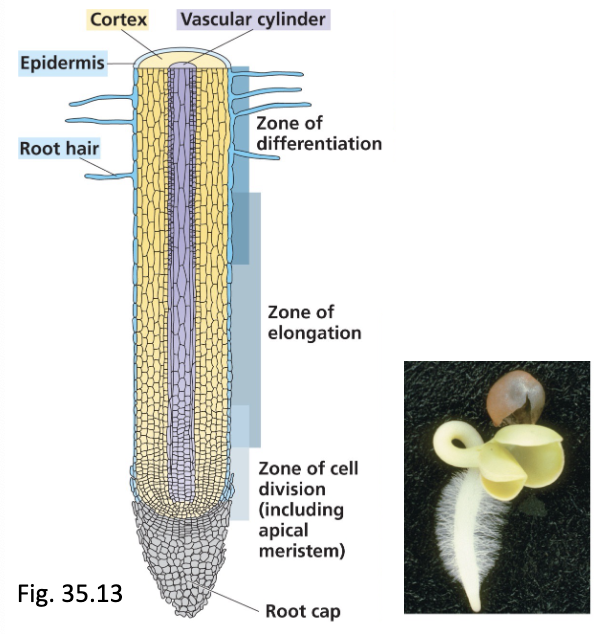
Roots (w/ root hair, zone of cell division downwards = apical meristem)
leaves
stems
Sporophyte = dominant phase of life cycle
Gametophyte = one type and bisexual
*tall: major advantage, because selection pressure to outgrow competition/surroundings to have access to light
*roots: major advantage because selection pressure to grow lots of roots to uptake limited water and nutrients in environment.
*leaves: major advantage with cuticle and stomata to avoid wasting water + optimize amount of light absorbed in a limited light area.
Seedless Vascular plants: describe the asexual and sexual reproduction life cycle of a typical fern
Asexual:
spread vegetatively via rhizomes spreading out adn then new shoots (fronds) grow out of the ground… bracken fern
quick horizontal spread, with little herbivory because they have toxins and are fire resistant
Sexual:
Short gametophyte stage, sporophyte phase is the dominant plant.
alternation of generations
spore lands somewhere new and grows into small gametophyte with rhizoid on the bottom. Gametophyte is bisexual (makes sperm and egg on the bottom)
Sperm fertilizes egg on gametophyte, which makes zygote. Zygote grows into sporophyte, attached to the gametophyte.
Each gametophyte makes one sporophyte that has many sporophylls (special leaves) which make many sporangia (things that make spores), which will give out many spores.
Outline the current significance to humans of the giant Seedless Vascular plant
forests of the Carboniferous period (~360 - 290 million years ago)
Formation of fossil fuels
ferns, lycophytes, horsetails made swamp forests. Dead plant material accumulated at the bottom of these anaerobic swamps —> no decomposition —> over millions of years, got buried under sediment and water —> peat —> heat and pressure turned it into coal.
Ancient seedless vascular plant forest growth reduced atmospheric CO2 (photosynthesis), cooling the climate and making oxygen.
As we dig up the fossil fuels and burn them, we release the carbon back into the atmosphere where it warms
Compare bryophytes vs. seedless vascular plants
Bryophytes:
non vascular, seedless, attach with rhizoids (no true roots)
short, live in the boundary layer
Usually exist as haploid gametophyte
asexual or sexual reproduction (alternation of generations)
asexual: clonal fragmentation
Sexual reproduction:
seperate male and female gametophytes
Male gametophyte makes sperm (in antheridium), which then (with water) is able to move and fertilize the egg (made in archegonium), produced in the female gametophyte.
This creates a zygote, which develops into a multicelled embryo (good because is protected and nourished by female gamete- dependant on the female gametophyte)
sporophyte grows off the female gametophyte at the top
ONE sporangium (thing that makes spores) per sporophyte
Gametophyte is dominant plant, sporophyte is secondary
Seedless vascular plants:
vascular, seedless, have true roots and rhizoids (in gametophyte)
More advanced position in embryophyte (land plant) phylogeny.
Have structural support (vascular) so can grow taller
Have true roots to anchor them in the ground and get nutrients.
usually exist as diploid sporophyte
asexual reproduction = rhizoids spread and new clones bud off at the nodes.
sexual reproduction: Advanced form of alternation of generation
bi-sexual gametophytes; male part (antheridium) makes sperm, female part (archegonium) makes egg. Sperm fertilizes egg on underside of gametophyte.
zygote is on gametophyte, large sporophyte grows off of gametophyte.
MANY sporangium on each sporophyll (specialized leaf), per sporophyte.
Sporophyte is dominant plant (2n), gametophyte is tiny.

