EXAM 1 332 quiz 1 set wk 1 and 2;;;; 332 wk 3 and 4 (attention);;;; 332 wk 5 and 6 STM brought up in wk 4 slightly EXAM 1
0.0(0)
 Studied by 2 people
 Call Kai
 Learn
Learn Practice Test
 Spaced Repetition
 Match
Match Flashcards
 Knowt Play
Card Sorting
1/187

Earn XP
Description and Tags
Last updated 1:38 PM on 11/18/22
Name | Mastery | Learn | Test | Matching | Spaced | Call with Kai |
|---|
No analytics yet
Send a link to your students to track their progress
188 Terms
1
New cards
Attention
Focus, selective, multitasking "times we lose focus."
2
New cards
Multiple levels and types of memory storage
(STM, LTM, semantic, episodic, procedural) and the interactions between the different levels to generate learning, reasoning, problem solving and intelligence.
3
New cards
Automatic Processing
(Information is quickly processed without awareness and does not require a demanding amount of attention)
4
New cards
Conscious processing
• (Information is deliberately processed with the use of awareness and requires a demanding amount of attention)
5
New cards
Information processing approach
Cognition and learning emerges from the coordinated operation of active mental processes within a multi-component memory system.
6
New cards
Bottom-up processes
processing of information that is driven by the available and immediate information from the environment.
7
New cards
Stroop Effect
Automatic process of reading interferes with controlled process of naming aloud the color of a word. // Successful performance on the Stroop task involves suppression of automatic processing of information // Variations on the Stroop task were developed investigate the suppression of automatic processing and the interference of other cognitive processes
8
New cards
Top-down processes
Processing of information is driven by background knowledge, pre-conceptions and expectations.
9
New cards
Global (Gestalt)
level of processing information // bigger picture
10
New cards
Local (Focused, Detailed)
level of processing information // smaller images
11
New cards
Parallel Processing of Information
multiple cognitive processes can co-occur at the same time. This helps promote cognitive efficiency and emerges through the activation of multiple brain regions or through extensive practice.
12
New cards
Functional level // level of analysis
What is the goal of the computations? (The function/purpose of the cognitive processes. Information inputs and behavioral outputs of the system)
13
New cards
Algorithm and computational level // level of analysis
What are the representations of storing inputs, and the steps and rules that transforms inputs into outputs? (The cognitive processes such as memory and attention)
14
New cards
Hardware level // level of analysis
How is the algorithm and computation implemented? (The parts of the brain that processes memory and attention)
15
New cards
Reaction time (RT) // methods in measuring information processing
The time elapsed when a stimulus is presented and the person's response to the stimulus // Typically measured in milliseconds // Faster reaction times represent the automatic processing or highly accessible information
16
New cards
Reading times // methods in measuring information processing
Time needed to read out passage or sentence
17
New cards
Verbal Protocols // methods in measuring information processing
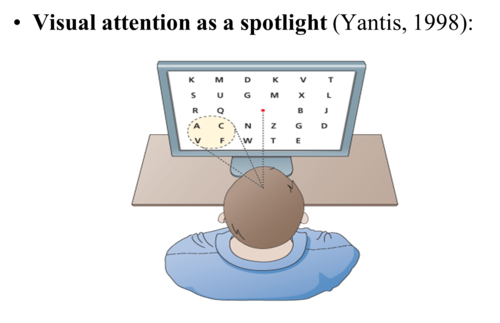
A description and analysis of a participant's verbalizations of their thinking processes during reasoning or problem solving. (This provides a window at the self-awareness about our own mental/thinking processes)
18
New cards
Preference method // methods in measuring information processing
involves the ability of a stimulus to be chosen by a participant given an available competitive stimulus // • (This is measured via a probability choice) COW
19
New cards
Eye tracking // Special Type of Preference method
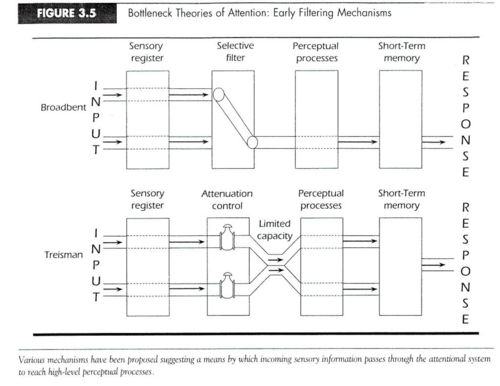
is the process of measuring either the point of gaze (where we are looking) or the motion of an eye relative to the head. An eye tracker is a device for measuring eye positions and eye movements.
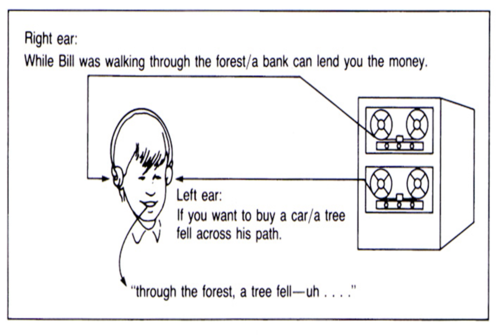
20
New cards
Accuracy Measures // Special Type of Preference method
The number and type of errors a participant makes. (ex. How many items a participant correctly recalled? Which items were omitted? What type of information is recalled?) // Often measured as a probability or percent correct.
21
New cards
Wisconsin Card Sort Task
• Participants are given a set of cards to sort (color, number and shape)
• Participants are given feedback if they are performing the correct sorting or not.
• Rules of sorting the cards are constantly changed throughout the task by the experimenter
• Participants are given feedback if they are performing the correct sorting or not.
• Rules of sorting the cards are constantly changed throughout the task by the experimenter
22
New cards
Priming
Stimulus initially presented // • Priming can activate automatic, unconscious cognitive processes.
23
New cards
Demonstration of Priming
You will be shown anagrams (letters that are jumbled that can be rearranged to form words). Before being shown an anagram, a word will appear (prime). When the anagram (target) does appear, shout out aloud the correct unscrambled word for the anagram. // WORD SCRAMBLE
24
New cards
Neurocognition
Interface between the cognitive processes and the regions of the brain responsible for a given cognitive process.
25
New cards
Localization of function // Principles of Brain Function
Specific areas of the brain perform specific functions. Makes processing of information more efficient
26
New cards
Contralaterality // Principles of Brain Function
The receptor and control centers for one side of the body are in the opposite hemisphere of the brain
27
New cards
Hemispheric Specialization // Principles of Brain Function
Different brain functions tend to rely more heavily on one hemisphere or the other. // (Ex. The left hemisphere controls most language functions and the right hemisphere handles most visuo-spatial processing for most right-handed people.)
28
New cards
Cognitive Neuropsychology // Different approaches to investigate Cognitive Processes in the Brain
researchers examine the behaviors and high level processes (attention, memory, language) of patients with unique brain damage in different contexts, or with different stimuli. (Case studies, Animal models of Cognition) // UNIQUE DAMAGE
29
New cards
Cognitive neuroscience // Different approaches to investigate Cognitive Processes in the Brain
researchers perform experimental manipulation of stimuli presented to human participants and then observe the parts of the brain that gain a boost in physiological activity. (Use of advanced brain imaging methods) // OBSERVE PARTS OF BRAIN THAT GAIN BOOST
30
New cards
Subtraction method // mapping
baseline activity for a specific task is recorded (control stimulus), neural activity for an experimental task is recorded (experimental stimulus). Subtract the brain activity during baseline task from the experimental task. // During a cognitive activity, there are parts of the brain that are working harder in comparison to other parts of the brain. Therefore, this region will use up more energy (glucose), oxygen, and generate more activity (more electrical activity) in relation to other brain parts.
31
New cards
Electroencephalogram (EEG) // Methods in mapping the living brain
Use electrodes placed on the scalp to measure brain electrical activities. Used to diagnose epilepsy // (These give an excellent description of the timing of cognitive processes in the brain, but it does not describe where the cognitive processes occur.)
32
New cards
Event-related potential (ERP) // Methods in mapping the living brain
an averaged measurement of EEG's that is directly the result of a thought or perception experienced by a participant. This highlights the specific timing involved in a cognitive process, but it can only approximate the location of the brain activity // (These give an excellent description of the timing of cognitive processes in the brain, but it does not describe where the cognitive processes occur.)
33
New cards
Positron-emission tomography (PET) scan // Methods in mapping the living brain
Metabolism of glucose (via mild radioactive isotope marker (2 deoxyglucose) and a special scanner) // (Both give excellent descriptions where in the brain cognitive processes occur, but it does not describe the timing of the cognitive processes.)
34
New cards
Functional magnetic resonance imaging (fMRI) // Methods in mapping the living brain
Scanner measures the oxygenated bloodflow in the areas of the brain // (Both give excellent descriptions where in the brain cognitive processes occur, but it does not describe the timing of the cognitive processes.)
35
New cards
Transcranial magnetic stimulation (TMS) // Methods in mapping the living brain
using a powerful magnetic field to inactivate patches of neurons
36
New cards
Occipital lobes // Cognitive and Motor functions of the Cerebral Cortex
Processing of visual information
37
New cards
Parietal lobes // Cognitive and Motor functions of the Cerebral Cortex
• Integrates information from the world. It contains the ("somatosensory cortex that receives information about pain, touch, pressure and temperature from the body. It also processes spatial representation // like hot air blown over your face when you use a hair-dryer
38
New cards
Temporal lobes // Cognitive and Motor functions of the Cerebral Cortex
Processing of auditory (hearing) information, memory, perception and emotion
39
New cards
Frontal lobes // Cognitive and Motor functions of the Cerebral Cortex
Contains the ("motor cortex and ("premotor cortex that initiate voluntary muscle movement. Also involved in short-term memory and speech production
40
New cards
Prefrontal cortex (of the Frontal lobe) // Cognitive and Motor functions of the Cerebral Cortex
this serves in advanced planning, self-control, short-term-working memory, impulse control and other higher order cognitive functions. It coordinates the activity of various parts of the brain
41
New cards
Dorsolateral Prefrontal Cortex // Cognitive and Motor functions of the Cerebral Cortex
// Cognitive and Motor functions of the Cerebral Cortex 1
42
New cards
Medial Prefrontal cortex (Anterior Cingulate cortex) // Cognitive and Motor functions of the Cerebral Cortex
// Cognitive and Motor functions of the Cerebral Cortex 2
43
New cards
Ventral Prefrontal cortex (Orbital Prefrontal Cortex) // Cognitive and Motor functions of the Cerebral Cortex
// Cognitive and Motor functions of the Cerebral Cortex 3
44
New cards
Computer simulations
• Previously, computer simulations have been developed to predict weather patterns, geological patterns, stock market trends etc.
• Computers can be programmed to represent the architecture and theorized processing that is involved in human memory and cognition.
• The most common form of computer simulations comes in the form of parallel distributed processing models.
• Computers can be programmed to represent the architecture and theorized processing that is involved in human memory and cognition.
• The most common form of computer simulations comes in the form of parallel distributed processing models.
45
New cards
Sensation
detecting physical energies emitted by the environment. The external physical energies are detected by receptors in the sense organs
46
New cards
Transduction
The sense organs transform physical energies into nerve impulses then to brain
47
New cards
Perception
The processes allowing the neurons of the brain to interpret and organize the sensory neural impulses about the world
48
New cards
Visual system
• Between 50-60% of the brain is devoted to processing visual information
• The visual system starts with the eyes detecting light energy
• The visual system starts with the eyes detecting light energy
49
New cards
Retina
neural layer in the back of the eye that have the receptors for vision (Rods and Cones).
50
New cards
Artificial Retina Implant
Best was blurry image
51
New cards
Feature detectors // How are visual features represented in the brain
neurons in the visual cortex that are sensitive to specific features of the environment
52
New cards
Hubel & Weisel // How are visual features represented in the brain
used single-unit recordings to study neurons on the visual cortex. They discovered simple cells that are activated by specific line orientations, but inhibited by other line orientations. (lines and edges) (Test subject: Cat) // cortical cells provide a range of activation)
53
New cards
Pattern recognition
• How does the visual system recognize alphanumeric patterns (letters and numbers) with considerable variations in the stimuli? What allows the flexibility of the perceptual system?
54
New cards
Template theories
there are miniature copy (template) is stored in Long Term Memory (LTM) corresponding to each of the visual patterns we experienced //
• This is not effective for complex categories of objects or irregular stimuli (e.x. cars, dogs etc.)
• Uneconomical use of cognitive resources (too many templates to store)
• This is not effective for complex categories of objects or irregular stimuli (e.x. cars, dogs etc.)
• Uneconomical use of cognitive resources (too many templates to store)
55
New cards
Evaluation of Template theories
• This is not effective for complex categories of objects or irregular stimuli (e.x. cars, dogs etc.)
• Uneconomical use of cognitive resources (too many templates to store)
• Uneconomical use of cognitive resources (too many templates to store)
56
New cards
Feature Theories
A pattern consists of a set of specific features or attributes. First, features are extracted from the visual stimulus. Then, the set of features are combined and compared against information stored in memory. //
• This utilizes parallel distributed processing (McClelland & Rumelhart, 1981).
• This assumes that detailed analyses precedes global analysis. These theories are more efficient in using cognitive resources.
• This utilizes parallel distributed processing (McClelland & Rumelhart, 1981).
• This assumes that detailed analyses precedes global analysis. These theories are more efficient in using cognitive resources.
57
New cards
Evaluation of Feature theory
• In reality, global processing often precedes more detailed processing (Gestalt).
• Navon (1977) found that performance speed with small letters is slowed down when there is a mismatch with a large letter. In contrast, decision speed is not affected for the large letter regardless of the small letters. // -was the large letter an H or S?-were the small letters H or S
• Navon (1977) found that performance speed with small letters is slowed down when there is a mismatch with a large letter. In contrast, decision speed is not affected for the large letter regardless of the small letters. // -was the large letter an H or S?-were the small letters H or S
58
New cards
Pattern recognition and integration by the visual system based on the activation of simple hierarchical model of visual cortical processing
Processing in the visual association cortex: Zeki (1992, 1993) identified functional specialization of the brain between the different aspects of visual features.
59
New cards
V1
Primary visual cortex
60
New cards
V1 and V2
neurons sensitive to color and form
61
New cards
V3 and V3A
neurons sensitive to shapes and objects in motion (and color)
62
New cards
V4
neurons for line orientation (and color)
63
New cards
V5 (MT)
neurons for visual motion (but not color)
64
New cards
Fusiform gyrus
found in the temporal lobes: highly activated during face recognition (Kanwisher, McDermott, Chun, 1997 // (in pink); Furthermore, it is highly activated during the object recognition by experts (ex. cars, birds) (Grill-Spector, Sayres , Ress, 2006)
65
New cards
Prosopagnosia
is an inability in recognizing faces or facial features, while the ability to recognize other objects may be relatively intact // This is often linked to damage or poor processing of information in the fusiform gyrus
66
New cards
Binocular cues // Visual Depth and Distance cues
depth cues that require both eyes
67
New cards
Retinal disparity // Visual Depth and Distance cues
the slight difference between the
information seen by the two eyes on the same object
information seen by the two eyes on the same object
68
New cards
Monocular cues // Visual Depth and Distance cues
depth cues that requires only one eye
69
New cards
Linear perspective // Visual Depth and Distance cues
All lines in an image meet a
specific point in space
specific point in space
70
New cards
Size constancy // Visual Depth and Distance cues
People know that objects stay the same size as they move towards (or away) from a person even though direct visual information indicates a change in size
71
New cards
Learned Perception
• Kittens raised in an environment deprived of horizontal lines, have difficulty navigating in a world with horizontal features (Daw & Wyatt, 1976)
• Infants as old a 6 months can discriminate sounds from many different languages, but infants after 10-12 months of age can only discriminate sounds from their native language (Kuhl, 1993).
• Turnbull (1961) found that BaMbuti Pygmies who grew up in forests have difficulty with size constancy (it is hard for them to realize that large objects can appear small from afar)
• Infants as old a 6 months can discriminate sounds from many different languages, but infants after 10-12 months of age can only discriminate sounds from their native language (Kuhl, 1993).
• Turnbull (1961) found that BaMbuti Pygmies who grew up in forests have difficulty with size constancy (it is hard for them to realize that large objects can appear small from afar)
72
New cards
Constructivist perception
emphasized the top-down processing involved in perception // (Bruner, 1957, Neisser, 1967, Gregory, 1972)
• ++++++ Theoretical assumptions include: +++++++
• (1)Perception is an active and constructive process
• (2)Perception is a product between the interaction of information from the environment and background knowledge, emotion (Schafer & Murphy, 1943) or expectations.
• (3) An internal mental representation
• (4) Because perception interacts with expectations and background knowledge, it is sensitive to errors (Visual illusions).
• ++++++ Theoretical assumptions include: +++++++
• (1)Perception is an active and constructive process
• (2)Perception is a product between the interaction of information from the environment and background knowledge, emotion (Schafer & Murphy, 1943) or expectations.
• (3) An internal mental representation
• (4) Because perception interacts with expectations and background knowledge, it is sensitive to errors (Visual illusions).
73
New cards
Evaluation of the constructivist approach to perception
• This approach predicts that perception will often cause errors, but perception is typically accurate.
• Most experiments testing the constructivist approach to perception involves artificial stimuli (lacks ecological validity)
• The hypotheses generated may vary from person to person (Subjective).
• Most experiments testing the constructivist approach to perception involves artificial stimuli (lacks ecological validity)
• The hypotheses generated may vary from person to person (Subjective).
74
New cards
Direct perception
proposed that there is a wealth of information from the sensory input when a person moves through their environment (bottom-up processing) // Gibson (1950)
• ++++++ Theoretical assumptions are: ++++++
• (1) The pattern that light reaching the eye is an optic array containing the current visual information from the environment.
• (2) Optic array provides unambiguous information from the environment (unchanging)
• (3) Perception involves detecting the information that is present in the optic array via resonance.
(4) Internal mental representation is not necessary
// • The higher order characteristics of the visual array (invariants) remain unaltered when they move around the environment (same over different viewing angles)
• The environment provides cues that guide processing of information in the world.
• ++++++ Theoretical assumptions are: ++++++
• (1) The pattern that light reaching the eye is an optic array containing the current visual information from the environment.
• (2) Optic array provides unambiguous information from the environment (unchanging)
• (3) Perception involves detecting the information that is present in the optic array via resonance.
(4) Internal mental representation is not necessary
// • The higher order characteristics of the visual array (invariants) remain unaltered when they move around the environment (same over different viewing angles)
• The environment provides cues that guide processing of information in the world.
75
New cards
Affordance
a quality of an object, or an environment, which allows an individual to perform a specified action (Gibson 1977, Norman, 1988). // THINK DOORS
76
New cards
False affordance
bad design
77
New cards
Evaluation of Direct perception
• The theory does not distinguish when a perception of an experience compared to when a perception itself can guide behavior.
• The argument that perception does not need internal representations is false.
// Kosslyn (1994) showed that visual imagery activates similar neurons compared to a person actually looking at a visual image.
• This does not account for the extension of imagination upon the physical features of objects (ex. symbolic play by children)
• The argument that perception does not need internal representations is false.
// Kosslyn (1994) showed that visual imagery activates similar neurons compared to a person actually looking at a visual image.
• This does not account for the extension of imagination upon the physical features of objects (ex. symbolic play by children)
78
New cards
Theoretical integration between constructivist and direct perception // COMPARING BOTH OF THEM AND APPLYING BOTH
• Visual perception is driven by bottom-up processes when the viewing conditions are good
• Top-down processes are activated when there is interference in the environment (ex. Brief presentation times or lack of stimulus clarity)
• Some constructivist theorists attach significant impact of stored knowledge and expectations that influence perception, but others argued that stored knowledge and expectations plays a minor role in visual perception.
• Top-down processes are activated when there is interference in the environment (ex. Brief presentation times or lack of stimulus clarity)
• Some constructivist theorists attach significant impact of stored knowledge and expectations that influence perception, but others argued that stored knowledge and expectations plays a minor role in visual perception.
79
New cards
Organ of corti
• contains the receptors for sound (Hair cells (cilia) and Basilar membrane)
80
New cards
Cochlear Implant
Cochlear Implant
81
New cards
Representation of auditory features in the brain
• The organization of sounds is based on a specific location on the auditory cortex.
• The lower frequency sounds are stored towards the exterior region of the auditory cortex.
An increase in musical experience (via early musical training) is associated with an increased area of activation in the auditory cortex where discrimination of sounds are processed (Schneider, Scherg, Dosch, Specht, Gutschalk & Rupp, 2002) .
• The lower frequency sounds are stored towards the exterior region of the auditory cortex.
An increase in musical experience (via early musical training) is associated with an increased area of activation in the auditory cortex where discrimination of sounds are processed (Schneider, Scherg, Dosch, Specht, Gutschalk & Rupp, 2002) .
82
New cards
Signal-detection theory
an observer's response in a detection task of a sensory process, depends on the strength of the stimulus, and a decision process, influenced by the observer's response bias //
• Hit, Correct rejection, Miss, False alarm
• Ideally, we want people and machines to have High hit and Correct rejection rates, along with Low Miss and False alarm rates. // THINK BREAST CANCER VID
• Hit, Correct rejection, Miss, False alarm
• Ideally, we want people and machines to have High hit and Correct rejection rates, along with Low Miss and False alarm rates. // THINK BREAST CANCER VID
83
New cards
Applications of the signal detection theory
• Accuracy of radiologists detecting tumors on x-ray film.
• People trained to detect lies
• Second opinions and converging evidence is important to overcome the limits of signal detection.
• Technology can be developed in order to overcome the limitations of the signal detection performance of an individual.
• People trained to detect lies
• Second opinions and converging evidence is important to overcome the limits of signal detection.
• Technology can be developed in order to overcome the limitations of the signal detection performance of an individual.
84
New cards
Synesthesia
a neurologically based phenomenon in which stimulation of one sensory or cognitive pathway leads to automatic, involuntary experiences in a second sensory or cognitive pathway. // • Synesthesia is also sometimes reported by individuals under the influence of psychedelic drugs, after a stroke, during a temporal lobe epilepsy seizure, or as a consequence of blindness or deafness.
• Researchers have found that the visual cortex is recruited for processing touch sensation (i.e. Braille reading) in early blind people (Sadato, Pascual-Leone, Grafman, Ibañez, Deiber, Dold, Hallett, 1996). // THINK DARE DEVIL MARVEL
• Researchers have found that the visual cortex is recruited for processing touch sensation (i.e. Braille reading) in early blind people (Sadato, Pascual-Leone, Grafman, Ibañez, Deiber, Dold, Hallett, 1996). // THINK DARE DEVIL MARVEL
85
New cards
// Multiple Meanings of Attention
Alertness, awareness or arousal
86
New cards
// Multiple Meanings of Attention
Orientating reflex or response in the environment
87
New cards
// Multiple Meanings of Attention
Focused spotlight attention and search in the environment
88
New cards
// Multiple Meanings of Attention
Selective attention of specific information from the environment that is accepted into awareness and block out other information from awareness.
89
New cards
// Multiple Meanings of Attention
Attention has a Limited Capacity.
90
New cards
// Multiple Meanings of Attention
Multitasking of attention.
91
New cards
Focused (Selective) attention
the ability of attention to select certain inputs in the environment and ignore other inputs. (Provides information how attention selects input from the environment and the fate of unattended stimuli) // (Ex. Paying attention to the conversation with the person in front of you despite auditory interference from other people).
92
New cards
Divided attention
the ability of attention to process information from multiple inputs. Multitasking (Provides information on the processing limitations of attention)
// (Ex. Talking on the cellphone while driving)
// (Ex. Talking on the cellphone while driving)
93
New cards
Shadowing Task // Methods of testing Focused Auditory Attention
Different auditory messages are presented to each ear and a listener had to listen to one message and ignore the other. (Cherry, 1953)
// (People can only determine the gender of speaker and loudness of the message, but not notice reversed speech, a foreign language, or content of unattended message)
// (People can only determine the gender of speaker and loudness of the message, but not notice reversed speech, a foreign language, or content of unattended message)
94
New cards
Dichotic Listening // Methods of testing Focused Auditory Attention
Different auditory messages are presented to each ear and a listener is later asked to repeat back information from both sources. (Broadbent, 1958).
// (Organization of information is based on the ear that received specific inputs (left ear 496 and right ear 852).)
// (Organization of information is based on the ear that received specific inputs (left ear 496 and right ear 852).)
95
New cards
Donald Broadbent's Filter theory of Attention (1958) // Theories of Focused Attention (Auditory)
There is a cognitive filter that helps prevent the overload of the limited capacity short-term/working memory
3 stages include:
•(1) Two inputs or messages are received in a sensory buffer that briefly stores information.
•(2) One of the inputs is allowed through a cognitive filter on basis of physical characteristics.
•(3) The selected input is sent to Short-term/Working memory for further processing.
3 stages include:
•(1) Two inputs or messages are received in a sensory buffer that briefly stores information.
•(2) One of the inputs is allowed through a cognitive filter on basis of physical characteristics.
•(3) The selected input is sent to Short-term/Working memory for further processing.
96
New cards
Evaluation of the Filter theory
•The filter theory was not flexible to account the variability of processing that occurs with unattended stimuli.
•Underwood (1974) found that experts can identify more details in unattended message than non-experts.
-Triesman (1964) found that participants can recognize their own name in the unattended message
// even when supposed to ignore it
•Underwood (1974) found that experts can identify more details in unattended message than non-experts.
-Triesman (1964) found that participants can recognize their own name in the unattended message
// even when supposed to ignore it
97
New cards
Anne Treisman's Attenuation Model of Attention (1964)
the processing of unattended information is attenuated (suppressed). // This model allows for the flexibility of the cognitive filters.
•4 stages include:
•Two inputs or messages are received in a sensory buffer that briefly stores information.
•(2) Cognitive filter checks for physical properties of the "message" (loudness, pitch). Based on these properties, the information is either "weakened" or passed to the next cognitive filter. (Inhibition)
•3) Cognitive filter checks for meaning (relevant words). Based on the meaning, the information is either "weakened" or sent to short-term working memory (Inhibition)
•(4) The selected input is sent to short-term/working memory for further processing.
•4 stages include:
•Two inputs or messages are received in a sensory buffer that briefly stores information.
•(2) Cognitive filter checks for physical properties of the "message" (loudness, pitch). Based on these properties, the information is either "weakened" or passed to the next cognitive filter. (Inhibition)
•3) Cognitive filter checks for meaning (relevant words). Based on the meaning, the information is either "weakened" or sent to short-term working memory (Inhibition)
•(4) The selected input is sent to short-term/working memory for further processing.
98
New cards
Figure 3.5
*
99
New cards
Evidence for attenuation model: Triesman (1960)
*
100
New cards
Focused attention (visual)
Visual attention as a spotlight (Yantis, 1998):
 Note
Note  Flashcards (57)