ESS W4 L1 - atmospheric circulation
 Call Kai
 Learn
Learn Practice Test
 Spaced Repetition
 Match
Match Flashcards
 Knowt Play
1/33

Earn XP
Description and Tags
atmosphere and oceans - atmospheric circulation
Name | Mastery | Learn | Test | Matching | Spaced | Call with Kai |
|---|
No analytics yet
Send a link to your students to track their progress
34 Terms
Why is the atmosphere important – key functions in the earth system:
Supports life on Earth by keeping it warm via the Greenhouse effect and supply the necessary chemicals for life
Protects Earth's Biosphere from harmful ultraviolet (UV) radiation coming from the Sun
Cycles heat, water, and necessary chemicals through the climate system
Without the atmo, temperatures would be below freezing everywhere on earth’s surface
The heat absorbed and trapped by the atmo keeps the average surface temp at 15C
Structure of the atmosphere:
exosphere
thermosphere
mesosphere
stratosphere
troposphere
exosphere
Exo = outside
Outermost layer of the earth’s atmosphere
Higher altitude satellites
thermosphere
Thermo = heat
This layer has extremely high temperatures.
The thickest layer with only the lightest gas such as oxygen, helium and hydrogen. This is where the satellites and aurora (northern and southern lights) are.
Aurora are natural light caused by the collision of charged particles from the magnetosphere into atoms and molecules in the upper atmosphere.
mesosphere
Meso = middle
Most meteors broke off in this layer. Noctilucent clouds are the highest clouds in Earth’s mesosphere
stratosphere
Stratos = layer
This layer has it own set of layers.
This where the OZONE LAYER absorbs the armful ultra-violet radiation from the sun (UV) and converts it to heat.
troposphere
Tropos = change
This layer gets its name from the WEATHER that is constantly changing.
The lowest part of the atmosphere by Earth's surface, from the ground to about 12 km altitude a the equator and 6 km at the poles..
This is where almost all the weather takes place, with most of the water vapor that forms cloud and rain, the air we breathe . This is where the greenhouse effect maintains temperature and where there are living things.
Temperature gradient:
The property that changes most strikingly with altitude is air temperature. Unlike the change in pressure and density, which decrease with altitude, changes in air temperature are not regular.
A change in temperature with distance is called a temperature gradient.
layers
The atmosphere is divided into layers based on how the temperature in that layer changes with altitude, the layer’s temperature gradient (Figure) The temperature gradient of each layer is different.
in some layers, temperature increases with altitude and in others it decreases. The temperature gradient in each layer is determined by the heat source of the layer (See opening image).
Structure of the atmosphere – how it happens:
The atmosphere is comprised of layers based on temperature
Structure of the atmosphere – how it happens: thermosphere
High temperature increases with altitude, with little or no gases.
Structure of the atmosphere – how it happens: mesosphere
The coldest where we found ice cloud, less air particles, less pressure.
The temperature decrease with altitude.
Structure of the atmosphere – how it happens: stratosphere
The ozone (O3) absorbs the ultraviolet radiation (UV) from the solar radiation and converts it into heat.
More radiation is absorbed at higher altitude so the temperature increases with altitude.
Structure of the atmosphere – how it happens: troposphere
The incoming radiation from the sun passing through the atmosphere is absorbed and warms the earth surface.
The heat reflected back from the ground to the tropospheric air by conduction and convection process.
The temperature decrease with altitude.
The densest layer thanks to gravity.
There is less air as we go higher so air pressure decrease
The changing earth:
Earth is a complex system of interlocking parts.
Today, we will look at the basis of the
Circulation in the troposphere.
The troposphere connects the different components of the earth system together – and more. We need to understand that transport.
Credit ESA
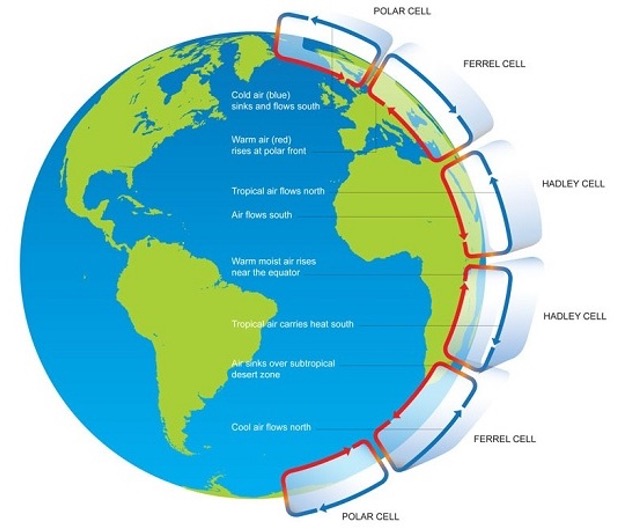
Main features of global atmospheric circulation: warm air rises
Gas molecules are able to move freely, and if they are uncontained, as they are in the atmosphere, they can take up more or less space.
When gas molecules are cool, they are sluggish and do not take up as much space. With the same number of molecules in less space, both air density and air pressure are higher.
When gas molecules are warm, they move vigorously and take up more space. Air density and air pressure are lower.
Warmer, lighter air is more buoyant than the cooler air above it, so it rises. The cooler air then sinks down, because it is denser than the air beneath it. This is convection
Coriolis force makes air to curve into storms. When there is a low water pressure, the cloud will go from the high water pressure to the low water pressure in a b-line, but the cloud will travel and float above the planet which as decreasing velocity of as the cloud goes north. The equator is going at 1600miles/hour. Because as the circle around the planet are smaller as we go north but, the travel is done in the same amount of time as the equator do, so the velocity is smaller on earth as we go north..
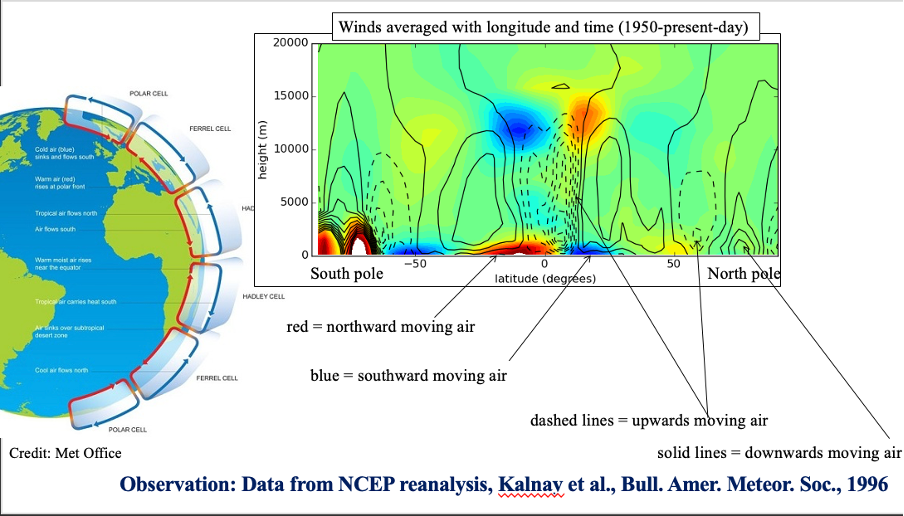
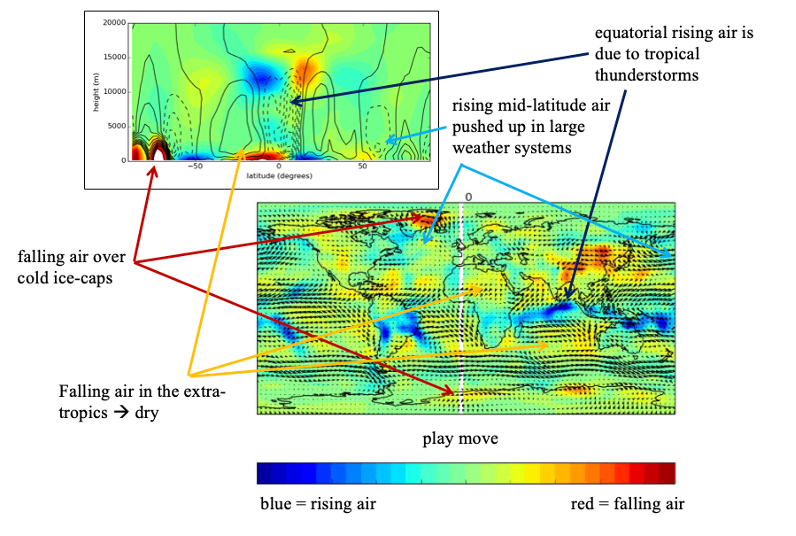
Summary of what we can see:
Rising air associated with high-latitude storms
Rising air associated with tropical thunderstorms
Falling air creating high pressure and dry conditions at around 30°
Falling air over the poles, cold and dry
At high altitude a much simpler picture – actually you can’t make out the return flow at all, the circulation is completely dominated by the east-west jet streams.
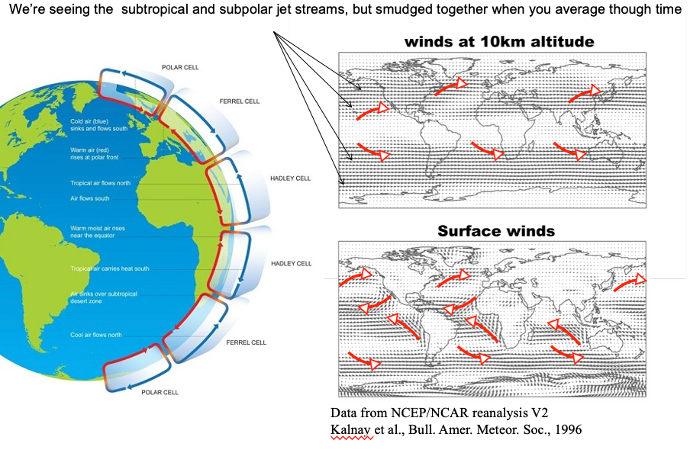
Why do we not clearly see air moving north or south at high latitudes like we would expect – this is overwhelmed by this west-to-east flow of air.
At 35N, the air is trying to go North, but ending up going East, and trying to go South and ending up going East… any ideas about what is causing this?
At high altitude a much simpler picture – actually you can’t make out the N/S flow at all, the circulation is completely dominated by the east-west jet streams.
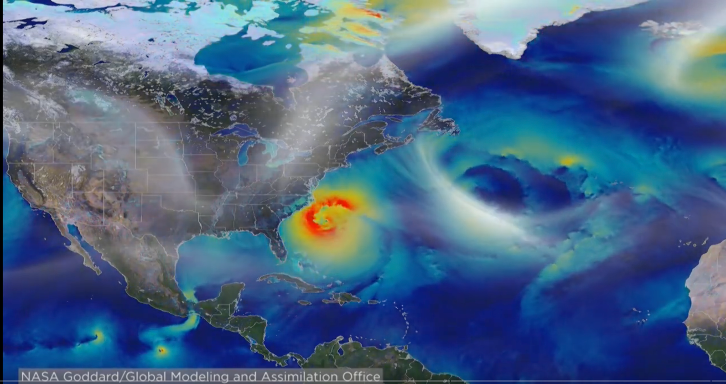
coriolis hurricanes
Hurricanes (low pressure) are counter clockwise in the norther hemisphere
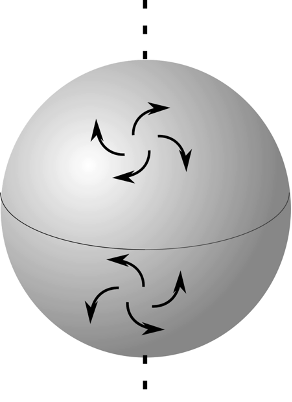
Coriolis – conceptual overview:
Diversion to the right in the northern hemisphere
Diversion to the left in the southern hemisphere
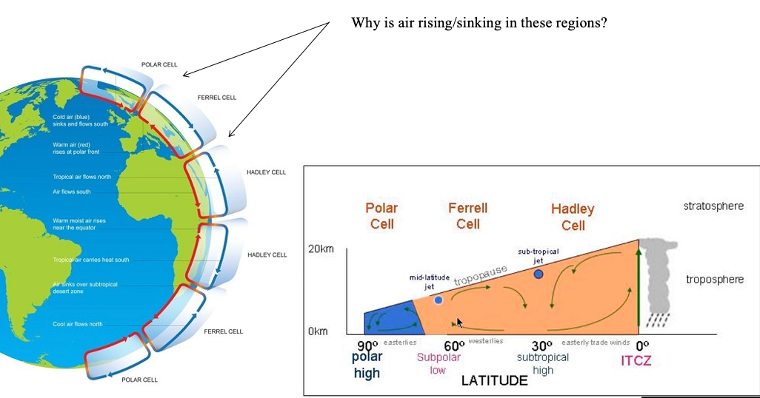
why does air rise/ sink in certain regions:
The movement of air across the planet occurs in a specific pattern.
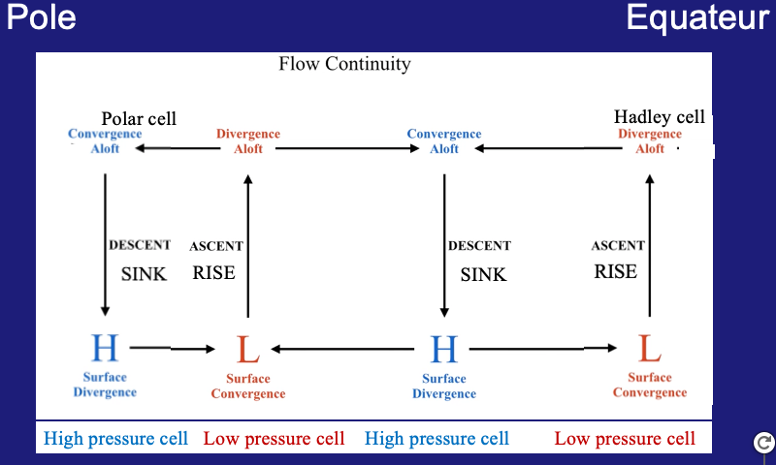
The whole system is driven by the equator, which is the hottest part of the Earth. Air rises at the equator, leading to low pressure and rainfall.
When the air reaches the edge of the atmosphere, it cannot go any further and so it travels to the north and south.
The air becomes colder and denser, and falls, creating high pressure and dry conditions at around 30° north and south of the equator. Large cells of air are created in this way.
Air rises again at around 60° north and south and descends again around 90° north and south
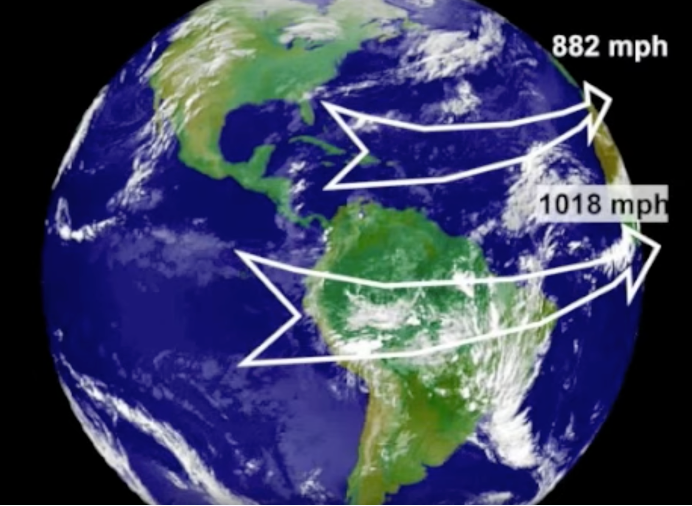
Earth rotational velocity:
The Earth rotates to the east (the direction of the sunrise!)
The rotational velocity decreases when we go North. Why?
When we go north, velocity is slower as there is less to travel in 24 hours (one revolution per day)
When you are moving to the north you are getting closer and closer to the earth’s axis of rotation
Basics of angular momentum:
When an object changes latitude, it changes the distance to the axis of rotation, and this is where we need to explore angular momentum.
Rotating objects have a version of momentum, it is called angular momentum, and it indicates how difficult it will be to stop the object from rotating.
Angular momentum is calculated by multiplying the momentum by the radius of rotation r.
Since Earth is rotating, water and gas on or above its surface have angular momentum. When a fluid moves from one latitude, it changes the distance from the axis of rotation, so r, so the rate of rotation changes to maintain constant angular momentum.
Angular velocity (omega) is the rate at which an object rotates or revolves around an axis or point. It's measured in radians per second (rad/s), where one radian is the angle made at the center of a circle by an arc whose length is equal to the radius of the circle. Earth completes one rotation every 24 hours, giving us a way to calculate its angular velocity as omega=(2/tri)T , with T being the period of rotation.
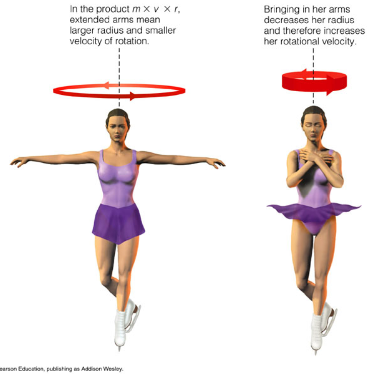
- Conservation of Angular Momentum
An essential principle in this field is the conservation of angular momentum, which states that if no external torque acts on a system, the total angular momentum of the system remains constant.
Example: As the radius of the skater decreases, they spin faster, and as their radius increases, they rotate slower.
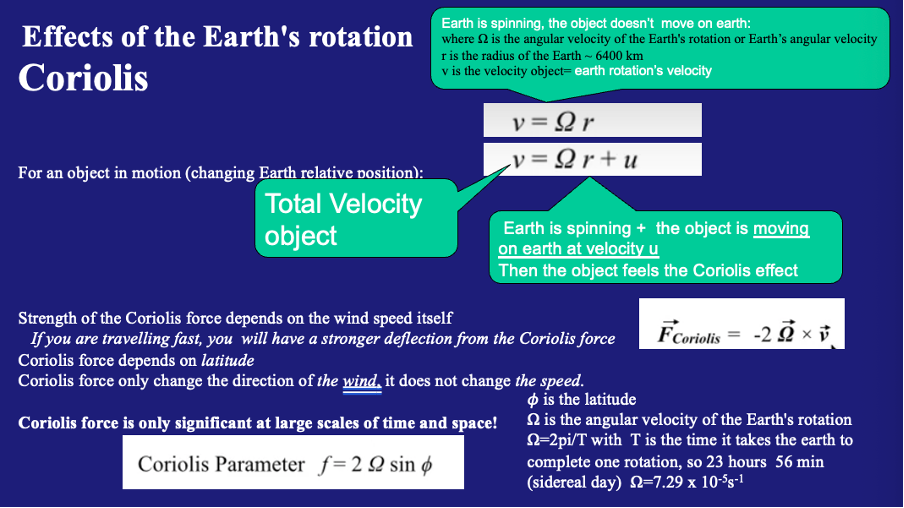
Effects of the earth’s rotation – Coriolis:
The amount of deflection the air makes is directly related to both the speed at which the air is moving and its latitude. Therefore, slowly blowing winds will be deflected only a small amount, while stronger winds will be deflected more. Likewise, winds blowing closer to the poles will be deflected more than winds at the same speed closer to the equator. The Coriolis force is zero right at the equator.
Centrifugal force
When a car turns left, the passengers experience an outward push due to the centrifugal force.
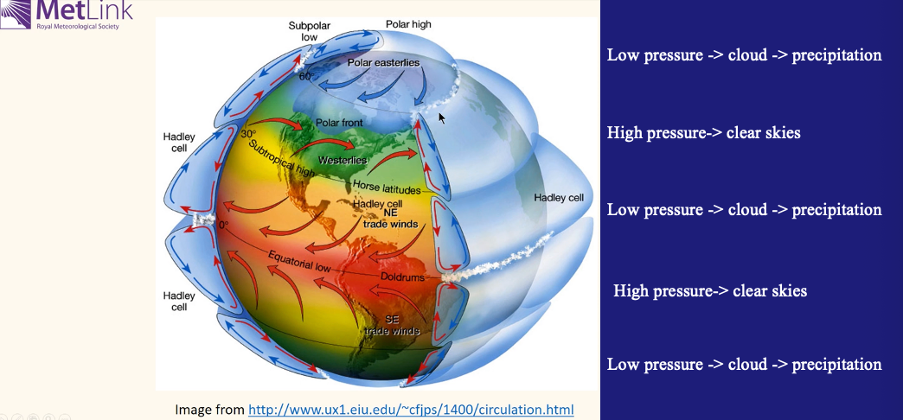
Coriolis:
The Coriolis Effect causes objects to deflect to the right of their indented path in the northern hemisphere and to the left in the southern hemisphere.
This is why low pressure systems like hurricanes and extra-tropical cyclones circulate CCW in the NH
The strength of the deflection is proportionate to the speed.
The Coriolis effect is zero at the equator and increases as you go towards the poles
Summary:
The two main ‘ingredients’ that control the general circulation of the atmosphere:
Differential heating (i.e. warming of the equator, cooling of the pole)
Earth’s rotation
this is simplifying the story slightly, but essentially:
air rises at the equator
by the time that air has moved to around 30 degrees North (or South) it is traveling West-East
it loses its heat to space, cools and sinks

