[PO2] Accommodation Anomalies
 Call Kai
 Learn
Learn Practice Test
 Spaced Repetition
 Match
Match Flashcards
 Knowt Play
1/38

There's no tags or description
Looks like no tags are added yet.
Name | Mastery | Learn | Test | Matching | Spaced | Call with Kai |
|---|
No analytics yet
Send a link to your students to track their progress
39 Terms
Accommodation
⭐ The human eye possesses a remarkable ability to adjust its optical power to focus on objects at varying distances
ciliary muscles
⭐ The function of accommodation is primarily controlled by the (BLANK), which alter the shape of the crystalline lens to maintain clear vision.
Grosvenor
⭐ defines accommodation as 'the process by which the crystalline lens varies its focal length in response to changes in the vergence of incident light.’
Glasser
⭐ accommodation as a 'dynamic, optical change in the dioptric power of the eye allowing the point of focus of the eye to be changed from distance to near objects'.
for near vision
⭐ the ciliary muscles contracts and the central lens thickness increases to increase its power
⭐ when your eye muscles squeeze, the lens gets thicker and stronger so you can see close things clearly.
Reflex
Voluntary
Tonic
Convergent
Proximal
TYPES OF ACCOMMODATION
Reflex Accommodation
• Definition: An automatic, involuntary response to maintain clear vision when the viewing distance changes.
• Mechanism: When an object moves closer or farther, the retina detects defocus, triggering an automatic adjustment in lens curvature to maintain clarity.
• Example: When shifting gaze from a book to a distant television, the lens changes shape instantly without conscious effort.
• Clinical Relevance: Defects in (BLANK) can lead to blurred vision and difficulty in focusing quickly between distances.
Voluntary Accommodation
•Definition: A conscious effort to change focus from one distance to another.
• Mechanism: Requires intentional effort to adjust focus.
• Example: Trying to read tiny text on a medicine bottle by intentionally focusing on it.
• Clinical Relevance: Some individuals may struggle with (BLANK) particularly in conditions like accommodative insufficiency.
Tonic Accommodation
• Definition: The resting state of accommodation when no visual stimulus is present.
• Mechanism: When there is no object to focus on (e.g., in darkness or with closed eyes), the ciliary muscles maintain a certain level of contraction, keeping the lens in a slightly accommodated state.
• Example: The eyes remain slightly focused even when in total darkness.
• Clinical Relevance: The level of tonic accommodation varies between individuals and can influence baseline refractive errors.
Convergent Accommodation
• Definition: Accommodation that occurs in response to the inward movement of both eyes when focusing on a near object.
• Mechanism: When looking at a nearby object, the extraocular muscles trigger both (blank) (eyes turning inward) and accommodation (lens thickening for near focus).
• Example: When reading a book, the eyes naturally move inward, and the lens adjusts accordingly.
• Clinical Relevance: This type of accommodation is linked to the AC/A ratio (Accommodative Convergence to Accommodation), which describes how much the eyes converge per unit of accommodation. A high AC/A ratio can lead to excessive convergence (esotropia), while a low AC/A ratio may cause difficulty in sustaining near focus.
Proximal Accommodation
• Definition: Accommodation triggered by the awareness or perception of a nearby object, even before actual focus adjustment occurs.
• Mechanism: The brain anticipates the need for accommodation based on prior knowledge and spatial awareness.
• Example: If you know a book is close, your eyes begin adjusting before actually looking at the text.
• Clinical Relevance: Problems with (BLANK) can cause delays in focusing and visual discomfort.
Reflex Accommodation

Voluntary Accommodation

Tonic Accommodation

Convergent Accommodation

Proximal Accommodation

PRESBYOPIA
⭐ an age-related decline in accommodation, making it difficult to focus on near objects.
⭐ typically begins to manifest around the age of 40 and progresses over time.
⭐ this occurs due to the loss of elasticity in the lens and the weakening of the ciliary muscles, reducing the eye’s ability to adjust focus for near vision.
⭐ individuals with (BLANK) often experience blurred near vision, eye strain, headaches, and difficulty reading small print.
⭐ as the global population ages, awareness of (BLANK) and its impact on daily life is essential for maintaining visual comfort and quality of life.
PHYSIOLOGY BEHIND PRESBYOPIA
1) CHANGE IN CRYSTALLINE LENS
2) WEAKENING OF THE CILIARY MUSCLES
3) INCREASED RIGIDITY OF ZONULAR FIBERS
4) DECREASED AMPLITUDE OF ACCOMMODATION
Accommodative Insufficiency
Accommodative Infacility / Inertia
Ill Sustained Accommodation
Paralysis of Accommodation
Spasm of Accommodation
ANOMALIES OF ACCOMMODATION
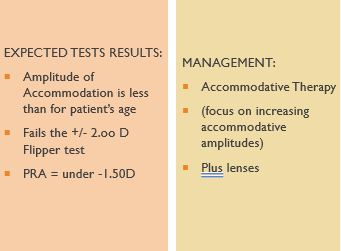
Accommodative Insufficiency
⭐ occurs when the amplitude of accommodation (AA) is lower than expected for the patient's age and is not due to sclerosis of the crystalline lens.
⭐ Patients with (BLANK) usually demonstrate poor accommodative sustaining ability.
⭐ when your eyes don’t have enough focusing power to see close things clearly.
Accommodative Insufficiency
(Causes, Signs & Symptoms)
CAUSES:
⭐ Lower AA than expected for the patient’s age
Uncorrected EOR
SIGNS AND SYMPTOMS:
⭐ Blurred Vision
⭐ Difficulty reading
⭐ Poor Concentration
⭐ Headache
⭐ Can be associated with Convergence Excess
Accommodative Infacility / Inertia
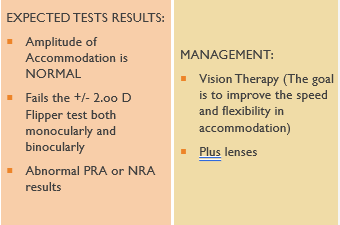
⭐ occurs when the accommodative system is slow in making a change, or when there is a considerable lag between the stimulus to accommodation and the accommodative response.
⭐ Some have considered this (BLANK) to be a precursor to myopia.
Accommodative Infacility / Inertia
(Causes, Signs & Symptoms)
CAUSES:
⭐ slow change in accommodative response, both in stimulation and relaxation.
SIGNS AND SYMPTOMS:
⭐ The patient often reports blurred distance vision immediately following sustained near work.
Ill Sustained Accommodation
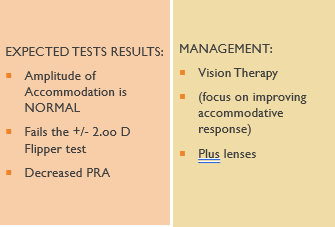
⭐ a condition in which the AA is normal, but fatigue occurs with repeated accommodative stimulation.
⭐ when your eyes can focus okay at first, but get tired and blurry after looking close for a while.
Ill Sustained Accommodation
(Causes, Signs & Symptoms)
CAUSES:
⭐ Ciliary muscles weakening/fatigue
SIGNS AND SYMPTOMS:
⭐ Blurred Vision after prolonged near work
Paralysis of Accommodation
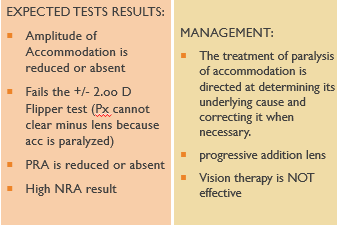
⭐ a rare condition in which the accommodative system fails to respond to any stimulus. The condition, which can be unilateral or bilateral, may be associated with a fixed, dilated pupil.
Paralysis of Accommodation
(Causes, Signs & Symptoms)
CAUSES:
⭐ It can be caused by the use of cycloplegic drugs, or by trauma, ocular or systemic disease, toxicity, or poisoning.
SIGNS AND SYMPTOMS:
⭐ Blurring of vision due to failure to accommodate
Spasm of Accommodation
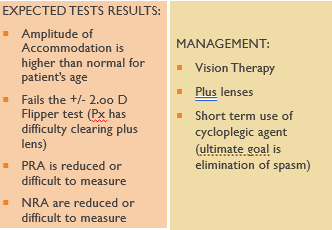
⭐ The result of overstimulation of the parasympathetic nervous system, (BLANK) may be associated with fatigue. It is sometimes part of a triad (overaccommodation, overconvergence, and miotic pupils) known as spasm of the near reflex (SNR).
⭐ when your eyes focus too much, get stuck, and make it hard to see far away.
Spasm of Accommodation
(Causes, Signs & Symptoms)
CAUSES:
This condition may also result from other causes, such as the use of either systemic or topical cholinergic drugs, trauma, brain tumor, or myasthenia gravis.and Vergence Dysfunction
SIGNS AND SYMPTOMS:
Blurring distance vision (Pseudomyopia)
Int. BOV at all distances
AMPLITUDE OF ACCOMMODATION
POSITIVE RELATIVE ACCOMMODATION
NEGATIVE RELATIVE ACCOMMODATION
(PUSH UP TEST) NEAR POINT OF ACCOMMODATION
ACCOMMODATIVE FACILITY TESTING
DIFFERENT ACCOMMODATIVE TESTING
AMPLITUDE OF ACCOMMODATION
TEST DISTANCE: 13 INCHES
TARGET: 0.62EM TYPE
LENSES IN PLACE: SUBJECTIVE FINDING
A. PRESBYOPE – PLUS SPHERE ADDED UNTIL PRINT IS NOT READABLE
B. NON PRESBYOPE – MINUS LENSES UNTIL PRINT IS NOT READABLE
ILLUMINATION: NORMAL
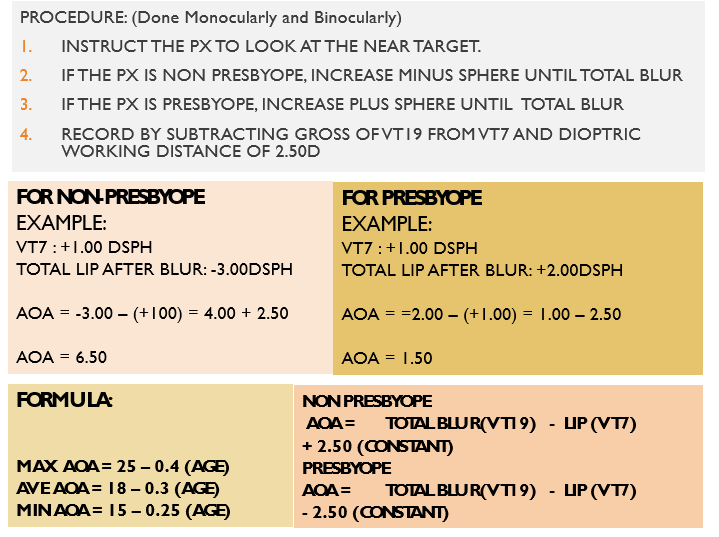
AMPLITUDE OF ACCOMMODATION (FORMULA)
MAX AOA = 25 – 0.4 (AGE)
AVE AOA = 18 – 0.3 (AGE)
MIN AOA = 15 – 0.25 (AGE)
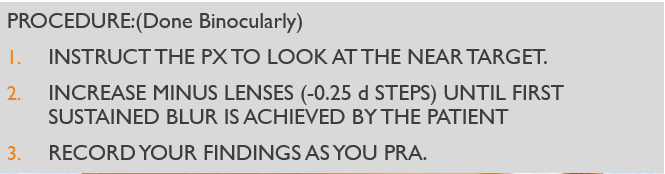
POSITIVE RELATIVE ACCOMMODATION
TEST DISTANCE: 16 INCHES
TARGET: 20/20 REDUCED SNELLEN
LENSES IN PLACE: SUBJECTIVE FINDING
ILLUMINATION: NORMAL
EXPECTED VALUE: -2.00 TO -2.25
ENDPOINT: FIRST SUSTAINED BLUR
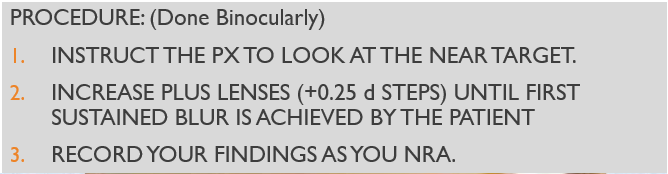
NEGATIVE RELATIVE ACCOMMODATION
TEST DISTANCE: 16 INCHES
TARGET: 20/20 REDUCED SNELLEN
LENSES IN PLACE: SUBJECTIVE FINDING
ILLUMINATION: NORMAL
EXPECTED VALUE: +1.75 to +2.00
ENDPOINT: FIRST SUSTAINED BLUR
NEAR POINT OF ACCOMMODATION (PUSH UP TEST)
TEST DISTANCE: 16 INCHES
TARGET: 0.62EM TYPE
LENSES IN PLACE: SUBJECTIVE FINDING
ILLUMINATION: NORMAL
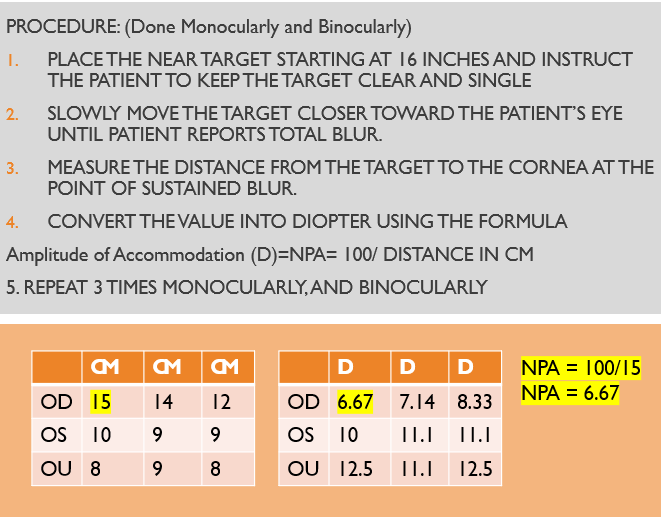
ACCOMMODATIVE FACILITY TESTING
MATERIALS NEEDED:
FLIPPER LENS +2.00/-2.00
NEAR VISION TARGET: 20/30 LETTER AT 40CM
ILLUMINATION: NORMAL
TIMER
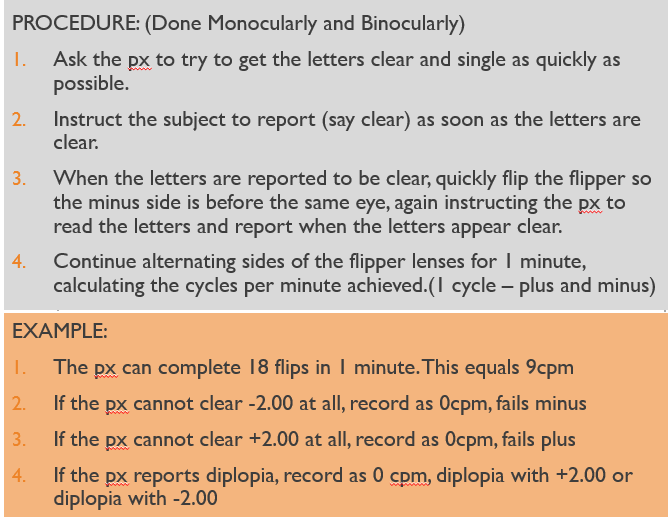
Accommodation
plays a crucial role in maintaining clear vision at different distances by adjusting the optical power of the eye.
overaccommodation
overconvergence
miotic pupils
Triad (Spasm of the Near Reflex (SNR))
Accommodative Response
When performing MEM Retinoscopy, what aspect of accommodation are you specifically measuring?

