Pre-Lecture Lesson 1.4: Respiratory & Circulatory Systems
 Studied by 1 person
 Call Kai
 Learn
Learn Practice Test
 Spaced Repetition
 Match
Match Flashcards
 Knowt Play
1/24

There's no tags or description
Looks like no tags are added yet.
Name | Mastery | Learn | Test | Matching | Spaced | Call with Kai |
|---|
No analytics yet
Send a link to your students to track their progress
25 Terms
What is the highest percent oxygenation of the blood that can be achieved if blood and water flow are in the same direction?
50% because of equilibrium
Diffusion
will always occur when there is a concentration gradient; the blood entering the gills
Explain how gills in a fish allow for a very efficient mechanism to absorb oxygen from their environment.
The gills of utilize countercurrent flow, meaning that the water can carry more oxygen into the blood as it is flowing from the opposite direction, and maintain a higher oxygenation of 70% versus 50% (in a concurrent flow)
What is the crucial difference between bird lungs and mammalian lungs that prevents us mammals from engaging in countercurrent flow
Mammals do not have undirectional airflow through their lungs (not possible with the tidal flow of mammals with their dead end aeoli). Birds air sacs act as bellows that allow the lungs to have undirectional airflow
How do respiratory pigments increase the rate of diffusion from alveoli into the blood fluid (plasma) in adjeacent capillaries?
By reducing the concentration of oxygen dissolved in the blood fluid.
Which variable of the Fick’s Law of Diffusion equation is optimized by moving respiratory gases largely via mass flow in the circulatory system?
L is minimized
The oxygen molecule moves via _____ from the air outside your body into the air space of the alveoli. This is an _____ process, because it requires the contraction of your diaphragm and rib muscles.
The oxygen molecule then moves via _____ through the epithelial cell layer that lines your alveoli, and through the endothelial cell layer that lines your pulmonary capillaries. This is an _____ process because it requires no input of work.
The oxygen molecule then continues its journey via the blood flow using _____. This again is an _____ process, requiring the contraction of the heart muscle in this case.
Finally, once the oxygen molecule arrives in systemic capillaries, it moves into a cell of your body via _____, crossing the endothelial cell layer of the capillary, and the cell membrane of the final cell it reaches. Note how every body cell is no more than 1-3 cells away from the nearest capillary. This part of its journey is _____ again.
All in all, the oxygen molecule only had to cross a length equivalent to __ cell widths via _____.
mass flow, endergonic
diffusion, exergonic
mass flow, endergonic
diffusion, exergonic
~4, diffusion
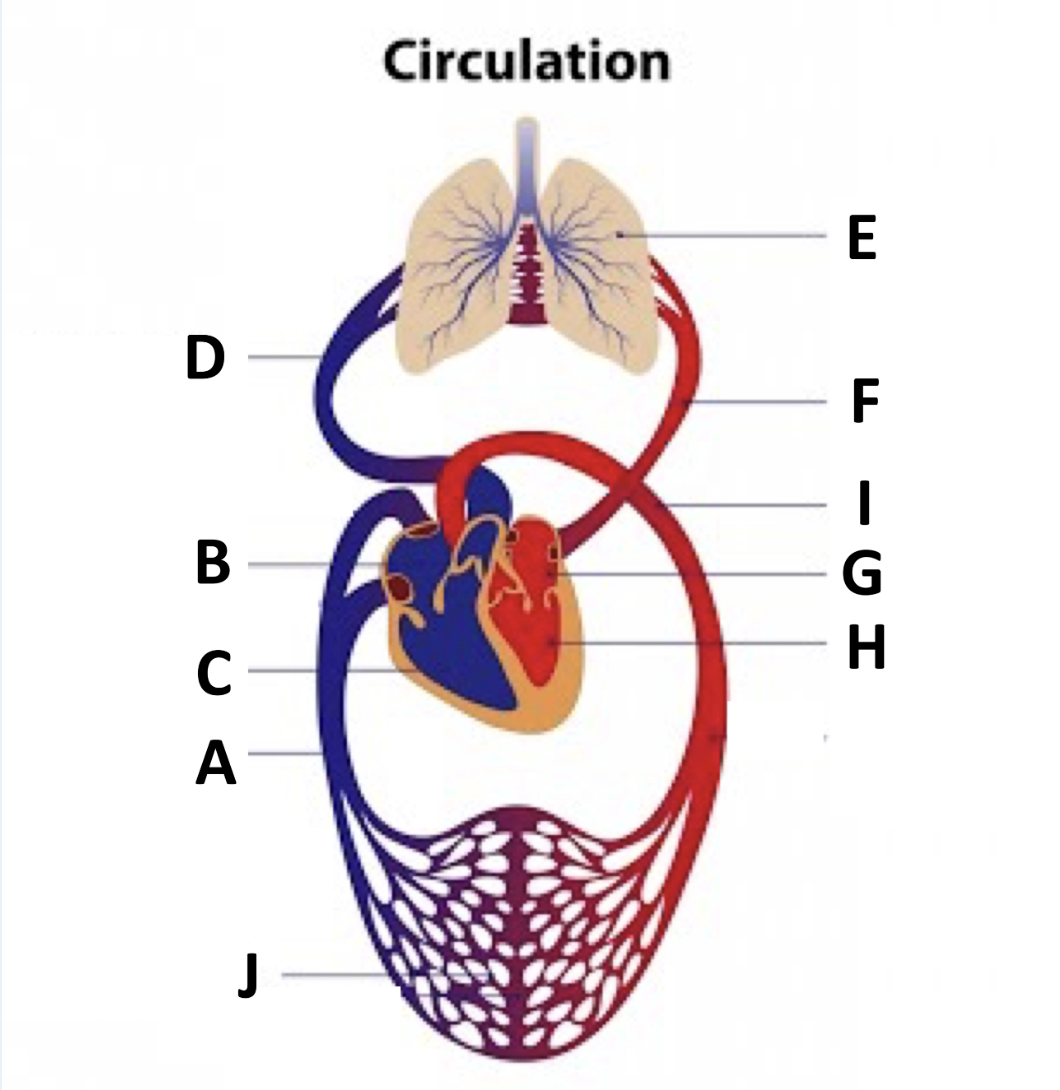
A: [vena cava] [deoxygenated] [toward the heart]
B: [right atrium] [deoxygenated]
C: [right ventricle] [deoxygenated]
D: [pulmonary artery] [deoxygenated] [away from heart]
E: [pulmonary capillaries] [site of gas exchange]
F: [pulmonary vein] [oxygenated] [toward the heart]
G: [left atrium] [oxygenated]
H: [left ventricle] [oxygenated]
I: [aorta] [oxygenated] [away from heart]
J: [systemic capillaries] [site of gas exchange]
Pulmonary circuit
deoxygenated blood moved through the respiratory surfaces (blood and lungs) and moves through and becomes oxygenated; moving from the heart into the lungs
systemic circuit
freshly oxygenated blood that returned to the heart, branches to blood vessels, moves to the rest of the tissue to supply oxygen
arteries
blood vessels that come out of the heart; move deoxygenated blood
veins
return blood to the heart
pulmonary veins
two veins that move from the two lungs
vena cava
veins that come from the two main regions of the body; above the heart (superior) and below the heart (inferior)
vena cava
deoxygenated blood, flowing toward the heart
right atrium
deoxygenated blood
right ventricle
deoxygenated
pulmonary artery
deoxygenated blood, flowing away from heart
pulmonary capillaries
site of gas exchange
pulmonary vein
oxygenated blood, flowing toward the heart
left atrium
oxygenated blood
left ventricle
oxygenated blood
aorta
oxygenated blood, away from heart
systemic capillaries
site of gas exchange
What is a consequence of the separation and independent pumping of pulmonary and systemically-derived blood through the heart?
Respiratory gas exchange is maximized because blood with the lowest oxygen concentration (from vena cava) is directed towards the respiratory surfaces
Oxygenated and deoxygenated blood have no possibility of mixing
It allows for higher blood pressure in the systemic compared to the pulmonary circuit, leading to high efficiency of oxygenation of tissues
 Note
Note  Flashcards (223)