Ch. 8 - New Product Development
 Call Kai
 Learn
Learn Practice Test
 Spaced Repetition
 Match
Match Flashcards
 Knowt Play
1/36

There's no tags or description
Looks like no tags are added yet.
Name | Mastery | Learn | Test | Matching | Spaced | Call with Kai |
|---|
No analytics yet
Send a link to your students to track their progress
37 Terms
Product Life Cycle
Describes the stages that a new product goes through, starting with its initial introduction into the marketplace and moving through to the stages of growth, maturity, and decline.
This concept is used by many marketers to help manage a product from its initial launch through to its eventual decline.
Marketers want to extend the time until the decline stage, or prevent it at all.
Introduction Stage
Stages of the Product Life Cycle
A product experiences minimal sales that are growing slowly, minimal or nonexistent profits, and very few competitors. Occurs when a product is first introduced to its intended target market.
During this period, profits are minimal, typically due to: Slow sales growth
High product development costs
High levels of marketing spending needed to launch the new product.
The key marketing objective during this stage is to create consumer awareness and to stimulate trial (or the first purchase) of the new product.
Rapid Growth
Stages of the Product Life Cycle
Over time, propelled by marketing programs and product demand, a product moves into a period of product demand, and profits increase.
As the competition becomes more severe, consumers are presented with competitive products, which cause a product’s sales and profits to flatten out and eventually, if not addressed by a marketer, decline.
Price Skimming
Strategy where a company charges a high price initially, then lowers the price over a period of time. This is common in the introduction stage, especially with a product that is new to consumers.
Listing fees
Price needs to be paid to place your product on a retailer’s shelf or Ecommerce platform.
Penetration Pricing
Entering the market at a lower cost, and encourage rapid acceptance and adoption of an invention. This is also used to combat threats (competitors).
Growth Stage
Sees an increase in competition and a rapid rise in sales and profits.
Market flooded with competing brands that thrust a category and its products into the forefront.
Results in new consumers being enticed into the category and a resultant increase in sales.
Marketers focus their programs on differentiating products from competitive offerings.
New features are added to original designs, and product proliferation often occurs.
Pricing levels are generally lowered to become more competitive and distribution increases.
Profits usually reach their peak during this stage.
Maturity Stage
Characterized by a slowdown of sales growth and profit. Competitors are well established, and fewer new consumers enter the market.
Marketing focuses on holding or gaining market share by continuing to differentiate the product and building on existing customer loyalty.
Profits level off at this stage, often due to price competition.
A major consideration is to control overall marketing costs by improving promotional and distribution efficiency.
Usually the longest stage in the life cycle.
Decline Stage (2 Strategies of Decline / DH)
Occurs when sales and profits steadily drop over time. Frequently, a product enters this stage when products become obsolete due to technological innovation or changes in consumer needs. As a result, a company follows one of two strategies to deal with a declining product.
Delete: This is when a product is discontinued. This is a thought our process, as there may still be products that consumers actively use.
Harvest: When a company keeps the product, but reduces marketing support in an attempt to reap some minor profits at this stage in the life cycle.
Length of the Product Life Cycle
Varies according to the industry, the competition, technological innovation, and approaches to marketing the product. There is no set timeframe for a product to move through its life cycle. Consumer products may have a shorter life cycle than business products.
Mass media communication has made this process faster.
Technology has greatly shortened it.
Life Cycle Curves (4 Types)
High-learning products: Switch from DVDs to streaming services.
Low-learning products: Apple Watch (Brand Equity)
Fashion products: Clothing trends that recycle.
Fad products: Labubus, things that gain immediate attention.
High-learning products
Life Cycle Curves (4 Types)
One where there is an extended introductory period due to the significant efforts required to educate customers on the usage and benefits of the product.
Movie-streaming services are an example of such a product. A switch to online movie streaming from DVD or Blu-ray was a real shift in thinking for many consumers who were a bit slow to understand the advantages of the new technology, how to use it, and what to do with their old DVDs and video rental memberships.
It took considerable time for consumers and the industry to fully adopt this technology, resulting in an extended introductory period for movie streaming services.
Low-Learning Products
Has a short introductory stage in the product life cycle. In these instances, the benefits of purchasing these products are self-evident and very little learning is required.
An example of a successful low-learning product is the Apple Watch, which required little education for consumers.
Consumers trusted the Apple brand and were familiar with its touch technology from use of the Apple iPhone.
Fashion Products
Cyclical. The length of the cycle will vary, but it is relatively short, going from introduction to decline, generally within a two- to three-year period, only to resurface a few years later.
Life cycles for this most often appear in men’s and women’s footwear and apparel.
Whether we like it or not, fashion trends such as bell bottom pants, crop tops, and leggings have gone away only to come back again years later.
Fad Products
Refers to a product with a very short product life cycle.
It typically experiences immediate rapid growth, followed by an equally rapid decline, with no real maturity stage at all.
These products tend to be novelties, such as the Pet Rock craze and Pokémon Go, Labubus.
Extension of Product Life Cycles
4 Ways
Modifying the product: Product improvements and line extensions to ensure competitive edge.
Modifying the market: Increase product awareness within an existing customer group or finding a new customer base.
Repositioning a product: Adjusting the product to provide a renewed competitive advantage.
Introducing a new product
Modifying the Product (& Line Extension)
Extension of Product Life Cycles
Product improvements and line extensions are often used by marketers to ensure that products remain competitive and address new trends in the market.
This can include product improvement, which changes the product to meet consumer demands (e.g. addressing concerns over healthier or more sustainable options).
It also includes line extensions, where successful brands innovate products to stay relevant to customers.
A line extension is when a new item is added to an already existing product line (e.g. Cheerios creating chocolate Cheerios).
Modifying the Market
Extension of Product Life Cycles
Companies may decide that their current product is under-represented with certain consumer groups and may see an opportunity to target these consumers.
Marketers may try to increase a product’s use within its existing customer group, which is an especially useful strategy where there is strong brand loyalty.
A company may develop new uses for a product, extending its utility to the customer.
This can be done through finding new customers (e.g. expanding markets from only women to men), increasing a product’s use (e.g. advertising for a winter product like soup in the summer), and creating a new situation (e.g. promoting rice Krispies for baking recipes).
Repositioning a Product
Extension of Product Life Cycles
Once a product has reached its maturity stage, it often needs an injection of newness to focus the market on the product and to provide it with a renewed competitive advantage.
This can be achieved through adjusting the product to meet changing consumer needs, to react to a competitor’s move, or to improve the value offered to the consumer.
Introducing a New Product
Extension of Product Life Cycles
Can provide the focus that a mature product needs, bringing it back in the product life cycle to either the growth or early maturity stage.
Apple has done this successfully by regularly introducing new versions of its iPhones, iPads, and computers with updates to their technology and design.
Regardless of the type of product, new products have a greater chance of success if they provide meaningful benefits to its target market (e.g. Apple Watches having a fall mechanism for older users).
New Product Type Innovations
Minor innovations
Continuous innovations
Radical innovations
Minor Innovations
Refers to minor product modifications that require no adjustments on behalf of the consumer.
Consumers do not need to be taught how to use the product.
Colgate Max Fresh KnockOut is an example of a minor innovation.
The extra features in the new toothpaste do not require buyers to learn new behaviours, so effective marketing for a product like this is focused on generating awareness for the innovation.
Continuous Innovation
Refers to new products that include more than just a minor product improvement but do not require radical changes in consumer behaviour.
Not as common and require extensive product development by a company.
Marketers must invest in marketing communication programs to launch these innovative products and to communicate their benefits to consumers.
Electric Cars are an example because they require education and communication.
Radical Innovations
Are the least common form of innovation. They involve the introduction of a product that is entirely new to the market. The success of these products is often dependent on the education of the consumer, usually through advertising and/or public relations efforts.
Drones are an example because they combine technology such as GPS, cameras, controllers, computer programming, and radio-frequency or Wi-Fi communication.
The Adoption Curve
The sequential diffusion and acceptance of an innovation into the market by consumers.
The success of a new product and how quickly it is adopted by consumers.
Takes the point of view that some consumers are more ready than others to buy an innovative product.
Why New Products Fail (5 Reasons)
Insignificant point of difference: Why bother switching?
Incomplete new concept definition: Consumers don’t understand what the product is, how to use it, or why it matters.
Insufficient market attractiveness: The idea may be good, but the target market is too small, shrinking, or unprofitable.
Poor execution of the marketing mix: The product could succeed, but price, promotion, place, or product execution is wrong
Bad timing: The idea may be solid, but consumers or technology weren’t ready, or too late.
Approaches to New Product Development (2)
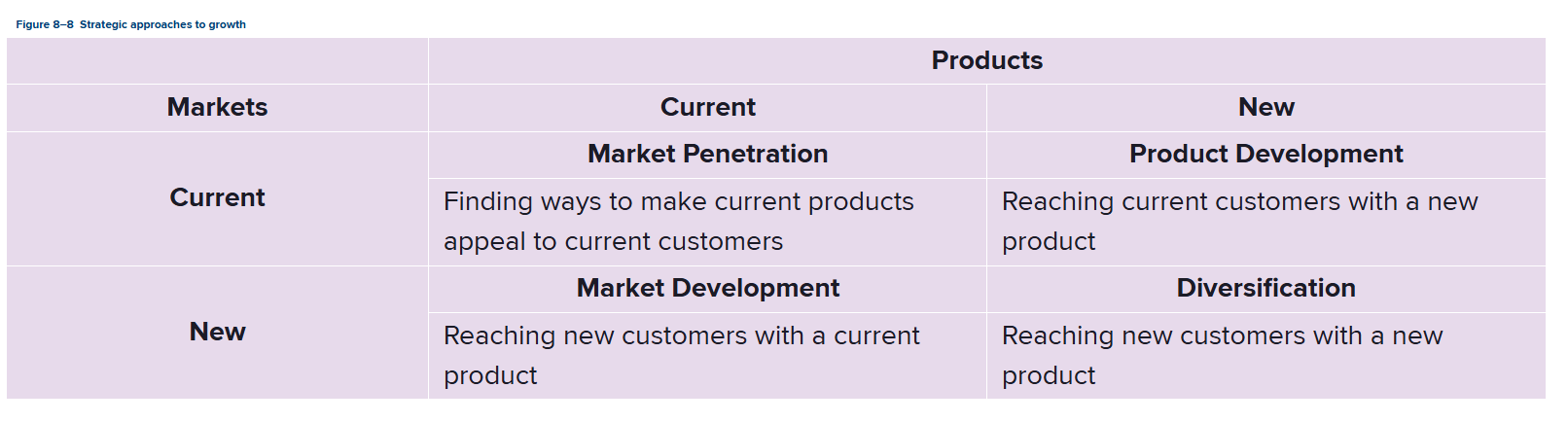
Strategic Direction: Firms grow through low-risk strategies like market penetration (selling more to current customers) and product development (new products for current customers), or higher-risk strategies like market development (current products in new markets) and diversification (new products in new markets).
Company Structure: Companies encourage innovation through organizational structure, often using cross-functional teams (marketing, product development, regulatory, quality, and sales), internal teams, external customer input, or dedicated new product development teams.
Strategic Direction / Ansoff’s Different Approaches to Growth
A strategic tool that shows how a business can grow by combining products (current vs. new) and markets (current vs. new), with each option involving different levels of risk.
Market Penetration: Sell current products to current customers (lowest risk).
Product Development: Sell new products to current customers.
Market Development: Sell current products to new customers.
Diversification: Sell new products to new customers (highest risk).
Concept Tests
Related to Step 3: Screening and Evaluation of the New Product Development Process.
External evaluations of the new product idea, rather than the actual product itself.
Several key issues are addressed during this, such as how the customer perceives the product, who would use it, and how it would be used.
The purpose of these evaluations is to get feedback on the strengths and weaknesses of the concepts and to understand what further modifications are required.
New Product Development Process
7 Steps
New product development strategy
Idea generation
Screening and evaluation
Business analysis
Development
Test marketing
Commercialization
Step 1: New Product Development Strategy
New Product Development Process
Involves setting the new product strategic direction for the company as a whole, as well as the precise objectives for the innovation at hand. There must be consistency between the two.
Step 2: Idea Generation
New Product Development Process
Ideas can be generated from a number of sources and in a number of different ways. Ideas can come from inside or outside the company, depending on the organization’s approach to new product development.
Step 3: Screening and Evaluation
New Product Development Process
Attempts to reduce the array of product ideas down to a manageable list of promising concepts. Ideas are initially examined internally by the new-product development team, which eliminates ideas that do not meet the objectives as well as those that are clearly not technically feasible.
This includes concept tests.
Step 4: Business Analysis
New Product Development Process
Financial projections on the impact of bringing the new product to market and selling it in the future. Typical financial projections for a new product cover a three-year period and often look five years into the future.
Step 5: Development
New Product Development Process
Turning the idea into a prototype for further consumer research and manufacturing tests. This step is considerably complex, involving laboratory and consumer tests to ensure that the product consistently meets legal and quality control requirements.
Step 6: Test Marketing
New Product Development Process
Involves offering a product for sale on a limited basis in a defined geographic area. This test is done to determine whether consumers will actually buy the product, and to what extent.
Expensive to conduct, and alert competition right away.
Competitors can sabotage by altering their own prices and marketing support, to make the test unsuccessful.
Step 7: Commercialization
New Product Development Process
The step when the new product is brought to market with full-scale production, sales, and marketing support. Companies proceed very carefully at the this stage because this is the most expensive stage for most new products. To minimize risk corporations will do regional roll outs. This allows production levels and marketing activities to build gradually.

