GC650 Lecture 5 - CEA and CUA with Sensitivity Analyses
 Call Kai
 Learn
Learn Practice Test
 Spaced Repetition
 Match
Match Flashcards
 Knowt Play
1/30

There's no tags or description
Looks like no tags are added yet.
Name | Mastery | Learn | Test | Matching | Spaced | Call with Kai |
|---|
No analytics yet
Send a link to your students to track their progress
31 Terms
Willingness to Pay
Arbitrary threshold of whether something is a good value.
When we say an intervention is ‘cost-effective’ we mean that the cost per QALY is below some threshold of Willingness to Pay.
Cost Effectiveness Plane
Y-axis: Cost
X-axis: Effectiveness
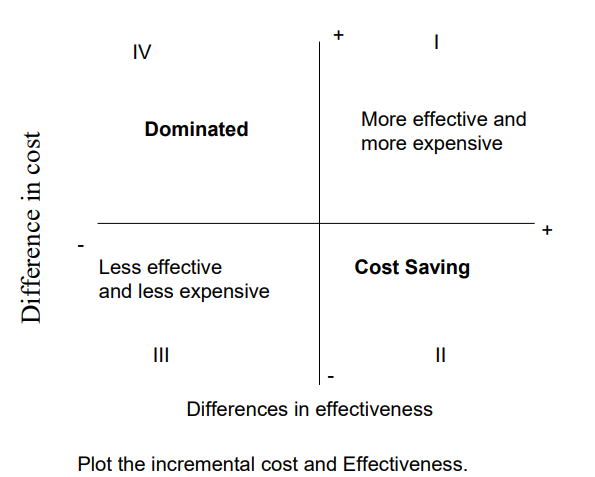
Dominated
If the new treatment is less effective and more expensive than the old, it is dominated by the old treatment.
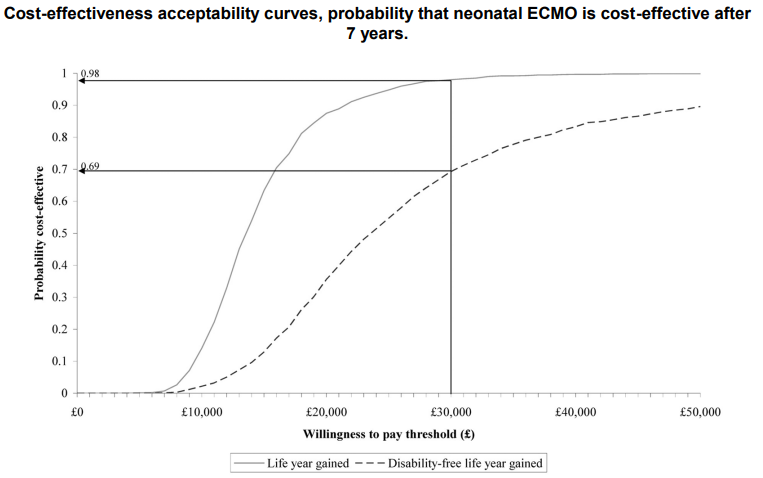
Cost Effectiveness Acceptability Curve
A graphical tool used in health economics to represent the probability that an intervention is cost-effective compared to alternatives across various willingness-to-pay (WTP) thresholds
Sensitivity Analysis
Used to help us understand how much the data quality issues may impact the outcomes of the model
Allow you to test “What-If” situations when you know a set of model inputs may not be entirely correct or if you suspect something may change in the near future
One-way
Vary one uncertainty input at a time.
Tornado Diagram
A specialized horizontal bar chart used in sensitivity analysis to visually compare the impact of various input variables on a specific outcome
Two-way (Multi-way)
Vary two (or multiple) inputs at the same time
The graphic axes are the minimum to maximum values of each parameter
The “inner” part of the graphic is shaded where one strategy is more cost effective than the other
Probabilistic Sensitivity Analyses
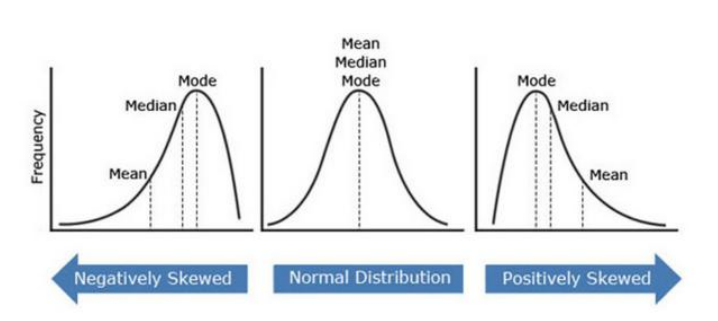
Rather than use the MEAN of each input, we use the distribution
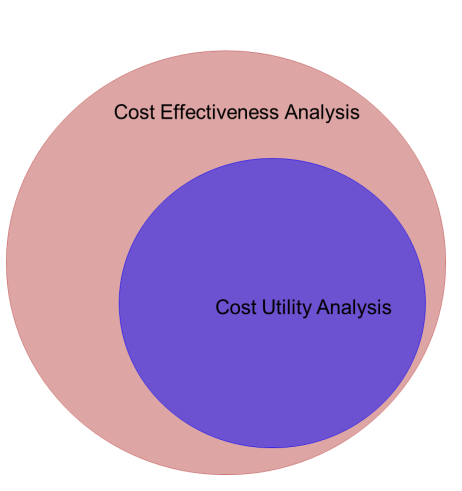
CEA and CUA Relationship
CUA is a subset of CEA
Result of of CUA is QALY
Uncertainty
Uncertainty reflects variability in model inputs (costs, outcomes, probabilities)
Characterizing uncertainty enhances reliability and transparency.
Types of Uncertainty (2)
Structural - model design choices
Parameter - input variability
Methods to Address Uncertainty (3)
One-way Sensitivity Analysis
Two-Way Sensitivity Analysis
Probabilistic Sensitivity Analysis (PSA) - Monte Carlo simulations
What Can Cause Error in Mean Measurements (3)
Endpoints can have a lot of variability (large SD)
Quality issues in the input studies
Lack of data on some data points
Quality Issues in Models (4)
The data best suited for the model often do not exist
Prior studies are of lower quality than desirable
Prior studies may not be generalizable
Some data points may not be available at all
Ways the Data Available May Not Fit the Model (3)
Prior studies conducted on a different population
Prior studies conducted with a different comparator
Prior studies conducted under a different treatment paradigm
Single Deterministic One-Way Analysis
Shows the impact of changing one model input (or parameter) on a key outcome (cost or effectiveness) for each treatment strategy
Multiple Deterministic using Tornado Diagram One-Way Analysis
Shows the impact of changing a series of inputs, one at a time, on the ICER and plots them in order of biggest impact to smallest impact
Types of One-Way Analyses
Single Deterministic
Multiple Deterministic using Tornado Diagram
Natural Variation in Patient Experience
All data are derived from a pool of observations that represent natural variations in experience, when we summarize data – especially with models – we often focus on or use the mean or median of the data and may not perfectly reflect the real world experience
Probabilistic Sensitivity Analyses Take into Account (3)
That the mean does not represent everyone, there is variation among individual patients
That the mean has error in its measurement
That the incremental cost per outcome will also vary by individual and with measurement error
Steps of a Probabilistic Sensitivity Analysis (3)
Distribution is specified by the user based on SE and expected standard distribution (gamma, weibull, etc…)
The model randomly selects a point from the distribution of each input parameter
We run the model roughly 1,000 times
Negatively Skewed, Normal Distribution, Positively Skewed Distribution Appearances
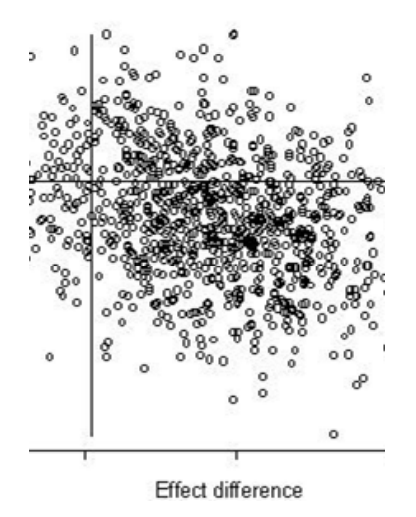
Monte Carlo Simulations
We run the model roughly 1,000-10,000 times, ach time randomly selecting a point off the distribution of every input parameter (this is the monte carlo part)
Then we plot the points on the CE Plane
Discounting
Current and future dollars are not valued the same 🡪 TIME PREFERENCE FOR MONEY AND TREATMENT BENEFITS
Future dollars must be discounted to reflect present value when program extends beyond one year
What Can be Discounted (4)
Costs
Utilities
QALYs
Benefits in dollars (CBA)
Discounting Calculation
3% per year is the recommended discount rate

Should you discount benefits?
Yes - because there is a preference for having additional life years or utility gains NOW versus later
No - Some argue against if there is no trade-off between having additional life years/utility gains now versus later
Final recommendation - Future benefits SHOULD be discounted, at the same rate as costs, if they are in units of QALYS or utilities
C/U Ratio if Benefits are Not Discounted
If you only discount costs, then C/U Ratio will always improve over time.
Inflation
Future costs, both direct and indirect, will increase each year.
We generally inflate costs but not benefits/outcomes.
Discounting With Inflation Steps (2 and a Substep)
Adjust historical costs for inflation first, to bring them to present value
Then apply an inflation-adjusted discount rate for each year of analysis in the future.
If using a 3% discount rate, and inflation rate for hc goods and services is 2%, then inflation adjusted discount rate is 1%

