Clinical Studies
0.0(0)
 Studied by 0 people
 Call Kai
 Learn
Learn Practice Test
 Spaced Repetition
 Match
Match Flashcards
 Knowt Play
Card Sorting
1/177

Earn XP
Description and Tags
227.314
Last updated 10:26 AM on 3/31/23
Name | Mastery | Learn | Test | Matching | Spaced | Call with Kai |
|---|
No analytics yet
Send a link to your students to track their progress
178 Terms
1
New cards
Reasons for surgery
1. Therapeutic Reasons (treatment)
2. Diagnostic(exlap or biopsy)
3. Increased suitability for particular use (castration or dehorning)
4. Biomedical Research
5. Cosmetic reasons
2
New cards
\-Ectomy
surgical removal of…
3
New cards
\-Otomy
incision into or opening
4
New cards
\-Ostomy
Creation of (semi)permanent opening or stoma
5
New cards
\-Pexy
Fixation
6
New cards
\-Centesis
Perforate or tap
7
New cards
\-Oscopy
Use of fiberoptic instruments for diagnosis and surgery
8
New cards
When are scalpels used
Dense tissue e.g skin
minimise collateral damage and crushing
minimise collateral damage and crushing
9
New cards
When are scissors used
Loose tissue e.g adventitia and fat
cause crushing and bruising
cause crushing and bruising
10
New cards
Cautery
direct application of heat
Uses: disbudding
Uses: disbudding
11
New cards
Electrosurgery
generation of a electrical waveforms that cause coagulation and tissue cutting
12
New cards
Monopolar Electrosurgery
Uses an electrode under patient (dispersal pad). current travels from active electrode through patient.
13
New cards
Dipolar Electrosurgery
active and return electrodes are at the tips of forceps. only tissue grasped is part of circuit.
14
New cards
Laser surgery
Light amplification by stimulated emission of radiation. forms cutting tool used to ablate/vapourise/weld tissue
15
New cards
Endoscopic / telescopic equipment
used for minimally invasive surgery
16
New cards
Arthroscope
lensed eyepiece with camera and light source that provides a scope in joints or tendon sheaths
17
New cards
Advantages of arthroscopy
1. Minimally invasive
2. Decreased Hospital stay
3. Better Field of view: magnification and lighting
18
New cards
Most common life-threatening surgery complications
infection and haemorrhage
19
New cards
Aspects that improve surgery sucess
1. Reduced tissue trauma
2. Aseptic techniques
20
New cards
Halsted’s Principles
1. Gentle tissue handling
2. Meticulous haemostasis
3. Preserve blood supply
4. Strict aseptic techniques
5. Minimise tension on tissues
6. Eliminate dead space
7. Meticulous approximation of wound layers
8. Minimise foreign material in wound (Extra principle)
21
New cards
Rough handling during surgery causes:
1. Post-operative infection
2. Delayed healing
3. Increased surgical shock
4. Increased pain and dysfunction
22
New cards
Results of affective haemostasis
1. Better surgical conditions
2. Lessens chance of haemorrhagic shock
3. Lessens chance of post-op infection
23
New cards
Aseptic technique reduces
Risk of post-op infection
24
New cards
Why is surgery performed within a theatre environment
Protect patient from contact and airborne bacteria
25
New cards
Why prepare patient’s skin
protect them from their own flora
26
New cards
Why minimise tension on wound edges
Tight sutures can tear tissue and reduce wound strength.
Strangulation and tissue death can cause infection and delay healing
Strangulation and tissue death can cause infection and delay healing
27
New cards
Dead space
Accumulation of blood and fluid in tissue space.
Delays healing and increases risk of infection
Delays healing and increases risk of infection
28
New cards
Results of meticulous approximation of wound layers
1. Promotes rapid healing
2. Increased wound strength
3. Lessens chance of infection
29
New cards
What needs to be noted in History taking
1. Overall health
2. Intercurrent diseases
3. Owners expectations
4. Are the owners able to cope with the aftercare
30
New cards
Pre-operative information required
1. Time available
2. Signalment of patient
3. Financial capacity of owner
31
New cards
What is a wound
Injury to the body tissue resulting in disruption to normal cellular and anatomical continuity
32
New cards
4 Phases of Wound Healing
1. Inflammatory
2. Debridement
3. Proliferative (repair)
4. Remodelling (Maturation)
33
New cards
Features of the inflammatory phase
Features of the inflammatory phase
34
New cards
1. 6 hrs after injury
2. neutrophils accumulate and phagocytose debris
Features of the debridement phase
35
New cards
1. Within the first 12 hrs after wounding
2. epithelialisation
3. migration of fibroblasts→ collagen formation
4. Granulation formation
5. Wound contraction
Features of Proliferative phase
36
New cards
1. Resistant to local infection
2. Barrier to systemic infection
3. Blood supply
4. Supports fibroblasts
Features of Granulation tissue
37
New cards
1. 3 weeks after injury
2. collagen undergoes functional orientation
3. increase in tensile wound strength
4. scar formation (15% weaker)
Features of Remodelling phase
38
New cards
1. Reduced movement over joints
2. Stenosis of a body opening
3. Thin epithelium
Disadvantages of wound contraction
39
New cards
1. Clean
2. Clean-contaminated
3. Contaminated
4. Dirty
4 Wound Classifications
40
New cards
* Surgically created under ideal operative conditions
* No entry into GI, Genital-urinary or respiratory tracts
* No entry into GI, Genital-urinary or respiratory tracts
Characteristics of a Clean wound
41
New cards
* Minimally contaminated/ contaminants easily removed
* Operations into GI, GU or R tracts
* Minor breaks in aseptic technique
* Operations into GI, GU or R tracts
* Minor breaks in aseptic technique
Characteristics of a Clean-contaminated wound
42
New cards
* Fresh or operative wounds with minor breaks in aseptic technique
* spillage of GI or GU tract contents
* spillage of GI or GU tract contents
Characteristics of Contaminated wound
43
New cards
* Old traumatic wounds
* Clinical infection
* abscess or perforated viscera
* Clinical infection
* abscess or perforated viscera
Characteristics of a Dirty wound
44
New cards
Restoration of tissue continuity occurs directly, without granulation
Primary Closure
45
New cards
Wound repair accomplished with granulation tissue
Healing by Secondary intention
46
New cards
Wound closure 3-5 days after time of infection, Before granulation tissue is formed.
When contamination cannot be removed or definitive debridement cannot be formed
When contamination cannot be removed or definitive debridement cannot be formed
Delayed Primary tissue healing
47
New cards
closure in the presence of granulation tissue
5-10 days post injury
5-10 days post injury
Secondary Closure
48
New cards
1. Expense
2. prolonged healing
3. May not completely heal
4. large defects
5. impairment of function
Disadvantages of Secondary healing
49
New cards
removal of all debris, necrotic tissue or obviously devitalised tissue
Surgical debridement
50
New cards
\
1. prevent further contamination
2. lavage -flushing
3. debridement
4. drainage
5. closure
6. bandaging
1. prevent further contamination
2. lavage -flushing
3. debridement
4. drainage
5. closure
6. bandaging
Steps of contaminated wound management
51
New cards
material applied directly to the wound
primary layer
primary layer
Dressing
52
New cards
1. Contact (primary)
2. Intermediate (secondary)
3. Outer (tertiary)
### 3 layers of a bandage
53
New cards
Holds primary dressing in place, eliminates dead space, absorb exudate
Function of intermediate bandage
54
New cards
Protect underlying layers, establish pressure and stops fluid leaking
Function of tertiary bandage layer
55
New cards
dressings that don’t serve any additions function
Passive dressing
56
New cards
Dressings that contain factors that speed up healing
Active dressings
57
New cards
indicated for wounds that have necrotic tissue, foreign matter or viscous exudates on their surface
Wet-to-dry dressings
58
New cards
only if wound exudes copious quantities of low-viscosity fluid that does not tend to aggrogate
Dry-to-dry dressings
59
New cards
1. Sufficient moisture
2. Complete contact
3. Correct temperature
4. Correct contact time
4 Conditions of Steam Sterilisation
60
New cards
1. Steam readily available
2. Cheap
3. Rapid
4. Reliable
5. Sterilizes most articles
6. Can be stored
1. Steam readily available
2. Cheap
3. Rapid
4. Reliable
5. Sterilizes most articles
6. Can be stored
61
New cards
Disadvantages of autoclaves
1. Requires special equipment
2. Requires careful monitoring
3. Cannot sterilize sharp or delicate instruments, oils and powders
62
New cards
Advantages of Dry heat sterilization
Kills organisms by oxidative denaturation of proteins
1. Simple
2. Cheap
3. Sterilizes oils and powders
4. doesnt dull sharp instruments
5. No moisture, non-corrosive
1. Simple
2. Cheap
3. Sterilizes oils and powders
4. doesnt dull sharp instruments
5. No moisture, non-corrosive
63
New cards
Disadvantages of dry heat
1. long exposure times
2. poor penetration
3. careful load technique
4. required careful monitoring
5. unsuitable for heat sensitive material
64
New cards
conditions for chemical sterilisation
must be non-corrosive and is used for delicate items e.g lensed arthroscopes
65
New cards
Gamma Raditaion
disrupts normal cellular metabolism at atomic levels
66
New cards
Sterility indicators
1. Indicator strips
2. Browne tubes
3. Biological indicators
67
New cards
How strong should a suture be
at least as strong as the tissue, depends on collagen
\
fascia/skin > viscera > muscle/fat
\
fascia/skin > viscera > muscle/fat
68
New cards
Disadvantages of using excessively strong sutures
Tend to be thicker or braided which increase risk of infection
69
New cards
What do natural fibre sutures induce
Inflammation and immune response
Absorption occurs via phagocytosis
Absorption occurs via phagocytosis
70
New cards
What do synthetic fibres induce
designed to be minimally inflammatory and absorption occurs mainly via hydrolysis
71
New cards
Features of monofilaments
pros- tend to be more bactericidal, less tissue drag
cons- weaken when crushed, coatings reduce knot security
cons- weaken when crushed, coatings reduce knot security
72
New cards
common antibacterial coating
1. Monocryl Plus
2. Coated Vicryl Plus
3. PDS II Plus
\
all coated with Triclosan
73
New cards
Multifilament sutures
Pros- easier to handle, better knot security
Cons- Capillarity
Cons- Capillarity
74
New cards
9 Characteristics of sutures
1. Maintain adequate tensile strength
2. Stimulate minimal inflammation
3. Discourage bacterial growth
4. Non-capillary
5. Non-Allergenic
6. Non-Electrolytic
7. Non-Carcinogenic
8. Good handling properties
9. Good knot security
75
New cards
Improper sutures alter biological healing by causing
1. Tissue reaction
2. Potentiation of infection
3. Sinus infection
4. Potentiation of calculi, thrombi and ulcers
76
New cards
Why do we use the smallest suture size possible
1. Less tissue trauma
2. Less suture material volume
3. Smaller knots
4. Greater knot security
5. Encourages gentle handling
77
New cards
Closed eye needles
for use with suture material on reels
78
New cards
Advantages of swaged needles
1. Available for immediate use
2. Unlikely to detach suture material
3. Guaranteed sterile
4. Less tissue trauma
5. Less handling of suture material
79
New cards
Disadvantages of eyed needles
suture may fall out of eye→ contamination of surgical field
80
New cards
Haemostasis
bleeding is halted by vasoconstriction and coagulation by surgical means
81
New cards
Primary haemorrhage
Haemorrhage that occurs immediately after vessel is opened
82
New cards
Delayed Haemorrhage
1. Intermediate
83
New cards
Methods to achieve preventative haemostasis
1. Careful planning
2. Ligation/ coagulation of vessels
3. Gentle and accurate dissection
84
New cards
Advantages of Meticulous Haemostasis
1. Reduced blood loss
2. Promotes tidy surgery
3. Maintains tissue health
4. Maintains tissue perfusion
5. Good visualisation of tissue
85
New cards
Methods of stopping Haemorrhage
1. Pressure
2. Artery forceps
3. Suture ligation
4. Metal clips cautery
5. Tourniquets
6. Haemostatic agents
86
New cards
signs of fractures
1. pain
2. dysfunction
3. blood loss
4. nerve injury
5. perforated organs
87
New cards
Bone blood supply
1. periosteal artery (most important in repair)
2. principle artery
3. metaphyseal artery
4. nutrient artery (2/3 cortical supply)
5. epiphyseal artery
88
New cards
Secondary bone healing
* callus stabilises fracture
* laminar growth fills gap
* laminar growth fills gap
89
New cards
Incomplete fracture
greenstick or fissure fractures. Only 1 cortices cracked
90
New cards
Simple Complete fracture configurations
* transverse
* short oblique
* long oblique
* spiral
* short oblique
* long oblique
* spiral
91
New cards
Comminuted complete fractures
* butterfly
* comminuted
* segmented
* comminuted
* segmented
92
New cards
Treatment of open fractures
1. Prevent further contamination
2. Aseptic debridement
3. Preserve blood supply and nerves
4. Stable fixation - ideally ESF
5. Early limb mobilisation
93
New cards
Grade I open fracture
* bone retracts
* small wound
* good prognosis and splint within 6 hrs
* small wound
* good prognosis and splint within 6 hrs
94
New cards
Grade II open fracture
* wound > 1 cm
* no excessive soft tissue damage
* some foreign material
* no excessive soft tissue damage
* some foreign material
95
New cards
Grade III open fracture
* excessive skin damage
* muscle and neuro-vascular damage
* extensive treatment
* muscle and neuro-vascular damage
* extensive treatment
96
New cards
Articular fractures
1. Extra-
2. Partial
3. Complete
4. Physeal
97
New cards
Extra- articular fracture
* separate from diaphysis
* metaphyl- adults
* Physeal- young
* metaphyl- adults
* Physeal- young
98
New cards
Partial Articular fracture
* section of articular surface e.g unicondylar
99
New cards
Complete articular fracture
* joint surface fractured
* separate from diaphysis
* e.g bicondylar
* separate from diaphysis
* e.g bicondylar
100
New cards
Salter-Harris classifications
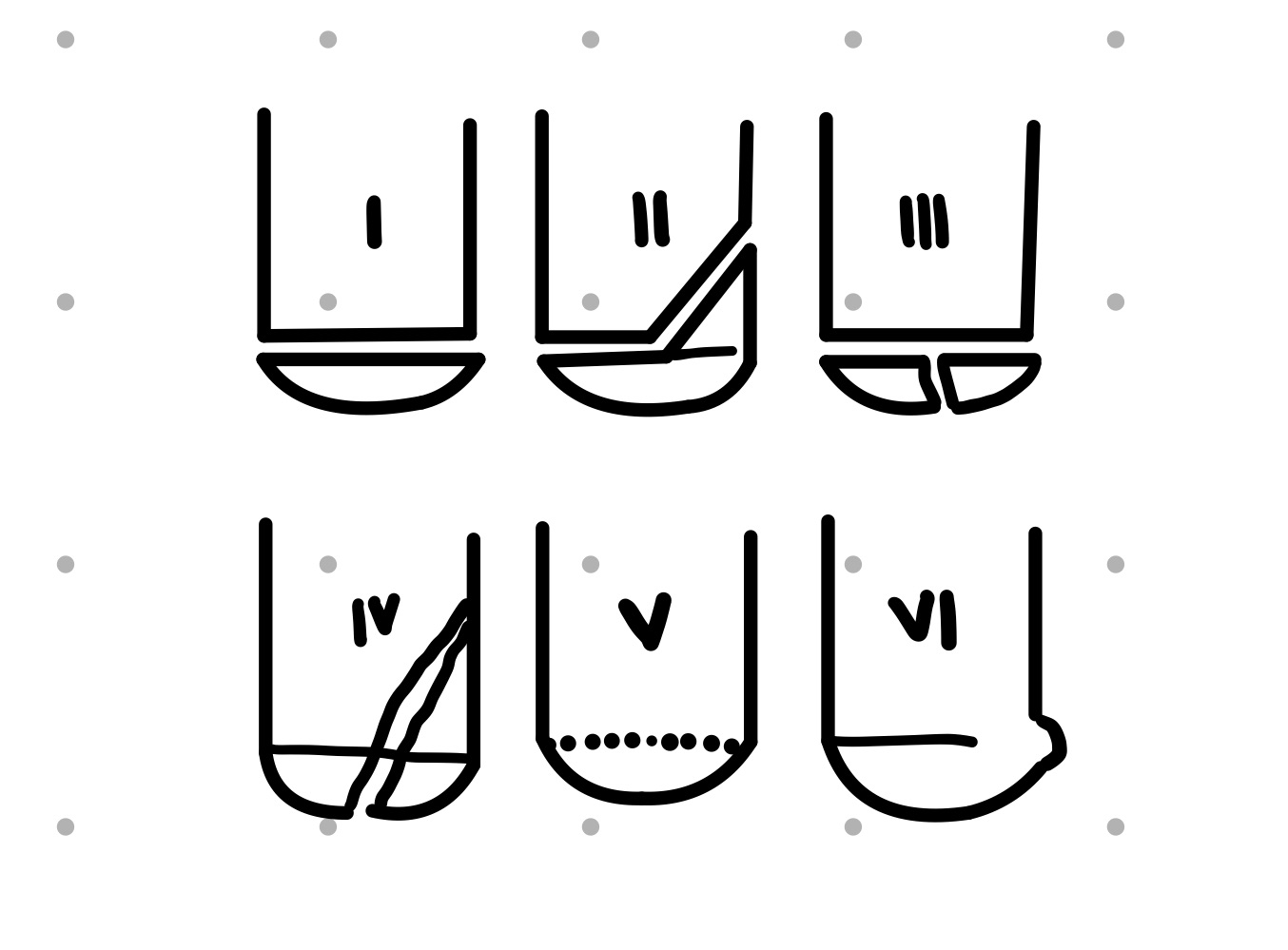
 Note
Note  Flashcards (74)