CH: 10 Socioemotional and Moral Development in Early Childhood: Key Concepts and Influences
 Call Kai
 Learn
Learn Practice Test
 Spaced Repetition
 Match
Match Flashcards
 Knowt Play
1/49

There's no tags or description
Looks like no tags are added yet.
Name | Mastery | Learn | Test | Matching | Spaced | Call with Kai |
|---|
No analytics yet
Send a link to your students to track their progress
50 Terms
Erikson's Initiative vs Guilt
Ideally they take initiative to explore the world outside of the dependence of their caregiver and are not weighed down by guilt from failures.
Self-Understanding
The child's cognitive representation of self: the substance and content of the child's self-conceptions.
Young children's self-description
Young children think that the self can be described by physical and material attributes.
Psychological traits in self-descriptions
About 4-5 years of age, they begin to include psychological traits and emotion terms in their own self-descriptions.
Perspective Taking
The social cognitive process involved in assuming the perspective of others and understanding their thoughts and feelings.
Self-Conscious Emotions
Pride, shame, embarrassment, guilt etc. Self-conscious emotions do not appear to develop until self-awareness appears, which is around 18 months of age.
Emotion-Coaching Parents
Monitor their children's emotion, view their children's negative emotions as opportunities for teaching, assist them in labeling emotions.
Emotion-Dismissing Parents
View their role as to deny, ignore, or change negative emotions.
Moral Development
Development that involves thoughts, feelings, and behaviors regarding rules and contentions about what people should do in their interactions with people.
Conscience
An internal regulation of standards of right and wrong that involves an integration of moral thought, feeling, and behavior.
Freud Id/Ego/Superego
Children begin experiencing guilt, empathy, sympathy, and perspective taking.
Heteronomous Morality
The first stage of moral development in Piaget's theory, occurring from approximately 4-7 years of age.
Autonomous Morality
The second stage of moral development in Piaget's theory, displayed by older children (about 10 years of age and older).
Immanent Justice
The expectation that, if a rule is broken, punishment will be meted out immediately.
Moral Behavior
Typically children repeat positive behavior when it is rewarded and reduce negative behavior when they are punished.
Gender Identity
The sense of one's own gender, including knowledge, understanding, and acceptance of being male or female.
Gender Role
A set of expectations that prescribes how females or males should think, act, and feel.
Estrogens
Influence the development of female physical sex characteristics.
Androgens
Promote the development of male physical sex characteristics.
Social Role Theory
A theory that gender differences arise from contrasting roles of men and women.
Psychoanalytic Theory of Gender
Freud's view that the preschool child develops a sexual attraction to the opposite-sex parent.
Oedipus Complex
A concept for boys where they renounce attraction to the opposite-sex parent and identify with the same-sex parent.
Electra Complex
A concept for girls where they renounce attraction to the opposite-sex parent and identify with the same-sex parent.
Social Cognitive Theory of Gender
A theory that emphasizes that children's gender development occurs through observation and imitation of gender behavior.
Mothers' Socialization Strategies
In many cultures mothers socialize their daughters to be more obedient and responsible than their sons.
Fathers' Socialization Strategies
Fathers show more attention to sons than to their daughters, engage in more activities with sons, and put forth more effort to promote sons' intellectual development.
Peer Pressure
Support for going against or with gender norms.
Gender Schema Theory
The theory that gender typing emerges as children gradually develop gender schemas of what is considered gender-appropriate and gender-inappropriate in their culture.
Authoritarian Parenting
A restrictive, punitive parenting style in which parents exhort the child to follow their directions and to respect their work and effort.
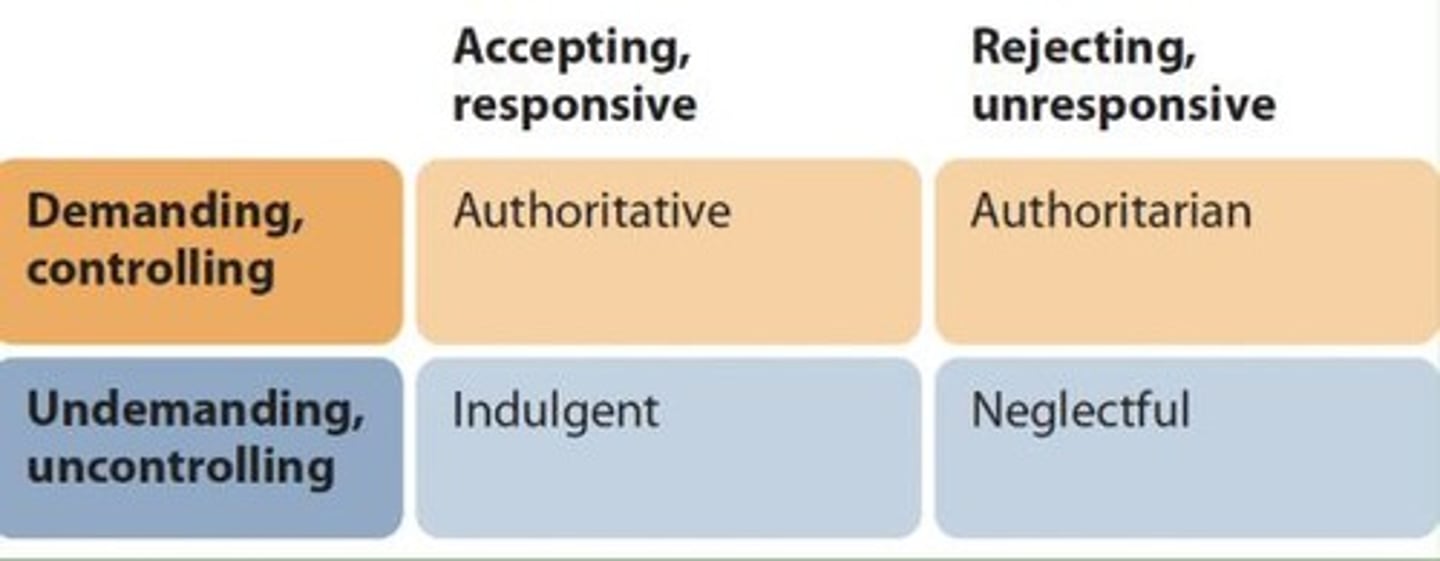
Authoritative Parenting
A parenting style in which parents encourage their children to be independent, but still place limits and controls on their actions.
Neglectful Parenting
A style of parenting in which the parent is very uninvolved in the child's life; it is associated with children's social incompetence, especially a lack of self-control.
Indulgent Parenting
A style of parenting in which parents are highly involved with their children but few demands or controls on them.
Child Maltreatment
Includes various forms of abuse and neglect that can affect a child's development.
Physical Abuse
The infliction of physical injury (even if unintended).
Child Neglect
Failure to provide for the child's basic needs (including physical, educational, or emotional).
Sexual Abuse
Includes fondling a child's genitals, intercourse, incest, rape, sodomy, exhibitionism, and exploitation.
Emotional Abuse
Includes acts or omissions by parents or other caregivers that have caused, or could cause, serious behavioral, cognitive, or emotional problems.
Sibling Relationships
Siblings have conflict very often, and how parents react can have an impact.
Types of Play
Includes sensorimotor play, practice play, pretense/symbolic play, social play, constructive play, and games.
Sensorimotor Play
Behavior engaged in by infants to derive pleasure from exercising their existing sensorimotor schemas.
Practice Play
Play that involves repetition of behavior when new skills are being learned or when physical or mental mastery and coordination of skills are required.
Pretense/Symbolic Play
Play in which the child transforms aspects of the physical environment into symbols.
Social Play
Play that involves social interactions with peers.
Constructive Play
Play that combines sensorimotor/practice play with symbolic representation.
Games
Activities engaged in for pleasure that includes rules and often competition with one or more individuals.
Screen Time
Includes how much time individuals spend watching television, playing video games, and using computers or mobile media.
Educational Media
Media that provides information for developing schemas/stereotypes.
Promoting Prosocial Behavior
Media that encourages positive social interactions.
Promoting Aggressive Behavior
Media that encourages negative or aggressive actions.
Cohesive vs Non-Cohesive Co-Parenting
Differences in parenting styles between partners that can affect child development.

