PHYS006 HW Q's
 Studied by 0 people
 Call Kai
 Learn
Learn Practice Test
 Spaced Repetition
 Match
Match Flashcards
 Knowt Play
1/53

There's no tags or description
Looks like no tags are added yet.
Name | Mastery | Learn | Test | Matching | Spaced | Call with Kai |
|---|
No analytics yet
Send a link to your students to track their progress
54 Terms
An apple is released from a tree and begins to fall toward the ground. Is it accelerating while
it falls? Explain what “acceleration” means in this situation
Yes the apple is accelerating as it falls. Acceleration refers to a change in an object’s velocity (either the speed and/or direction). The apple is accelerating as it goes from being still, to falling and gaining speed and velocity as it approaches the ground. Additionally, its direction is changed, from being stagnant in the air to plummeting downward to the ground.
Two objects in space attract each other by gravity. Describe how this gravitational attraction
changes if:
(a) one object becomes more massive, and
(b) the objects move farther apart.
If an object increases in mass, the gravitational attraction between said object and another object increases as well.
As distance between objects increases, the gravitational attraction between the objects decreases exponentially.
Astronauts on the Moon weigh less than they do on Earth, but their mass is the same.
Explain the difference between mass and weight, and say which one changes when someone
goes from Earth to the Moon.
Mass is the amount of matter in an object. Weight is the measure of force acting on an object. The strength of forces differ from Earth and the Moon, but mass remains the same, so weight is the only factor impacted out of the two as the Moon’s gravitational pull is weaker than Earth’s.
A small car and a large delivery van are traveling side by side at the same speed. Which one
has the greater momentum? Explain your reasoning using the definition of momentum
Momentum is the measure of motion (mass x velocity) of an object. Based on this definition, the large delivery van would have the greatest momentum due to it having a greater mass than the small car.
Newton’s three laws can all be described using the idea of momentum. For each law, briefly
explain what it says in terms of an object’s momentum.
Newton’s first law states that an object’s momentum does not change if left alone, and it changes only when force is applied.
Newton’s second law states that a force can change an object’s momentum.
Newton’s third law states that for any force, there is an equal and opposite reaction force. In other words, momentum is always conserved.
Choose one of Newton’s laws and describe a real-life situation where you can see it in action.
Explain how the law applies in that situation.
Newton’s second law which, in the context of momentum, states that a force can change an object’s momentum can be applied to the situation of a stationary object, such as a ball in a field and someone walking up to the ball and kicking it, causing the ball to roll until it finally stops. The ball’s momentum changed once it was kicked, and continued to change as it came to stop due to the force of friction being exerted on it.
7. Give an example from everyday life or sports that shows conservation of angular momentum,
and explain what changes and what stays the same in your example
A person standing on a spinning base holding weights in both arms, if they pull the weights toward their body, the radius decreases causes an increase in spin speed
Angular momentum: momentum involved in spinning/circling (m x v x r)
Conservation of Angular Momentum: AM depends on M, V, R
No torque = total angular momentum is constant
So…if the quantity of one decreases, the other has to increase
Imagine that the Moon slowly moved closer to Earth over millions of years. How would this
affect the strength of the ocean tides on Earth? Explain your reasoning.
The ocean tides on Earth would increase if the moon moved closer as gravitational force between the moon and Earth is strongest closest together and weaker further apart. The gravitational pull of the moon results in a tidal bulge on one side of the earth.
The stronger the gravitational pull, the higher the high tides
. In astronomy, distances are often given in light-years. What does one light-year measure:
time or distance? Explain in your own words.
One light-year measures distance because light takes time to travel, and a light-year is the distance that light travels in one year.
If a star exploded today at a distance of 20 lightyears away from Earth, when would we find
out? Why?
2046 because it would take the light 20 years to travel for use to be able to see it on Earth.
Describe the differences between the two main types of planets in the solar system
Terrestrial Planets: Smaller size and mass, higher density, made mostly of rock and metal, solid surface, few (if any) moons and no rings, closer to the sun (and closer together) with warmer surface; close to the Sun
Jovian Planets: Larger size and mass, lower density, made mostly of hydrogen, helium, and hydrogen compounds; far from the Sun
The orbits of the planets are all nearly in the same plane. What does this tell us about how the solar system formed?
Nebular Theory: the solar system formed the from giant cloud of interstellar gas
Anything with mass has gravity
As cloud of gas collapses, it flattens into a disk
The most abundant elements in the solar nebula (and in the universe) were hydrogen and helium. Can planets form from those elements alone? Why or why not?
Hydrogen and helium cannot form planets together.
However, Hydrogen compounds can form planets if they are outside of the frost line since they conddense at very low temperatures
Helium cannot as it never condenses
Consider where planetesimals formed in the early solar system. Would you expect those that formed close to the Sun to differ from those that formed farther away? Why or why not?
Yes, the closer a planetesimal is to the sun, the less likely ice is to be involved in its formation; mostly rocks and metals
outside of the frost line: rock, metal AND ice
temperature changes with distance
Why were Jovian planets more effective at capturing gas than terrestrial planets?
Jovian planets form from ice (dust, pebbles, rocks, boulders) and have a icy/rocky core, they have much more mass than the core of terrestrial planets
How did the moons around Jovian planets form?
Minitaure disks
What are the main two types of objects in the solar system that may collide with the Earth?
asteroids: small, rocky, or metallic objects that orbit the Sun; leftover rocky planetsimals and comets:Formed in the cold, outer regions of the solar system, comets are icy counterparts to asteroids
Nucleus of comet is a “dirty snowball”: ice* mixed with rock and dus
a) Where do comets spend most of their lives? b) What do they look like when they are at
that location?
a. far away from the sun in the Oort Cloud
b. Oort cloud has never been observed, but it can be inferred from the orbits and frequency of the comets we do observe
Comets spend most of their lives far from the Sun, yet they only become visible when they
come close to it. Why is that? What changes as a comet moves into the inner solar system?
Developing a coma and tails
As comets approach the sun, their ices begin to sublimate*, forming a coma that surrounds the nucleus
Sublimate: to transform from solid to gas
When comets get even closer to sun, solar wind and light push on the coma, and tails are formed
When a comet travels through the inner solar system, in which direction does its tail point?
What causes this direction?
Away from the sun
Comets have two tails
Plasma tail
Ionized gas (from the ices) swept back by solar wind
Dust tail
Dust particles swept back more slowly by radiation (light and radiation interchangeable)
Radiation from the sun pushes dust particles back\
Why do we see specific meteor showers at the same time of the year every year?
We pass through the orbit of meteoroid swarm which increases the number of meteors for that time
What evidence do we have that many of the moons and planets in our solar system have
experienced collisions?
Impact Craters
10-15x the size of meteorites that produced them
In the scale model shown, the Sun is about 1.5 meters across (roughly the span of your
outstretched arms).
At this scale:
• How large is the Earth?
• How far from the Sun is Neptune?
Earth: 1.4cm
4.9km from Neptune
Based on the size of the Tenoumer crater (1.9 km, pictured below), would you expect this
impact to have affected Earth on a global scale? Explain your reasoning
no..A collision with large (>1 km) meteorite would vary in global consequence mostly due to the debris
Impact causes massive explosion producing intense heat, shock waves, global earthquakes, and tsunamis
Major disruption of photosynthesis and climate
Widespread ecosystem collapse and mass extinctions
Why is it important to discover and track Near Earth Objects (NEOs)?
to try to develop strategies to deal with potential impactors
larger NEOs might threaten life on Earth
What problem was NASA’s DART mission designed to test? What was the basic method it
used?
DART: Double Asteroid Redirection Test
Launched in 2021: intentionally collided with asteroid moon Dimorphos in 2022
The target was the small moon of binary asteroid Didymos (neither object threatened Earth
What is ESA’s Hera mission studying, and how does it build on the results of DART?
Launched Oct 2024, en route to the Didymos/Dimorphos binary asteroid system
Scheduled to rendezvous with the system in late 2026 (with planned detailed observation of Dimorphos
Will map the impact crater, measure mass, internal structure, and geometry of both bodies
Carries two CubeSats (e.g., Milani, Juventas) to investigate surface properties and evolve the binary dynamics
Hera’s data will help scientists understand momentum transfer and refine deflection models for planetary defense
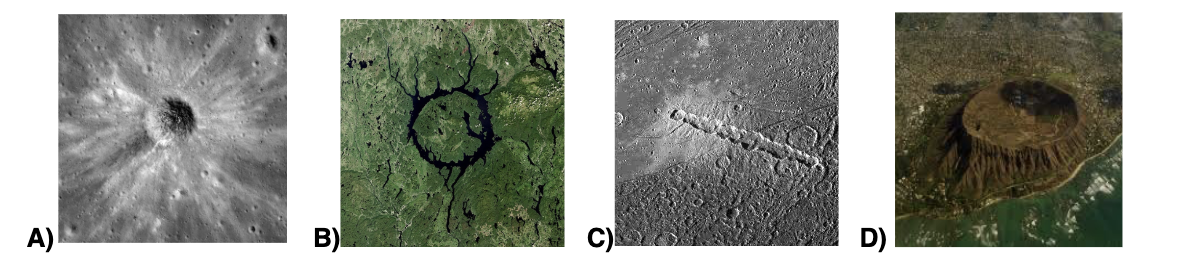
Which of the following craters was most likely formed by a comet collision? Write the letter
corresponding to the picture and describe your reasoning.
c
comets break apart in orbit easier than asteroids, so remnants will be more spread out; asteroids remain as one solid chunk
The Moon’s surface is much more heavily cratered than Earth’s. Give two reasons for this
difference.
The earth has certain features that either mitigate the impacts or completely erase them after they happen
The Earth has an atmosphere
Plate tectonics
How did the Moon form (what is the most likely hypothesis)?
Giant Impact Hypothesis:
During middle to late stages of Earth’s accretion, about 4.5 billion years ago, a Mars-sized body impacted the Earth and the giant impact quickly propelled a shower of debris from both the impacter and Earth into space
The impact sped up Earth’s rotation and tilted Earth’s orbital plane 23º
The moon aggregated from the debris
Ancient moon rocks brought back by the Apollo astronauts support this impact hypothesis
a) How big is the radius of the Sun compared to that of the Earth? b) How many Earths could
you fit inside the Sun? c) What is the Sun made of?
a. 109x larger
b. 1.3 million Earths
c. hydrogen 75% fuses into helium 25%
The Sun does not collapse under its own gravity. What prevents it from collapsing, and where does that support come from?
Tug of war; two things competing
One side: Gravity pushes in
Other side: Gas pressure pushes out
The outward push of pressure balances the inward pull of gravity = hydrostatic equilibrium
Explain why the core of the Sun is hotter than its “surface” (i.e., the photosphere)
More weight → more compression → higher temperature → higher pressure
What is nuclear fusion and why are high temperatures needed for hydrogen fusion to occur?
The nuclear strong force is even stronger than the electromagnetic force, but it only acts over extremely short distances
At low speeds, electromagnetic repulsion prevents the collision of nuclei
High temperatures increase protons’ speeds - this enables nuclear fusion to happen in the Sun’s core
About how long does it take energy to travel through the Sun’s radiative zone, and why does
it take so long?
It takes about million years for each photon to cross this zone
energy slowly transported upward by photons
Energy gradually leaks out of the radiative zone in the form of randomly bouncing photon
Energy moves outward from the Sun’s core in two different ways. What are they, and in
which part of the Sun does each one dominate
Radiative Zone: energy slowly transported upward by photons
Energy gradually leaks out of the radiative zone in the form of randomly bouncing photons. It takes about million years for each photon to cross this zone
Convection Zone:
Energy transported upward by rising hot gas
Energy is transported by convection in convection zone
Energy moves much faster here than in the radiative zone
Like boiling water, the bottom is hot, the air moves up and cools (sinking back down) in a cycle
Why do we see light coming from the Sun’s photosphere rather than from much deeper
inside the Sun?
photosphere is transparent'; the gases from the Sun become too opaque going deeper because of the (bouncing photons)
What is the solar wind, and what does it carry away from the Sun?
A flow of charged particles from the surface of the Sun
Sun’s gravity cannot bind hot atmosphere, so it boils off as a wind
1. Explain what is meant by differential rotation of the sun.
different latitudes of the sun rotate at different speeds. equator is fastest- 1 rotation in 25 days
2. What happens to the Sun’s magnetic field lines over time? What causes this?
The Sun’s magnetic field is constantly being generated and reshaped by the motion of hot, charged gas inside the Sun
Caused by differential rotation : When magnetic field lines pointing in opposite directions are pushed together, they can suddenly rearrange and reconnect
3. Approximately how often does the Sun’s global magnetic field reverse polarity? What changes do we observe in the sun during this cycle
11-years
sunspots, solar flares, and coronal mass ejections
4. What is a sunspot? Why are sunspots darker than the surrounding solar surface?
Dark, cooler regions in the visible surface of the sun, caused by strong magnetic fields
Cooler gas emits less light, so they look darker than their surroundings
5. Sunspots, solar flares, prominences, and coronal mass ejections all arise from the same
underlying physical cause. What is that cause, and how does it lead to these phenomena?
The sun’s differential rotation caused by its magnetic fields
gases are constantly moving —> electric charges moving —> electric currents —> magnetic fields —> DR and Convection —> kinks
6. What are coronal mass ejections (CMEs)? List two ways CMEs can affect Earth.
Giant clouds of particles hurled out into space
Take 1-3 days to get to Earth
power outages, auroras visible down to the equator
7. What are the aurora borealis and aurora australis, and what causes them to form?
natural, vibrant light displays in the sky
When the magnetosphere is overloaded by the flow of charged particles from the Sun, they may cascade toward Earth, producing aurorae
8. If you wanted to minimize the effects of space weather on daily life, where on Earth would be a relatively safe place to live? Explain why.
near the equator, low latitudes.
magnetic field lines are horizontal, most high-energy is towards the poles
9. What condition must be met for a cloud of gas to begin forming stars?
Stars form in places where gravity can overcome gas pressure
Cold temperatures (~10K) result in lower gas pressure
10. What properties of molecular clouds make them good environments for star formation?
Have a high concentration of dust grains that blocks the light from other stars, so molecular hydrogen can survive in them
They are dense and cold: the ideal conditions for star formation
11. What is interstellar dust? How does it affect our ability to observe star-forming regions?
Tiny, solid grains of elements such as carbon and silicon in the interstellar medium
absorbs and scatters ultraviolet light = opaque
12. Describe how wavelength, frequency, and energy are related for photons.
Photons: “pieces” of light, each with a precise energy
But light ALSO behaves like an electromagnetic wave
Shorter wavelength —> higher frequency & energy
Longer wavelength —> low frequency and energy
3. List the main regions of the electromagnetic spectrum, from shortest wavelength to longest wavelength
(high energy to low) gamma rays, x-rays, ultraviolet, visible light, infrared, microwaves, and radio waves
14. How do human eyes produce color images? How is this process similar to how astronomers create color images of astronomical objects?
Human eyes have rods and cones, rods (black and white), cones (color)
So your camera has some pixels that capture red light, some green, and some blue just like our eyes
Your camera uses a demosaicing algorithm to reconstruct the true-color image just like your brain does
5. Two moons have the same size, mass, and composition.
Moon A has a surface temperature of 600 K, and Moon B has a surface temperature of 1500 K.
a) Which moon emits more total light?
b) Which moon emits light with shorter typical wavelengths?
An object’s thermal radiation spectrum (that is, how much light it emits at each wavelength) depends on one property: temperature
a) Moon B emits more total light, because higher temperature
b) Hotter objects emit photons with higher average energy (ie, they emit more light at shorter wavelengths)
16. Why are infrared observations especially important for studying star formation, compared to observations in visible light?
Infrared light is affected much less by dust particles than visible light
With infrared detectors we can see stars hidden behind thick clouds of dust and gas
 Note
Note  Flashcards (23)