Systems 3/4 - Electronics 2
 Call Kai
 Learn
Learn Practice Test
 Spaced Repetition
 Match
Match Flashcards
1/23

There's no tags or description
Looks like no tags are added yet.
24 Terms
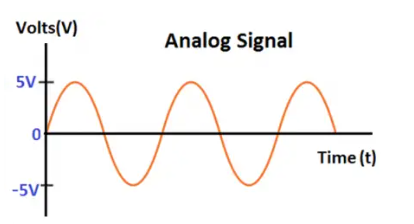
Analogue signal
Description
Example component
Graph
A signal that can have much variation between a minimum and maximum value.
Potentiometer
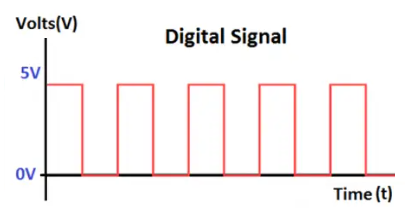
Digital
Description
Example component
Graph
A signal that can is either on or off (1 or 0)
Switch
Positive and negative
Identification (which is which)
Diode diagram (or most components)
Battery diagram
(Battery has conventional current leaving positive)

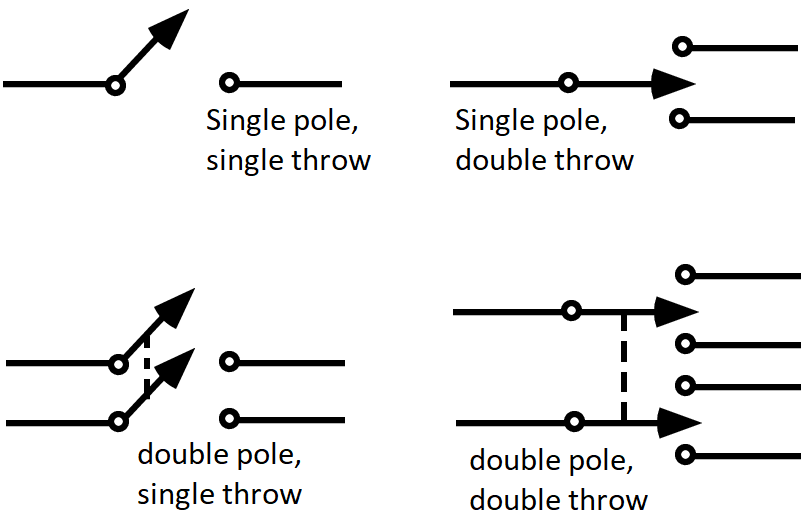
Switch poles and throws
Description
Diagram symbol (single and double of both poles and throws - 4 diagrams)
Poles: Number of moving "flaps".
Throws: Number of positions switch can make circuits
(You dont have to draw the arrow heads)
Semiconductor
Description
Example (2)
A material that is half way between a conductor and insulator, typically activating when current is added in various ways
Diode, transistor
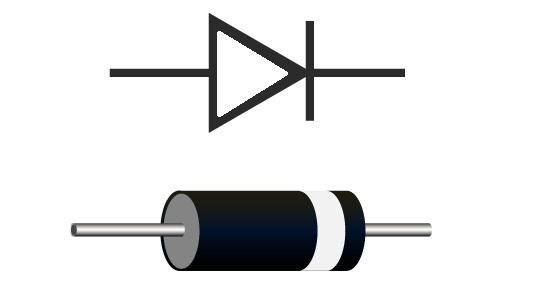
Diode
Description
Diagram symbol
What a physical diode looks like (not LED)
A device that permits current to flow through it in only one direction.
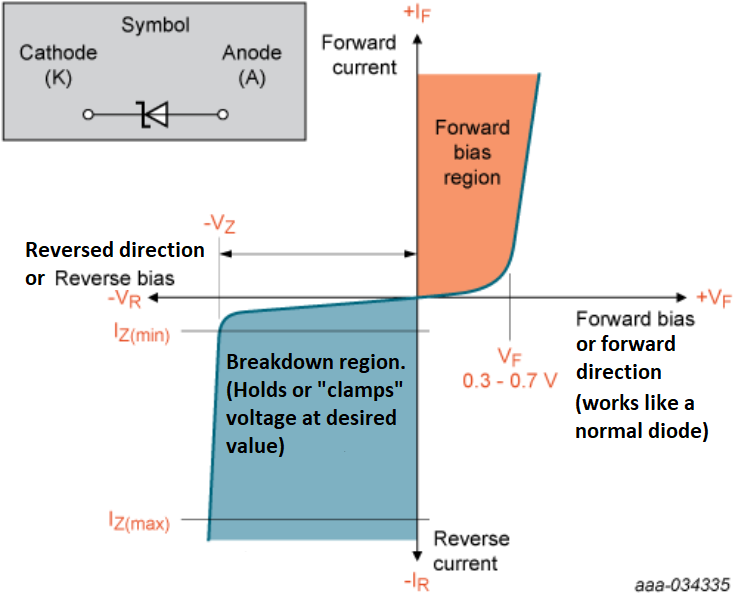
Zener Diode
Description (forward/backward bias?)
Use case
Diagram symbol + (rare)breakdown graph
Works like a diode in normal forward configuration (bias), but in backwards bias allows a set amount of voltage to pass when inside a breakdown region (min and max current)
Clamping voltage in a power source
LED
What does it stand for?
Description
Is it polarised?
Diagram symbol
Light Emitting Diode
A semiconductor that emits light when current flows through it.
Yes. Connecting it backwards might break it.

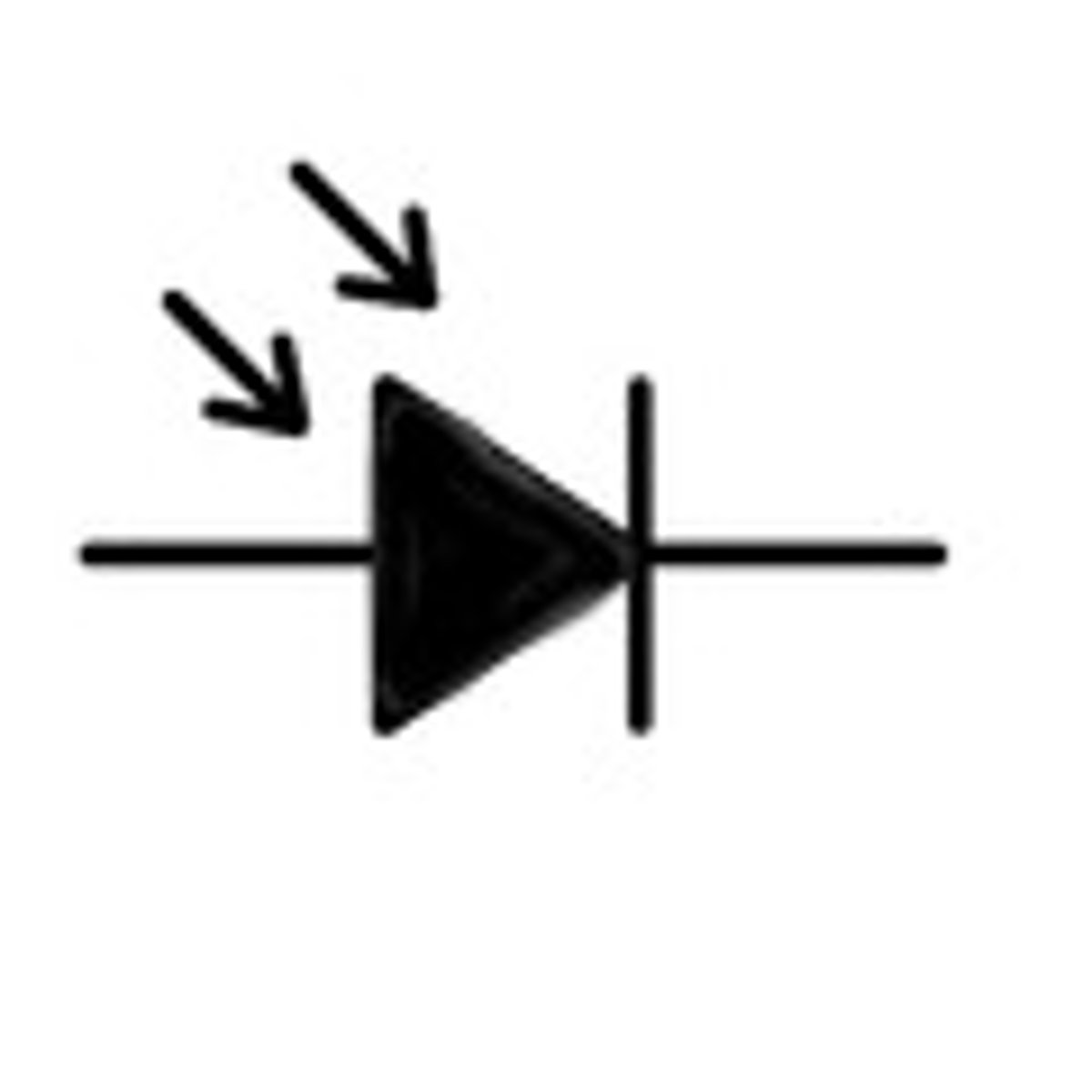
Photo Diode
Description
Use case
Diagram symbol
Only allows current to pass in one direction AND if light is shining on it.
Light-controlled switch.
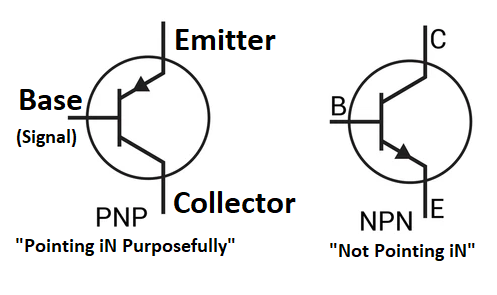
BJT Identification
What does it stand for?
Description/ use case
Diagram symbol (NPN and PNP)
A Bipolar Junction Transistor
A component that acts as an electrical switch or amplifier (increase of current)
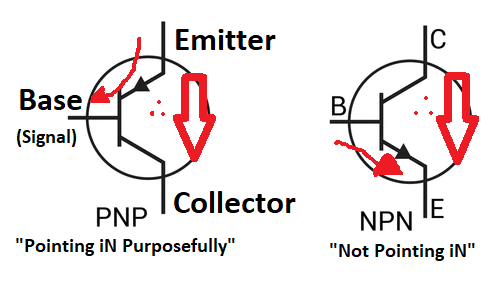
PNP and NPN current directions
Which way does the voltage drop need to occur for PNP?
Which way does the voltage drop need to occur for NPN?
When there is a voltage drop (0.7v) from emitter to base, then a larger current can flow from emitter to collector
When there is a voltage drop (0.7v) from base to emitter, then a larger current can flow from collector to emitter
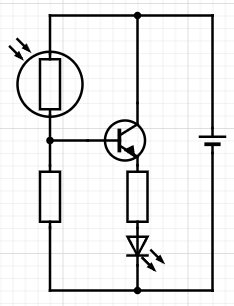
(rare + tough)
NPN BJT use case diagram
What happens to flow of electrons when there is low resistance in the LDR (darkness)?
Low resistance of LDR allows flow of electrons around outer trace, allowing current into the NPN (voltage drop), allowing an LED to turn on
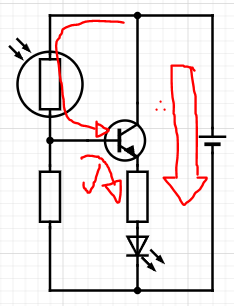
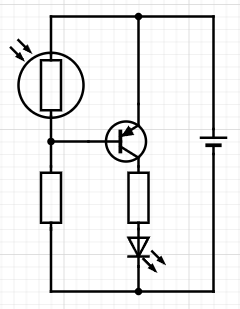
(rare + tough)
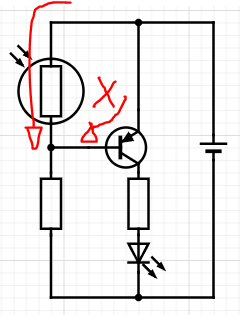
PNP BJT use case diagram
What happens to flow of electrons when there is low resistance in the LDR (darkness)? How is this different from NPN?
What happens when there is high resistance in the LDR (brightness) instead?
Low resistance of LDR allows for flow of electrons around outer trace, but the PNP RELEASES current when active (reverse bias), so does not activate, so LED is not turned on.
The current would flow preferentially through the BJT from emitter to base, turning on the LED.
General battery card (FINISH)
Capacitors
Description
Use case
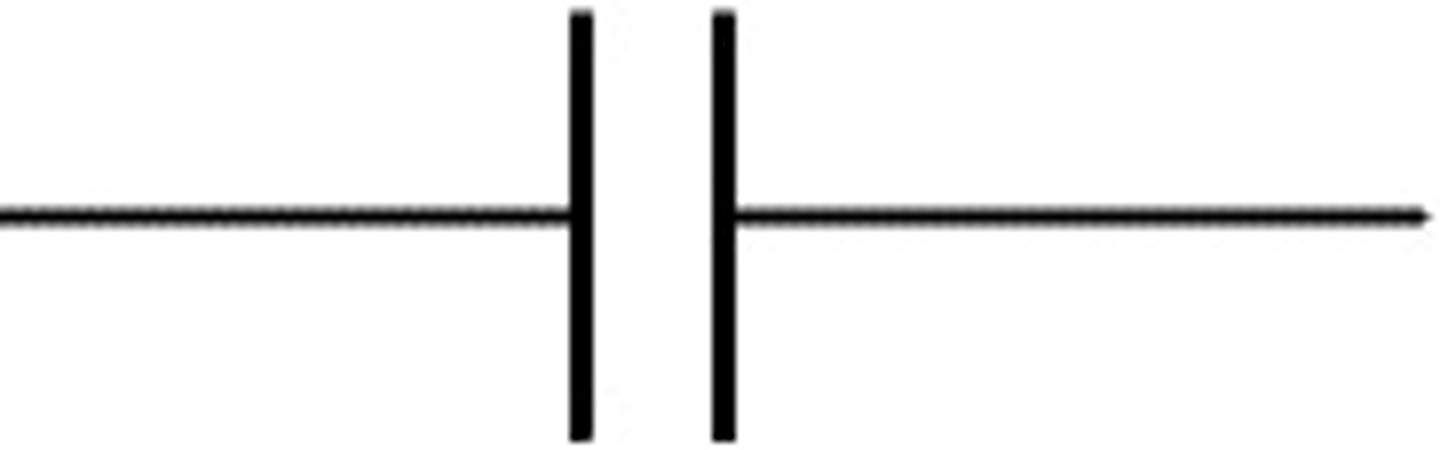
Diagram symbol
Component that has the ability to store and discharge electrical potential energy, similar to a battery but much faster
Smoothing rectified DC voltage, removing noise/ decoupling, timing circuits
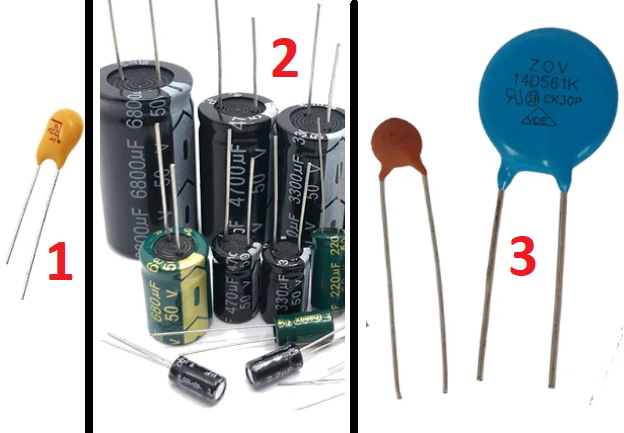
(rare) Types of Capacitors
Provide for each numbered type the:
Name
Electrostatic or electrolytic
Polarised?
Typical capacity (roughly)
Pros/Cons
Tantalum - electrostatic - non-polarised - Less than 1µF - tiny, medium density, $, flammable
Electrolytic (name and contents) - polarised - More than 1µF - large, high density,
Ceramic and polyester - electrostatic - Less than 1µF - small, low density, $
(rare)
Variable capacitor
Description
Use case
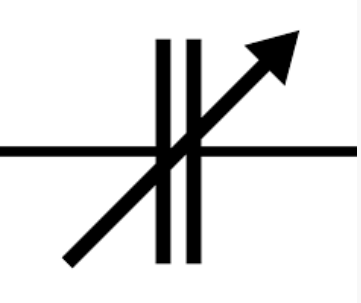
Diagram symbol
Capacitor where the capacitance is changed electrically or mechanically
Resonant circuits, such as radio tuners
Voltage divider
Description
Why do we prefer a voltage regulator?
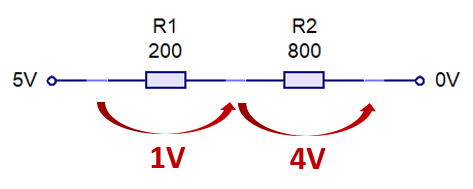
Identification (diagram)
Two resistors in series, where the voltage drop across one can be used in parallel to provide that lower voltage
As the total voltage drops (eg. battery), so does the output voltage - not desirable
Voltage regulator
Description
Use case
(rare) Common name of one
A device that maintains a constant voltage level (voltage divider lowers in voltage as total voltage drops)
Computer power supply
LM7805 (05 is the output voltage)
(rare)
Inverter
A device that converts DC to AC.
Open/Closed loop systems
What is a closed - loop system?
Example of closed - loop
What is an open - loop system?
Example of open - loop
Example of a combined open and closed loop system
A system with an automatic feedback loop
Automatic temperature control
A system that does not influence it’s own actions
Toaster
Fridge (temp-control + door light)
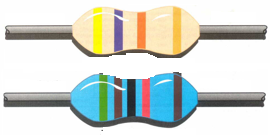
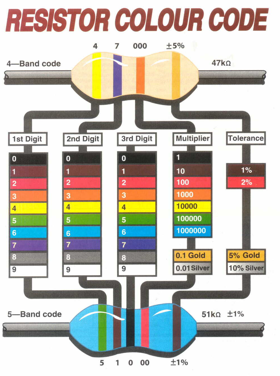
Resistors
What does the coloured bar on the far right (by itself) refer to?
What does the bar next to that one refer to? (second from right)
What do all other bars refer to?
Tolerance (= percent given in data sheet)
Multiplier (= number zeroes)
Digits (= actual digits, left to right)
(rare) LCD
What does it stand for?
Description
What does it look like (Image)
Liquid Crystal Display
Thin electronic display to block light in a grid to display images (no emission of light)

(rare)
Input transducer
Description
Example
Component that takes variations in physical (mechanical) energy and converts it into an electrical signal that can be read
Microphone