Organic Evolution Exam 3
 Call Kai
 Learn
Learn Practice Test
 Spaced Repetition
 Match
Match Flashcards
 Knowt Play
1/56

There's no tags or description
Looks like no tags are added yet.
Name | Mastery | Learn | Test | Matching | Spaced | Call with Kai |
|---|
No analytics yet
Send a link to your students to track their progress
57 Terms
complex adaptations
coexpressed traits that experience selection for a common function
Blueprint for making spores
Dna damage induces Sda which represses KinA
Up regulation by energy
Bacteria can survive harsh conditions by making spores
Hox genes are regulatory network of developmental genes in
a. fungi
b. plants
c. animals
d. bacteria
c. animals
promiscuous proteins
capable of carrying out functions other than their primary task, likely to take on new functions if duplicated
paraog
homologous gene that arises by gene duplication
gene recruitment
co-option of a particular gene or network for a totally different function as a result of a mutation
novel traits can evolve
when genes are expressed in a new developmental context
when duplication occurs and proteins are co opted into other functions
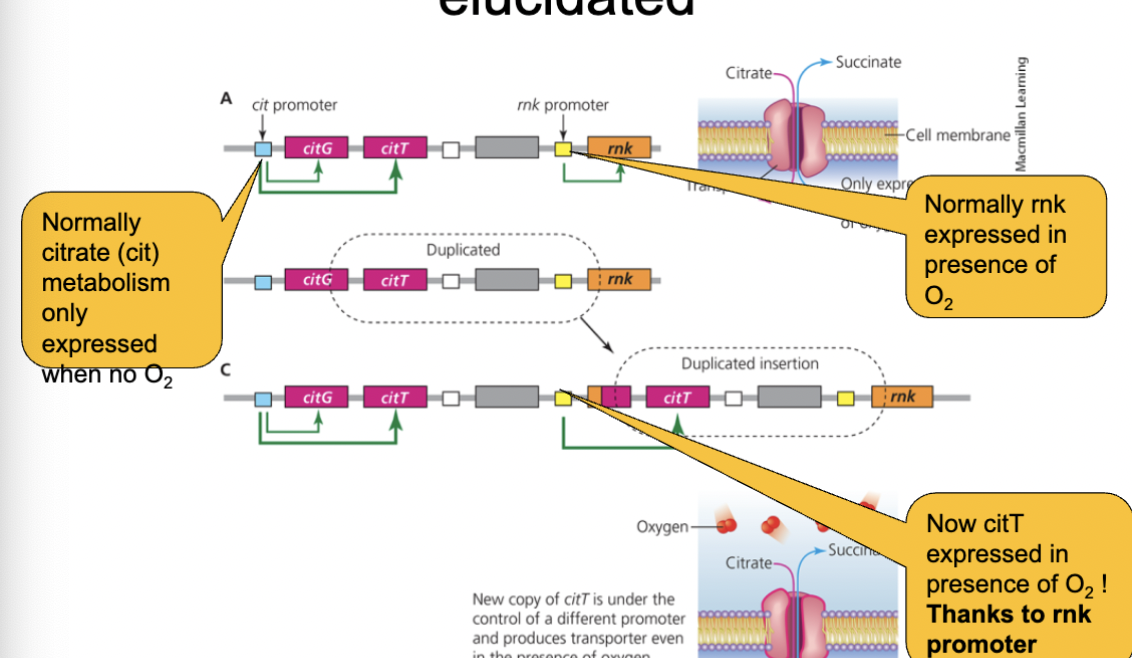
Question: In what way is gene recruitment involved in the evolution of aerobic citrate metabolism in E. coli?
A. Gene recruitment was not involved.
B. The citT gene was mutated to encode a promiscuous protein.
C. A duplicated citT gene came under the control of the rnk promoter.
D. A 2933-bp segment including the citT gene and the rnk promoter was duplicated and inserted next to the original segment.
C. A duplicated citT gene came under the control of the rnk promoter.
Molecular basis of citrate metabolism elucidated
normally citrate metabolism is only expressed w no oxygen
normally rnk expressed in presence of oxygen
now citT expressed in presence of oxygen
Venom delivery in venomous snakes requires
A. venom glands.
B. hollow teeth called fangs.
C. muscles around venom glands.
D. all of the above.
D. all of the above.
Regulatory mutation led to production of defensin gene in the mouth
pancreas to mouth(venom gland)
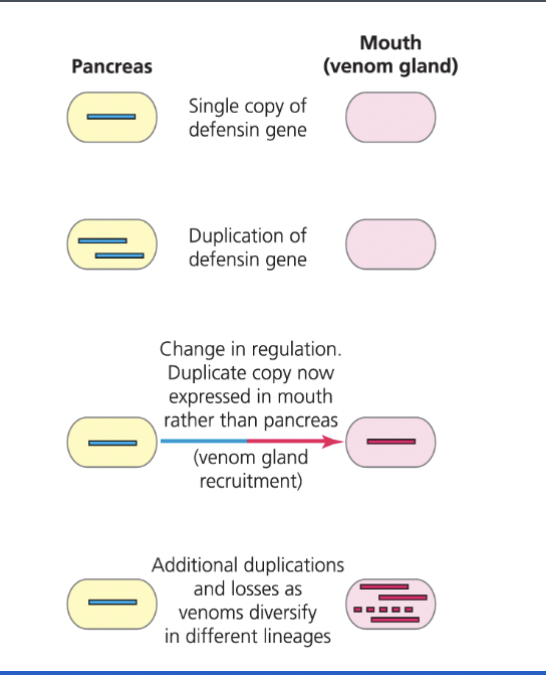
The genes recruited for venom production
a. evolved independently in each lineage of venomous snakes.
b. evolved in the ancestor of snakes.
c. evolved in the ancestor of snakes and their closest living relatives.
d. evolved in the ancestor of snakes and mammals.
c. evolved in the ancestor of snakes and their closest living relatives.
Based on the homology of Hox genes in humans, mice and flies, what can we deduce?
A. Hox genes are likely a result of convergent evolution.
B. Hox genes likely evolved after the two lineages diverged from a common ancestor.
C. The common ancestor of flies and mammals already had a set of Hox genes that controlled development.
D. The common ancestor of flies and mammals could not share a homology in developmental genes because the lineages are separated by nearly 570 million years
C. The common ancestor of flies and mammals already had a set of Hox genes that controlled development.
Hox genes are part of a conserved “genetic toolkit” among animals
A common ancestor in early animal evolution passed this gene set to animals now as diverse as flies and mammoths
orthologs
homologous genes seperated
Expression of Alx4 and Hoxd13 in fishes and tetrapods drives limb differences
Alx doesn’t extend beyond the wrist
How do bat forelimbs differ from their mammalian counterparts?
A. They have elongated digits.
B. They have an extra elongated digit.
C. They have extra limb bones evolved from a different ancestor.
D. There is no difference in bat forelimbs compared to their mammalian counterparts.
A. They have elongated digits.
Change in expression of Bmp2
Expression differences in a single gene – Bmp2 – give rise to limb elongation
Changes in the expression of developmental genes can dramatically alter phenotypes
– Turning fins into limbs.
– Turning ordinary mammal limbs into bat wings.
Opsin evolution
evolved the ability to capture photons and the early animals with these opsins could now sense light
Crystallins evolved through gene recruitment
When a gene is co- opted for a new function (but maintains its original) as a result of a mutation.
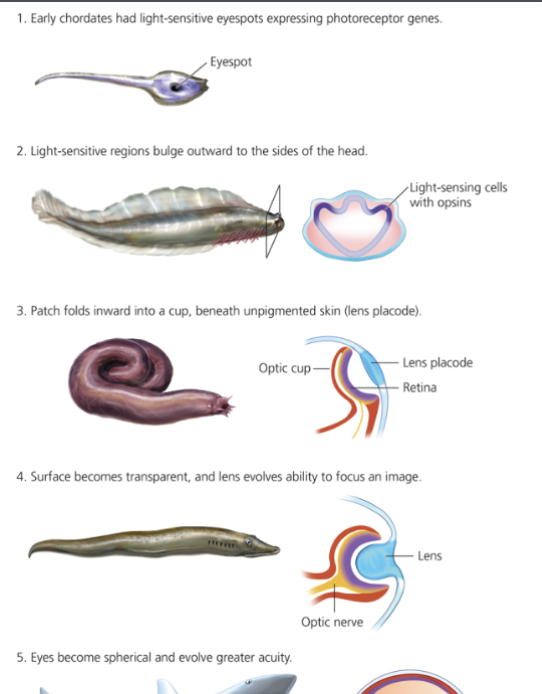
recent hypothesis for evolution of the vertebrae eye
The condition that occurs when a mutation that causes beneficial effects for one trait also causes detrimental effects on other traits is
A. pleiotropy.
B. positive selection.
C. negative selection.
D. antagonistic pleiotropy.
D. antagonistic pleiotropy.
Antagonistic pleiotropy
Single gene affects expression of many traits
mutations may have positive effects for one trait but negative effects for another trait
Law of physics
atmospheric O2 concentrations constrain insect size
Parallel evolution is
A. the independent evolution of two lineages into a similar form.
B. the independent evolution of similar traits, starting from a similar ancestral condition.
C. the process in which the genealogy of any pair of homologous alleles merges in a common ancestor.
D. a condition that occurs when the growth and development of traits in different lineages result from underlying genetic mechanisms that are inherited from a common ancestor.
B. the independent evolution of similar traits, starting from a similar ancestral condition.
Convergent evolution
Independent evolution leading to similar traits in two different lineages
– Result of similar selection pressures
parallel evolution
Independent evolution of similar traits in multiple lineages, all starting from a similar ancestral condition
– Cavefish species
– Three-spined stickleback
deep homology
When growth and development of traits in different lineages result from underlying mechanisms inherited from a common ancestor
• Is the fly eye homologous to the mouse eye, or is it
convergent?
• Both, depending on the level of development
examined
patterns of diversification
divergent evolution, convergent evolution, parallel evolution, coevolution
The difference in beak size between offspring of finches that survived the drought on Daphne Major and the population average before the drought is
a. the response to selection (R).
b. the selection differential (S).
c. heritability (H2).
d. heritability (h2).
e. the mutation rate (μ).
a. the response to selection (R).
What is beak size evolution
severe drought resulted in only harder woody seeds
result: larger beaked birds are favored
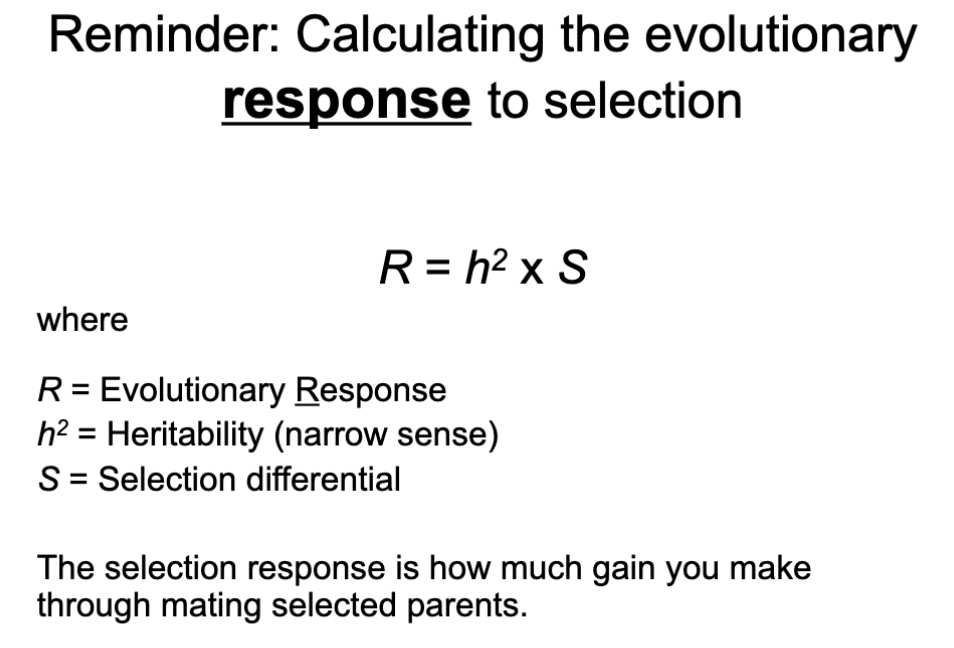
evolutionary response to selection equation
R=h²xS
broad sense heritability h² equation
proportion of total phenotypic variance of a trait that is attributable to genetic differences among individuals
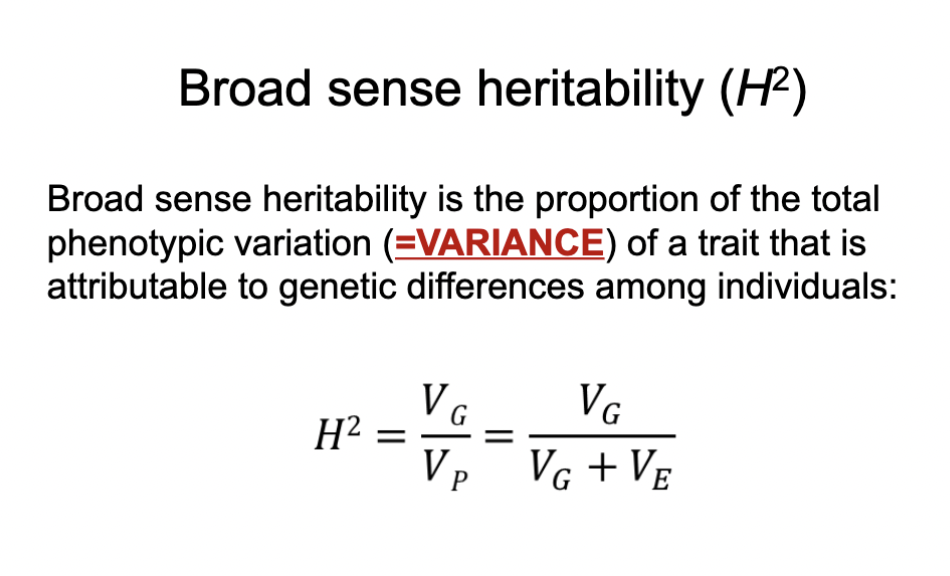
phenotypic variance
vp=vg+ve, environment + gene
broad sense heritability in terms of vg and vp
vg/vp or (va+vd+vi)/vp
narrow sense heritability equation
The proportion of phenotypic variance explained by the additive effects of alleles:
h²=va/vp
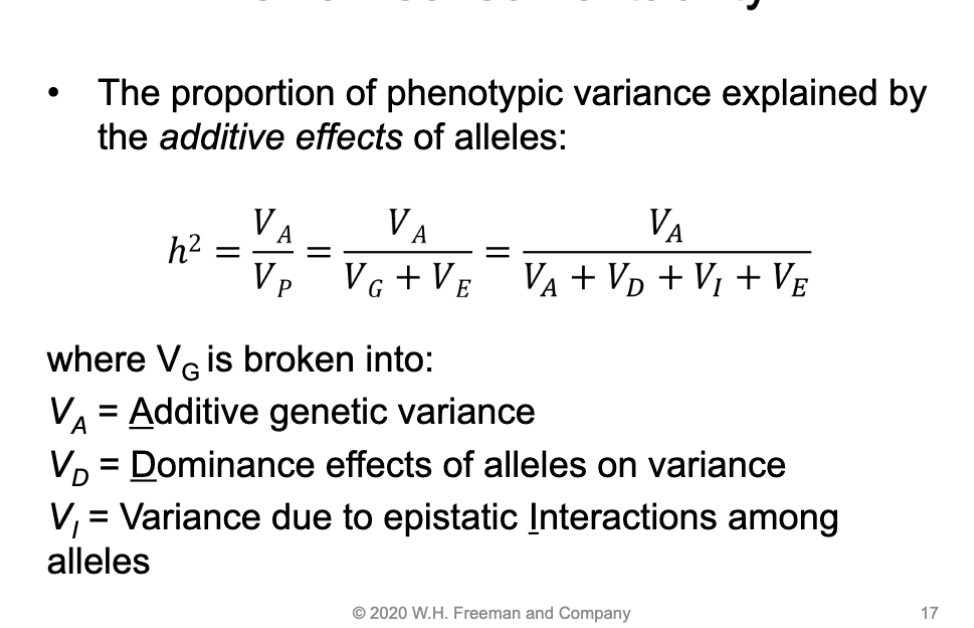
how to estimate heritability
mean of offspring from 2 specific parents
slope=heritability on graph
significance of peter and rosemary grant’s findings
They have demonstrated how very rapid changes in body and beak size in response to changes in the food supply are driven by natural selection.
selection differential equation
S=mean of reproducing individuals-mean of original population
true or false: high heritability results in larger change
true
stabilizing selection
mean selected, variance decreases
directional selection
mean shifts, variance decreases
disruptive selection
mean stays or two selected, variance increases
Question: Which statement describes the evolutionary history of winter-brown
snowshoe hares in Washington?
A. Their entire genome suggests they are in a clade with black- tailed jackrabbits and acquired the Agouti gene from winter- white hares.
B. They have a mutation for winter-brown fur that occurred in theAgouti gene of a winter-white hare and persisted where it increased fitness.
C. They descended from winter-white hares and acquired the Agouti allele for winter-brown fur from random matings with black-tailed jackrabbits.
D. They are infertile hybrids produced by matings between winter-white hares and black-tailed jackrabbits, which contribute the Agouti allele.
B. They have a mutation for winter-brown fur that occurred in theAgouti gene of a winter-white hare and persisted where it increased fitness.
which type of heritablity did the grant’s measure
narrow-sense heritability
Natural selection can lead to variations across habitats or environments.
Atlantic and Gulf Coast mice both evolved white fur, but the specific mutations responsible are different.
• The effect of natural selection can change in response to climate change.
• Alleles can spread rapidly in populations via hybridization.
predators vs parastitoids
More than one agent of selection can act on a trait
• Such agents can drive selection in two different directions at the same time
stabilizing selection on gall size
Intermediate size (stabilizing selection) results because:
1. Woodpecker eat larger galls
(directional selection for smaller galls).
2. Parasitoids are more effective at infecting smaller galls
(directional selection for larger galls).
If a population of gallflies occurred in an area where birds were present but parasitoid wasps were absent, which type of selection is most likely to affect gall size?
a. stabilizing
b. negative frequency-dependent
c. directional
d. disruptive
c. directional
Parallel evolution
the independent development of similar traits, forms, or behaviors in closely related, distinct lineages, usually when adapting to similar ecological niches
Question: Why do three-spined stickleback fish with low-Eda alleles have an advantage in freshwater over sticklebacks with high-Eda alleles? They have fewer predators in lakes.
A. Low-Eda fish stop growing at smaller body sizes, which allows them to survive with less armor.
B. Low-Eda fish use their available energy to grow faster and add body mass instead of armor.
C. Low-Eda fish can grow heavier armor to defend against the predators in freshwater.
D. Low-Eda fish can produce both large bodies and heavy armor when food is abundant.
B. Low-Eda fish use their available energy to grow faster and add body mass instead of armor.
Low-Eda allele favored in freshwater populations
• Production of armor is energetically costly.
– Little predation pressure means the cost may outweigh the benefit.
• Low-Eda allele present at low frequency in marine environment
– Favored when introduced to freshwater.
Humans as agents of selection
domesticated many plants and animals
many variations of both have been produced by artificial selection
Question: Why have so many species of weeds become resistant to glyphosate?
A. Glyphosate persists in the environment for a long time.
B. Many farmers used glyphosate as their only herbicide for years.
C. Glyphosate only targeted weeds and did not affect any crop plants.
D. Plants repeatedly sprayed with glyphosate develop tolerance for it
B. Many farmers used glyphosate as their only herbicide for years.
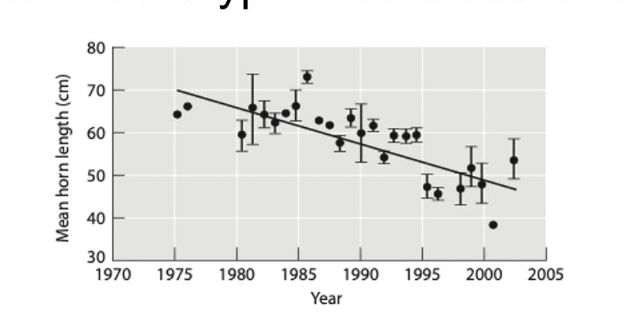
The graph below shows the effect of hunting imposed on horn length in bighorn sheep populations. What type of selection does it show?
a. stabilizing
b. negative frequency-dependent
c. directional
d. disruptive
c. directional

