Long Exam 2 Concepts (Capacitors)
 Call Kai
 Learn
Learn Practice Test
 Spaced Repetition
 Match
Match Flashcards
 Knowt Play
1/24

There's no tags or description
Looks like no tags are added yet.
Name | Mastery | Learn | Test | Matching | Spaced | Call with Kai |
|---|
No analytics yet
Send a link to your students to track their progress
25 Terms
Capacitor
A device consisting of two conductors separated by an insulator that stores electric potential energy and electric charge.
Capacitance (C)
The ratio of the magnitude of charge (Q) on one conductor to the potential difference (V) between them.
Farad (F)
The SI unit of capacitance; 1 F = 1 Coulomb per Volt (C/V).
Note: 1 F is very large; most problems use (μF, 10-6).
Dielectric
A nonconducting material (insulator) like paper, plastic, or glass placed between capacitor plates.
Dielectric Constant (K)
A dimensionless number that represents how much a material increases the capacitance.
K = 1
How much K (Dielectric Constant) does a vacuum have?
Dielectric Breakdown
The failure of an insulator at very high voltages, resulting in a spark or short circuit.
Permittivity (ϵ)
A measure of how much a material "permits" an electric field.
ϵ = κϵ0
Formula
Permittivity if a Dielectric
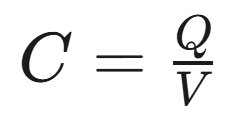
Formula
Fundamental Capacitance
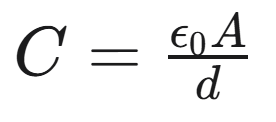
A = Area of plates (m2)
d = separation distance (m)
Formula
Capacitance (Parallel Plate)
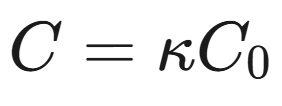
K = Dielectric Constant
C0 = Original Capacitance
Formula
Capacitance with Dielectric
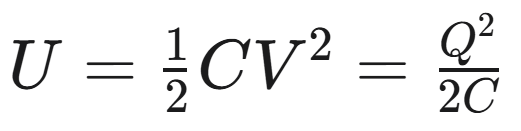
Formula
Potential Energy Stored
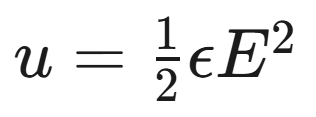
Formula
Energy Density
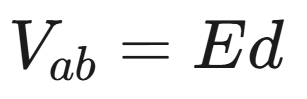
Formula
Voltage/Field Relation
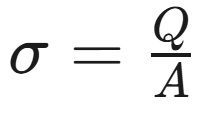
Formula
Surface Charge Density
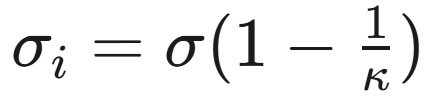
Formula
Induced Charge Density
Increases
Increasing vs. Decreasing
If you increase the area (A): Capacitance (C) …
Decreases
Increasing vs. Decreasing
If you increase the distance (d): Capacitance (C) …
Charge (Q)
If you insert a Dielectric and the battery is disconnected, which one is constant Charge (Q) or Voltage (V)?
Voltage (V)
If you insert a Dielectric and the battery is connected, which one is constant Charge (Q) or Voltage (V)?
Capacitance (C): Increases by factor K
Voltage (V): Decreases
Electric Field (E): Decreases
Energy (U): Decreases
If we insert a Dielectric when the battery is disconnected, what will happen to the Capacitance (C), Voltage (V), Electric field (E), and Energy (U)?
Capacitance (C): Increases by factor K
Voltage (V): Constant
Electric Field (E): Increases
Energy (U): Increases
If we insert a Dielectric when the battery is connected, what will happen to the Capacitance (C), Voltage (V), Electric field (E), and Energy (U)?
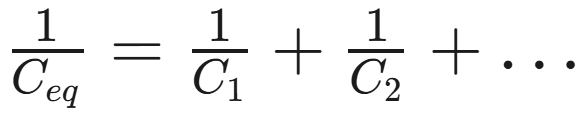
Rule: Every capacitor has the same Charge (Q).
Formula
How to get the Ceq in a Series.
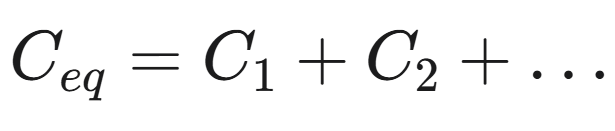
Rule: Every capacitor has the same voltage (V).
Formula
How to get the Ceq in a Parallel.

