Reading Modalities & Threats to Literacy lit psych
 Studied by 0 people
 Call Kai
 Learn
Learn Practice Test
 Spaced Repetition
 Match
Match Flashcards
 Knowt Play
1/29

There's no tags or description
Looks like no tags are added yet.
Name | Mastery | Learn | Test | Matching | Spaced | Call with Kai |
|---|
No analytics yet
Send a link to your students to track their progress
30 Terms
Reading Modalities
Traditional paper books
Audiobooks
Ebooks
Interactive platforms
Audiobooks
Audio recordings of someone reading a book
Decontextualized speech
Opportunity to share as a group
Can be paired with a physical book
E-Books
Digital books that can be read on devices (phones, tables, ereaders)
Sometimes include interactive features (e.g., multimedia, text-to-speech)
Adjustable fonts and features to individualize
Interactive Platforms
Apps, games, etc., meant to teach reading skills
Come in many different forms
Socrates Objections to the Written Word
1. Inflexibility of the written word
Dialogue was central to the Socratic Method of asking probing questions to prompt critical thinking, but the written word was “dead language” lacking the back-and-forth power of “living speech”
2. Memory’s destruction
Before writing, the ancient Greeks transmitted their cultures orally, which required huge amounts of information be memorized
Although writing had benefits for cultural memory, it had risks to an individual’s memory skills and knowledge building
“It will implant forgetfulness in their souls; they will cease to exercise memory because they rely on that which is written, calling things to remembrance no longer from within themselves, but by means of external marks. What you have discovered is a recipe not for memory, but for reminder.”
3. The loss of control over language
Once written language was released, there would be no control over what would be written, who would read it, and how it would be interpreted
Key Findings Regarding Reading on Screens
People spend more time reading
Previously reading intensively was more common – focusing on one or a few sources (e.g., books) at a time
Now people read extensively – reading all kinds of materials (e.g., articles, blogs) but much more quickly
Now that screens have become more prevalent, people spend more
time on:
Browsing, scanning, and keyword spotting
Non-linear reading (zig-zagging across the page rather than line by line)
More reading selectively (can’t read everything, so picking and choosing bits to read)
And less time on:
In-depth reading and concentrated reading (deep reading)
Sustained attention (more likely to be interrupted with other tasks or demands for attention)
Novelty Bias
We have an evolutionary bias to attend to new information
Devices give us endless novelty
Devices are designed to addict users
”Persuasive design”
Takes advantage of these natural tendencies
Encourages users to spend more time on devices
Continuous Partial Attention
The tendency to divide one’s attention between multiple things at once
90% of undergraduates said they were likely to multitask when reading onscreen, compared to 10% when reading in hard copy
Drawbacks of Continuous Partial Attention
Shallow thinking and weaker learning
Lower quality work
Mental fatigue and burnout
Increased stress and anxiety
Reduced emotional presence
Illusion of productivity
Decreased creativity
Habit-forming and self-reinforcing
Lasting Effects of Reading on Screens
The more constant the digital stimulation, the more intense the boredom and innui experienced when they are gone
The more we read digitally, the more our brain circuitry is tailored to that medium and how it is used
“Bleeding over” effect of reading on a screen may impact how you read other information
Screens threaten reading because
They can interfere with interaction
They leave less free time for reading
They are a distraction from reading
They pose a risk to deep reading
Screens can interfere with interaction
Interaction is the most important ingredient to language and literacy development
Effect of screens depends on how much interaction the child gets otherwise
Technoference = Technology + Interference
When technology interferes
with in-person interaction
Managing Screen Time & Preventing “Technoference”
Set time limits
Designate screen-free times
Consume content together
How do kids spend their free time?
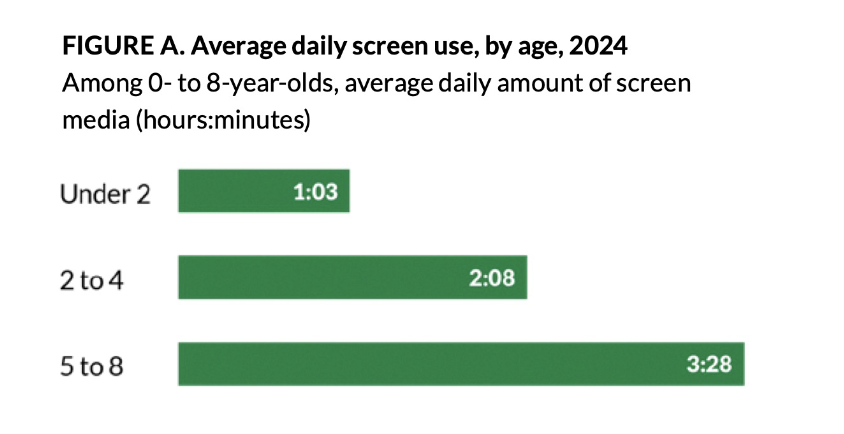
Screen Time & Academic Achievement
Parents reported children’s total screentime, TV and digital media time, and video gaming time, which was compared to standardized academic tests from grade 3
TV and digital media time and video game use were associated with lower
achievement levels in grade 3 reading
Each additional hour of total screen time was associated with 9% to 10% lower
odds of achieving a higher academic level in grade 3 reading
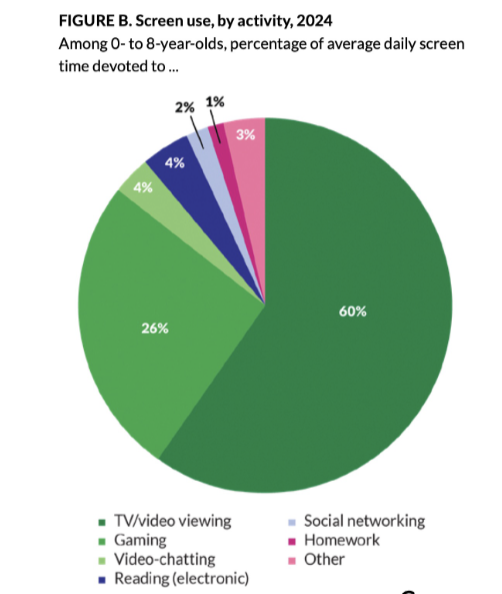
How do kids use screens?
Note: Only 4% of children’s screen time is spent reading
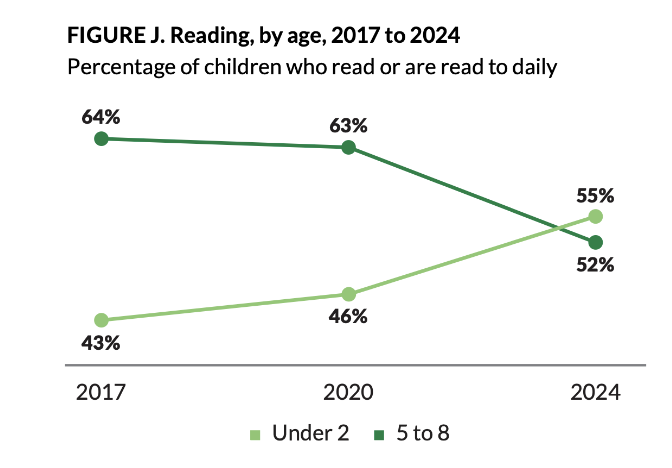
How many children read daily?
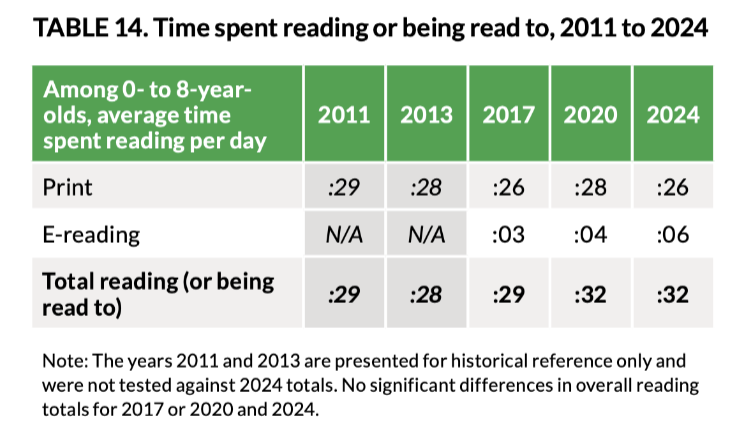
How much time do children spend reading?
Trade-offs Between Screen & Reading Time
Children’s screen use and reading activities were assessed via maternal report at age 24, 36, and 60 months
Greater screen use at 24 months was associated with lower reading at 36 months
In turn, lower reading at 36 months was associated with greater screen use at 60 months
A trade-off between screen use and reading was identified
Early screen use was associated with lower reading activities, resulting in greater screen use at later ages
Neural Effects of Screens vs. Reading
This study compared the time spent using screen-based media or reading on the functional connectivity of the reading-related brain regions in children aged 8–12
Parents completed surveys on how many hours their children spent on independent reading and screen-based media time, including smartphones, tablets, desktop or laptop computers and television
Children underwent magnetic resonance imaging that assessed their resting-state connectivity between the visual word form area (VWFA) and other brain regions
The more time children spent reading, the higher the functional connectivity between the VWFA and language regions to visual and cognitive control regions
In contrast, screen time was related to lower connectivity between the VWFA and regions related to language and cognitive control
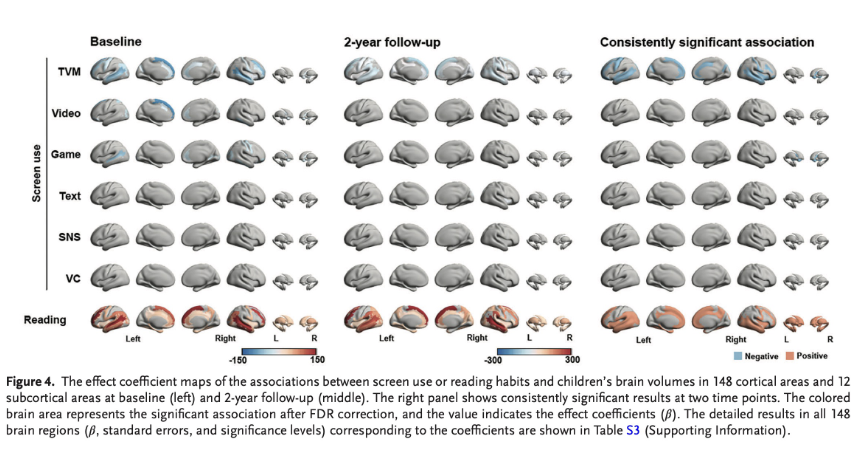
Neural Effects of Screentime & Reading in Adolescents
There are adverse causal effects of screen use on language ability and specific behaviors in early adolescents, while reading has positive causal effects on their language ability and brain volume in the frontal and temporal regions
Even Background TV is a Distraction
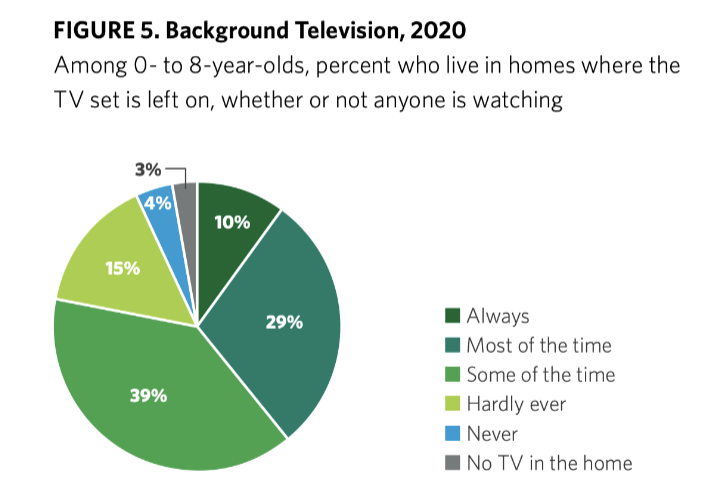
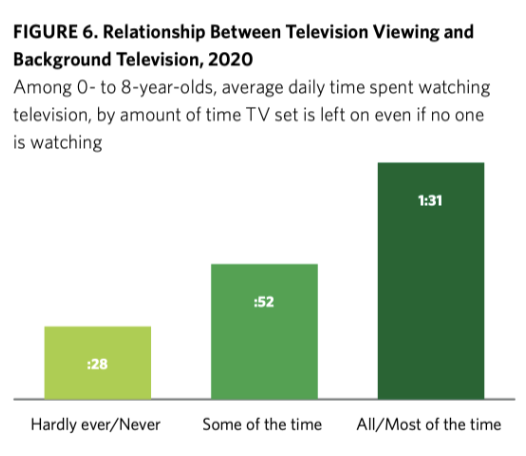
Background TV is linked to…
More TV watching
Less interaction and smaller vocabulary size
Reduced maternal language input — fewer words, fewer different words, and fewer questions directed at infants (Pempek et al., 2014)
A pattern of interaction that persists within the family across time and settings
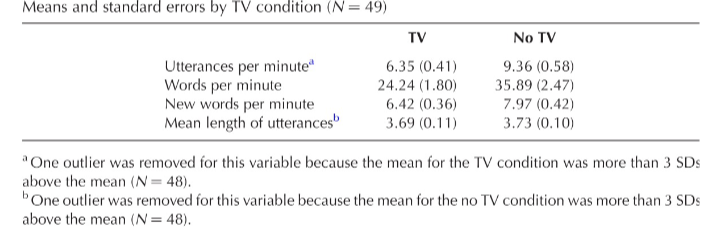
An Experimental Investigation
A within-subjects study in which half the time a TV was on and half the time a TV was off as parent-child pairs played in the room
• Both the quantity and quality of parent–child interactions decreased when the TV was on, even though children paid little direct attention to it
• Parents were less verbally responsive, less attentive, and less actively involved in their child’s play with background TV
Screens can interfere with deep reading
The type of attention we bring to reading can radically change our experience of it
Reading deeply allows you to examine the information, compare it to what you know, and add new information to your knowledge store
But those who have not collected a store or engaged in this kind of thinking do not know what they do not know
Screens can interfere with adults’ ability to think deeply about what they read
But for kids, the impact is much greater
They may never acquire skills in deep reading to begin with
Access isn’t Enough
Philadelphia libraries sought to “level the playing field” for children of low-income households by providing increased access to computer and reading materials
Research examined use of these materials across neighborhoods of low-high SES
Library access and use of resources was equivalent across SES
Differences emerged in quality of time spent
Differences in parent engagement according to SES
Children from low-SES neighborhoods were most often alone, whereas children in higher-SES neighborhoods were most often accompanied by an adult
This difference in parent engagement was consistent across both computer and book resources
Parent involvement was related to spending more time engaging in educational reading and computer activities at or above the child’s age level
Parental Involvement
Parental involvement remains crucial, regardless of the modality, in guiding comprehension and fostering a love of reading
Screens, when used purposefully, can support literacy development
Reading on Electronic Devices
Read it like a regular book (using dialogic reading)
Don’t get hung up on the tech
Research shows that parents spend lots of time discussing tech features and how to use it
Avoid using tech to take your place
Kids can get limited benefits from screen use on their own
Beware the “read to me” feature
Adding Value to Screen Time
Kids can get more from screen time when it’s interactive
Viewing alone may not lead to learning, even when content is educational
Educational content is best if it is:
Slow
Repetitive
Realistic
Contingent
My Favorite Tip…
Read books together and then watch the movie!
Some great book/movie pairs:
Captain Underpants by Dav Pilkey
Charlie and the Chocolate Factory by Roald Dahl
Cloudy with a Chance of Meatballs by Judi Barrett
Harry Potter by J.K. Rowling
The BFG by Roald Dahl
Screens in Kids’ Bedrooms = Not Good
Research has found only negative effects associated with screens in children’s bedrooms. E.g.,…
More overall screen use
Less physical activity
Higher levels of obesity
Less sleep
Lower quality sleep
 Note
Note  Flashcards (56)