Lec 2: Cell structure and components

0.0(0)
studied byStudied by 4 people
0.0(0)
full-widthCall Kai
learnLearn
examPractice Test
spaced repetitionSpaced Repetition
heart puzzleMatch
flashcardsFlashcards
GameKnowt Play
Card Sorting

1/78

encourage image

There's no tags or description

Looks like no tags are added yet.

Study Analytics
Name
Mastery
Learn
Test
Matching
Spaced

No study sessions yet.

79 Terms

1
New cards

What is Cell Theory? 

  • All organisms are made up of cells.

    • Cells are like building blocks to make more complicated structures 

    • cells are specialized to carry out different functions

  • The cell is the fundamental unit of life.

    • cells are important unit of life

    • cell is the simplest entity that we can define as living.

  • Cells come from preexisting cells

    • arise from preexisting cells through the process of cell division.

    • When a single parent cell divides, it produces daughter cells. Of course

2
New cards

What is the evolution of cellular differentiation theory?

  • Theory: Size of organism scales with it's complexity 

  • Left corner: simple form of life --> gradually become more complicated  
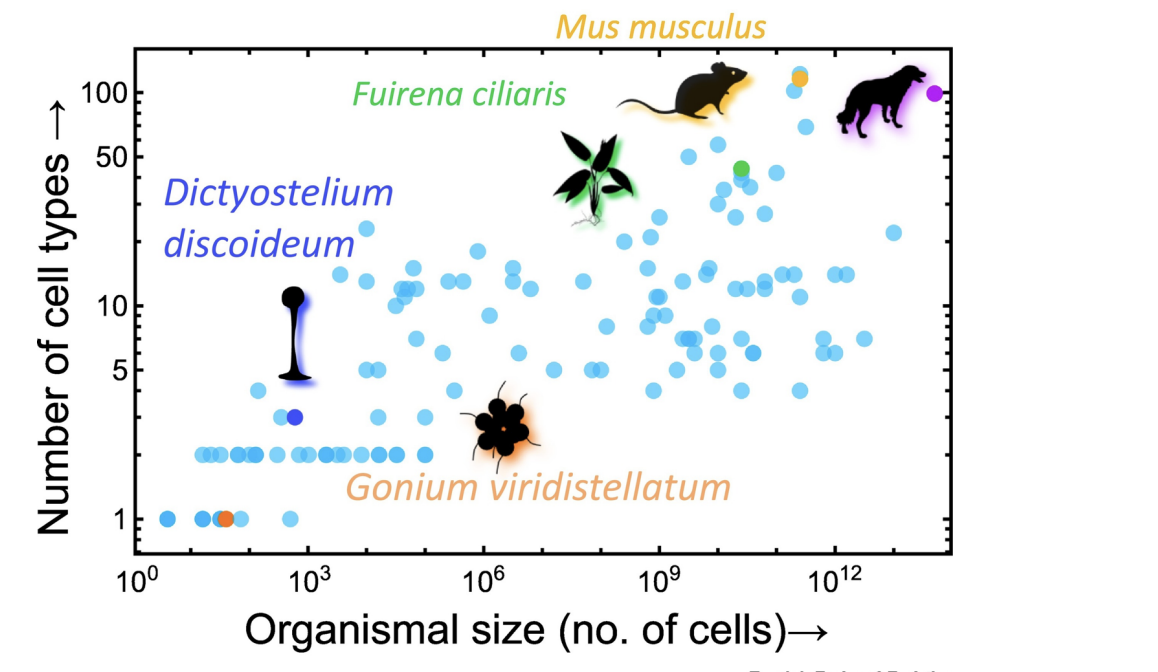
<ul><li><p><span style="background-color: inherit; line-height: 19.55px; color: windowtext;"><span>Theory: Size of organism scales with it's complexity</span></span><span style="line-height: 19.55px; color: windowtext;"><span>&nbsp;</span></span></p></li><li><p class="Paragraph SCXO3558683 BCX0" style="text-align: left;"><span style="background-color: inherit; line-height: 19.55px; color: windowtext;"><span>Left corner: simple form of life --&gt; gradually become more complicated&nbsp;</span></span><span style="line-height: 19.55px; color: windowtext;"><span>&nbsp;</span></span></p></li></ul><p></p>
3
New cards

What is the human cell atlas (HCA)?

  • Trying to build comprehensive map of human cells

    • structure and function are closely related

      • red blood cell looks and functions very differently from the long, slender muscle cells shown in that contract to exert force 

  • Serve as basis for understand human biological process --> used to diagnose, monitor, and treat diseases 
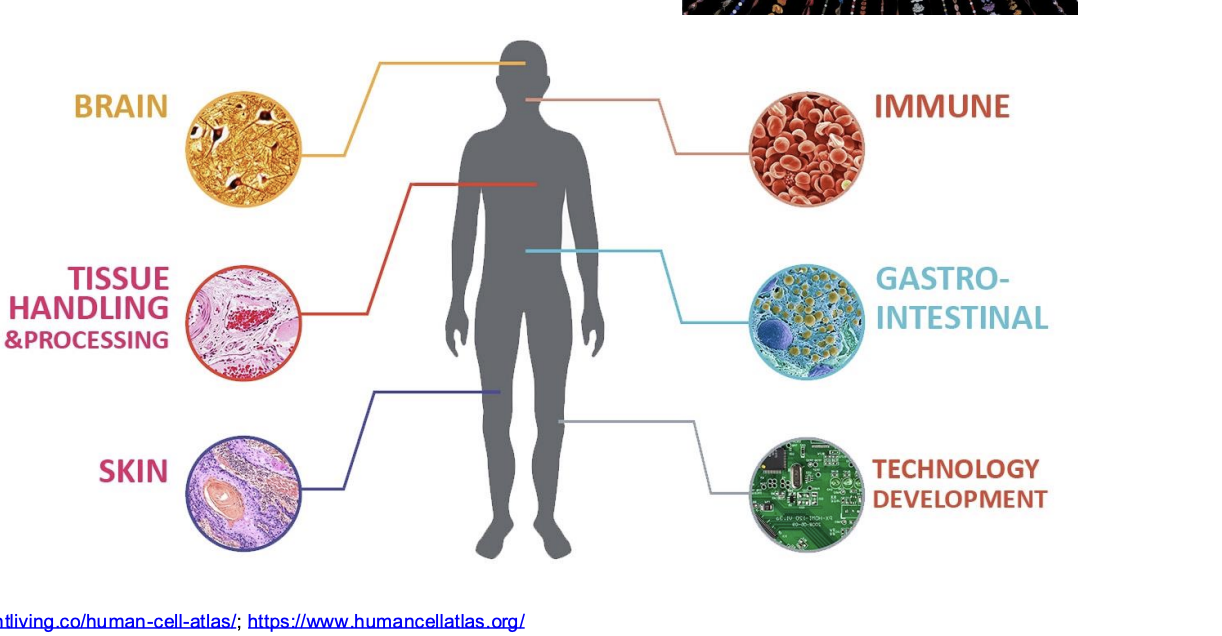
<ul><li><p><span style="background-color: inherit; line-height: 19.55px; color: windowtext;"><span>Trying to build comprehensive map of human cells</span></span></p><ul><li><p><span style="line-height: 19.55px; color: windowtext;"><span>structure and function are closely related</span></span></p><ul><li><p><span><span>red blood cell looks and functions very differently from the long, slender muscle cells shown in that contract to exert force</span></span><span style="line-height: 19.55px; color: windowtext;"><span>&nbsp;</span></span></p></li></ul></li></ul></li><li><p class="Paragraph SCXO74851803 BCX0" style="text-align: left;"><span style="background-color: inherit; line-height: 19.55px; color: windowtext;"><span>Serve as basis for understand human biological process --&gt; used to diagnose, monitor, and treat diseases</span></span><span style="line-height: 19.55px; color: windowtext;"><span>&nbsp;</span></span></p></li></ul><p></p>
4
New cards

Prokaryotes vs Eukaryotes

  • Prokaryotes

    • bacteria, archaea

    • lack a nucleus

    • First forms of life

    • genetic material is organized in one circular chromosome with many loops.

    • Instead of a nucleus, this genetic material is concentrated in a discrete region of the cell known as the nucleoid

    • cells smaller than eukaryotes

  • Eukaryotes

    • animals, plants, fungi, protists

    • have a nucleus: houses the vast majority of the cell’s DNA

    • transcription takes place in the nucleus first, and translation takes place later in the cytoplasm
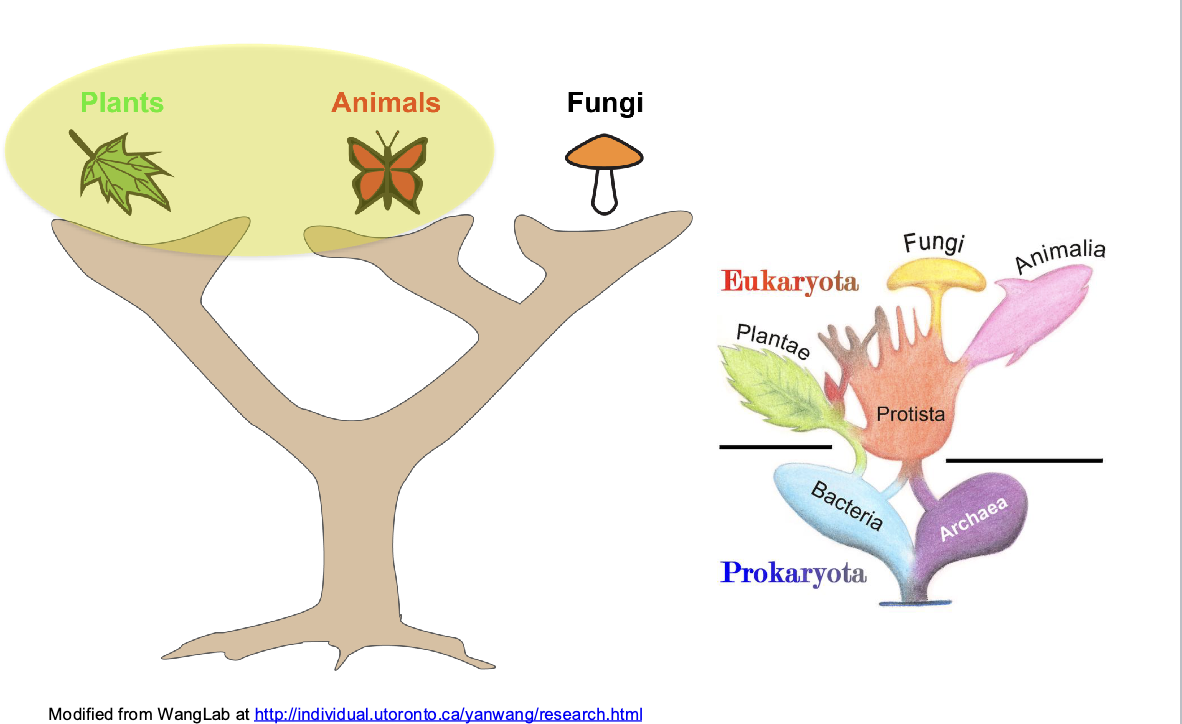
<ul><li><p>Prokaryotes</p><ul><li><p>bacteria, archaea</p></li><li><p>lack a nucleus</p></li><li><p>First forms of life</p></li><li><p>genetic material is organized in one circular chromosome with many loops.</p></li><li><p> Instead of a nucleus, this genetic material is concentrated in a discrete region of the cell known as the nucleoid</p></li><li><p>cells smaller than eukaryotes</p></li></ul></li><li><p>Eukaryotes</p><ul><li><p>animals, plants, fungi, protists</p></li><li><p>have a nucleus:&nbsp;<span><span>houses the vast majority of the cell’s DNA</span></span></p></li><li><p><span><span>transcription takes place in the nucleus first, and translation takes place later in the cytoplasm</span></span></p></li></ul></li></ul><p></p>
5
New cards

What is microscopy?

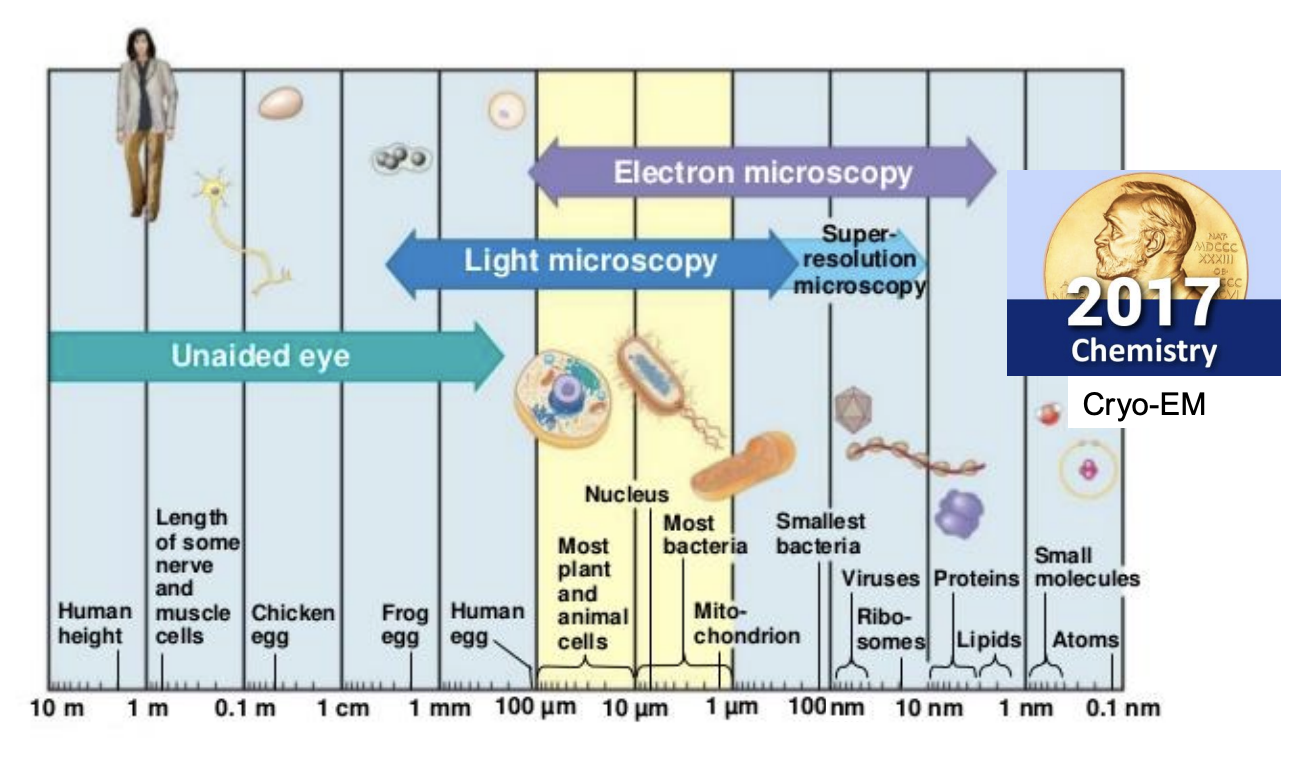
  • method of studying cells that can’t be seen by the human eye

    • below 100 fancy m meters

6
New cards

What are the types of micrscopy?

  • unaided eye: anything above 100 fancy ums

  • light microscopy: 100 - 1

    • most plant and land animals

    • nucleus

    • most bacteria

    • mitochondria

  • Electron microscopy: 100 -1 nm

    • light microscopy +

    • smallest bacteria

    • viruses

    • ribsoomes

    • proteins

    • lipids

  • super resolution microscopy: 1 fancy u - 10 nm

  • Cryo-EM: 1 - 0.1 nm

    • small molecules

    • atoms

<ul><li><p>unaided eye: anything above 100 fancy ums</p></li><li><p>light microscopy: 100 - 1 </p><ul><li><p>most plant and land animals</p></li><li><p>nucleus</p></li><li><p>most bacteria</p></li><li><p>mitochondria</p></li></ul></li><li><p>Electron microscopy: 100 -1 nm</p><ul><li><p>light microscopy +</p></li><li><p>smallest bacteria</p></li><li><p>viruses</p></li><li><p>ribsoomes</p></li><li><p>proteins</p></li><li><p>lipids</p></li></ul></li><li><p>super resolution microscopy: 1 fancy u - 10 nm</p></li><li><p>Cryo-EM: 1 - 0.1 nm</p><ul><li><p>small molecules</p></li><li><p>atoms</p></li></ul></li></ul><p></p>
7
New cards

What is needed to view microscopic things?

  • different kinds of microscopes

8
New cards

How can a fungal culture be seen in a microscope?

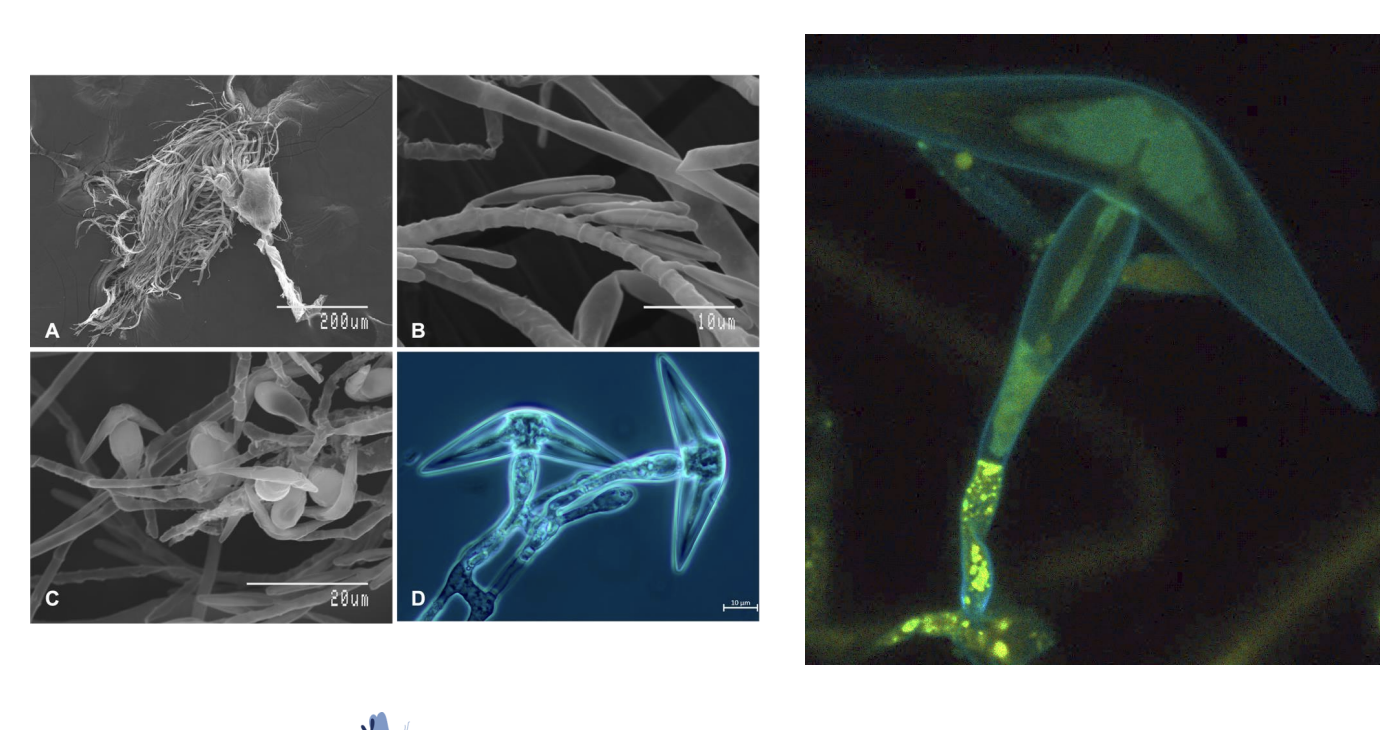
  • Left: fungal culture 

    • Can see with naked eye 

    • Microbial fungi --> colony formed 

  • Middle: microscope 

    • Colony on slide --> higher structure of fungal spores and fungal hierarchy 

  • 630: what spores look like (aquatic microbes that infect hosts, has felangees) 
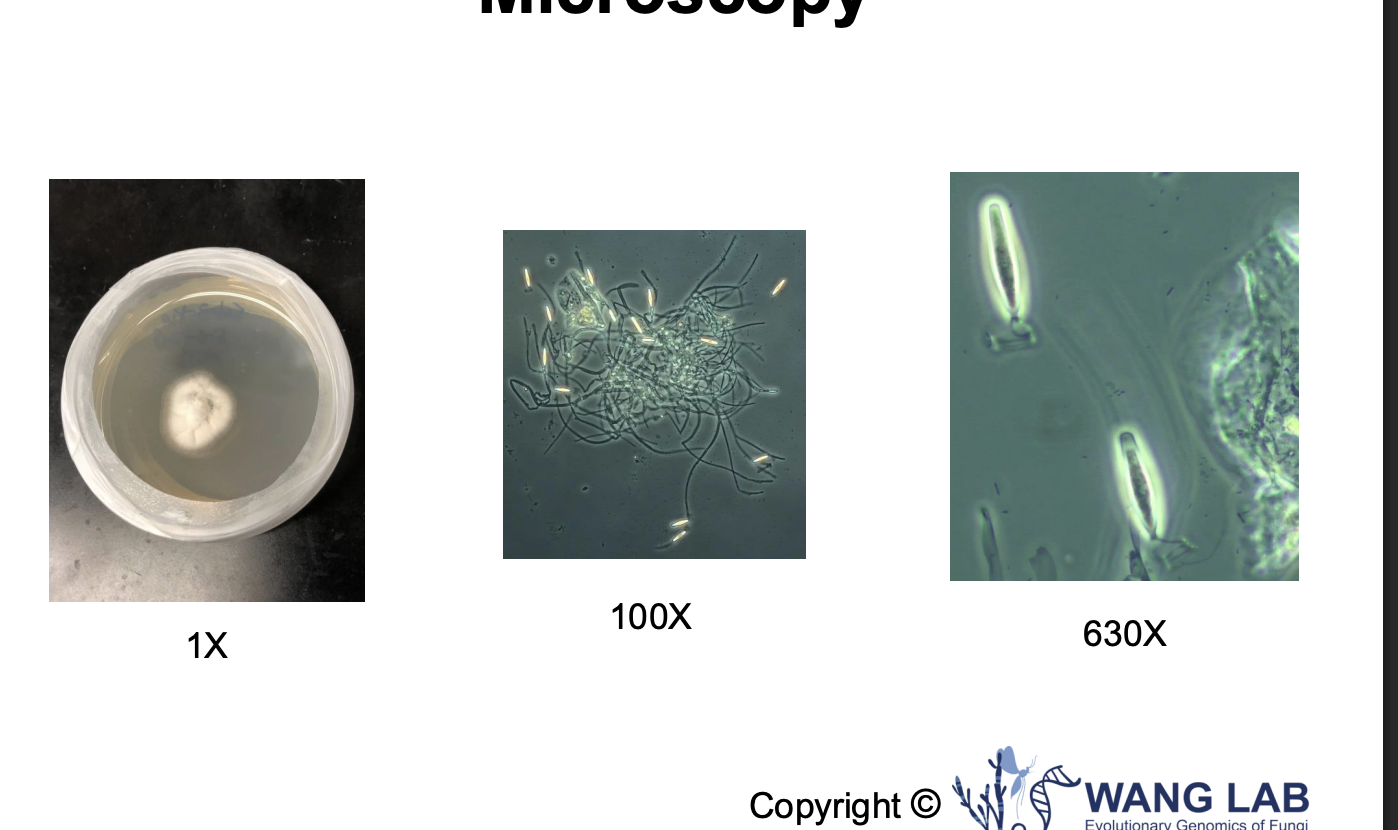
<ul><li><p><span style="background-color: inherit; line-height: 19.55px; color: windowtext;"><span>Left: fungal culture</span></span><span style="line-height: 19.55px; color: windowtext;"><span>&nbsp;</span></span></p><ul><li><p class="Paragraph  BCX0 SCXO190575521" style="text-align: left;"><span style="background-color: inherit; line-height: 19.55px; color: windowtext;"><span>Can see with naked eye</span></span><span style="line-height: 19.55px; color: windowtext;"><span>&nbsp;</span></span></p></li><li><p class="Paragraph  BCX0 SCXO190575521" style="text-align: left;"><span style="background-color: inherit; line-height: 19.55px; color: windowtext;"><span>Microbial fungi --&gt; colony formed</span></span><span style="line-height: 19.55px; color: windowtext;"><span>&nbsp;</span></span></p></li></ul></li><li><p class="Paragraph  BCX0 SCXO190575521" style="text-align: left;"><span style="background-color: inherit; line-height: 19.55px; color: windowtext;"><span>Middle: microscope</span></span><span style="line-height: 19.55px; color: windowtext;"><span>&nbsp;</span></span></p><ul><li><p class="Paragraph  BCX0 SCXO190575521" style="text-align: left;"><span style="background-color: inherit; line-height: 19.55px; color: windowtext;"><span>Colony on slide --&gt; higher structure of fungal spores and fungal hierarchy</span></span><span style="line-height: 19.55px; color: windowtext;"><span>&nbsp;</span></span></p></li></ul></li><li><p class="Paragraph  BCX0 SCXO190575521" style="text-align: left;"><span style="background-color: inherit; line-height: 19.55px; color: windowtext;"><span>630: what spores look like (aquatic microbes that infect hosts, has felangees)</span></span><span style="line-height: 19.55px; color: windowtext;"><span>&nbsp;</span></span></p></li></ul><p></p>
9
New cards

How can a mushroom be seen in a microscope?

  • See fine details on surface and inside the cell 

  • Right: study content inside the cell 

    • How nutrients transported 

<ul><li><p><span style="background-color: inherit; line-height: 19.55px; color: windowtext;"><span>See fine details on surface and inside the cell</span></span><span style="line-height: 19.55px; color: windowtext;"><span>&nbsp;</span></span></p></li><li><p class="Paragraph SCXO192429150 BCX0" style="text-align: left;"><span style="background-color: inherit; line-height: 19.55px; color: windowtext;"><span>Right: study content inside the cell</span></span><span style="line-height: 19.55px; color: windowtext;"><span>&nbsp;</span></span></p><ul><li><p class="Paragraph SCXO192429150 BCX0" style="text-align: left;"><span style="background-color: inherit; line-height: 19.55px; color: windowtext;"><span>How nutrients transported</span></span><span style="line-height: 19.55px; color: windowtext;"><span>&nbsp;</span></span></p></li></ul></li></ul><p></p>
10
New cards

What is the cell membrane?

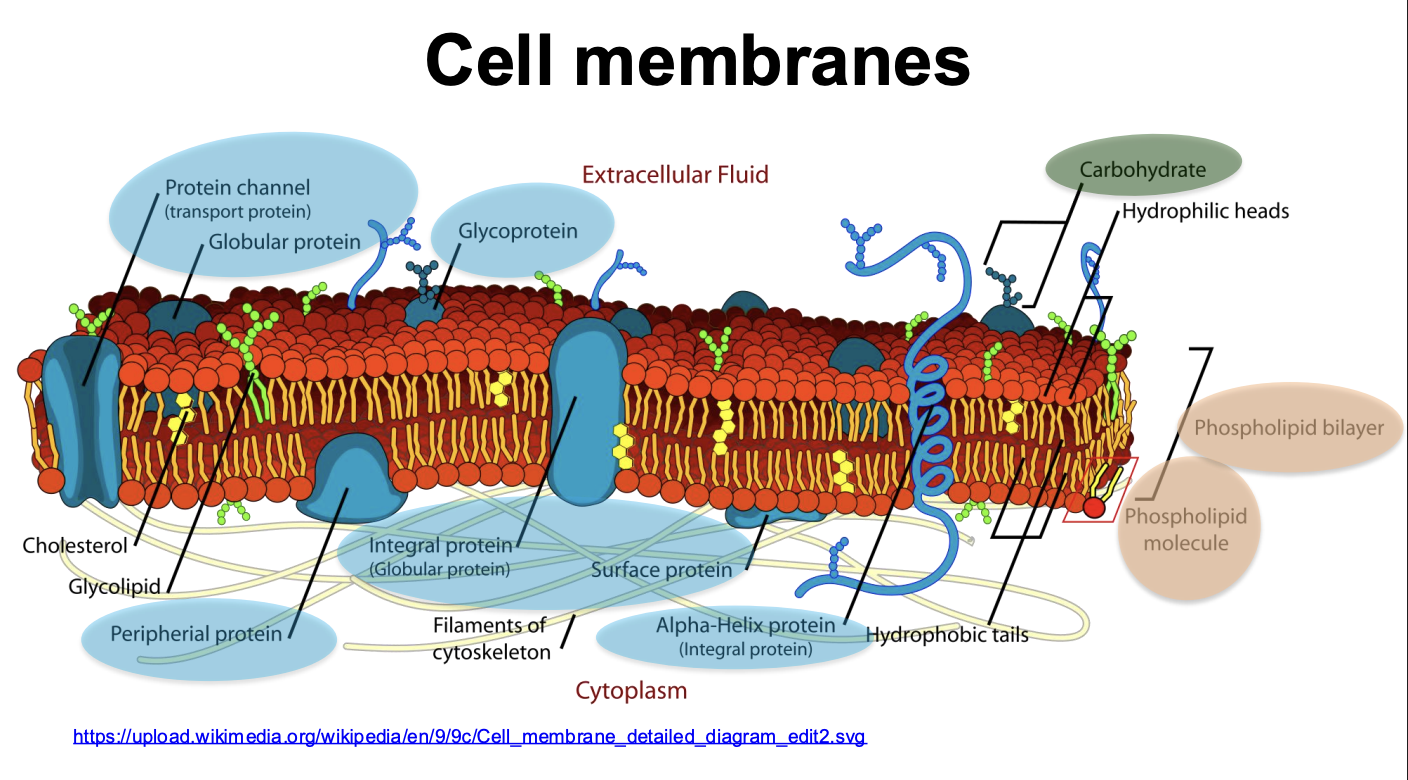
  • The membrane that surrounds the cytoplasm of the cell, separating the inside of the cell from the outside of the cell; also called the plasma membrane. (book)

  • composed of lipids, proteins, and carbohydrates.

11
New cards

What are the parts of the cell membrane?

  • Phospholipid bilayer

  • phospholipid molecule

  • protein chanel (transport protein)

  • Globular protein (integral protein)

  • peripheral protein

  • glycoprotein

  • Alpha-Helix protein (Integral protein)

  • filaments of cytoskeleton

  • cholesterol

  • carbohydrate

  • hydrophilic tails

  • hydrophobic tails

<ul><li><p>Phospholipid bilayer</p></li><li><p>phospholipid molecule</p></li><li><p>protein chanel (transport protein)</p></li><li><p>Globular protein (integral protein)</p></li><li><p>peripheral protein</p></li><li><p>glycoprotein</p></li><li><p>Alpha-Helix protein (Integral protein)</p></li><li><p>filaments of cytoskeleton</p></li><li><p>cholesterol</p></li><li><p>carbohydrate</p></li><li><p>hydrophilic tails</p></li><li><p>hydrophobic tails</p></li></ul><p></p>
12
New cards

What is the structure of phospholipids?

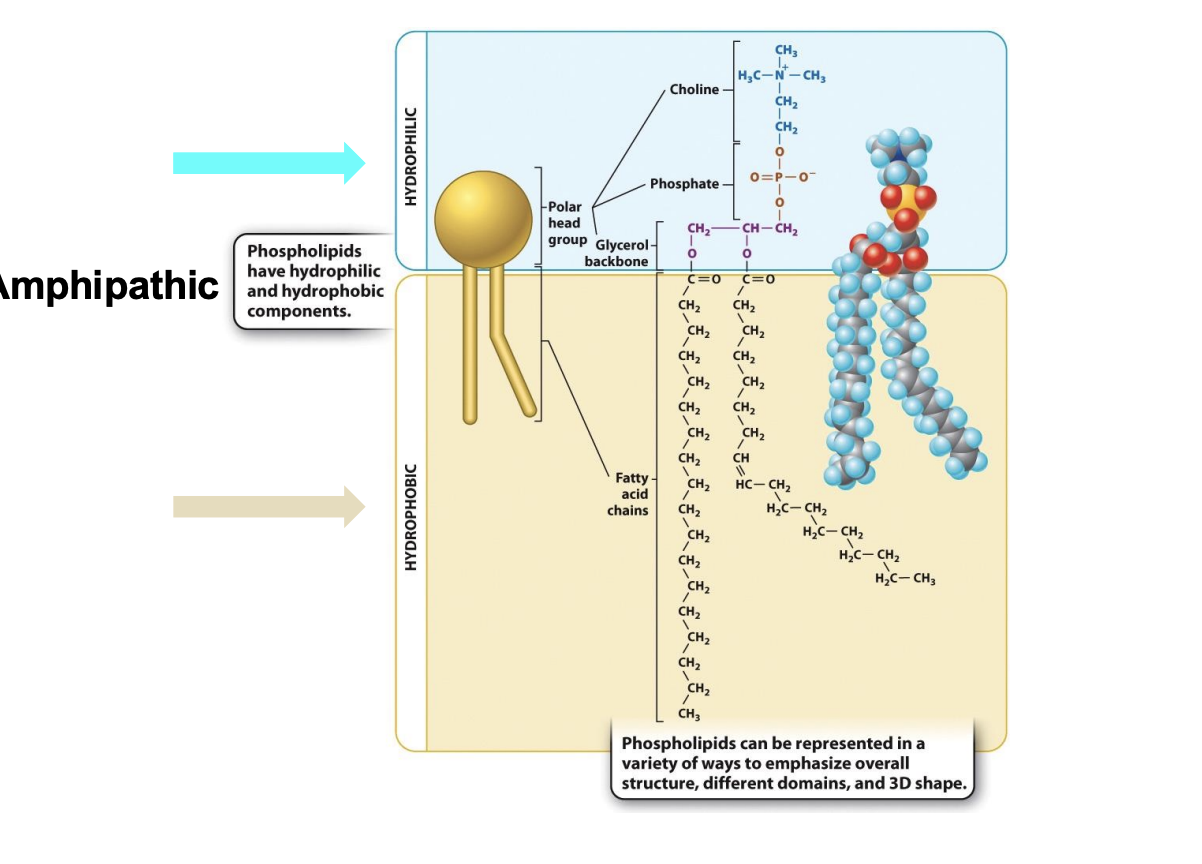
  • Amphipathic: both hydrophilic and hydrophobic 

    • Hydrophilic head (polar):

      • Choline + phosphate + glycerol backbone

    • Hydrophobic tail 

      • Fatty acid chain

      • nonpolar → do not form hydrogen bonds with water

    • Way to build stable larger structure --> assemble with peers 

    • spontaneously arrange themselves into various structures in which the polar head groups on the outside interact with water and the nonpolar tails come together on the inside away from water.

      • results from the tendency of polar molecules like water to exclude nonpolar molecules or nonpolar groups of molecules.
<p></p><ul><li><p><span style="background-color: inherit; line-height: 19.55px; color: windowtext;"><span>Amphipathic: both hydrophilic and hydrophobic</span></span><span style="line-height: 19.55px; color: windowtext;"><span>&nbsp;</span></span></p><ul><li><p class="Paragraph SCXO232232596 BCX0" style="text-align: left;"><span style="background-color: inherit; line-height: 19.55px; color: windowtext;"><span>Hydrophilic head</span></span><span style="line-height: 19.55px; color: windowtext;"><span>&nbsp;(polar):</span></span></p><ul><li><p class="Paragraph SCXO232232596 BCX0" style="text-align: left;">Choline + phosphate + glycerol backbone</p></li></ul></li><li><p class="Paragraph SCXO232232596 BCX0" style="text-align: left;"><span style="background-color: inherit; line-height: 19.55px; color: windowtext;"><span>Hydrophobic tail</span></span><span style="line-height: 19.55px; color: windowtext;"><span>&nbsp;</span></span></p><ul><li><p class="Paragraph SCXO232232596 BCX0" style="text-align: left;">Fatty acid chain</p></li><li><p class="Paragraph SCXO232232596 BCX0" style="text-align: left;">nonpolar → do not form hydrogen bonds with water</p></li></ul></li><li><p class="Paragraph SCXO232232596 BCX0" style="text-align: left;"><span style="background-color: inherit; line-height: 19.55px; color: windowtext;"><span>Way to build stable larger structure --&gt; assemble with peers</span></span><span style="line-height: 19.55px; color: windowtext;"><span>&nbsp;</span></span></p></li><li><p class="Paragraph SCXO232232596 BCX0" style="text-align: left;"><span><span>spontaneously arrange themselves into various structures in which the polar head groups on the outside interact with water and the nonpolar tails come together on the inside away from water. </span></span></p><ul><li><p class="Paragraph SCXO232232596 BCX0" style="text-align: left;"><span><span>results from the tendency of polar molecules like water to exclude nonpolar molecules or nonpolar groups of molecules.</span></span></p></li></ul></li></ul></li></ul><p></p>
13
New cards

What are the lipid structures?

  • Micelle

  • bilayer

  • liposome

14
New cards

What is a micelle?

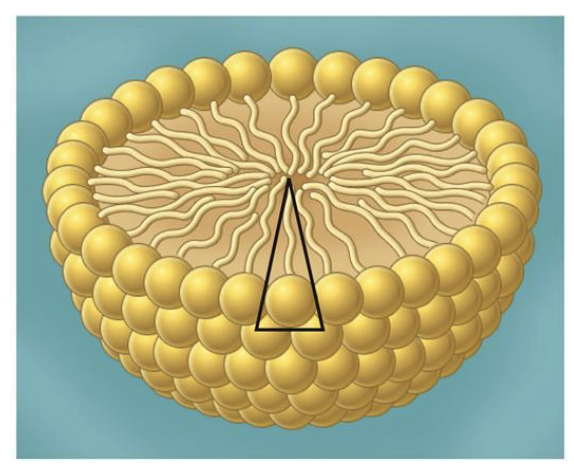
  • Head large

  • phospholipids can form circular structure (tails inside) 

  • Head is large and bulky with one hydrophobic tail buried.
<ul><li><p><span style="background-color: inherit; line-height: 19.55px; color: windowtext;"><span>Head large </span></span></p></li><li><p><span style="background-color: inherit; line-height: 19.55px; color: windowtext;"><span>phospholipids can form circular structure (tails inside)</span></span><span style="line-height: 19.55px; color: windowtext;"><span>&nbsp;</span></span></p></li><li><p>Head is large and bulky with one hydrophobic tail buried.</p></li></ul><p></p>
15
New cards

What is a bilayer lipid?

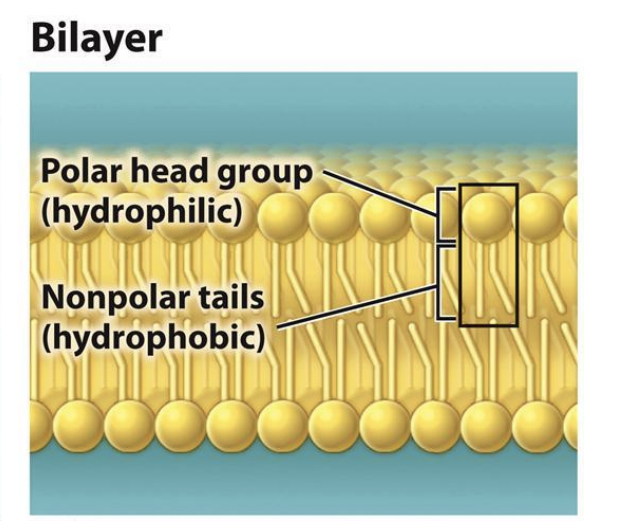
  • Heads small: form bilayer structure 

    • Typical cell membrane structure

    • two hydrophobic tails stuck inside layers
<ul><li><p><span style="background-color: inherit; line-height: 19.55px; color: windowtext;"><span>Heads small: form bilayer structure</span></span><span style="line-height: 19.55px; color: windowtext;"><span>&nbsp;</span></span></p><ul><li><p class="Paragraph SCXO5677968 BCX0" style="text-align: left;"><span style="background-color: inherit; line-height: 19.55px; color: windowtext;"><span>Typical cell membrane structure</span></span></p></li><li><p class="Paragraph SCXO5677968 BCX0" style="text-align: left;">two hydrophobic tails<span style="line-height: 19.55px; color: windowtext;"><span>&nbsp;stuck inside layers</span></span></p></li></ul></li></ul><p></p>
16
New cards

What is a liposome?

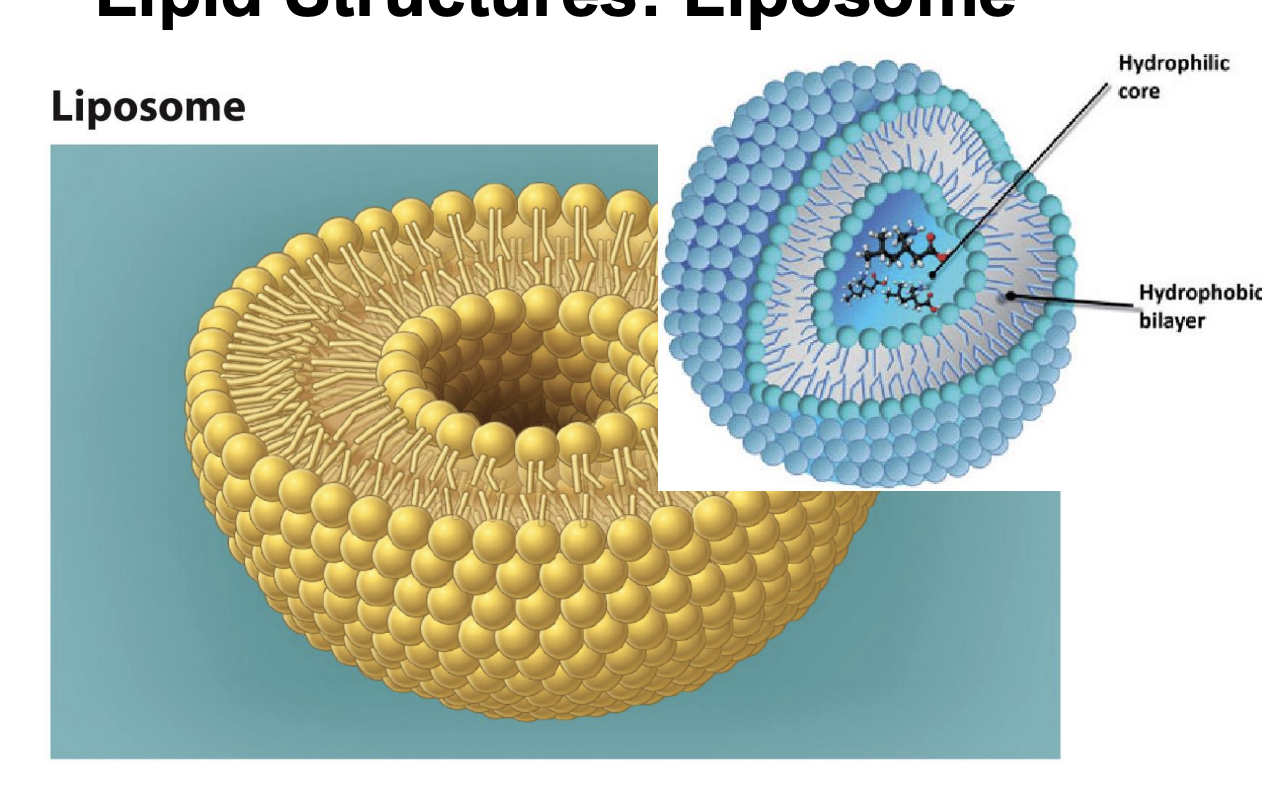
  • Bilayers can further form inclosed structure Liposome 

    • surround central space

    • Liposome have two layers --> formed by small head phospholipids 

    • Phospholipids spontaneously form enclosed bilayers

  • hydrophilic core and hydrophobic bilaye

  • Can place medicine in liposome and it will deliver to body and release into cell

  • Book: Forms spontaneously (when pH is 7 and concentration of high free phospholipids are high) 
<p></p><ul><li><p><span style="background-color: inherit; line-height: 19.55px; color: windowtext;"><span>Bilayers can further form inclosed structure Liposome</span></span><span style="line-height: 19.55px; color: windowtext;"><span>&nbsp;</span></span></p><ul><li><p class="Paragraph SCXO151176612 BCX0" style="text-align: left;">surround central space</p></li><li><p class="Paragraph SCXO151176612 BCX0" style="text-align: left;"><span style="background-color: inherit; line-height: 19.55px; color: windowtext;"><span>Liposome have two layers --&gt; formed by small head phospholipids</span></span><span style="line-height: 19.55px; color: windowtext;"><span>&nbsp;</span></span></p></li><li><p class="Paragraph SCXO151176612 BCX0" style="text-align: left;">Phospholipids spontaneously form enclosed bilayers</p></li></ul></li><li><p class="Paragraph SCXO151176612 BCX0" style="text-align: left;">hydrophilic core and hydrophobic bilaye</p></li><li><p class="Paragraph SCXO151176612 BCX0" style="text-align: left;"><span style="background-color: inherit; line-height: 19.55px; color: windowtext;"><span>Can place medicine in liposome and it will deliver to body and release into cell</span></span></p></li><li><p class="Paragraph SCXO151176612 BCX0" style="text-align: left;">Book: Forms spontaneously (when pH is 7 and concentration of high free phospholipids are high)&nbsp;</p></li></ul><p></p>
17
New cards

Liposome vs micelle?

  • Liposome have two layers --> formed by small head phospholipids

  • Micelle: just single layer and large head structure

18
New cards

What is cholesterol?

  • a component of animal cell membranes.

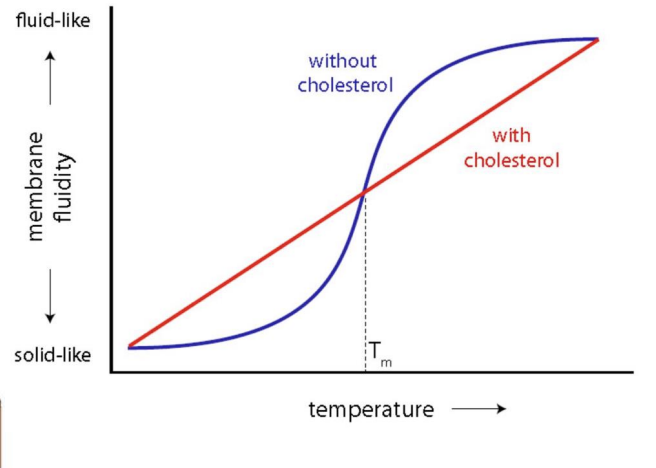
  • Cholesterol acts as a buffer to lessen the impact of temperature on membrane fluidity.

19
New cards

What important role does cholesterol play?

  • Influence membrane fluidity 

    • Forms strong interactions with phospholipids 

    • Between the phospholipids 

  • cholestoral acts as a buffer to lessen the impact of temp of membrane fluidity 
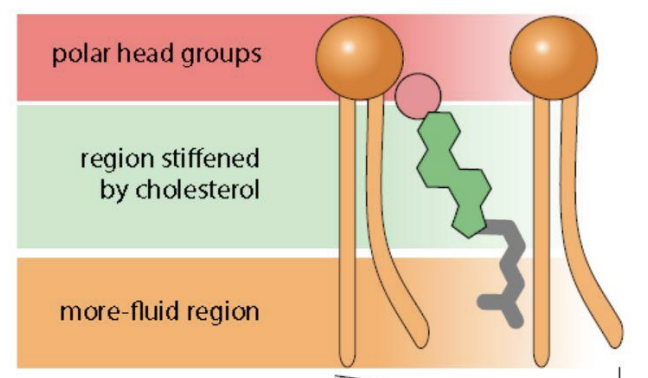
<p></p><ul><li><p class="Paragraph SCXO217765712 BCX0" style="text-align: left;"><span style="background-color: inherit; line-height: 19.55px; color: windowtext;"><span>Influence membrane fluidity</span></span><span style="line-height: 19.55px; color: windowtext;"><span>&nbsp;</span></span></p><ul><li><p class="Paragraph SCXO217765712 BCX0" style="text-align: left;"><span style="background-color: inherit; line-height: 19.55px; color: windowtext;"><span>Forms strong interactions with phospholipids</span></span><span style="line-height: 19.55px; color: windowtext;"><span>&nbsp;</span></span></p></li><li><p class="Paragraph SCXO217765712 BCX0" style="text-align: left;"><span style="background-color: inherit; line-height: 19.55px; color: windowtext;"><span>Between the phospholipids</span></span><span style="line-height: 19.55px; color: windowtext;"><span>&nbsp;</span></span></p></li></ul></li><li><p class="Paragraph SCXO217765712 BCX0" style="text-align: left;"><span style="background-color: inherit; line-height: 19.55px; color: windowtext;"><span>cholestoral acts as a buffer to lessen the impact of temp of membrane fluidity</span></span><span style="line-height: 19.55px; color: windowtext;"><span>&nbsp;</span></span></p></li></ul><p></p>
20
New cards

What is cell membrane fluidity?

  • membrane lipids are able to move in the plane of the membrane, the membrane

    • Lipids freely associate with one another because of the extensive van der Waals forces between their fatty acid tails

    • These weak interactions are easily broken and re-formed, so lipid molecules are able to move within the plane of the membrane

  • book: The longer the fatty acid tails, the less fluid the membrane

  • book: fewer the number of carbon–carbon double bonds, the less fluid the membrane

    • Saturated fatty acid tails, which have no carbon–carbon double bonds, are straight and tightly packed, reducing mobility

    • Carbon–carbon double bonds in unsaturated fatty acids introduce kinks in the fatty acid tails, reducing the tightness of packing and enhancing lipid mobility in the membrane

21
New cards

How does cholesterol work in high temps?

  • High temp, rigid cholesterol interacts with phosolipid tail and reduce fluidity of membrane (lower tail) → more stable

    • High temp phosphos separate from each other --> cholesterol and drags them together --> stability 
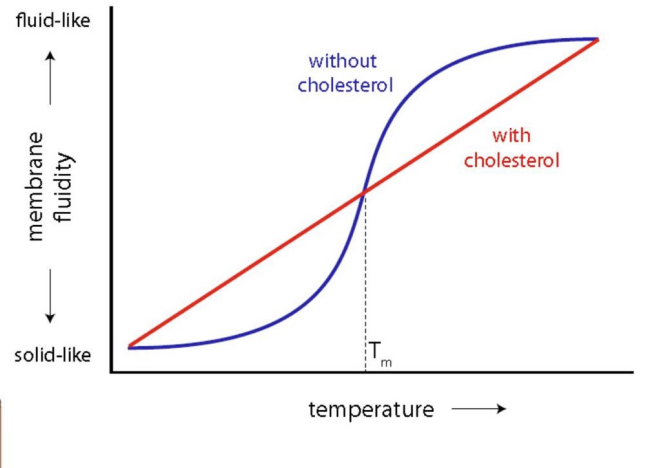
<ul><li><p><span style="background-color: inherit; line-height: 19.55px; color: windowtext;"><span>High temp, rigid cholesterol interacts with phosolipid tail and reduce fluidity of membrane</span></span><span style="line-height: 19.55px; color: windowtext;"><span>&nbsp;(lower tail) → more stable</span></span></p><ul><li><p class="Paragraph SCXO217765712 BCX0" style="text-align: left;"><span style="background-color: inherit; line-height: 19.55px; color: windowtext;"><span>High temp phosphos separate from each other --&gt; cholesterol and drags them together --&gt; stability&nbsp;</span></span></p></li></ul></li></ul><p></p>
22
New cards

How does cholesterol work in low temps?

  • Cholesterol prevent phospholipids from packing tighlty--> inc. Fluidity

  • Is a rigid structure --> packs or separates them

  • Creates stable line (red line)

<p><span style="line-height: 19.55px; color: windowtext;"><span> </span></span></p><ul><li><p class="Paragraph SCXO217765712 BCX0" style="text-align: left;"><span style="background-color: inherit; line-height: 19.55px; color: windowtext;"><span>Cholesterol prevent phospholipids from packing tighlty--&gt; inc. Fluidity</span></span><span style="line-height: 19.55px; color: windowtext;"><span> </span></span></p></li></ul><ul><li><p class="Paragraph SCXO217765712 BCX0" style="text-align: left;"><span style="background-color: inherit; line-height: 19.55px; color: windowtext;"><span>Is a rigid structure --&gt; packs or separates them</span></span><span style="line-height: 19.55px; color: windowtext;"><span> </span></span></p></li><li><p class="Paragraph SCXO217765712 BCX0" style="text-align: left;"><span style="background-color: inherit; line-height: 19.55px; color: windowtext;"><span>Creates stable line (red line)</span></span><span style="line-height: 19.55px; color: windowtext;"><span> </span></span></p></li></ul><p></p>
23
New cards

What are the proteins in the membrane?

  • Receptors, Enzymes, and Anchors

  • Protein is catagorized based on function

24
New cards

What are receptors?

  • allow the cell to receive signals from the environment.

  • responds in certain ways --> receives signal and decides how to response
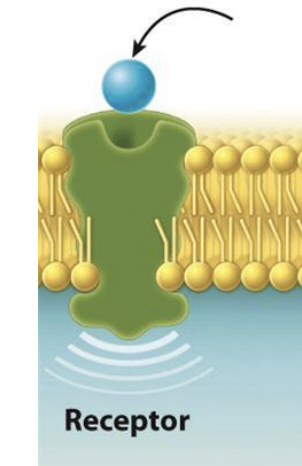
<ul><li><p>allow the cell to receive signals from the environment.</p></li><li><p><span style="background-color: inherit;"><span>responds in certain ways --&gt; receives signal and decides how to response</span></span></p></li></ul><p></p>
25
New cards

What are enzymes?

  • catalyze chemical reactions

  • change one thing to another to serve biological functions

  • A protein that functions as a catalyst to accelerate the rate of a chemical reaction; enzymes are critical in determining which chemical reactions take place in a cell (book)
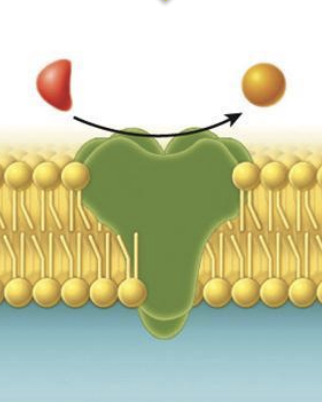
<ul><li><p>catalyze chemical reactions</p></li><li><p><span style="background-color: inherit;"><span>change one thing to another to serve biological functions</span></span></p></li><li><p><span><span>A protein that functions as a catalyst to accelerate the rate of a chemical reaction; enzymes are critical in determining which chemical reactions take place in a cell (book)</span></span></p></li></ul><p></p>
26
New cards

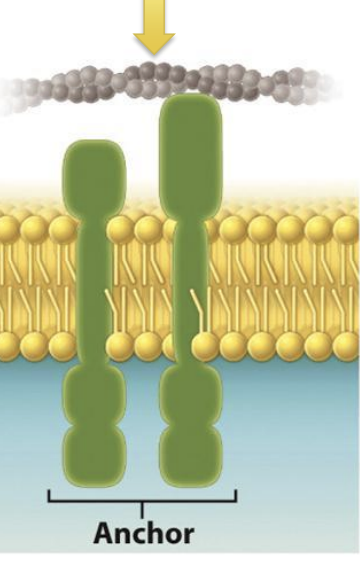
What are anchors?

  • attach to other proteins that help maintain cell structure and shape

  • A membrane protein that attaches to other proteins and helps to maintain cell structure and shape.

  • act as backbone

<ul><li><p>attach to other proteins that help maintain cell structure and shape</p></li><li><p><span><span>A membrane protein that attaches to other proteins and helps to maintain cell structure and shape.</span></span></p></li><li><p>act as backbone</p></li></ul><p></p>
27
New cards

What are integral membrane proteins?

  • green color

  • permanently associated with cell membranes

  • cannot separate them without destroying cell membrane structure 
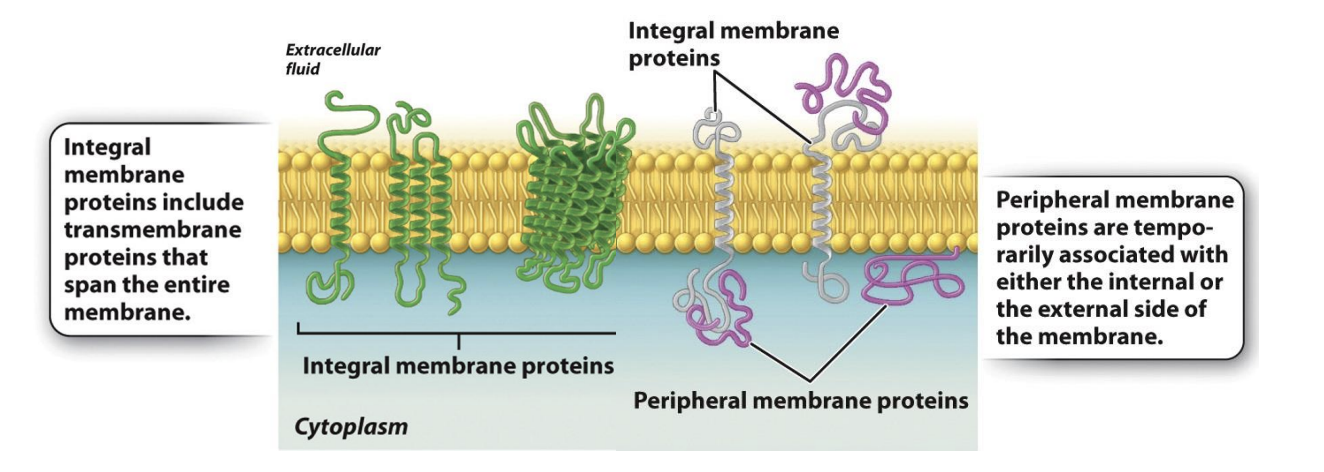
<ul><li><p>green color</p></li><li><p>permanently associated with cell membranes</p></li><li><p><span style="background-color: inherit; line-height: 19.55px; color: windowtext;"><span>cannot separate them without destroying cell membrane structure</span></span><span style="line-height: 19.55px; color: windowtext;"><span>&nbsp;</span></span></p></li></ul><p></p>
28
New cards

What do transmembrane proteins include?

  • most integral membrane proteins are transmembrane proteins

  • span entire lipid bilayer

  • There are two hydrophilic regions, one protruding from each face of the membrane in contact with the aqueous environment inside and outside of the cell.

  • one hydrophobic region that spans the hydrophobic interior of the membrane
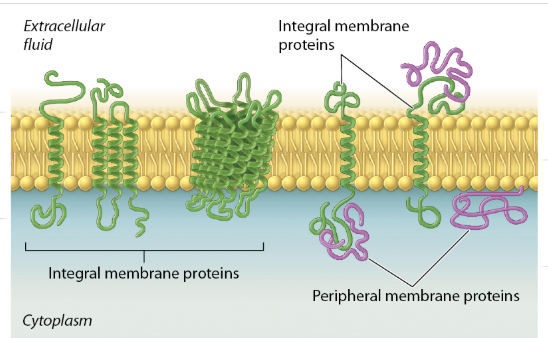
<ul><li><p>most integral membrane proteins are transmembrane proteins</p></li><li><p>span entire lipid bilayer</p></li><li><p><span><span>There are two hydrophilic regions, one protruding from each face of the membrane in contact with the aqueous environment inside and outside of the cell. </span></span></p></li><li><p><span><span>one hydrophobic region that spans the hydrophobic interior of the membrane</span></span></p></li></ul><p></p>
29
New cards

What are peripheral membrane proteins?

  • temporarily associated with the lipid bilayer or with integral membrane proteins through weak noncovalent interactions

  • Remove them or isolate them and the membrane can still be in tact 

  • temporarily associated with either the internal or external side of the membrane
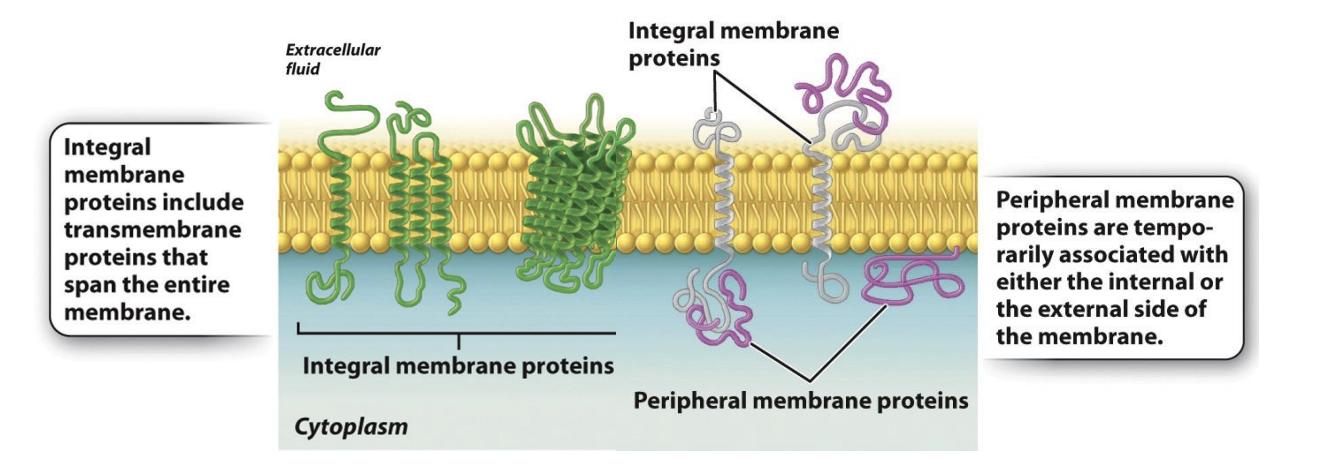
<ul><li><p>temporarily associated with the lipid bilayer or with integral membrane proteins through weak noncovalent interactions</p></li><li><p><span style="background-color: inherit; line-height: 19.55px; color: windowtext;"><span>Remove them or isolate them and the membrane can still be in tact</span></span><span style="line-height: 19.55px; color: windowtext;"><span>&nbsp;</span></span></p></li><li><p><span style="line-height: 19.55px; color: windowtext;"><span>temporarily associated with either the internal or external side of the membrane</span></span></p></li></ul><p></p>
30
New cards

What are transporters?

  • Integral membrane protein

  • move ions or molecules across the membrane.

  • Show Whole lipid bilayer --> how they can transport molecules inside and outside the cell 
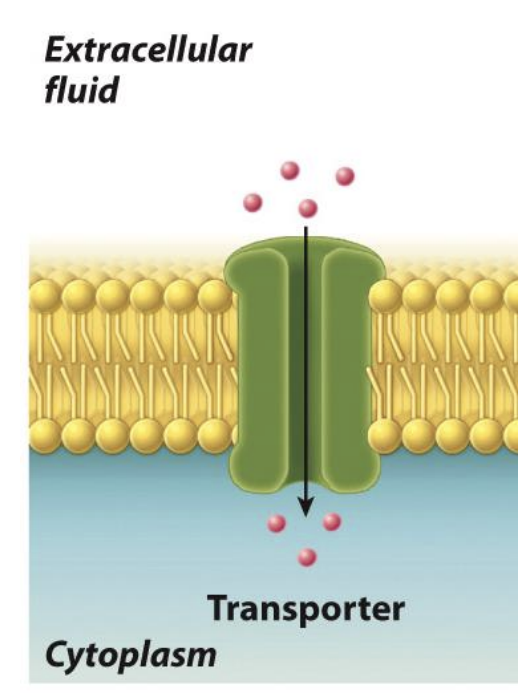
<ul><li><p>Integral membrane protein </p></li><li><p>move ions or molecules across the membrane.</p></li><li><p class="Paragraph SCXO237576771 BCX0" style="text-align: left;"><span style="background-color: inherit; line-height: 19.55px; color: windowtext;"><span>Show Whole lipid bilayer --&gt; how they can transport molecules inside and outside the cell</span></span><span style="line-height: 19.55px; color: windowtext;"><span>&nbsp;</span></span></p></li></ul><p></p>
31
New cards

What is the plasma membrane?

  • a selective barrier that controls the movement of molecules between the inside and the outside of the cell (partially impermeable - semipermeable)

    • hydrophobic interior of the lipid bilayer prevents ions and charged polar molecules from moving across it (B)

  • boundaries that define space of cell 

    • Water can move in and out freely 

    • Others under control through propane channels  (ex: ions, water, nutrients)

    • Some items not allowed to move into cel b/c of dmg 
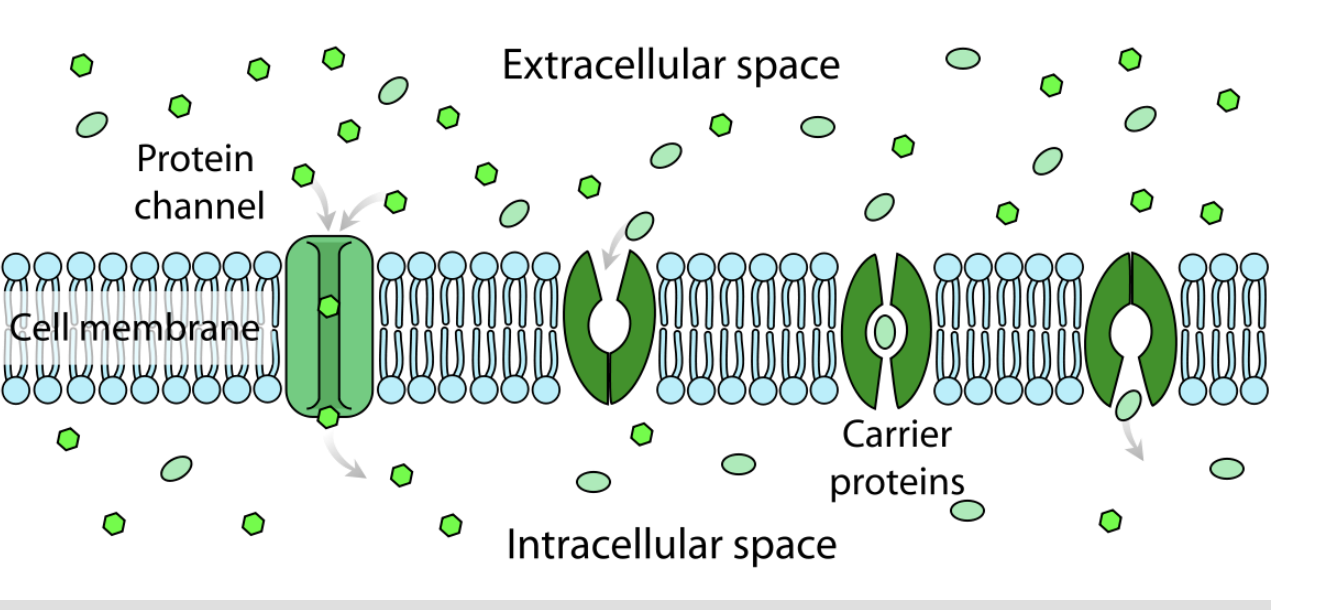
<ul><li><p>a selective barrier that controls the movement of molecules between the inside and the outside of the cell (partially impermeable - semipermeable)</p><ul><li><p><span><span>hydrophobic interior of the lipid bilayer prevents ions and charged polar molecules from moving across it (B)</span></span></p></li></ul></li><li><p><span style="background-color: inherit; line-height: 19.55px; color: windowtext;"><span>boundaries that define space of cell</span></span><span style="line-height: 19.55px; color: windowtext;"><span>&nbsp;</span></span></p><ul><li><p class="Paragraph SCXO154087625 BCX0" style="text-align: left;"><span style="background-color: inherit; line-height: 19.55px; color: windowtext;"><span>Water can move in and out freely</span></span><span style="line-height: 19.55px; color: windowtext;"><span>&nbsp;</span></span></p></li><li><p class="Paragraph SCXO57050636 BCX0" style="text-align: left;"><span style="background-color: inherit; line-height: 19.55px; color: windowtext;"><span>Others under control through propane channels</span></span><span style="line-height: 19.55px; color: windowtext;"><span>&nbsp; (ex: ions, water, nutrients)</span></span></p></li><li><p class="Paragraph SCXO57050636 BCX0" style="text-align: left;"><span style="background-color: inherit; line-height: 19.55px; color: windowtext;"><span>Some items not allowed to move into cel b/c of dmg</span></span><span style="line-height: 19.55px; color: windowtext;"><span>&nbsp;</span></span></p></li></ul></li></ul><p></p>
32
New cards

What is the protein channel?

  • molecules move directly through the lipid bilayer, while in facilitated diffusion, molecules move through a membrane transporter.

  • provides an opening between the inside and outside of the cell through which certain molecules can pass, depending on their shape and charge.

  • Some membrane channels are gated, which means that they open in response to some sort of signal, which may be chemical or electrical
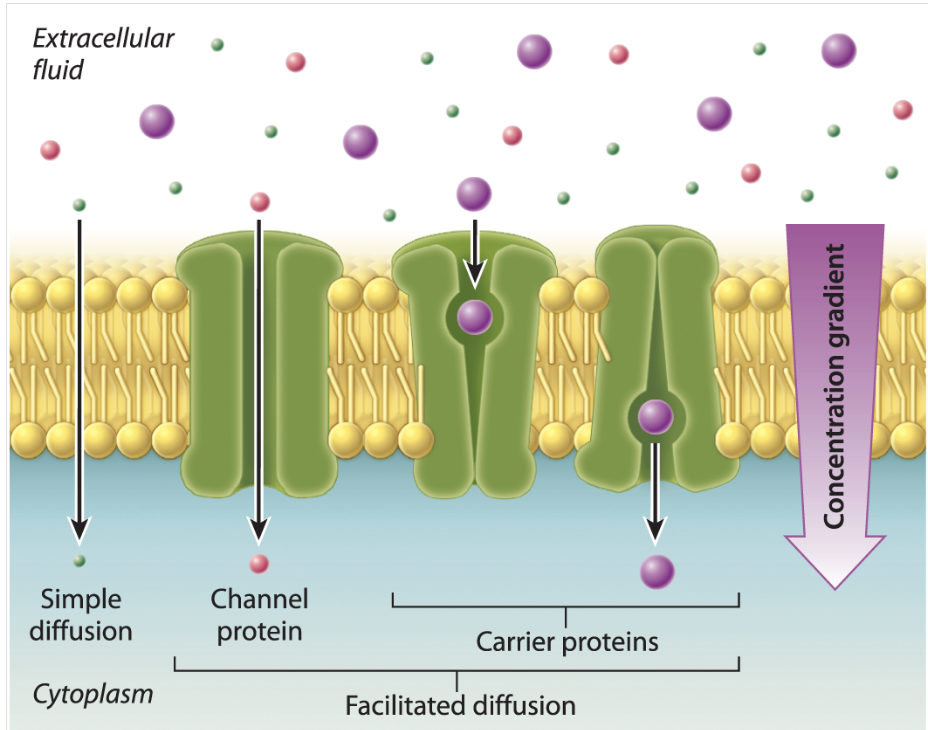
<ul><li><p><span><span>molecules move directly through the lipid bilayer, while in facilitated diffusion, molecules move through a membrane transporter.</span></span></p></li><li><p><span><span>provides an opening between the inside and outside of the cell through which certain molecules can pass, depending on their shape and charge. </span></span></p></li><li><p><span><span>Some membrane channels are gated, which means that they open in response to some sort of signal, which may be chemical or electrical</span></span></p></li></ul><p></p>
33
New cards

What are carrier proteins?

  • A transporter that facilitates movement of molecules across a cell membrane.

  • binds to and then transports specific molecules.

  • Membrane carriers exist in two conformations:

    • open to one side of the cell,

    • open to the other side of the cell.

    • Binding of the transported molecule induces a conformational change in the membrane protein, allowing the molecule to be transported across the lipid bilayer,
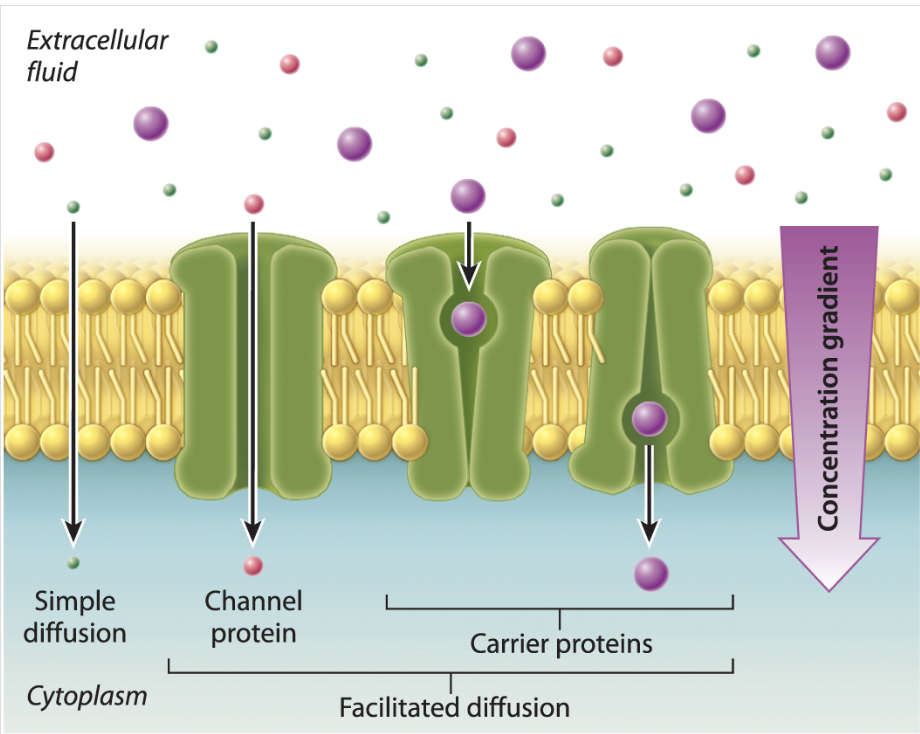
<ul><li><p><span><span>A transporter that facilitates movement of molecules across a cell membrane.</span></span></p></li><li><p><span><span>binds to and then transports specific molecules. </span></span></p></li><li><p><span><span>Membrane carriers exist in two conformations: </span></span></p><ul><li><p><span><span>open to one side of the cell, </span></span></p></li><li><p><span><span> open to the other side of the cell. </span></span></p></li><li><p><span><span>Binding of the transported molecule induces a conformational change in the membrane protein, allowing the molecule to be transported across the lipid bilayer,</span></span></p></li></ul></li></ul><p></p>
34
New cards

What is the fluid mosiac model (book)?

  • A model that proposes that the lipid bilayer is a fluid structure that allows molecules to move laterally within the membrane and is a mosaic of different types of molecules, including lipids, proteins, and carbohydrates.

  • ex: protiens move across the bilaer

35
New cards

(Book) What is homeostasis?

A model that proposes that the lipid bilayer is a fluid structure that allows molecules to move laterally within the membrane and is a mosaic of different types of molecules, including lipids, proteins, and carbohydrates.

36
New cards

What is diffusion?

  • Molecules are in constant, random motion in most environments.

  • The net movement of molecules from areas of higher to lower concentration as a result of their random thermal motion.

  • no cost of energy (passive transport)

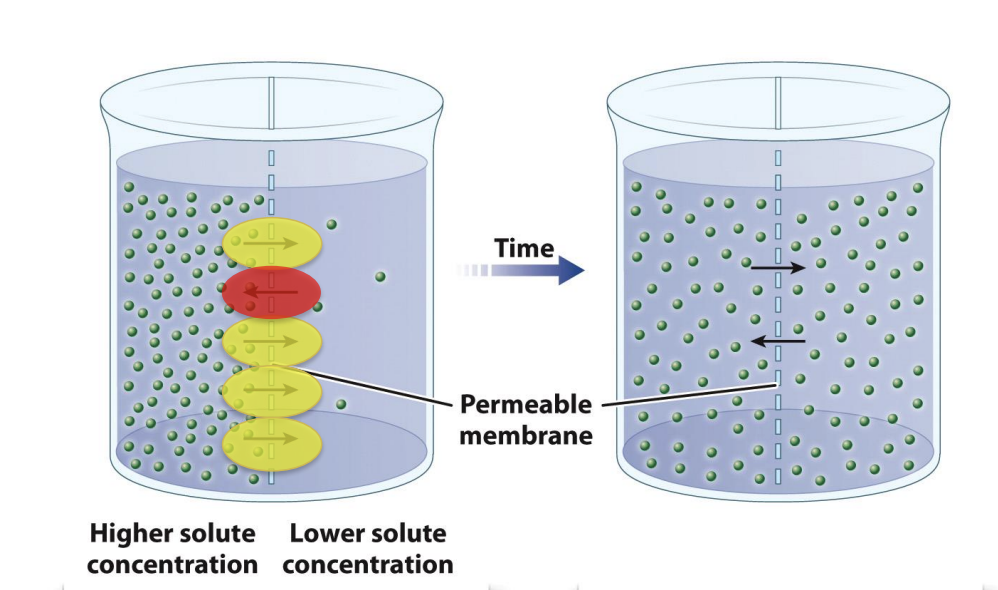
37
New cards
<p>What does this image show?</p>

What does this image show?

  • left: net movement of solute from area of higher solute concen to area of lower solute concen

  • Right: no net movement of solute but diffusion continues

  • Molecules are always moving backwards as well but not comparable (total volume from high to low) 

38
New cards

What is passive transport?

  • Movement of substances across a cell membrane by diffusion

  • The simplest movement into and out of cells is passive transport, which works by diffusion

39
New cards

What is facilitated diffusion?

  • Diffusion across a cell membrane through a transmembrane protein, such as a channel or carrier.

  • Large: cannot pass through it --> too large 

    Need door to open channel or have a carrier 

40
New cards

What uses simple and facilitated diffusion?

  • both passive diffusion

  • Simple: Small molecules can move across lipid bilayers through simple diffusion  

    • diffuse directly through the cell membrane

    • usually hydrophobic molecules (lipid bilayer also hydrophobic)

  • Larger: need help of facilitated diffusion through membrane protein (channel or carrier) 

    • Depends on how they are moved 

  • molecules move directly through the lipid bilayer, while in facilitated diffusion, molecules move through a membrane transporter.
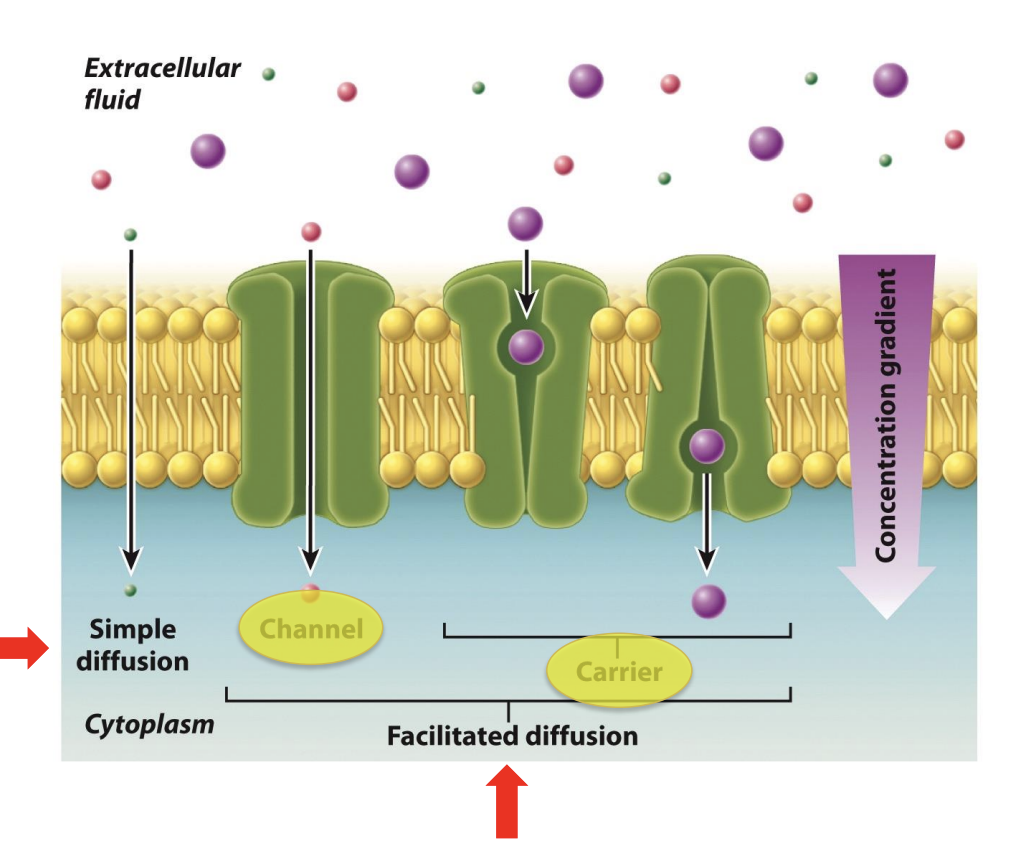
<ul><li><p>both passive diffusion</p></li><li><p><span style="background-color: inherit; line-height: 19.55px; color: windowtext;"><span>Simple: Small molecules can move across lipid bilayers through simple diffusion&nbsp;</span></span><span style="line-height: 19.55px; color: windowtext;"><span>&nbsp;</span></span></p><ul><li><p><span><span>diffuse directly through the cell membrane</span></span></p></li><li><p><span><span>usually hydrophobic molecules (lipid bilayer also hydrophobic)</span></span></p></li></ul></li><li><p><span style="background-color: inherit; line-height: 19.55px; color: windowtext;"><span>Larger: need help of facilitated diffusion through membrane protein (channel or carrier)</span></span><span style="line-height: 19.55px; color: windowtext;"><span>&nbsp;</span></span></p><ul><li><p class="Paragraph SCXO240248346 BCX0" style="text-align: left;"><span style="background-color: inherit; line-height: 19.55px; color: windowtext;"><span>Depends on how they are moved</span></span><span style="line-height: 19.55px; color: windowtext;"><span>&nbsp;</span></span></p></li></ul></li><li><p class="Paragraph SCXO240248346 BCX0" style="text-align: left;"><span><span>molecules move directly through the lipid bilayer, while in facilitated diffusion, molecules move through a membrane transporter.</span></span></p></li></ul><p></p>
41
New cards

What is osmosis?

  • The net movement of a solvent, such as water, across a selectively permeable membrane toward the side of higher solute concentration.

    • diffusion with water

    • Higher solute concentration = lower water concentration

    • lower solute concentration = higher water concentration

  • Selectively permeable membrane allows passage of water but not solute
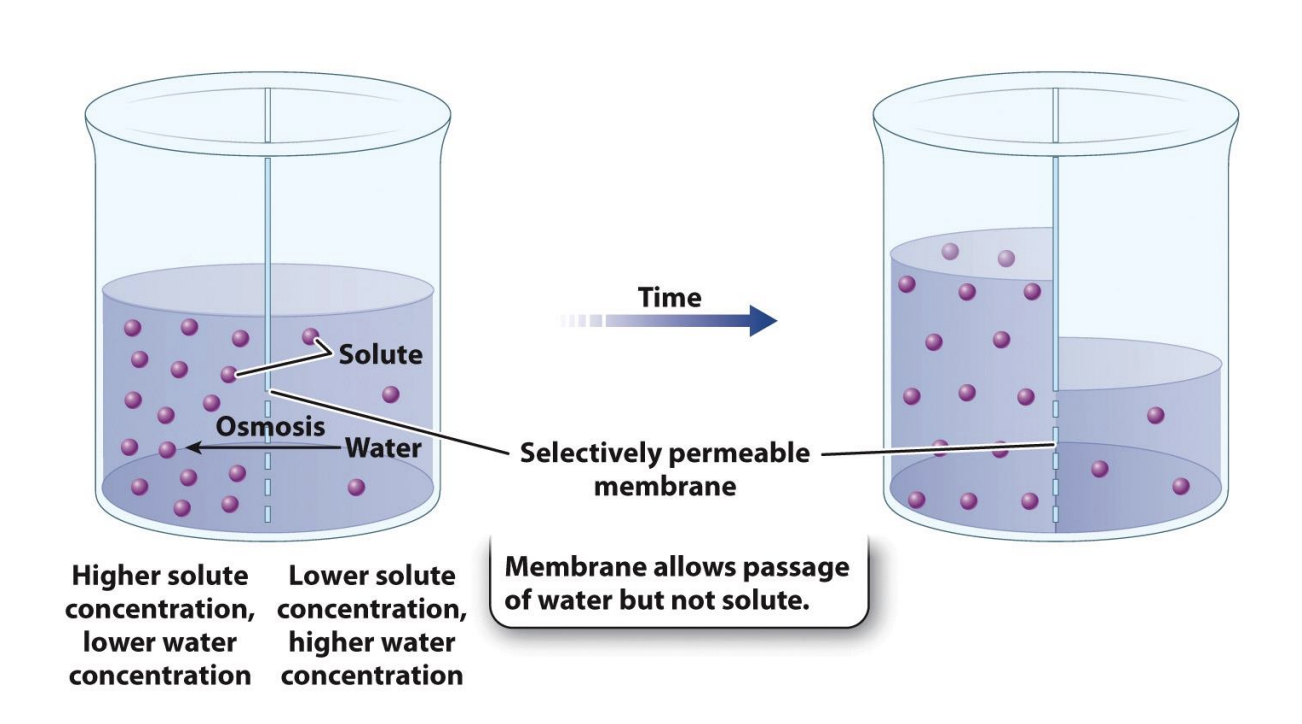
<ul><li><p><span><span>The net movement of a solvent, such as water, across a selectively permeable membrane toward the side of higher solute concentration.</span></span></p><ul><li><p>diffusion with water</p></li><li><p>Higher solute concentration = lower water concentration</p></li><li><p>lower solute concentration = higher water concentration</p></li></ul></li><li><p>Selectively permeable membrane allows passage of water but not solute</p></li></ul><p></p>
42
New cards

What is hypertonic?

A solution will be hypertonic to a cell if its solute concentration is higher than that inside the cell

43
New cards

What is isotonic?

  • a solution that contains the same concentration of water and solutes —> no net water movement

44
New cards

What is hypotonic?

If the solute concentration outside the cell is lower than inside the cell

45
New cards

How does osmosis impact blood cells?

  • Animals cells do not have cell wall--> cells are fragile and only have control of osmosis 

  • Some cells burst or become compressed 

  • Human blood cells 

    • Red blood cell placed in hypertonic solution 

      • Higher concentration outside than inside of cell 

      • Water leave cell with osmosis --> cell shrinks in extreme env 

    • Maintain same inside and outside concentration --> isotonic 

      • Ideal for cels 

      • Typical red blood cell 

    • Placed in hypotonic sol: higher solute concentration inside than outside 

      • Water moves into cell --> cell have no cell wall --> keeps adding water --> swells --> bursts in extreme situations 
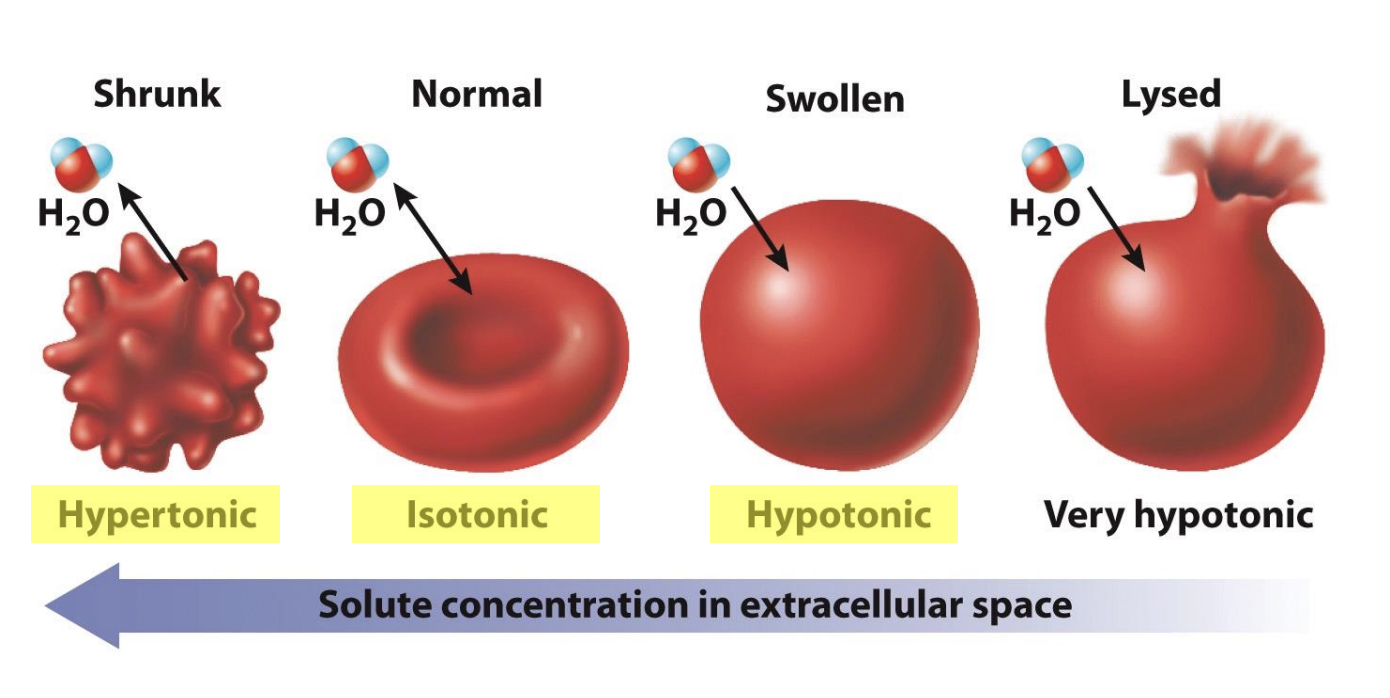
<ul><li><p class="Paragraph SCXO186949412 BCX0" style="text-align: left;"><span style="background-color: inherit; line-height: 19.55px; color: windowtext;"><span>Animals cells do not have cell wall--&gt; cells are fragile and only have control of osmosis</span></span><span style="line-height: 19.55px; color: windowtext;"><span>&nbsp;</span></span></p></li><li><p class="Paragraph SCXO186949412 BCX0" style="text-align: left;"><span style="background-color: inherit; line-height: 19.55px; color: windowtext;"><span>Some cells burst or become compressed</span></span><span style="line-height: 19.55px; color: windowtext;"><span>&nbsp;</span></span></p></li><li><p class="Paragraph SCXO186949412 BCX0" style="text-align: left;"><span style="background-color: inherit; line-height: 19.55px; color: windowtext;"><span>Human blood cells</span></span><span style="line-height: 19.55px; color: windowtext;"><span>&nbsp;</span></span></p><ul><li><p class="Paragraph SCXO186949412 BCX0" style="text-align: left;"><span style="background-color: inherit; line-height: 19.55px; color: windowtext;"><span>Red blood cell placed in hypertonic solution</span></span><span style="line-height: 19.55px; color: windowtext;"><span>&nbsp;</span></span></p><ul><li><p class="Paragraph SCXO186949412 BCX0" style="text-align: left;"><span style="background-color: inherit; line-height: 19.55px; color: windowtext;"><span>Higher concentration outside than inside of cell</span></span><span style="line-height: 19.55px; color: windowtext;"><span>&nbsp;</span></span></p></li><li><p class="Paragraph SCXO186949412 BCX0" style="text-align: left;"><span style="background-color: inherit; line-height: 19.55px; color: windowtext;"><span>Water leave cell with osmosis --&gt; cell shrinks in extreme env</span></span><span style="line-height: 19.55px; color: windowtext;"><span>&nbsp;</span></span></p></li></ul></li><li><p class="Paragraph SCXO186949412 BCX0" style="text-align: left;"><span style="background-color: inherit; line-height: 19.55px; color: windowtext;"><span>Maintain same inside and outside concentration --&gt; isotonic</span></span><span style="line-height: 19.55px; color: windowtext;"><span>&nbsp;</span></span></p><ul><li><p class="Paragraph SCXO186949412 BCX0" style="text-align: left;"><span style="background-color: inherit; line-height: 19.55px; color: windowtext;"><span>Ideal for cels</span></span><span style="line-height: 19.55px; color: windowtext;"><span>&nbsp;</span></span></p></li><li><p class="Paragraph SCXO186949412 BCX0" style="text-align: left;"><span style="background-color: inherit; line-height: 19.55px; color: windowtext;"><span>Typical red blood cell</span></span><span style="line-height: 19.55px; color: windowtext;"><span>&nbsp;</span></span></p></li></ul></li><li><p class="Paragraph SCXO186949412 BCX0" style="text-align: left;"><span style="background-color: inherit; line-height: 19.55px; color: windowtext;"><span>Placed in hypotonic sol: higher solute concentration inside than outside</span></span><span style="line-height: 19.55px; color: windowtext;"><span>&nbsp;</span></span></p><ul><li><p class="Paragraph SCXO186949412 BCX0" style="text-align: left;"><span style="background-color: inherit; line-height: 19.55px; color: windowtext;"><span>Water moves into cell --&gt; cell have no cell wall --&gt; keeps adding water --&gt; swells --&gt; bursts in extreme situations</span></span><span style="line-height: 19.55px; color: windowtext;"><span>&nbsp;</span></span></p></li></ul></li></ul></li></ul><p></p>
46
New cards

What are contractile vacuoles?

organelles that take up excess water from inside the cell and then, by contraction, expel it into the external environment

47
New cards

What is a vacuole?

  • absorbs water and contributes to turgor pressure.

  • plant and fungal cells

48
New cards

What is the cell wall?

  • organisms include bacteria, fungi, many protists, most algae, and all plants

  • provides structural support and protection for the cell.

  • Because the cell wall is rigid and resists expansion, it allows pressure to build up when water enters a cell.

49
New cards

What is turgor pressure?

  • The force exerted by water pressing against an object

  • Pressure within a cell resulting from the movement of water into the cell by osmosis and the tendency of the cell wall to resist deformation.

  • Inside plant cell have vacuole 

    • Turgor pressure builds as a result of water moving by osmosis into cells surrounded by a cell wall.

    • Vacuole absorbs water from env and form turgor pressure 

    • Turgor pressure: press against the cell wall --> vacuole will absorb water from env and contribute to turger pressure 

  • promote cell volume expansion

    • the higher the turgor pressure is, the larger the leaf expansion will be
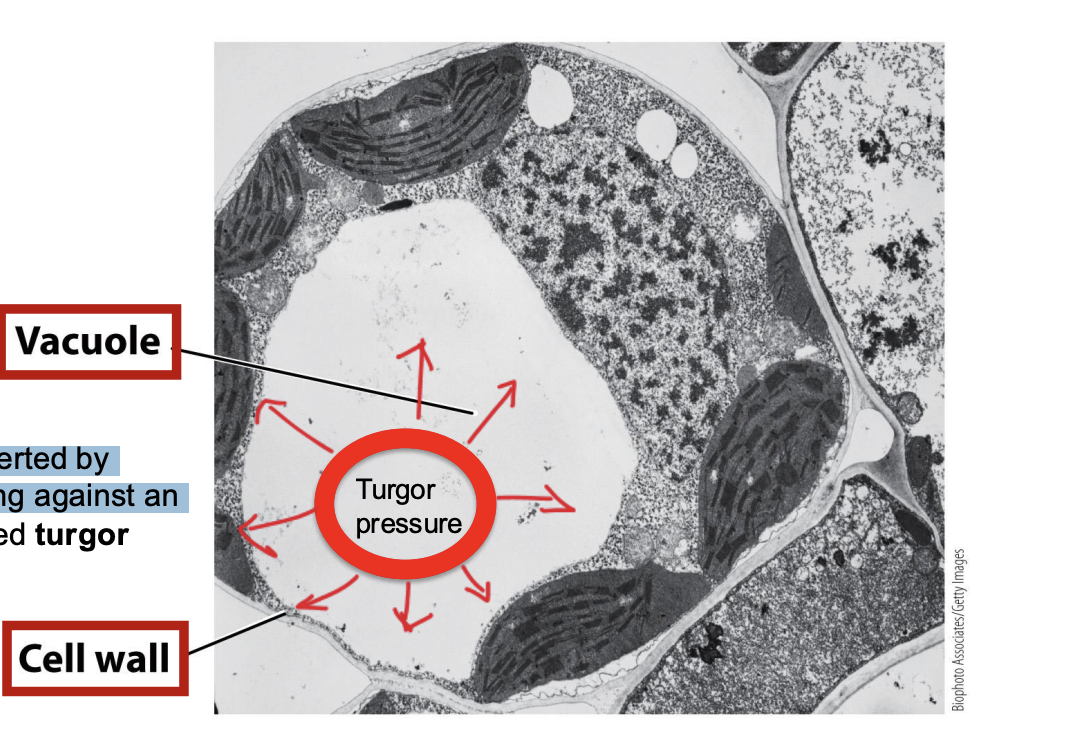
<ul><li><p>The force exerted by water pressing against an object</p></li><li><p><span>Pressure within a cell resulting from the movement of water into the cell by osmosis and the tendency of the cell wall to resist deformation.</span></p></li><li><p><span style="background-color: inherit; line-height: 19.55px; color: windowtext;"><span>Inside plant cell have vacuole</span></span><span style="line-height: 19.55px; color: windowtext;"><span>&nbsp;</span></span></p><ul><li><p><span><span>Turgor pressure builds as a result of water moving by osmosis into cells surrounded by a cell wall.</span></span></p></li><li><p class="Paragraph SCXO58431996 BCX0" style="text-align: left;"><span style="background-color: inherit; line-height: 19.55px; color: windowtext;"><span>Vacuole absorbs water from env and form turgor pressure</span></span><span style="line-height: 19.55px; color: windowtext;"><span>&nbsp;</span></span></p></li><li><p class="Paragraph SCXO58431996 BCX0" style="text-align: left;"><span style="background-color: inherit; line-height: 19.55px; color: windowtext;"><span>Turgor pressure: press against the cell wall --&gt; vacuole will absorb water from env and contribute to turger pressure</span></span><span style="line-height: 19.55px; color: windowtext;"><span>&nbsp;</span></span></p></li></ul></li><li><p class="Paragraph SCXO58431996 BCX0" style="text-align: left;">promote cell volume expansion</p><ul><li><p class="Paragraph SCXO58431996 BCX0" style="text-align: left;">the higher the turgor pressure is, the larger the leaf expansion will be</p></li></ul></li></ul><p></p>
50
New cards

Why it turgor pressure important?

  • Cells contain high concentrations of solutes

  • when a plant cell is placed in a hypotonic solution, water enters the cell by osmosis until the turgor pressure created by the cell wall increases to a level to stop osmosis

  • Turgor pressure develops because the cell wall resists being stretched and pushes back on the interior of the cell → provides structural support

    • High turgor pressure means that a plant cell is full of water and is firm, rigid, and turgid

  • loss of water from vacuoles → triggers turgor pressure → cells no longer maintain shape within cell wall
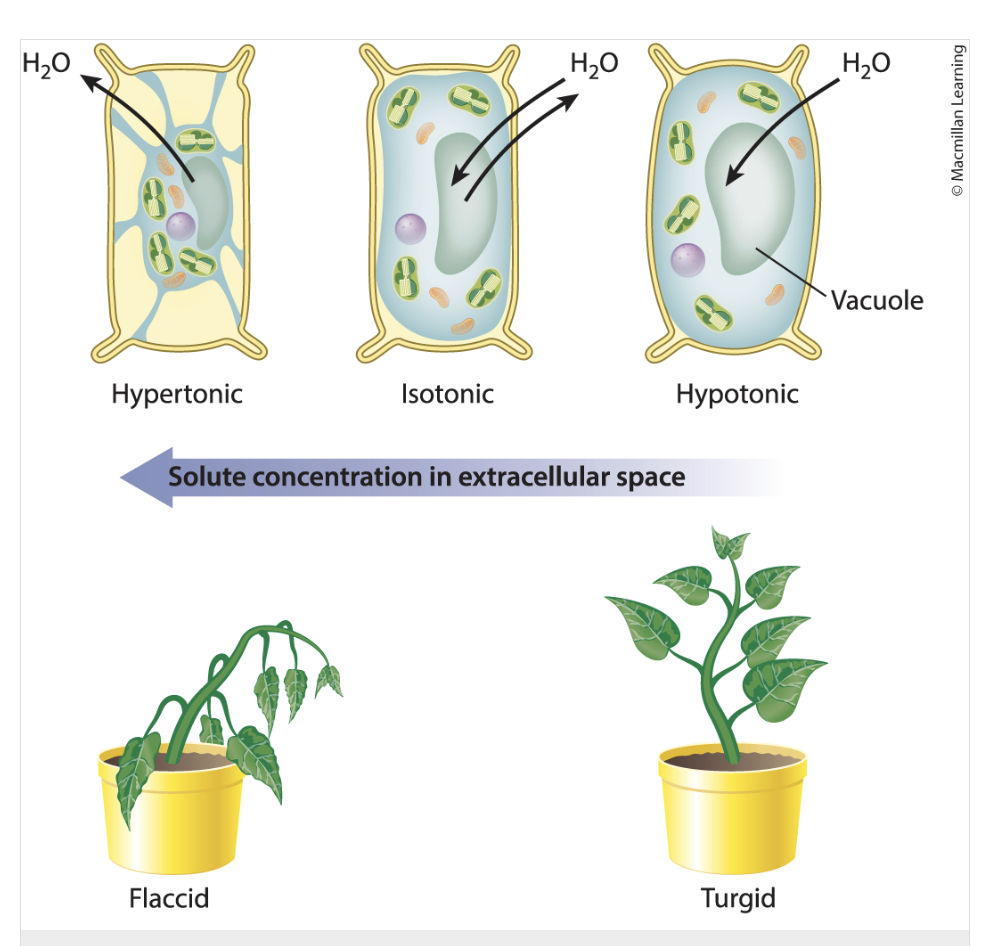
<ul><li><p><span>Cells contain high concentrations of solutes</span></p></li><li><p><span>when a plant cell is placed in a hypotonic solution, water enters the cell by osmosis until the turgor pressure created by the cell wall increases to a level to stop osmosis</span></p></li><li><p><span>Turgor pressure develops because the cell wall resists being stretched and pushes back on the interior of the cell → provides structural support</span></p><ul><li><p>High turgor pressure means that a plant cell is full of water and is firm, rigid, and turgid</p></li></ul></li><li><p><span>loss of water from vacuoles → triggers turgor pressure → cells no longer maintain shape within cell wall</span></p></li></ul><p></p>
51
New cards

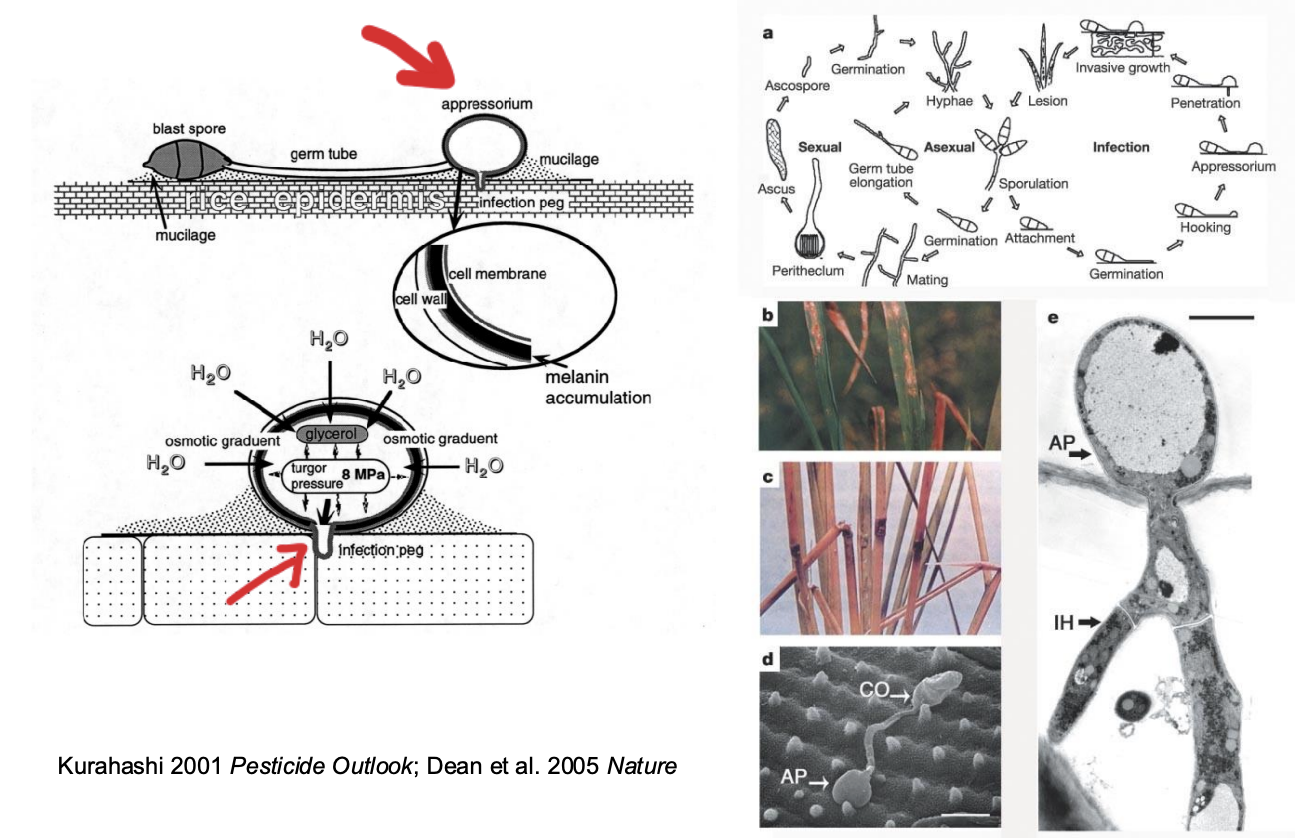
How do pathogens use turgor pressure?

  • Magnaporthe grisea: pathogens use turgor pressure to complete life cycle

  • Use turgor pressure to invade/infect host tissue (plants) 

  • Fungal spore attach to host surface --> release enzyme from body -->increase turgor pressure in plant cell with specialized compounds (melanin) --> increase concentration in cell --> start absorb water and increase turgor pressure 

  • Cell uses turgor pressure to penetrate plants surface (pressure used to break cell epidermis) --> creates infection path --> gets into cell and finish cycle in cell 

    • Absorb and use hots nutrients 

<ul><li><p>Magnaporthe grisea: pathogens use turgor pressure to complete life cycle</p></li><li><p><span style="background-color: inherit; line-height: 19.55px; color: windowtext;"><span>Use turgor pressure to invade/infect host tissue (plants)</span></span><span style="line-height: 19.55px; color: windowtext;"><span>&nbsp;</span></span></p></li><li><p class="Paragraph SCXO145515847 BCX0" style="text-align: left;"><span style="background-color: inherit; line-height: 19.55px; color: windowtext;"><span>Fungal spore attach to host surface --&gt; release enzyme from body --&gt;increase turgor pressure in plant cell with specialized compounds (melanin) --&gt; increase concentration in cell --&gt; start absorb water and increase turgor pressure</span></span><span style="line-height: 19.55px; color: windowtext;"><span>&nbsp;</span></span></p></li><li><p class="Paragraph SCXO145515847 BCX0" style="text-align: left;"><span style="background-color: inherit; line-height: 19.55px; color: windowtext;"><span>Cell uses turgor pressure to penetrate plants surface (pressure used to break cell epidermis) --&gt; creates infection path --&gt; gets into cell and finish cycle in cell</span></span><span style="line-height: 19.55px; color: windowtext;"><span>&nbsp;</span></span></p><ul><li><p class="Paragraph SCXO145515847 BCX0" style="text-align: left;"><span style="background-color: inherit; line-height: 19.55px; color: windowtext;"><span>Absorb and use hots nutrients</span></span><span style="line-height: 19.55px; color: windowtext;"><span>&nbsp;</span></span> </p></li></ul></li></ul><p></p>
52
New cards

What is passive transport?

  • Movement of substances across a cell membrane by diffusion

  • only works when the move is consistent with concentration gradient from high to low
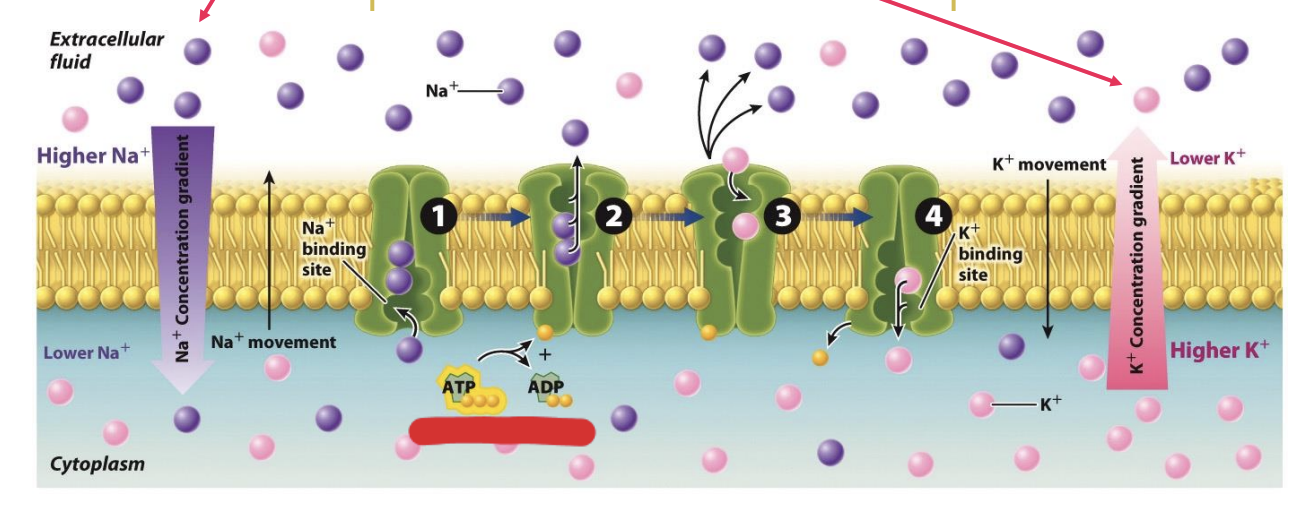
<ul><li><p><span><span>Movement of substances across a cell membrane by diffusion</span></span></p></li><li><p><span style="background-color: inherit;"><span>only works when the move is consistent with concentration gradient from high to low</span></span></p></li></ul><p></p>
53
New cards

What is active transport?

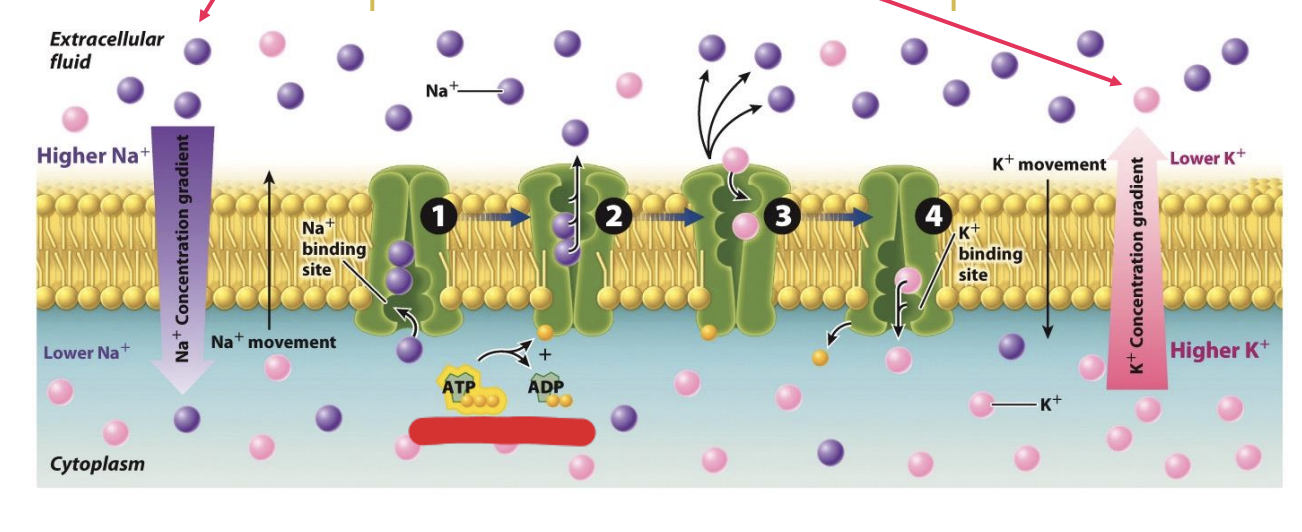
  • The movement of substances across a cell membrane against an electrochemical gradient, requiring an input of energy (ATP)

  • Cell moves substance against constant gradients (low concentration -->high): use active transport 

  • cells move substances through transport proteins embedded in the cell membrane

  • Ex:

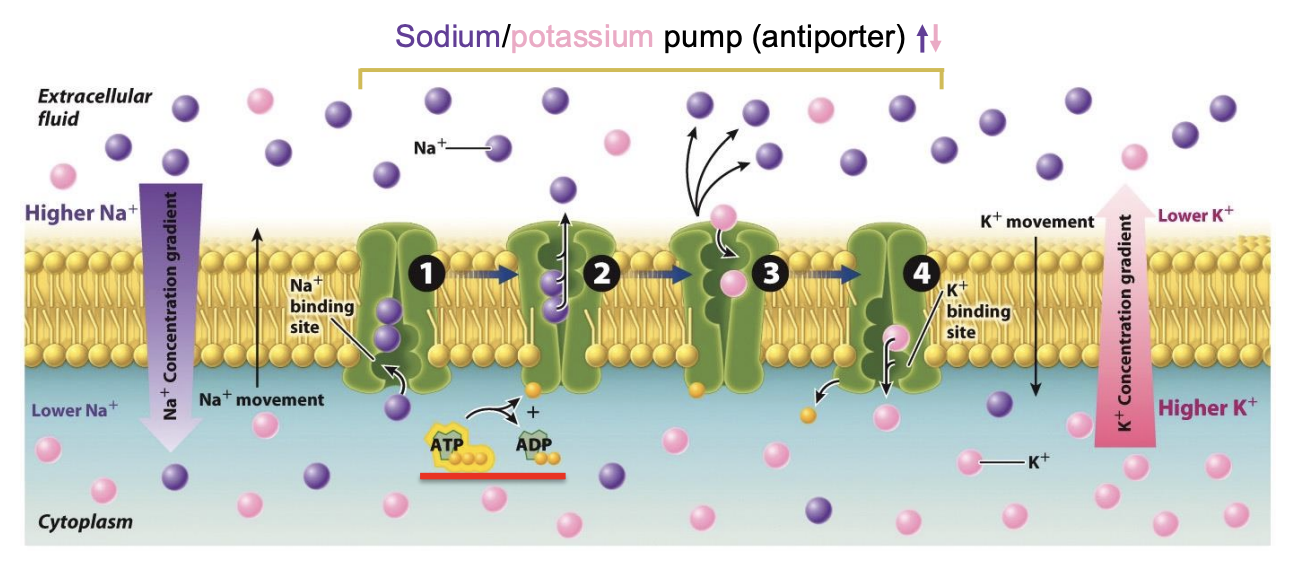
    • sodium–potassium pump

    • Within cells, sodium is kept at concentrations much lower than in the external environment; the opposite is true of potassium.

    • both sodium and potassium have to be moved against a concentration gradient.

    • The sodium–potassium pump actively moves sodium out of the cell and potassium into the cell
<ul><li><p><span>The movement of substances across a cell membrane against an electrochemical gradient, requiring an input of energy (ATP)</span></p></li><li><p><span style="background-color: inherit; line-height: 19.55px; color: windowtext;"><span>Cell moves substance against constant gradients (low concentration --&gt;high): use active transport</span></span><span style="line-height: 19.55px; color: windowtext;"><span>&nbsp;</span></span></p></li><li><p><span><span>cells move substances through transport proteins embedded in the cell membrane</span></span></p></li><li><p><span><span>Ex:</span></span></p><ul><li><p><span><span>sodium–potassium pump </span></span></p></li><li><p><span><span> Within cells, sodium is kept at concentrations much lower than in the external environment; the opposite is true of potassium. </span></span></p></li><li><p><span><span>both sodium and potassium have to be moved against a concentration gradient. </span></span></p></li><li><p><span><span>The sodium–potassium pump actively moves sodium out of the cell and potassium into the cell</span></span></p></li></ul></li></ul><p></p>
54
New cards

How does primary active transport work?

  • uses energy stored in ATP to move sodium and K+ against concentration gradient 

    • Energy is directly used to support transportation 

  • The sodium and potassium ions move in opposite directions, so the pump is an antiporter. .

<ul><li><p><span style="background-color: inherit; line-height: 19.55px; color: windowtext;"><span>uses energy stored in ATP to move sodium and K+ against concentration gradient</span></span><span style="line-height: 19.55px; color: windowtext;"><span>&nbsp;</span></span></p><ul><li><p class="Paragraph SCXO140916850 BCX0" style="text-align: left;"><span style="background-color: inherit; line-height: 19.55px; color: windowtext;"><span>Energy is directly used to support transportation</span></span><span style="line-height: 19.55px; color: windowtext;"><span>&nbsp;</span></span></p></li></ul></li><li><p class="Paragraph SCXO140916850 BCX0" style="text-align: left;">The sodium and potassium ions move in opposite directions, so the pump is an antiporter. .</p></li></ul><p></p>
55
New cards

What symporotrs (co-transporters)?

  • The transporters that move two molecules in the same direction are called symporters or co-transporters

56
New cards

What is secondary active transport?

  • Indirect (does not use energy direclty)

    • Because the movement of the coupled molecule is driven by the movement of protons and not by ATP directly,

  • Rely on consequence of primary active transportation and created concentration gradient 

  • small ions cannot cross the lipid bilayer → many cells have transport proteins that build up the concentration of a small ion on one side of the membrane.

    • Result: concentration gradient stores potential energy that can be harnessed to drive the movement of other substances across the membrane against their concentration gradient.

57
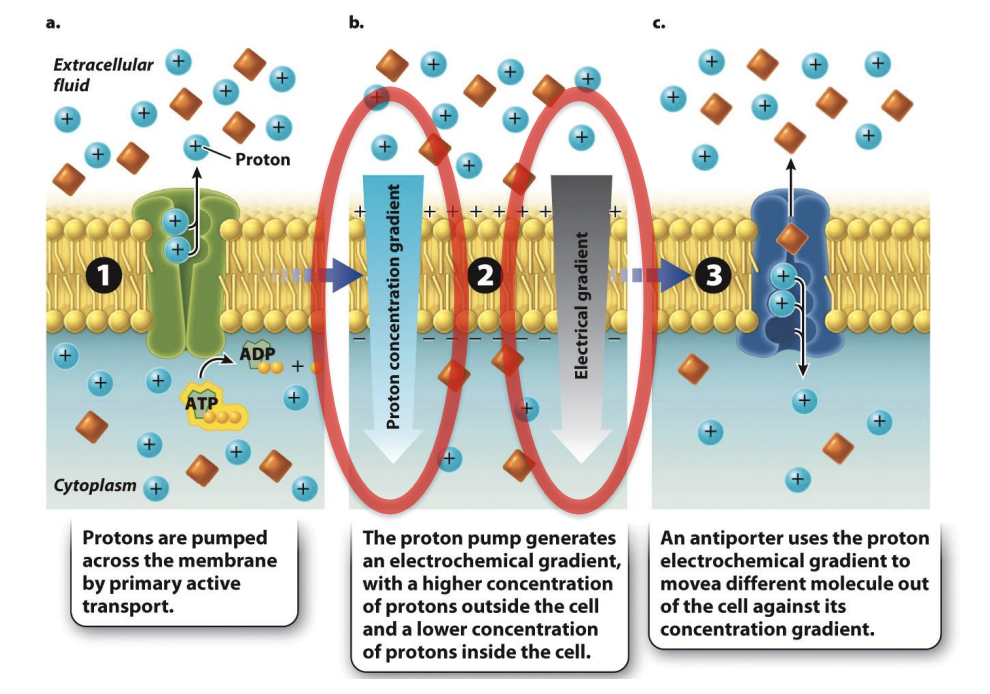
New cards

How does secondary active transport work?

  • Primary pumps protons across cell membrane using ATP --> transport protected(?) creates proton concentration gradient (protons charged) --> proton concentration gradient is also electron gradient -->  movement of proton move concentration gradient to drive the movement of other molecules (ex: square molecules against their won gradient)

    • Some cells actively pump protons ( H + ) across a membrane using ATP

  • protons pumped across membrane by primary active transport

  • proton pump generates electrochemical gradient, with higher concentration of protons outside the cell and lower concen of protons inside the cell

  • concentration differences favor the movement of protons back to the other side of the membrane.

    • blocking the movement of protons to the other side → the lipid bilayer creates a store of potential energy

  • Transporter: move one square molecules requires two protons to move from outside to inside 

    • can use the movement of protons to drive the movement of other molecules against their concentration gradient

    • The movement of protons is always from regions of higher to lower concentration,

    • movement of the coupled molecule is from regions of lower to higher concentration.

  • anitporter uses the proton electrochemical gradient to move different molecules of of the cell against the concentration gradient

  • Video in Bio book 3.4

<ul><li><p class="Paragraph SCXO40268134 BCX0" style="text-align: left;"><span style="background-color: inherit; line-height: 19.55px; color: windowtext;"><span>Primary pumps protons across cell membrane using ATP --&gt; transport protected(?) creates proton concentration gradient (protons charged) --&gt; proton concentration gradient is also electron gradient --&gt;&nbsp; movement of proton move concentration gradient to drive the movement of other molecules (ex: square molecules against their won gradient)</span></span></p><ul><li><p class="Paragraph SCXO40268134 BCX0" style="text-align: left;"><span><span>Some cells actively pump protons ( H + ) across a membrane using ATP</span></span></p></li></ul></li></ul><p class="Paragraph SCXO40268134 BCX0" style="text-align: left;"></p><ul><li><p class="Paragraph SCXO40268134 BCX0" style="text-align: left;"><span style="line-height: 19.55px; color: windowtext;"><span>protons pumped across membrane by primary active transport</span></span></p></li><li><p class="Paragraph SCXO40268134 BCX0" style="text-align: left;"><span style="line-height: 19.55px; color: windowtext;"><span>proton pump generates electrochemical gradient, with higher concentration of protons outside the cell and lower concen of protons inside the cell</span></span></p></li><li><p class="Paragraph SCXO40268134 BCX0" style="text-align: left;"><span><span>concentration differences favor the movement of protons back to the other side of the membrane. </span></span></p><ul><li><p class="Paragraph SCXO40268134 BCX0" style="text-align: left;"><span><span>blocking the movement of protons to the other side → the lipid bilayer creates a store of potential energy</span></span></p></li></ul></li><li><p class="Paragraph SCXO40268134 BCX0" style="text-align: left;"><span style="background-color: inherit; line-height: 19.55px; color: windowtext;"><span>Transporter: move one square molecules requires two protons to move from outside to inside</span></span><span style="line-height: 19.55px; color: windowtext;"><span>&nbsp;</span></span></p><ul><li><p class="Paragraph SCXO40268134 BCX0" style="text-align: left;"><span><span>can use the movement of protons to drive the movement of other molecules against their concentration gradient </span></span></p></li><li><p class="Paragraph SCXO40268134 BCX0" style="text-align: left;"><span><span>The movement of protons is always from regions of higher to lower concentration, </span></span></p></li><li><p class="Paragraph SCXO40268134 BCX0" style="text-align: left;"><span><span> movement of the coupled molecule is from regions of lower to higher concentration. </span></span></p></li></ul></li><li><p class="Paragraph SCXO40268134 BCX0" style="text-align: left;"><span style="line-height: 19.55px; color: windowtext;"><span>anitporter uses the proton electrochemical gradient to move different molecules of of the cell against the concentration gradient</span></span></p></li><li><p class="Paragraph SCXO40268134 BCX0" style="text-align: left;"><span style="line-height: 19.55px; color: windowtext;"><span>Video in Bio book 3.4</span></span></p></li></ul><p></p>
58
New cards

What is the endomembrane system?

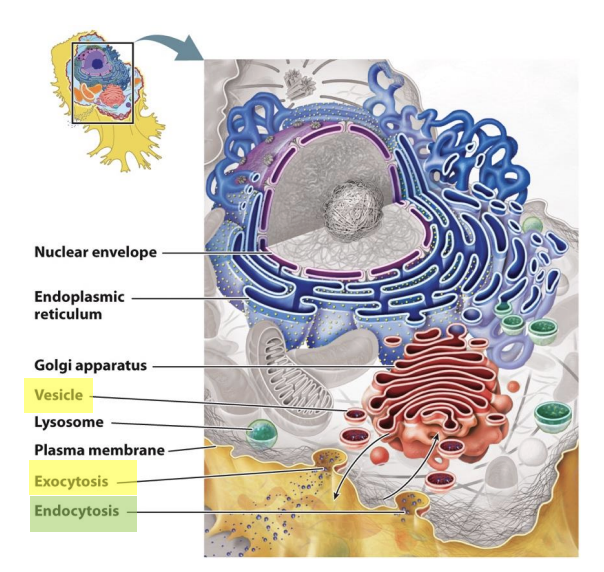
  • is an interconnected system of membranes that includes the nuclear envelope, endoplasmic reticulum, Golgi apparatus, lysosomes, vesicles, and plasma membrane.

  • isolated entities and they communicate with each other 

  • Transporter substance: connects between organelles --> creates endomembrane system 

  • Vesicles buds off from enodomembrane system -→ fuse with plasma membrane and deliver process into intercellular space (exocytosis) 

59
New cards

How do things move throughout the ER (book)?

  • endomembrane system divides the interior of a cell into two distinct spaces, one inside the compartments defined by these membranes and one outside these compartments.

  • A molecule within the interior of the endoplasmic reticulum (ER) can stay in the ER, in the interior of the Golgi apparatus, or even outside the cell by the budding off and fusing of a vesicle between these organelles.

  • a molecule associated with the ER membrane can move to the Golgi membrane or the cell membrane by vesicle transport. Molecules in the cytosol are in a different physical space, separated by membranes of the endomembrane system.

    • physical separation allows specific functions to take place within the spaces defined by the membranes and within the membrane itself.

60
New cards

What are vesicles?

  • small membrane-enclosed sacs that transport substances within a cell or from the interior to the exterior of the cell.

  • form by budding off an organelle, taking with them a piece of the membrane and internal contents of the organelle from which they derive.

  • They then fuse with another organelle or the cell membrane, re-forming a continuous membrane and unloading their contents.

61
New cards

What is exocytosis?

  • vesicle fuses with the cell membrane

    • provides a way for a vesicle to empty its contents to the extracellular space or to deliver proteins embedded in the vesicle membrane to the cell membrane

  • a vesicle that has budded off from the endomembrane system can fuse with the plasma membrane and deliver its contents into the extracellular space.

  • transport stuff from inside to outside?
<ul><li><p><span><span>vesicle fuses with the cell membrane</span></span></p><ul><li><p><span><span>provides a way for a vesicle to empty its contents to the extracellular space or to deliver proteins embedded in the vesicle membrane to the cell membrane</span></span></p></li></ul></li><li><p>a vesicle that has budded off from the endomembrane system can fuse with the plasma membrane and deliver its contents into the extracellular space.</p></li><li><p>transport stuff from inside to outside?</p></li></ul><p></p>
62
New cards

What is endocytosis?

  • material from outside the cell is brought into a vesicle that can then fuse with other organelles

  • a vesicle can bud off from the cell membrane, enclosing material from outside the cell and bringing it into the cell interior

63
New cards

What did Randy W. Schekman discover?

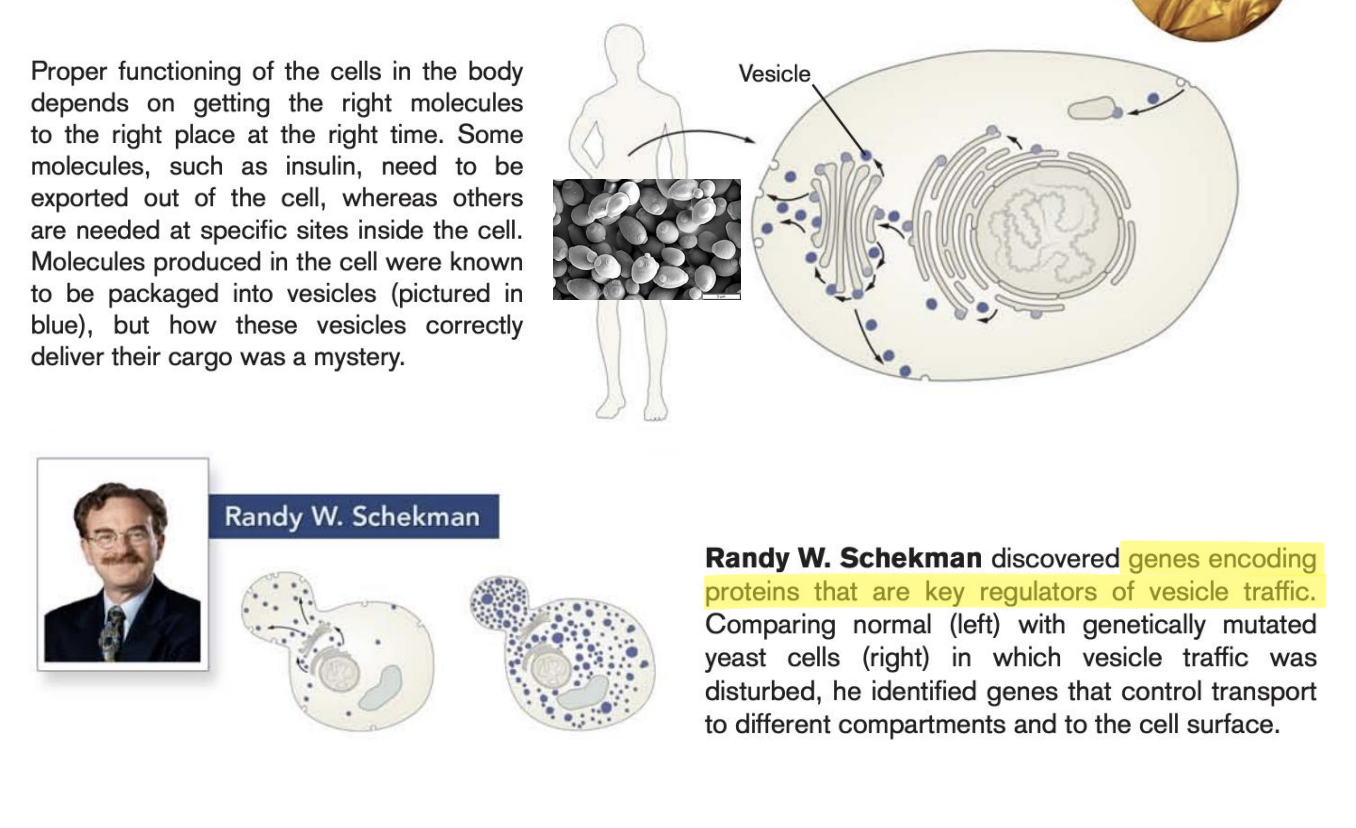
  • genes encoding proteins are key regulators of vesicle traffic

  • Dude discovered the vesicles 

  • Uses yeast (fungal spores) 

  • Discovered genes that encode protein

  • If you destory the gene  

    • Organized delivery of produce in cell come to a mass and is not working? 
<ul><li><p>genes encoding proteins are key regulators of vesicle traffic</p></li><li><p><span style="background-color: inherit; line-height: 19.55px; color: windowtext;"><span>Dude discovered the vesicles</span></span><span style="line-height: 19.55px; color: windowtext;"><span>&nbsp;</span></span></p></li><li><p class="Paragraph SCXO34109798 BCX0" style="text-align: left;"><span style="background-color: inherit; line-height: 19.55px; color: windowtext;"><span>Uses yeast (fungal spores)</span></span><span style="line-height: 19.55px; color: windowtext;"><span>&nbsp;</span></span></p></li><li><p class="Paragraph SCXO34109798 BCX0" style="text-align: left;"><span style="background-color: inherit; line-height: 19.55px; color: windowtext;"><span>Discovered genes that encode protei</span></span><span style="line-height: 19.55px; color: windowtext;"><span>n</span></span></p></li><li><p class="Paragraph SCXO34109798 BCX0" style="text-align: left;"><span style="background-color: inherit; line-height: 19.55px; color: windowtext;"><span>If you destory the gene&nbsp;</span></span><span style="line-height: 19.55px; color: windowtext;"><span>&nbsp;</span></span></p><ul><li><p class="Paragraph SCXO255234909 BCX0" style="text-align: left;"><span style="background-color: inherit; line-height: 19.55px; color: windowtext;"><span>Organized delivery of produce in cell come to a mass and is not working?</span></span><span style="line-height: 19.55px; color: windowtext;"><span>&nbsp;</span></span></p></li></ul></li></ul><p></p>
64
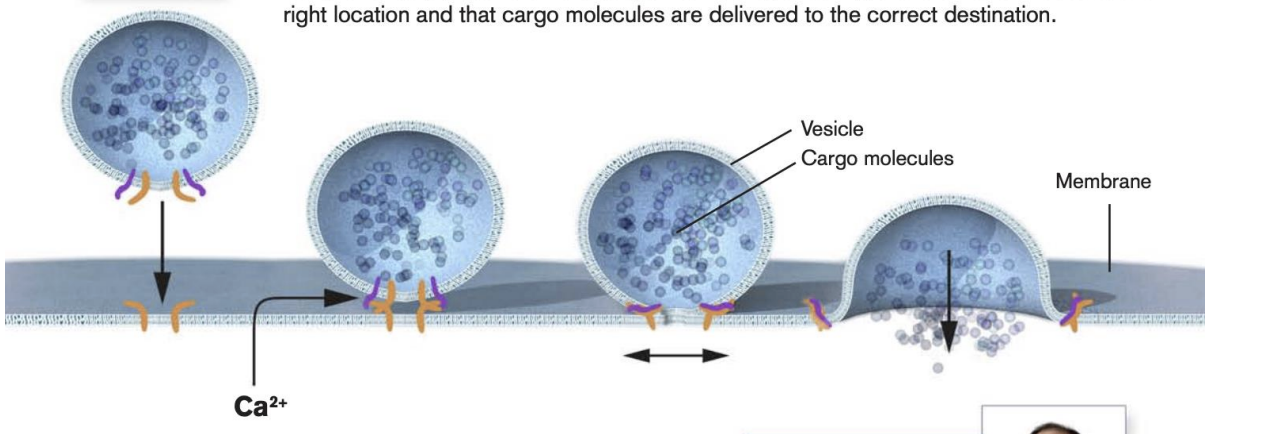
New cards

What did James E. Rothman and Thomas Sudhof discover?

  • protein complex (orange) enables vesicles to fuse with target membranes

    • proteins on vesicles bind to specific complementary proteins on the target membrane, ensuring that vesicle fuses at the right location and that cargo molecules are delivered to the correct destination

  • Molecular machinery (purple) senses calcium ions (Ca2+) and triggers vesicle fusion

    • how temporal percision is achieved and how signaling substances can be released from the vesicles on command

  • Membrane and surface of vesicle have protienes that recongize eachtoher 

  • Find spot where they land --> fuse with bilipid layer and release content within the cell 

    • Liposome: put medicine in liposome and release the medicine into the human cell 

  • efficient 

<ul><li><p>protein complex (orange) enables vesicles to fuse with target membranes</p><ul><li><p>proteins on vesicles bind to specific complementary proteins on the target membrane, ensuring that vesicle fuses at the right location and that cargo molecules are delivered to the correct destination </p></li></ul></li><li><p>Molecular machinery (purple) senses calcium ions (Ca2+) and triggers vesicle fusion</p><ul><li><p>how temporal percision is achieved and how signaling substances can be released from the vesicles on command</p></li></ul></li><li><p><span style="background-color: inherit; line-height: 19.55px; color: windowtext;"><span>Membrane and surface of vesicle have protienes that recongize eachtoher</span></span><span style="line-height: 19.55px; color: windowtext;"><span>&nbsp;</span></span></p></li><li><p class="Paragraph SCXO229795420 BCX0" style="text-align: left;"><span style="background-color: inherit; line-height: 19.55px; color: windowtext;"><span>Find spot where they land --&gt; fuse with bilipid layer and release content within the cell</span></span><span style="line-height: 19.55px; color: windowtext;"><span>&nbsp;</span></span></p><ul><li><p class="Paragraph SCXO229795420 BCX0" style="text-align: left;"><span style="background-color: inherit; line-height: 19.55px; color: windowtext;"><span>Liposome: put medicine in liposome and release the medicine into the human cell</span></span><span style="line-height: 19.55px; color: windowtext;"><span>&nbsp;</span></span></p></li></ul></li><li><p class="Paragraph SCXO229795420 BCX0" style="text-align: left;"><span style="background-color: inherit; line-height: 19.55px; color: windowtext;"><span>efficient</span></span><span style="line-height: 19.55px; color: windowtext;"><span>&nbsp;</span></span></p></li></ul><p></p>
65
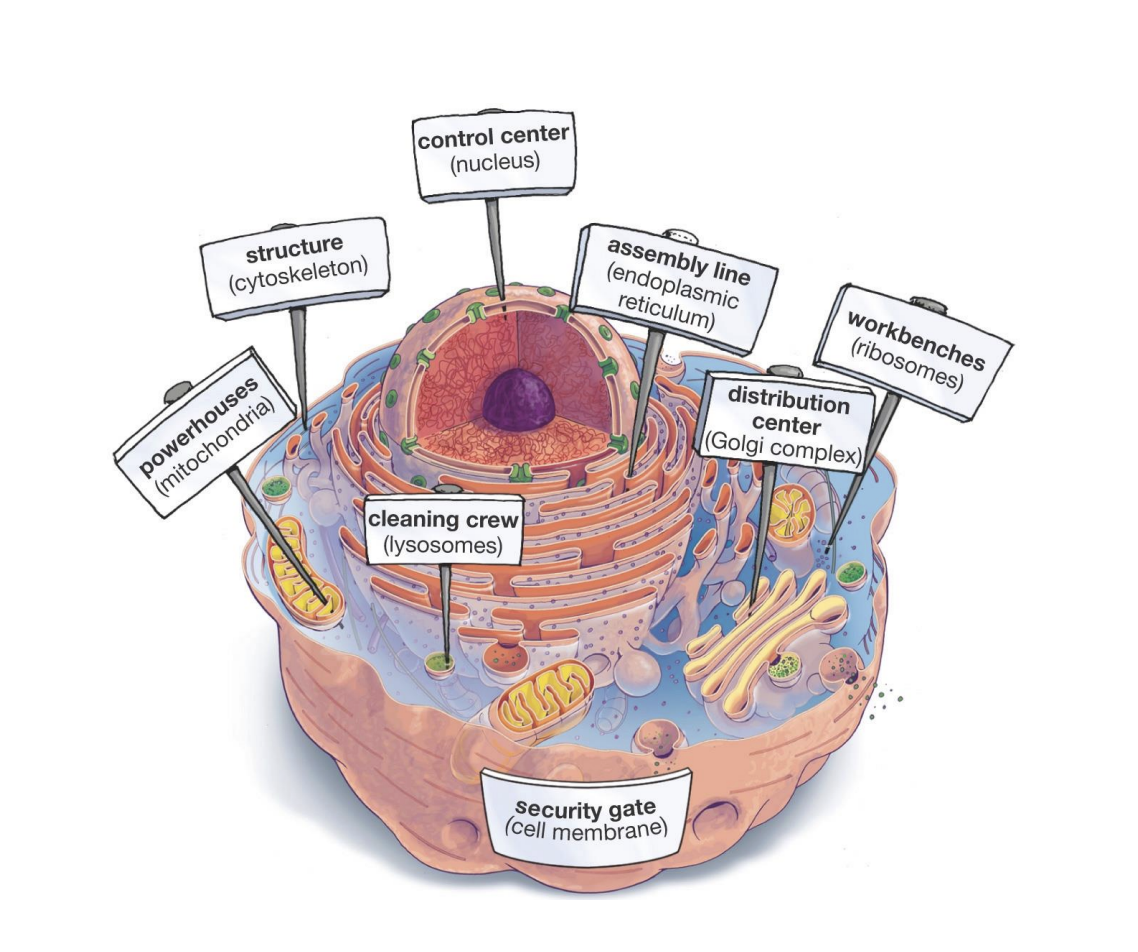
New cards

What are the jobs of the cell?

  • cytoskeleton: structure

  • Mitochondria: powerhouse

  • Lysosomes: breaking down and recycling waste materials and old cell parts

  • Golgi complex: modifies, sorts, and packages proteins and lipids for transport to different destinations in and out of the cell

  • ribosomes: workbenches

  • Endoplasmic reticulum: assembly line

  • nucleus: control center

  • Cell membrane: security gate

<ul><li><p>cytoskeleton: structure</p></li><li><p>Mitochondria: powerhouse</p></li><li><p>Lysosomes: <span>breaking down and recycling waste materials and old cell parts</span></p></li><li><p>Golgi complex: <span><span>modifies, sorts, and packages proteins and lipids for transport to different destinations in and out of the cell</span></span></p></li><li><p>ribosomes: workbenches</p></li><li><p>Endoplasmic reticulum: assembly line</p></li><li><p>nucleus: control center</p></li><li><p>Cell membrane: security gate</p></li></ul><p></p>
66
New cards

What is the nuclear envelope?

  • Nucleus: stores cell DNA  

  • Nuclear envelope: defines boundary of nucleus 

    • Have protein opening (nuclear pores) --> how small molecules can travel outside of the nucleus envelope 

      • Needed to communicate with the rest of the cell (especially mRNA) 
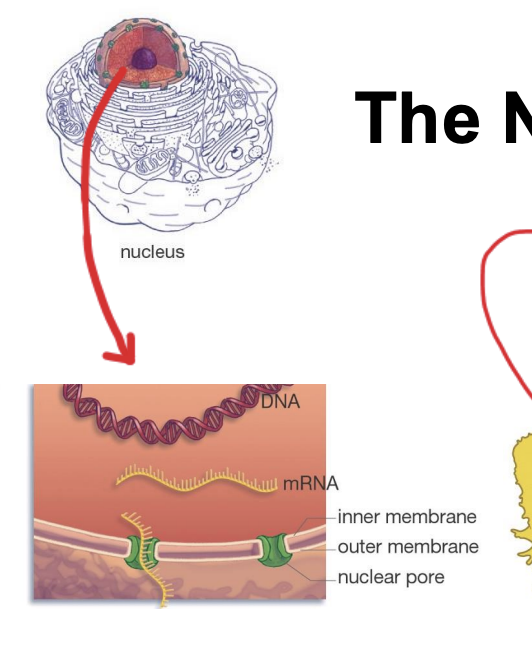
<ul><li><p><span style="background-color: inherit; line-height: 19.55px; color: windowtext;"><span>Nucleus: stores cell DNA&nbsp;</span></span><span style="line-height: 19.55px; color: windowtext;"><span>&nbsp;</span></span></p></li><li><p class="Paragraph SCXO143450012 BCX0" style="text-align: left;"><span style="background-color: inherit; line-height: 19.55px; color: windowtext;"><span>Nuclear envelope: defines boundary of nucleus</span></span><span style="line-height: 19.55px; color: windowtext;"><span>&nbsp;</span></span></p><ul><li><p class="Paragraph SCXO143450012 BCX0" style="text-align: left;"><span style="background-color: inherit; line-height: 19.55px; color: windowtext;"><span>Have protein opening (nuclear pores) --&gt; how small molecules can travel outside of the nucleus envelope</span></span><span style="line-height: 19.55px; color: windowtext;"><span>&nbsp;</span></span></p><ul><li><p class="Paragraph SCXO143450012 BCX0" style="text-align: left;"><span style="background-color: inherit; line-height: 19.55px; color: windowtext;"><span>Needed to communicate with the rest of the cell (especially mRNA)</span></span><span style="line-height: 19.55px; color: windowtext;"><span>&nbsp;</span></span></p></li></ul></li></ul></li></ul><p></p>
67
New cards

What are nuclear pores?

  • are essential for the nucleus to communicate with the rest of the cell.

  • envelope perforated by membrane protein openings (pores)

  • small molecules and ions can passively diffuse through the pores, but large proteins and RNA require active transport
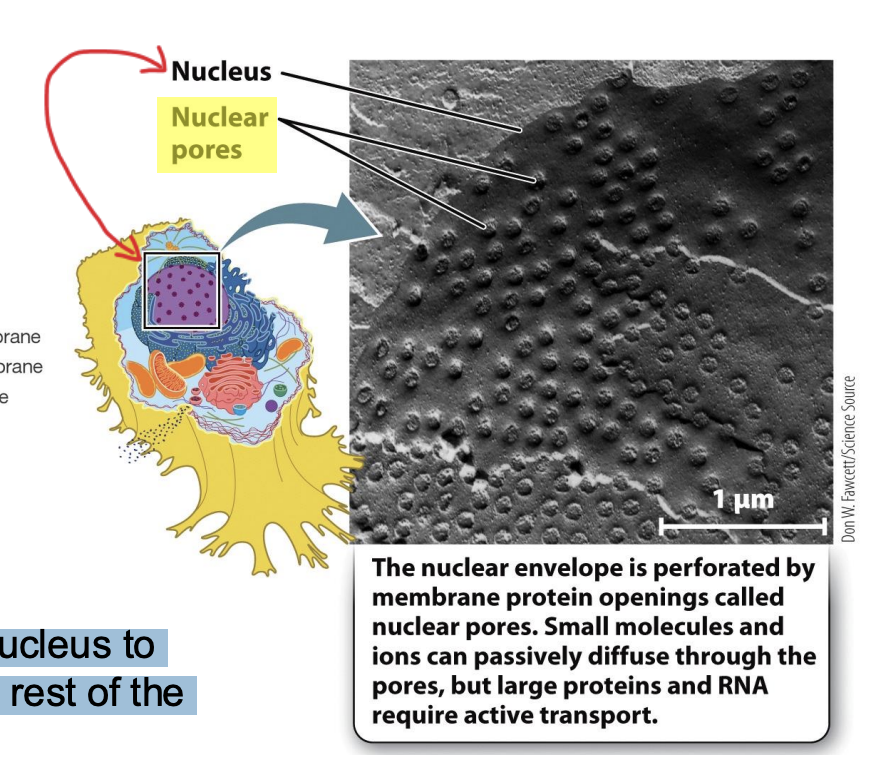
<ul><li><p>are essential for the nucleus to communicate with the rest of the cell.</p></li><li><p>envelope perforated by membrane protein openings (pores)</p></li><li><p>small molecules and ions can passively diffuse through the pores, but large proteins and RNA require active transport</p></li></ul><p></p>
68
New cards

What is the endoplasmic reticulum (ER)?

  • a large organelle in most eukaryotic cells, and it produces many of the lipids and proteins used inside and outside the cell.

  • outer membrane of the nuclear envelope is physically continuous with the ER

  • Its interior is continuous throughout and is called the lumen

  • involved in protein and lipid synthesis and site of production of most of the lipids that make up the various cell membranes

  • two catogries

    • Rough ER (RER)

    • Smooth ER

69
New cards

What are ribosomes?

  • the sites of protein synthesis, where amino acids are assembled into polypeptides.

  • round particles and exposed to cytosol --> where proteins are synthesized 

    • Amino acids assembled into peptides that are folded later to become proteins 

70
New cards

What is the RER?

  • associated with ribosomes (on surface)

  • many proteins, including those destined for secretion, are synthesized by ribosomes associated with RER

  • synthesizes transmembrane proteins, proteins that end up in the interior of organelles, and proteins destined for secretion
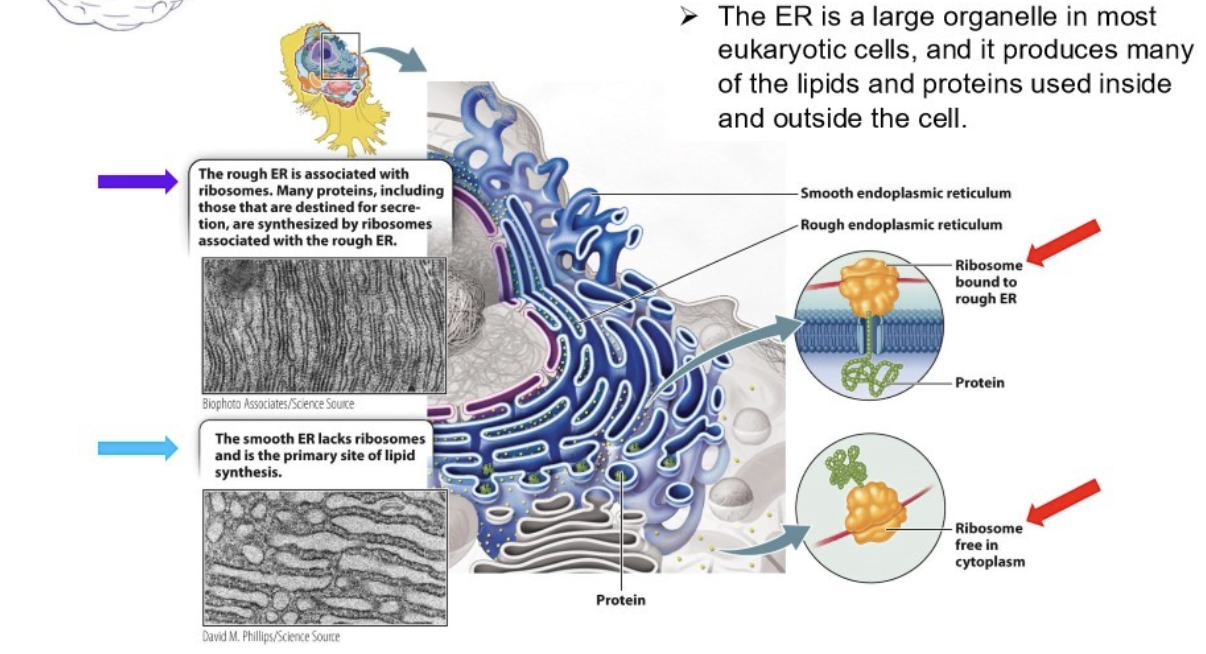
<ul><li><p>associated with ribosomes (on surface)</p></li><li><p>many proteins, including those destined for secretion, are synthesized by ribosomes associated with RER</p></li><li><p><span><span>synthesizes transmembrane proteins, proteins that end up in the interior of organelles, and proteins destined for secretion</span></span></p></li></ul><p></p>
71
New cards

What is smooth ER?

  • lacks ribosomes

  • site of fatty acid and phospholipid biosynthesis. → primary site of lipid synthesis
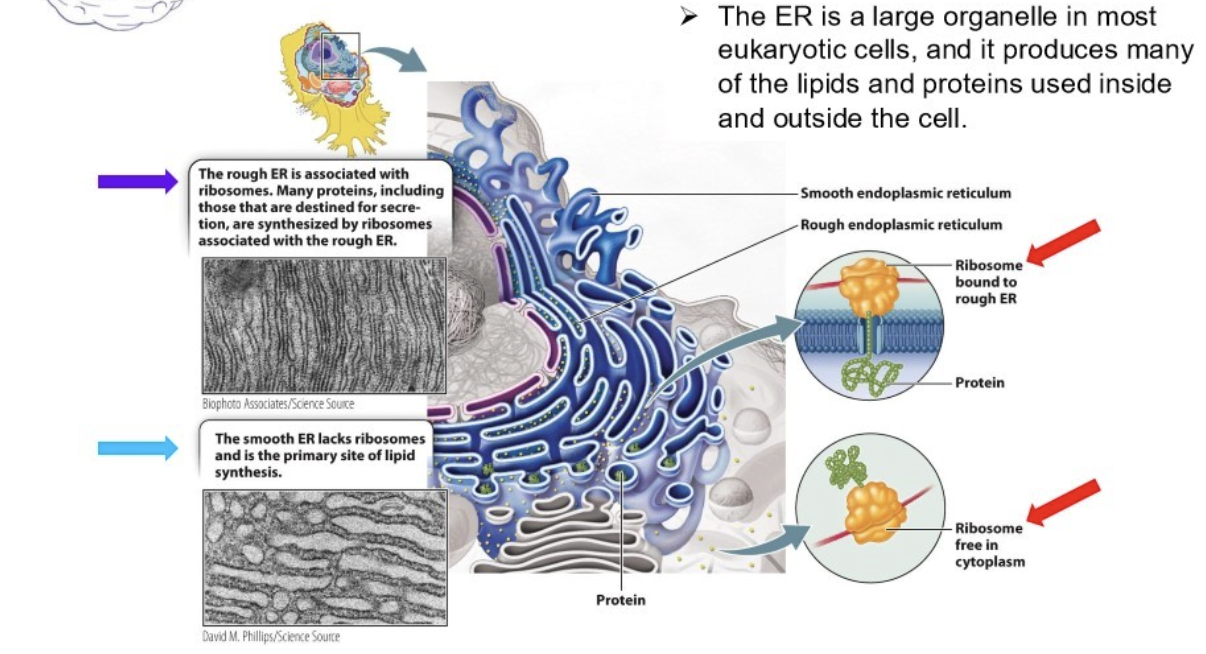
<ul><li><p>lacks ribosomes</p></li><li><p><span><span>site of fatty acid and phospholipid biosynthesis. →&nbsp;</span></span>primary site of lipid synthesis</p></li><li><p></p></li></ul><p></p>
72
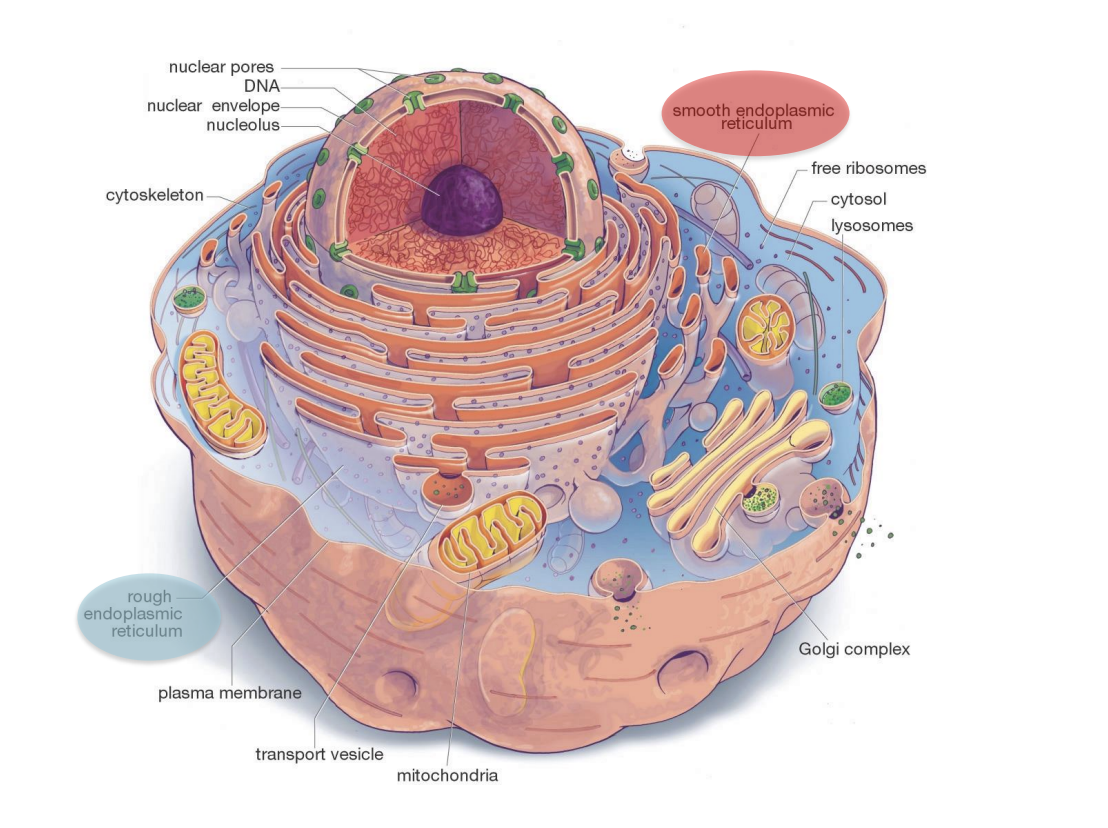
New cards

What is predominantly synthesized at the ERs?

  • Light blue: cytosol 

  • RER ribosomes are exposed to cytosol --> main sides of synthesizes of proteins dominant 

  • Smooth ER:  

    • Predominate that synthesize lipids 

<ul><li><p><span style="background-color: inherit; line-height: 19.55px; color: windowtext;"><span>Light blue: cytosol</span></span><span style="line-height: 19.55px; color: windowtext;"><span>&nbsp;</span></span></p></li><li><p class="Paragraph SCXO174600976 BCX0" style="text-align: left;"><span style="background-color: inherit; line-height: 19.55px; color: windowtext;"><span>RER ribosomes are exposed to cytosol --&gt; main sides of synthesizes of proteins dominant</span></span><span style="line-height: 19.55px; color: windowtext;"><span>&nbsp;</span></span></p></li><li><p class="Paragraph SCXO174600976 BCX0" style="text-align: left;"><span style="background-color: inherit; line-height: 19.55px; color: windowtext;"><span>Smooth ER:&nbsp;</span></span><span style="line-height: 19.55px; color: windowtext;"><span>&nbsp;</span></span></p><ul><li><p class="Paragraph SCXO174600976 BCX0" style="text-align: left;"><span style="background-color: inherit; line-height: 19.55px; color: windowtext;"><span>Predominate that synthesize lipids</span></span><span style="line-height: 19.55px; color: windowtext;"><span>&nbsp;</span></span></p></li></ul></li></ul><p></p>
73
New cards

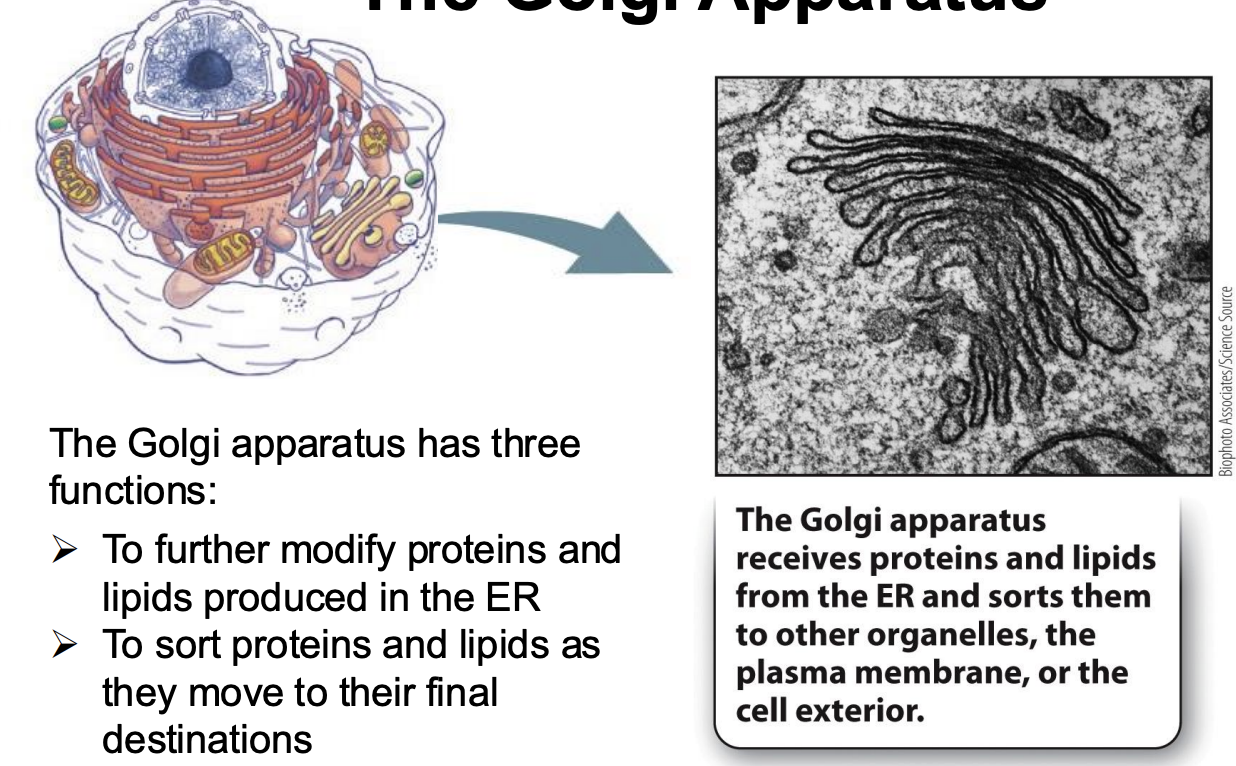
What is the Golgi apparatus?

  • receives proteins and lipids from the ER and sorts them to other organelles, the plasma membrane, or the cell exterior

  • Not physically attached to ER 

  • Next stop for vesicle that bud from ER 

  • Functions:

  • To further modify proteins and lipids produced in the ER

  • To sort proteins and lipids as they move to their final destinations

  • To synthesize the cell’s carbohydrates
<ul><li><p>receives proteins and lipids from the ER and sorts them to other organelles, the plasma membrane, or the cell exterior</p></li><li><p><span style="background-color: inherit; line-height: 19.55px; color: windowtext;"><span>Not physically attached to ER</span></span><span style="line-height: 19.55px; color: windowtext;"><span>&nbsp;</span></span></p></li><li><p class="Paragraph SCXO137407277 BCX0" style="text-align: left;"><span style="background-color: inherit; line-height: 19.55px; color: windowtext;"><span>Next stop for vesicle that bud from ER</span></span><span style="line-height: 19.55px; color: windowtext;"><span>&nbsp;</span></span></p></li><li><p>Functions:</p></li></ul><ul><li><p>To further modify proteins and lipids produced in the ER </p></li></ul><ul><li><p> To sort proteins and lipids as they move to their final destinations </p></li><li><p>To synthesize the cell’s carbohydrates</p></li></ul><p></p>
74
New cards

What are lysosomes?

  • can degrade proteins, nucleic acids, lipids, and complex carbohydrates

  • Proteins can be synthesized or degraded 

    • Damaged or malfunctions --> cells need a way to recycle them 

  • Lysosomes: specialized vesicle from the Golgi apparatus that degrade damaged  or uneeded macromolecules 

    • Can degrade proteins, nucleic acids, lipiss, and complex carbohydrates  

    • Lysosome Fuses with vesicle that contain micromolcules --> degraded and recycles 

    • Needed for healthy cells to remain functional

75
New cards

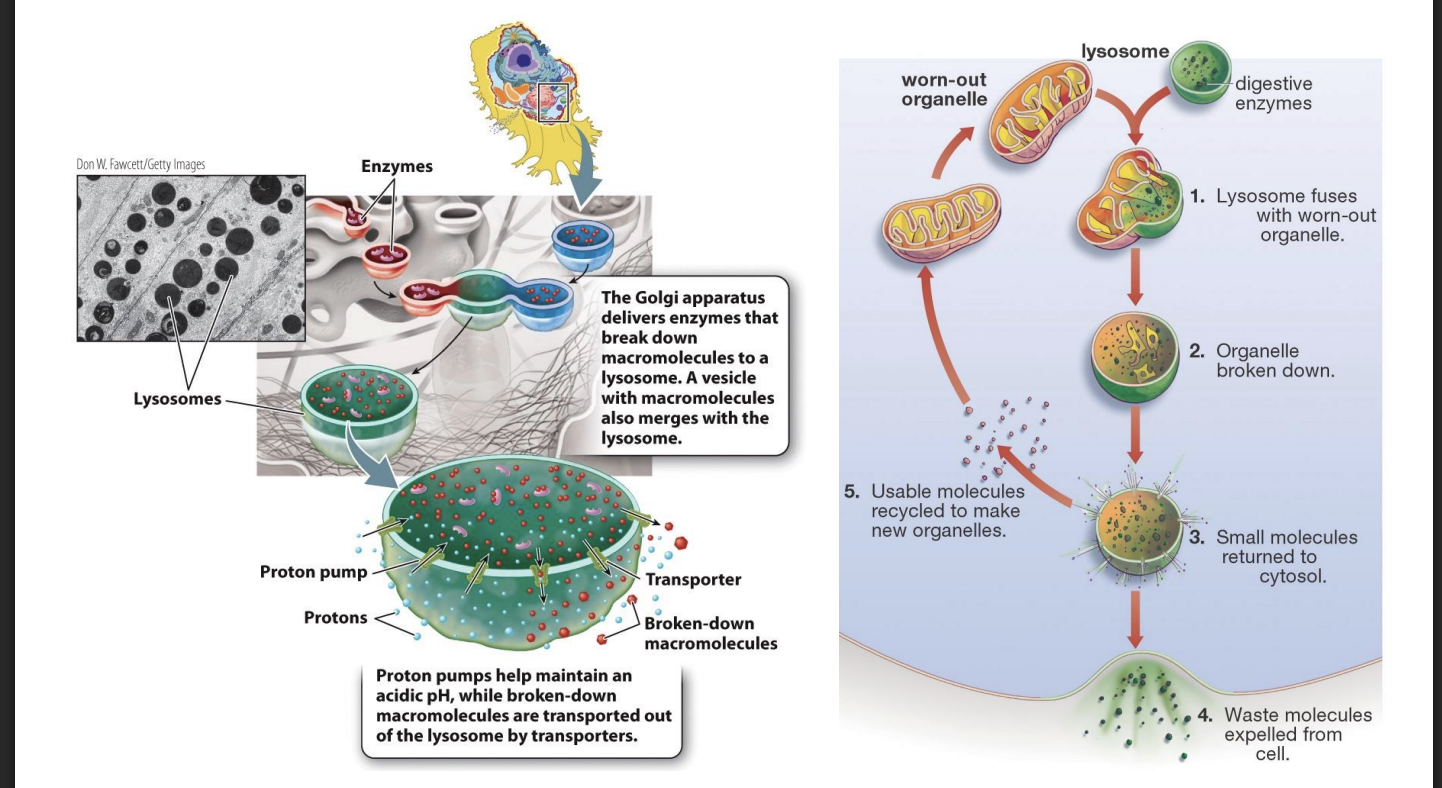
How do lysosomes do their job?

  • Golgi apparatus delivers enzymes that break down macromolecues to lysosomes: enzymes inside the lysosomes are synthesized in the rough ER, sorted in the Golgi apparatus, and then packaged into lysosomes.

    • vesicles with macromolecules also merges with the lysosome

    • proton pumps help maintain acidic pH

      • while broken down macromolecules are transported out of the lysosome by transporters

  1. lysosomes fuses with worn out organelle

  2. organelle is broken down

  3. small molecules returned to cytosol

  4. waste molecules expelled from cell

  5. usable molecules recycled to make new organelles

  • Lysosomal enzymes cannot function in the normal cellular environment, which has a pH of about 7

    • many of a cell’s enzymes and proteins would unfold and degrade if the entire cell were at the pH of the inside of a lysosome.

    • By restricting the activity of these enzymes to the lysosome, the cell protects proteins and organelles in the cytosol from degradation.
<ul><li><p>Golgi apparatus delivers enzymes that break down macromolecues to lysosomes:&nbsp;<span><span>enzymes inside the lysosomes are synthesized in the rough ER, sorted in the Golgi apparatus, and then packaged into lysosomes.</span></span></p><ul><li><p>vesicles with macromolecules also merges with the lysosome</p></li><li><p>proton pumps help maintain acidic pH</p><ul><li><p>while broken down macromolecules are transported out of the lysosome by transporters</p></li></ul></li></ul></li></ul><ol><li><p>lysosomes fuses with worn out organelle</p></li><li><p>organelle is broken down</p></li><li><p>small molecules returned to cytosol</p></li><li><p>waste molecules expelled from cell</p></li><li><p>usable molecules recycled to make new organelles</p></li></ol><ul><li><p><span><span>Lysosomal enzymes cannot function in the normal cellular environment, which has a pH of about 7</span></span></p><ul><li><p><span><span>many of a cell’s enzymes and proteins would unfold and degrade if the entire cell were at the pH of the inside of a lysosome.</span></span></p></li><li><p><span><span> By restricting the activity of these enzymes to the lysosome, the cell protects proteins and organelles in the cytosol from degradation.</span></span></p></li></ul></li></ul><p></p>
76
New cards

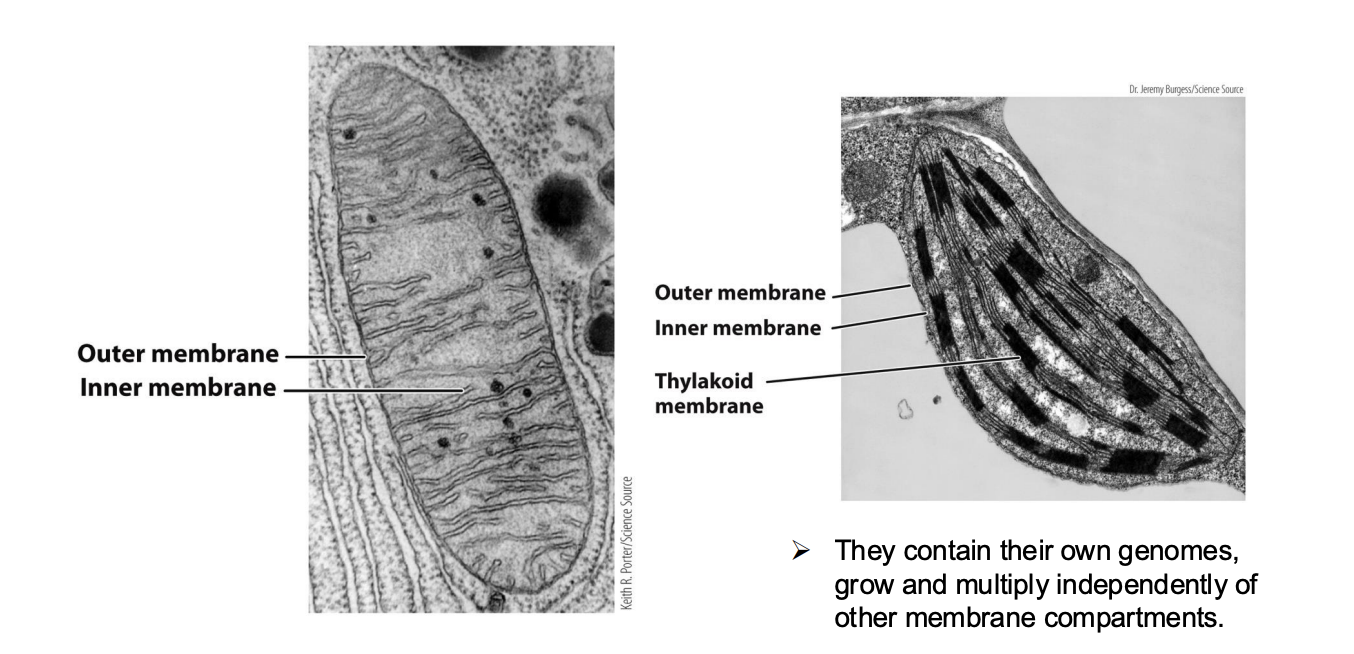
What are Mitochondria and chloroplasts?

  • organelles involved in harnessing energy and likely evolved from free-living prokaryotes.

  • Not part of Endomembrane system 

  • Mitochondria and chloroplast: harvest energy for the cell and hold genomes 

  • Can grow and multiply independently --> once bacteria that were captures by ancestor or eukaryotic cell 

    • Over time evolved current function in eukaryotic cells 

    • Genes sometimes change: endosymbiosis theory 
<ul><li><p>organelles involved in harnessing energy and likely evolved from free-living prokaryotes.</p></li><li><p><span style="background-color: inherit; line-height: 19.55px; color: windowtext;"><span>Not part of Endomembrane system</span></span><span style="line-height: 19.55px; color: windowtext;"><span>&nbsp;</span></span></p></li><li><p class="Paragraph SCXO210469357 BCX0" style="text-align: left;"><span style="background-color: inherit; line-height: 19.55px; color: windowtext;"><span>Mitochondria and chloroplast: harvest energy for the cell and hold genomes</span></span><span style="line-height: 19.55px; color: windowtext;"><span>&nbsp;</span></span></p></li><li><p class="Paragraph SCXO210469357 BCX0" style="text-align: left;"><span style="background-color: inherit; line-height: 19.55px; color: windowtext;"><span>Can grow and multiply independently --&gt; once bacteria that were captures by ancestor or eukaryotic cell</span></span><span style="line-height: 19.55px; color: windowtext;"><span>&nbsp;</span></span></p><ul><li><p class="Paragraph SCXO210469357 BCX0" style="text-align: left;"><span style="background-color: inherit; line-height: 19.55px; color: windowtext;"><span>Over time evolved current function in eukaryotic cells</span></span><span style="line-height: 19.55px; color: windowtext;"><span>&nbsp;</span></span></p></li><li><p class="Paragraph SCXO210469357 BCX0" style="text-align: left;"><span style="background-color: inherit; line-height: 19.55px; color: windowtext;"><span>Genes sometimes change: endosymbiosis theory</span></span><span style="line-height: 19.55px; color: windowtext;"><span>&nbsp;</span></span></p></li></ul></li></ul><p></p>
77
New cards

How does the mitochondria function (book) ?

  • an outer membrane and a highly convoluted inner membrane whose folds project into the interior A proton electrochemical gradient is generated across the inner mitochondrial membrane, and the energy stored in the gradient is used to synthesize ATP for use by the cell. The presence of folds of the inner mitochondrial membrane increases the surface area available for the biochemical machinery that pumps protons and then synthesizes ATP. The more folds there are, the more surface is available and the more ATP is synthesized. This is another example of structure and function coming together.

  • In the process of breaking down sugar and synthesizing ATP, oxygen is consumed and carbon dioxide is released.

78
New cards

How does the chloroplast function (book)?

  • plant cells and green algae have organelles called chloroplasts that capture the energy of sunlight to synthesize simple sugars

  • This process, called photosynthesis, results in the release of oxygen as a waste product. Like the nucleus and mitochondria, chloroplasts are surrounded by a double membrane.

  • They also have a third, internal membrane, called the thylakoid membrane. 

    •  membrane defines a separate internal compartment called the thylakoid. The thylakoid membrane contains specialized light-collecting molecules called pigments, of which chlorophyll is the most important.

79
New cards

What are the major differences between plants and

animals at the cellular level?

  • Share common structures, but some unique 

  • Plant cell 

    • Chloroplast 

    • Vacuole 

    • Cell wall 

  • Animal 

    • Cholesterol only in animal cells 

  • Diff leads to diff ecological roles in nature 

  • Plant cell uses energy to produce food in chloroplast (autotroph) 

  • Animal cells cannot produce food themselves (prey on other --> heterotroph) 
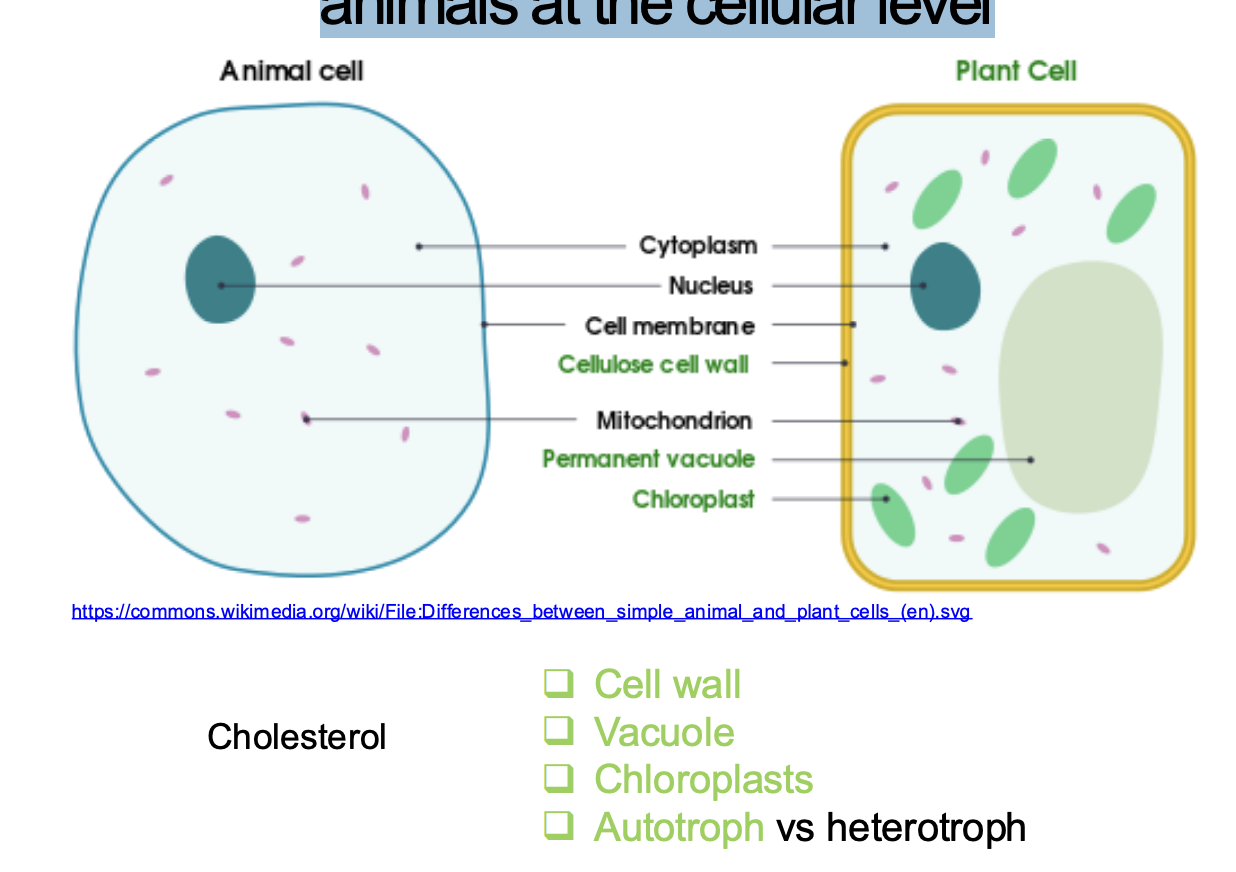
<ul><li><p><span style="background-color: inherit; line-height: 19.55px; color: windowtext;"><span>Share common structures, but some unique</span></span><span style="line-height: 19.55px; color: windowtext;"><span>&nbsp;</span></span></p></li><li><p class="Paragraph SCXO188022260 BCX0" style="text-align: left;"><span style="background-color: inherit; line-height: 19.55px; color: windowtext;"><span>Plant cell</span></span><span style="line-height: 19.55px; color: windowtext;"><span>&nbsp;</span></span></p><ul><li><p class="Paragraph SCXO188022260 BCX0" style="text-align: left;"><span style="background-color: inherit; line-height: 19.55px; color: windowtext;"><span>Chloroplast</span></span><span style="line-height: 19.55px; color: windowtext;"><span>&nbsp;</span></span></p></li><li><p class="Paragraph SCXO188022260 BCX0" style="text-align: left;"><span style="background-color: inherit; line-height: 19.55px; color: windowtext;"><span>Vacuole</span></span><span style="line-height: 19.55px; color: windowtext;"><span>&nbsp;</span></span></p></li><li><p class="Paragraph SCXO188022260 BCX0" style="text-align: left;"><span style="background-color: inherit; line-height: 19.55px; color: windowtext;"><span>Cell wall</span></span><span style="line-height: 19.55px; color: windowtext;"><span>&nbsp;</span></span></p></li></ul></li><li><p class="Paragraph SCXO188022260 BCX0" style="text-align: left;"><span style="background-color: inherit; line-height: 19.55px; color: windowtext;"><span>Animal</span></span><span style="line-height: 19.55px; color: windowtext;"><span>&nbsp;</span></span></p><ul><li><p class="Paragraph SCXO188022260 BCX0" style="text-align: left;"><span style="background-color: inherit; line-height: 19.55px; color: windowtext;"><span>Cholesterol only in animal cells</span></span><span style="line-height: 19.55px; color: windowtext;"><span>&nbsp;</span></span></p></li></ul></li><li><p class="Paragraph SCXO188022260 BCX0" style="text-align: left;"><span style="background-color: inherit; line-height: 19.55px; color: windowtext;"><span>Diff leads to diff ecological roles in nature</span></span><span style="line-height: 19.55px; color: windowtext;"><span>&nbsp;</span></span></p></li><li><p class="Paragraph SCXO188022260 BCX0" style="text-align: left;"><span style="background-color: inherit; line-height: 19.55px; color: windowtext;"><span>Plant cell uses energy to produce food in chloroplast (autotroph)</span></span><span style="line-height: 19.55px; color: windowtext;"><span>&nbsp;</span></span></p></li><li><p class="Paragraph SCXO188022260 BCX0" style="text-align: left;"><span style="background-color: inherit; line-height: 19.55px; color: windowtext;"><span>Animal cells cannot produce food themselves (prey on other --&gt; heterotroph)</span></span><span style="line-height: 19.55px; color: windowtext;"><span>&nbsp;</span></span></p></li></ul><p></p>