07 - Graphic medicine and visual arts
 Studied by 0 people
 Call Kai
 Learn
Learn Practice Test
 Spaced Repetition
 Match
Match Flashcards
 Knowt Play
1/40

There's no tags or description
Looks like no tags are added yet.
Name | Mastery | Learn | Test | Matching | Spaced | Call with Kai |
|---|
No study sessions yet.
41 Terms
Visual arts impacts
Growing body of research supports positive impacts
Visual arts impact on Patients
Improved self-esteem and self-respect
Reduced depression and anxiety
Re-engagement with wider social world
Visual arts impact on Providers
Increased empathy
Observational skills
Transdiscipinarity
• Commitment to working across disciplines
• Bypassing or abandoning subject boundaries
• Characterized by creative inquiry and intellectual risk taking
• Embraces diversity (socioeconomic and otherwise)
• Foregrounds creation of new knowledge
Drawing
• Oldest form of visual arts
• Predates writing by at least 25,000 years
• Don’t know what drawings communicate…Perhaps used as a form of communication?
• “mark-making for meaning” (p. 302)
Ardeche valley caves in Southern France
cave drawings from 17000-22000 years ago, depicting a scene of (subjective interpreatation) people on a savanna with animals
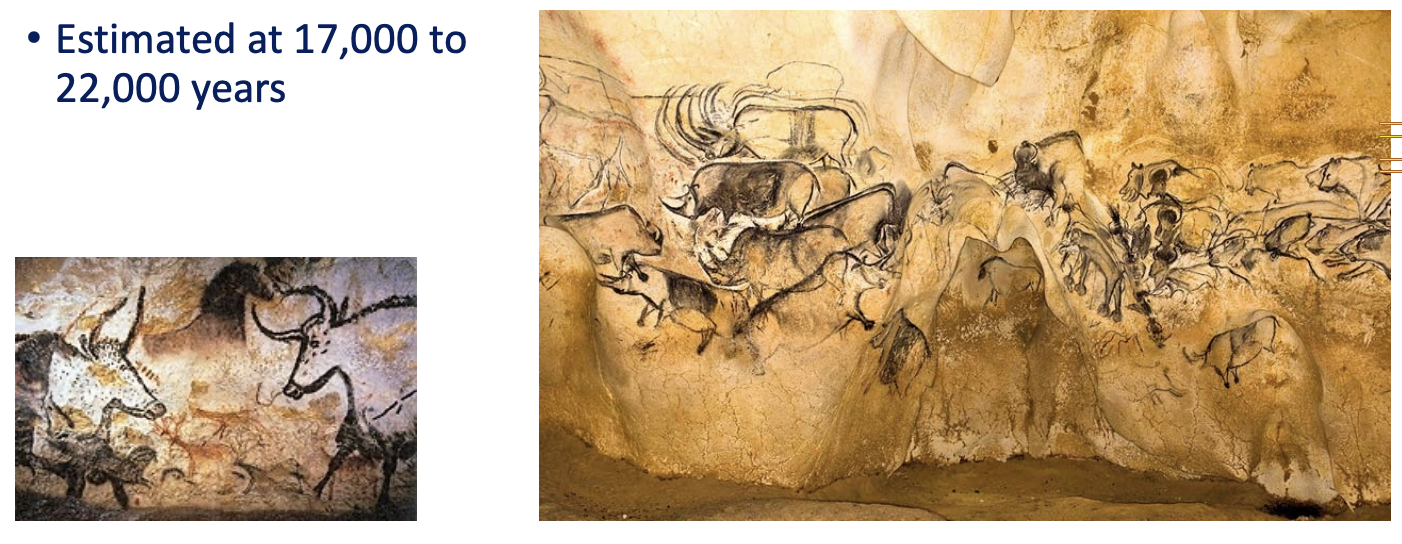
Blombos Cave, South Africa
fragment of rock has ochre pressed into it to form lines - don't know what it is, since the rock is a very small fragment of a possibly much larger piece
Drawing as noun
physical drawn artifact
Drawing as verb
the process of drawing
Drawing and everyday life
• Children make meaning of their world visually
• Self-directed drawing dwindles around 8-12 years old
• Corresponds with emphasis in school curriculum on text-based literacy and numeracy
• Intellectual capacity tacitly associated with word-based outputs
• Drawing becomes marginalized in adulthood
• When asked to draw, adults become anxious!
universally ubiquitous
everyday, ordinary, present, everywhere.
Drawing is for everyone
• “[Drawing is a] universally ubiquitous means for generating and critiquing ideas and forms and for investigating the world. It is entirely democratic: belonging to everyone, blurring distinction between art and everyday usage.” (p. 303)
• “When drawing, a trace or imprint of the thinking process is left on the page and the externalizing of thoughts helps structure thoughts.” (p. 306)
trace/imprint of the thinking process
throughout an artpiece, the artist's thought process and background will inevitably end up entangled within
Objective drawings
• All diagrams are drawings!
• Draw to explain concepts
eg. diagrams in textbooks, images that aim to show a representation of things as they are. Pathways, flow charts, anatomy diagrams
Subjective drawings
• Expressive, unconcerned with accuracy
• Capture a “sense” of situation
• Open-ended, intuitive, provisional, expansive, evocative, experimental
• Visual thinking, exploration, making new knowledge
• “Draw-and-write” or “Draw-and-tell” method
“Draw-and-write” or “Draw-and-tell” method
• People draw and then write or talk about their drawing
• Used to explore lived experience
Comics
• Not a genre but a medium
• Increasingly not only fiction but also non-fiction and documentary
• Enable us to enter, imaginatively, complex, ambiguous debates…potential of a comic to express complex issues and thus be pedagogically useful in discussions of medical ethics
• Stigma around comics?
Crusade against comics
1948, symposium on “The Psychopathology of Comic Books”, American Association of Psychotherapy
• Comic books promoted violence
• Undermined moral values
• Negatively influenced young readers’ psychological development
• Contributed to juvenile delinquency
• Encouraged disrespect for authority figures
1954, Comics Code
• Self-censorship rules adopted by US comics publishers
• Addressed public concerns about influence on youth
• Outlawed sympathetic portrayals of criminals, excessive violence, disrespect for authority
• Era officially ended in 2011 when DC Comics and Archie Comics withdrew
Comics as “third space”
A zone where one can play with ideas not yet accessible to linear thinking, draw together concepts, communities, and practices conventionally kept separate, and enjoy the fireworks that result
A meeting point, a hybrid place, where one can move beyond existing borders…a place of the marginal women and men, where old connections can be disturbed and new ones emerge…a precondition to building a community of resistance to all forms of hegemonic power
Hegemony
• Term popularized by Antonio Gramsci
• Refers to how the worldview of a dominant group is imposed and accepted as “common sense” or the norm by society
• Makes alternative perspectives seem unthinkable or dangerous
• Dominance is achieved through institutions like media, education, and religion
• Subtly reinforces the status quo and interests of those in power
historical hegemony
British empire in 18th & 19th century, dominated quarter of world’s landmass
cultural hegemony
Hollywood/ American movies and pop culture dominate global entertainment
social/ideological hegemony
English as most prominent global language
educational hegemony
Western-centric curriculum
Why comics?
• 21st century is a visual culture
• Digital age is driven by combination of images and text
• Comics are particularly adept at conveying information when:
• High density of information to be learned
• High level of importance to the information
• Learners are in a high-stress situation
Stigmatized topics
Disability
Death and dying
SA
Social and political activism
Racial and gender bias
Healthcare as a basic human right
social and political activism
comics touching on topics of human rights and political parties in power advocate for change
comics for community
• Comics are a medium of social connection
• Appreciation for comics transcends geography, language, social status, culture
• Illness isolates, but comics are a potent antidote for both social and physical isolation
Graphic medicine
Coined by physician/ comic illustrator Ian Williams in 2008
“Could the graphic be the medicine?” (p. 353)
Use of comics in context of medicine, patient care, stories of health, disability, illness…
Form of visual storytelling that combines image/ text, research/ experience, time/ space, language/ line
Convey complex messages
Understanding Comics
• Reading visual texts asks us to develop skills in visual literacy
• Poetics (the study of linguistic techniques in written arts) also shapes visual texts
• Visual images possess their own visual vocabulary and grammar
loiterature
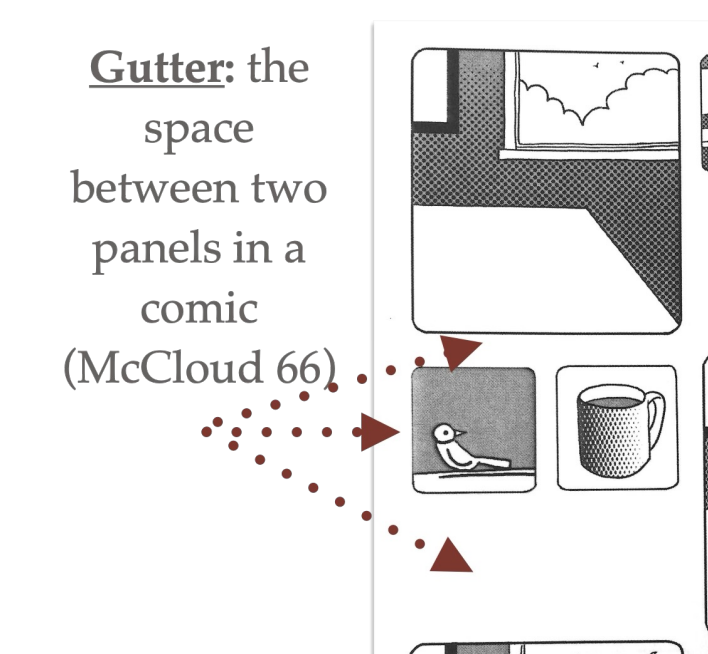
Refers to the kind of looping, recursive movement, a wandering in and out of the frame, back to the past and forward to the future, that is produced by the specific spatial affordances of comics—panels separated by blank spaces known as gutters
Why would anyone…respond to a cartoon as much or more than a realistic image?
• “Amplification through simplification” (McCloud)
• Abstracting an image does not so much eliminate details as focuses it on specific details
• The cartoon thus focuses our attention on an idea
comic - gutter
the space between two panels in a comic
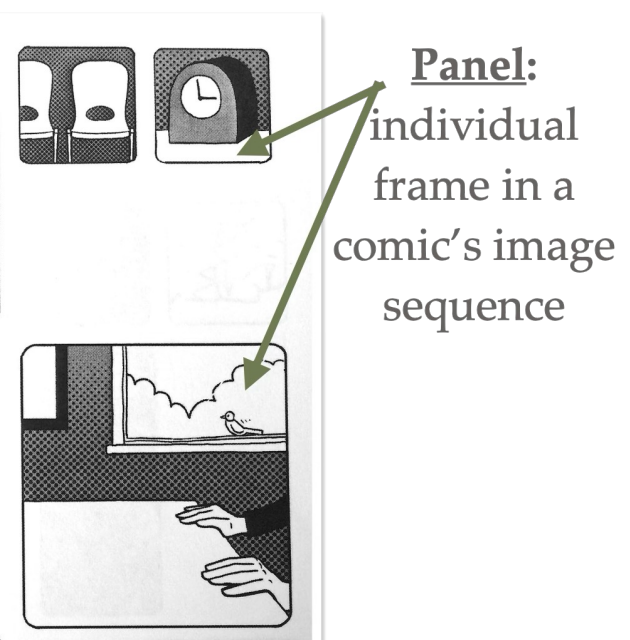
comic - panel
individual frame in a comic's image sequence
comic - closure
observing the parts but perceiving the whole
Williams, “Culpability”
Comic/ graphic portrait of therapeutic relationship; mental illness (depression); the ill person’s story (involves both health practitioner and client/ patient
Presents a case study of visual means of communicating pain and mental illness
ineffable
that which cannot be put into words, to be described or explained.
Reasons to use images in research
• Represent and explore the ineffable – that which is hard to put into words
• Convey an all-at-oneness – holistic depiction of ideas and feelings
• Make us attentive to things in new ways – unnoticed details
• Memorable – iconic images
• Develop empathetic understanding – humanitarian issue given new weight
• Provoke action for social justice – social change
• Vitalizing – jolt our sensibilities
Photography
a cultural critique, and a therapeutic practice of capturing the moment with a camera
"The Final Project" by Jo Spence
She used her camera as a way to document her journey with breast cancer, as a part of her that was analytical and critical, but still attached to emotional vulnerability of the experience of having breast cancer.
 Note
Note  Flashcards (35)