Thermal Physiology: Animal Adaptations to Cold and Heat
 Call Kai
 Learn
Learn Practice Test
 Spaced Repetition
 Match
Match Flashcards
 Knowt Play
1/67

There's no tags or description
Looks like no tags are added yet.
Name | Mastery | Learn | Test | Matching | Spaced | Call with Kai | Chat |
|---|
No analytics yet
Send a link to your students to track their progress
68 Terms
What are four physiological processes affected by temperature?
Protein structure and function, membrane fluidity, the rate of chemical reactions, and metabolic rate.
What is the lower temperature limit for aquatic organisms in freshwater versus saltwater?
0°C for freshwater and -1.86°C for saltwater.
What is the formula for the thermal energy balance of an animal?
ΔHtotal = ΔHmetabolism + ΔHcond/conv + ΔHradiation + ΔHevaporation + ΔHstorage.
How do animals maintain their body temperature within an acceptable range?
Through a combination of behavioral, biochemical, and physiological responses.
Define poikilotherms.
Animals whose internal body temperature varies with the environmental temperature.
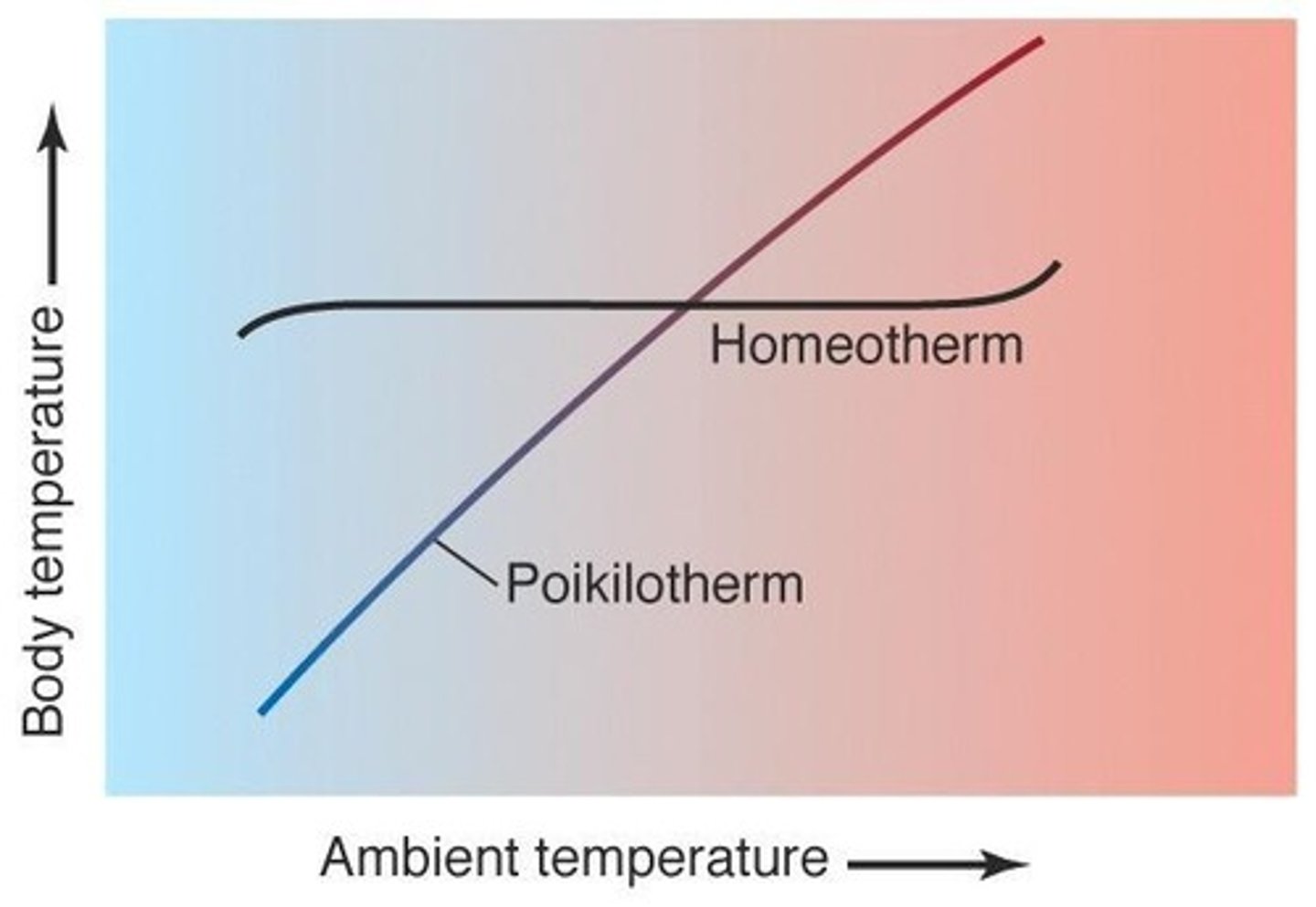
Define homeotherms.
Animals that maintain a relatively constant internal body temperature regardless of external environmental changes.
What is the primary difference between ectotherms and endotherms?
Ectotherms rely on environmental heat sources, while endotherms generate their own body heat through metabolism.
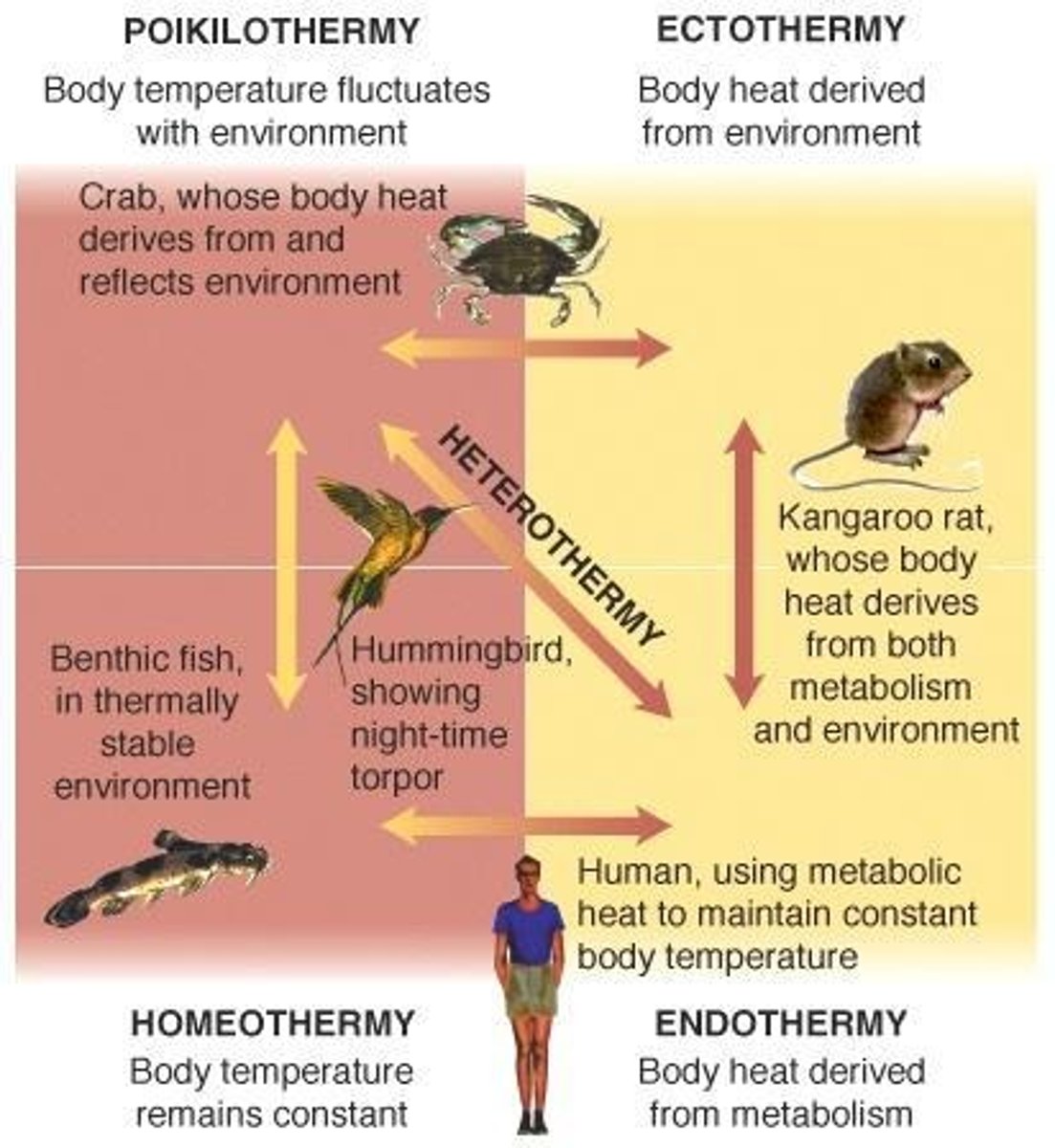
What is a heterotherm?
An animal that shows characteristics of both endothermy and poikilothermy, capable of endothermic heat production without strictly regulating body temperature within a narrow range.
What are regional heterotherms?
Animals that maintain specific regions or parts of their bodies at temperatures different from the ambient temperature.
What are temporal heterotherms?
Animals whose body temperatures vary widely over time, such as hibernating mammals or those experiencing daily torpor.
What is torpor?
A state of reduced metabolic activity occurring on a daily basis in some birds and small mammals.
How do flying insects like bees maintain regional heterothermy?
The thorax generates and conserves metabolic heat during flight, while the abdomen remains near the ambient temperature.
What is the function of the rete mirabile in fish like tuna and mako sharks?
It acts as a countercurrent heat exchanger to retain metabolic heat in the swimming muscles.
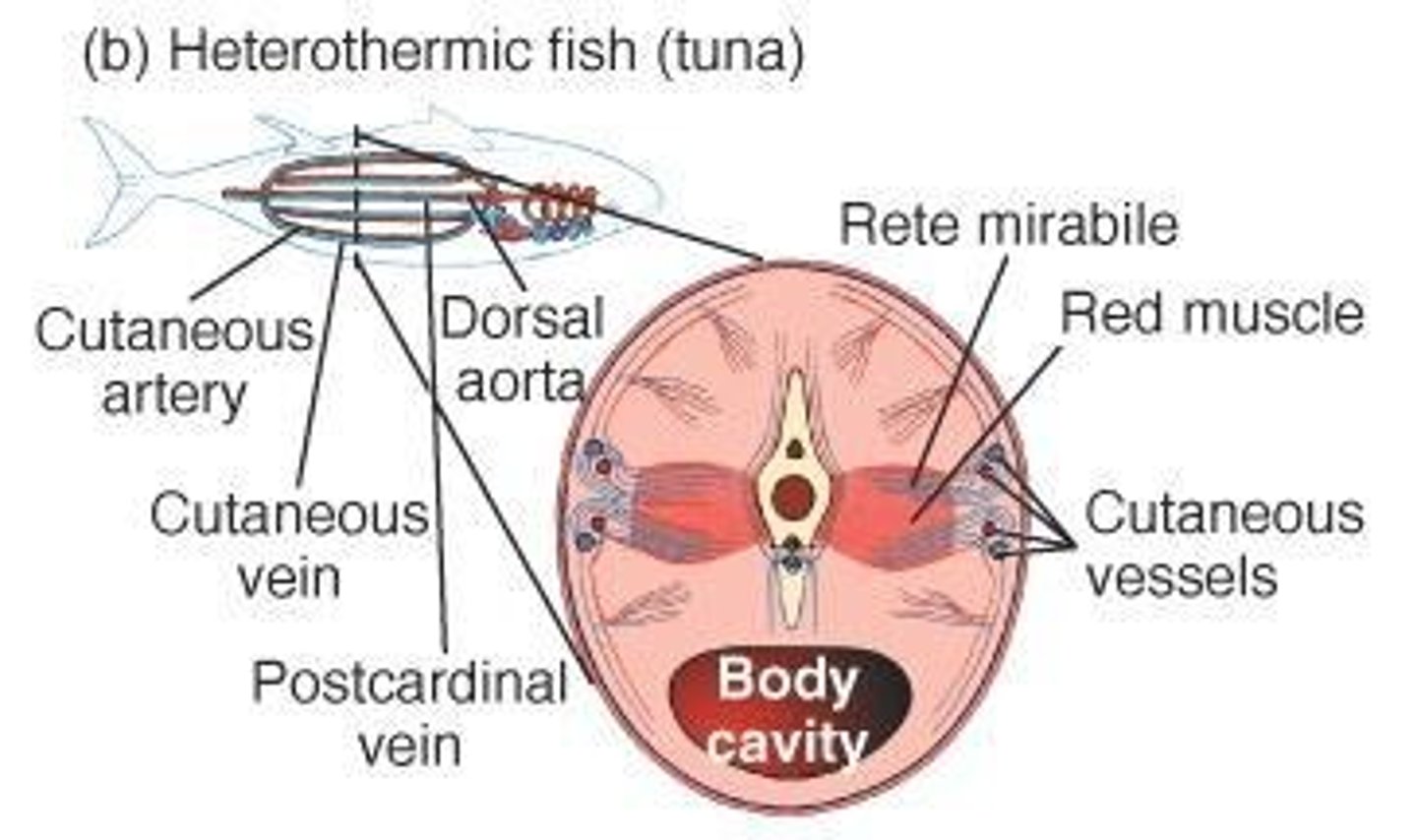
In the rete mirabile, how is heat conserved?
Incoming cold arterial blood is warmed by outgoing warm venous blood due to the parallel, close proximity of the vessels.
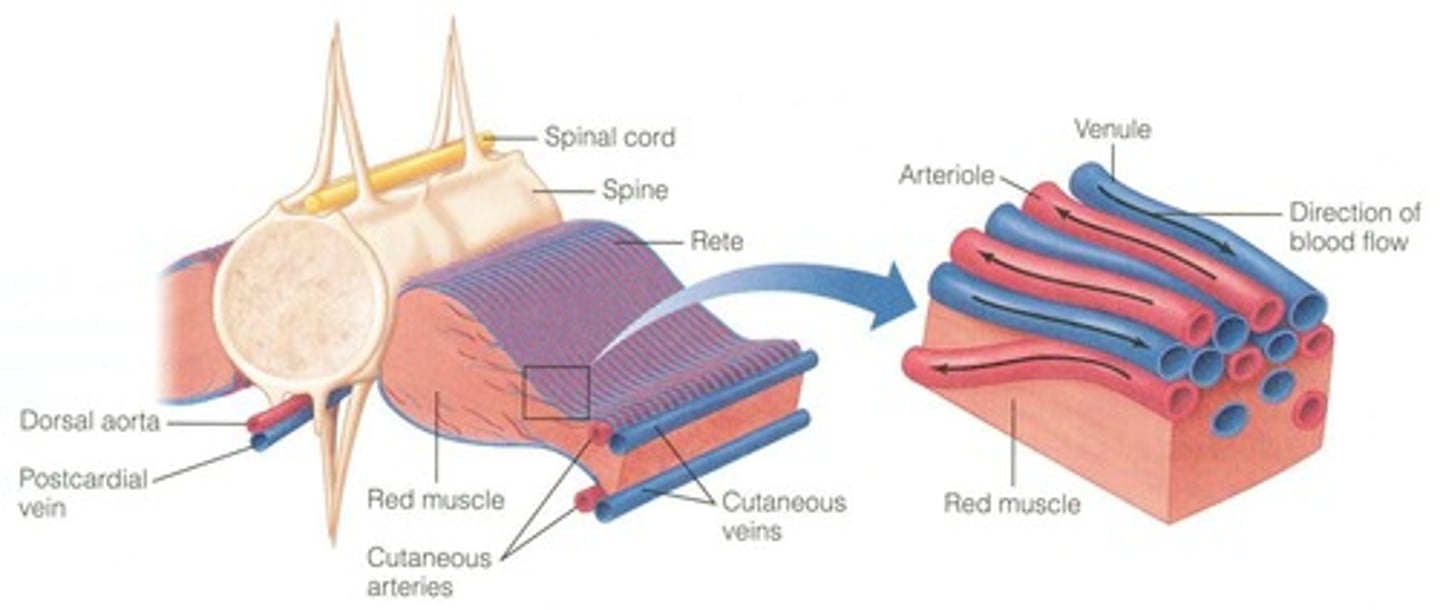
Where are the red (aerobic) swimming muscles located in fish that exhibit regional heterothermy?
Deep in the core of the body.
Where are the major blood vessels typically located in most fish compared to those with regional heterothermy?
Most fish have major vessels located centrally, whereas regional heterotherms often have cutaneous vessels located at the periphery.
Why do endotherms have higher energy requirements than ectotherms?
Because they generate their own body heat through internal metabolic processes.
Give two examples of animals that are considered heterotherms.
Tuna, mako sharks, bats, or camels.
What determines the upper limit of body temperature for most desert insects and reptiles?
They can tolerate body temperatures up to approximately 50°C.
What is the primary source of heat for an ectotherm?
Environmental sources.
What is the primary source of heat for an endotherm?
Internal metabolism.
Which ecosystem typically shows the most variability in environmental temperatures?
Terrestrial ecosystems.
What is the typical depth habitat of Lampris guttatus?
Approximately 400 meters.
How does the opah (Lampris guttatus) generate internal body heat?
Through the constant flapping of its pectoral fins by the swim muscle.
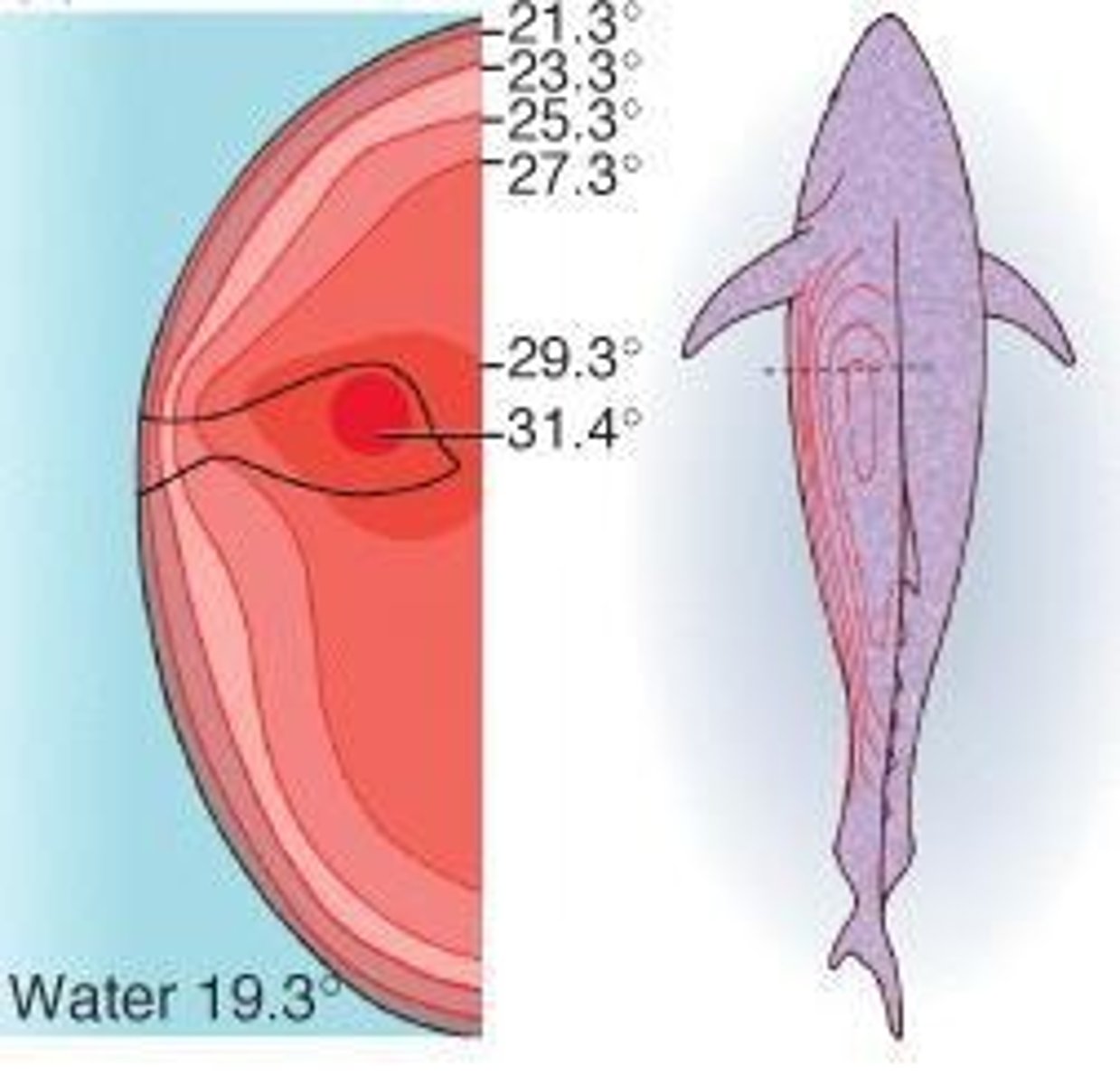
What anatomical structure minimizes heat loss in the opah?
A rete mirabile, which uses warm outgoing blood to heat incoming cool blood from the gills.
How much warmer is the opah's body temperature compared to ambient water?
Approximately 5 degrees Celsius higher.
What is the primary advantage of the opah's warmed blood distribution?
Enhanced physiological performance for hunting prey in cold environments.
What are the two main categories of cold adaptation for animals living above 0 degrees Celsius?
Thermal selection (ectotherms) and migration (endotherms), or hibernation, torpor, and estivation.
Define hibernation.
A seasonal state where an animal allows its body temperature to approximate ambient temperature for several days or longer, accompanied by a reduced metabolic rate.
Define estivation.
A state of dormancy or reduced metabolic rate during summer to conserve energy and reduce water loss.
Define daily torpor.
A state where an animal reduces its metabolic rate and allows its body temperature to drop close to ambient temperature for part of the day.
What physiological mechanism do estivating snails use to reduce water loss?
They secrete an epiphragm (dried mucus) over the shell opening.
How do desert spadefoot toads survive long periods of estivation?
They store water in their bladder, accumulate urea to increase osmotic pressure, and reduce their metabolic rate to 20-30% of normal.
What is the purpose of discontinuous breathing in estivating animals?
To reduce water loss.
Why do small endotherms undergo daily torpor?
To conserve energy and survive cold nights.
What is pre-hibernation hyperphagia?
A period of excessive eating before hibernation to gain significant body mass, often up to 40%.
What type of fats are typically accumulated by animals preparing for hibernation?
Polyunsaturated fats.
What is a hibernaculum?
A dark, microenvironment near 0 degrees Celsius where animals hibernate.
What is the difference between hibernation and estivation in terms of timing?
Hibernation occurs in winter to survive cold, while estivation occurs in summer to survive heat and drought.
How do hibernators manage their metabolic rate during winter?
They significantly reduce their metabolic rate (MR) to conserve energy.
Which organelle or process is suppressed in estivating snails to lower metabolic rate?
Na+/K+-ATPase activity.
What happens to the body temperature of a thirteen-lined ground squirrel during hibernation?
It drops to approximate the ambient temperature of the environment.
Besides fins, what physical feature helps the opah retain heat?
Fat deposits that provide insulation.
What is hibernation in the context of thermal physiology?
A state of controlled hypothermia.
What happens to protein synthesis during hibernation?
It slows to less than 1% of normal levels.
How is energy production affected during hibernation?
It slows to less than 5% of normal levels.
What is the freezing point (FP) of a substance?
The highest temperature at which a liquid can turn into a solid.
What is the melting point (MP) of a substance?
The lowest temperature at which melting (solid to liquid) occurs.
What is thermal hysteresis?
The difference between the freezing point and the melting point of a substance.
What are the two broad strategies animals use to survive below 0°C?
Freeze tolerance and freeze avoidance.
What is the role of ice-nucleating agents in freeze-tolerant animals?
They encourage controlled extracellular ice formation to prevent intracellular freezing.
How does extracellular ice formation affect intracellular fluid?
It draws water out of the cell, increasing intracellular solute concentration and lowering the freezing point.
What is supercooling?
The process of lowering a liquid's temperature below its freezing point without forming a solid.
What is the supercooling point?
The temperature at which a liquid crystallizes and forms ice crystals.
What is the primary difference between colligative and non-colligative antifreezes?
Colligative antifreezes lower the freezing point by increasing total solute concentration, while non-colligative antifreezes (AFPs) suppress ice crystal growth.
Name three common colligative cryoprotectants.
Glycerol, glucose, and sorbitol.
What percentage of body water can the wood frog freeze and still survive?
65-70%.
What substance does the wood frog use to protect its cells during freezing?
Glucose, which increases in the blood by over 450-fold.
Why is glucose accumulation important for the wood frog during freezing?
It acts as a compatible cryoprotectant and keeps intracellular fluid in osmotic balance with the extracellular environment.
What are antifreeze proteins (AFPs)?
Non-colligative proteins that prevent ice crystal growth by binding to the ice lattice.
How do AFPs prevent ice crystal growth?
They adsorb to the surface of ice crystals, preventing water molecules from adding to the ice lattice.
What is the typical concentration range for colligative antifreezes?
0.2 to 2 M.
What is the typical concentration range for non-colligative AFPs?
Less than 0.2 M.
What is cryoprotective dehydration?
A process where water is removed from cells to prevent intracellular freezing, often involving movement toward lower water potential.
What happens to membrane pumps and channels during hibernation?
They become inactive.
Are freeze tolerance and freeze avoidance mutually exclusive?
No, many animals use a combination of both strategies.
What is the primary function of AFPs in polar marine fishes?
To preserve subcellular structures and prevent ice crystal expansion.
What is the relationship between melting point and freezing point in the presence of AFPs?
The melting point becomes higher than the freezing point, creating a thermal hysteresis gap.