BIOL 1108 Springthorpe UGA - Exam 1
 Studied by 1 person
 Call Kai
 Learn
Learn Practice Test
 Spaced Repetition
 Match
Match Flashcards
 Knowt Play
1/104

There's no tags or description
Looks like no tags are added yet.
Name | Mastery | Learn | Test | Matching | Spaced | Call with Kai |
|---|
No analytics yet
Send a link to your students to track their progress
105 Terms
Population
All of the individuals of a SINGLE SPECIES that interact
Community
All of the populations of LIVING things that interact in a place
Ecosystem
A biological community of interacting organisms and their physical environment (biotic & abiotic)
Abiotic
Non-living factors in an ecosystem
-Climate
-Temperature
-Precipitation
-Soil Properties
-Water Properties
-Disturbance Types and Frequency
Biotic
Living factors in an ecosystem
-Biodiversity
-Biomass (NPP)
-Species Interactions
-Invasive Species
-Keystone Species
What size is an ecosystem?
There is no defined size
Biome
A distinct type of geographical region defined by vegetation present
What causes changes in vegetation?
Temperature and Precipitation
Changes as elevation increases
Temp, soil quality/depth, pressure, O2 all go down. Humidity and water availability generally go up. As temperatures drop, the air is able to hold less water vapor, so we say it has higher relative humidity.
Biomes change...
As height and latitude change
Which has more biodiversity? 100 km2 at the base of a mountain vs 100 km2 of mountains?
100km2 of Mountains, more changes in biome
Old Growth Forest
•never been logged
•Not undisturbed
•Diverse forests and lots of wildlife
"Rich" Soil
lots of available nutrients for plant growth
Tephra/Ash
Rock dust, unable to hold water well or have nutrients
Which organisms reach disturbed areas first?
Animals are going to reach the area first but will be unable to survive.
Which organisms establish in disturbed areas first?
Plants (nitrogen fixing specifically)
How do plants migrate into disturbed areas?
Seed dispersal
Seed dispersal
How seeds/spores are spread away from the parent plant
Seed Dispersal Types
Wind
Expulsion
Animals
Water
Seed Coat functions
Protection from environment
Protects From getting crushed, digested, dried out, waterlogged, etc.
Thick vs Thin Seed Coat
Seeds are thinner or thicker based on energy investment from a plant. It costs energy more for plants to make a thicker seed coat (more seeds vs better seeds)
Cotyledons
the "yolk" for the little embryonic plant.
Holds food, can be a monocot or dicot
Large Cotyledon Pros
•Can store more energy
•Can last longer before sprouting (germination)
•Can grow quickly to overtop competitors before they need to tap into their own food and water
•Each seed is individually more likely to survive
Small Cotyledon Pros/Cons
•Can produce many more
•Longer distance dispersal
•BUT...Each seed has a lower chance of survival (per capita survivorship)
Larger Seeds vs Smaller Seeds
Smaller seeds take less energy to make
Larger seeds take more energy
Fitness
a measure of evolutionary success based on the number of offspring that survive to maturity by the PARENT plant. It's not about how many seeds you make, but how many survive to reproduction.
Traits that help a seed REACH first, reduce SURVIVAL probability
Traits that help SURVIVAL probability, reduce dispersal distance
What else determines survival?
Ability to acquire nutrients once the cotyledon runs out, after germination
•Germination
seed emergence
-Seed becomes seedling
Macronutrients
NPK
Nitrogen
Phosphorus
Potassium
-makes nucleic acids/amino acids
Micronutrients
Needed in small quantities to make coenzymes
Where do plants get macronutrients?
NPK all come from the soil and are taken in by the roots
C (Carbon) - By air
O2 (Oxygen) - Air and Soil
Lupine
Established in the pumice plain first
What was limiting in tephra
Nitrogen
Liebig's Law of the Minimum
Individuals:
-Individuals will grow only up to the point it runs out of a vital resource, even if there are surpluses in other categories
Populations:
-Populations will grow only up to the point that they run out of a vital resource
How many limiting resources can exist at once
1
Why Do Organisms Need Nitrogen (N)?
DNA - Nitrogenous bases (ACTG)
•Chlorophyll
•Neurotransmitters
•Proteins -macromolecules with many functions
Protein overview
-Complex molecules made of amino acids that do MANY things
-Synthesized (made) using ribosomes and an mRNA template (translation)
-Can denature (change shape) when too hot
All amino acids are composed of
•Central carbon
•Amino group (NH2)
•Carboxyl Group (COOH)
•Side Chain (R group)
Amino acids make up...
proteins
A change in one stage affects all...
Later stages
1 affects 2 3 and 4
3 affects 3 and 4, etc.
At each stage, shape is determined by
bonds and IMFs
Bonds
•"permanent" connections between atoms in a single molecule (intramolecular forces)
Types of Bonds
•Covalent (share electrons)
•Ionic (donate/steal electrons)
IMFs
Intermolecular Forces - electrostatic (charge) attractions between molecules that can vary in permanence and strength
Electronegativity
the differences that exist in electronegativity between atoms in a bond determine how much time electrons will spend around one atom or another and whether or not that bond will be polar or non-polar as a result. The higher the electronegativity, the tighter hold an atom has on its electrons.
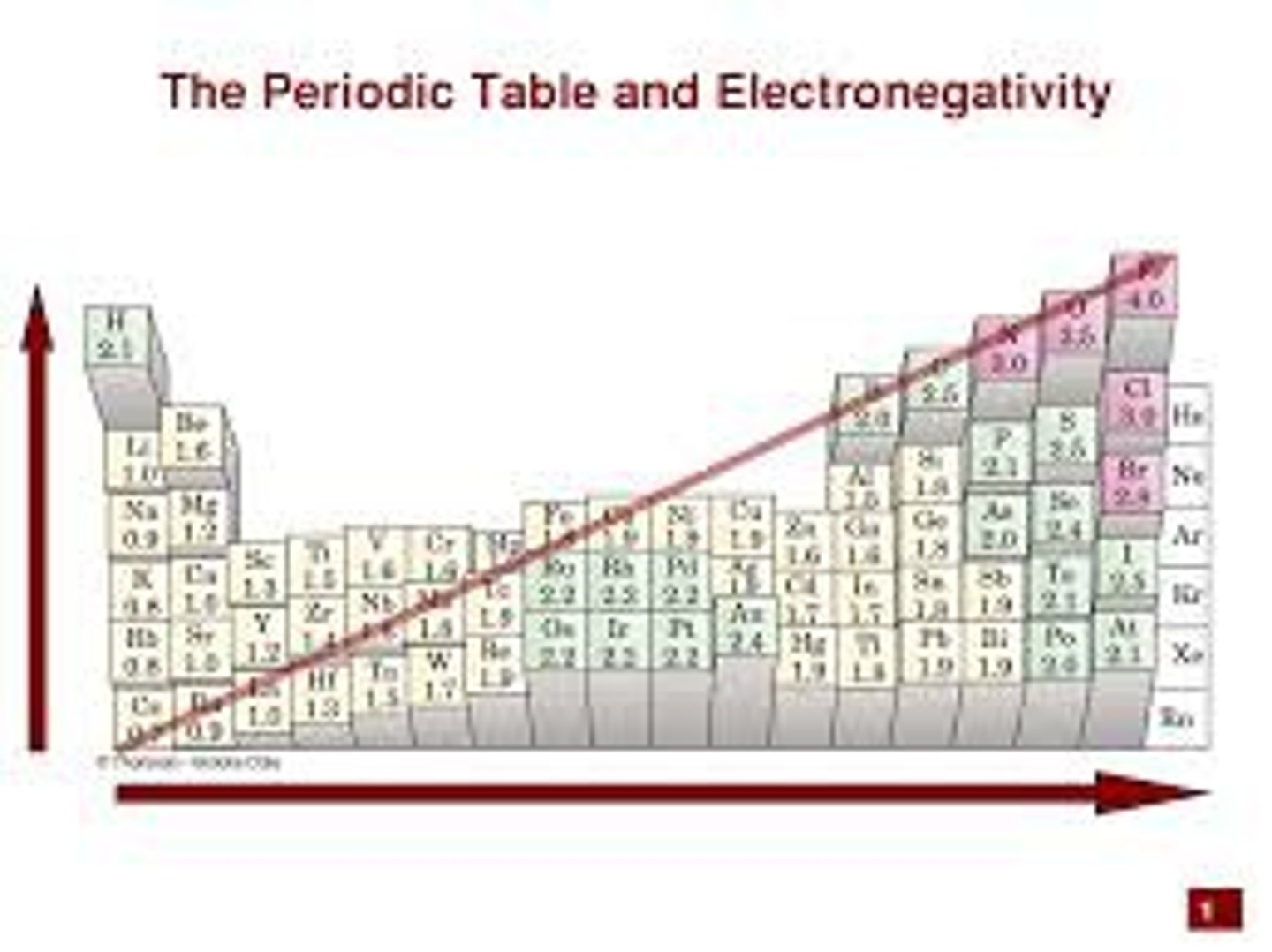
Differences in electronegativities, even within a covalent bond can lead to...
partial charges being applied to atoms. These partial charges result in polar bonds or molecules.
Type of bond is based on the relative amount of time electrons spend around involved atoms
0-.4 - Nonpolar Covalent
.4-1.7 Covalent
>1.7 Ionic
IMFs (Non-Covalent Interactions) 1.
Dipole-Dipole
An attractive force between any δ+ in one molecule and the δ- in another molecule
IMFs (Non-Covalent Interactions) 2.
•Hydrogen Bond (H-bond)
A special dipole-dipole between a δ+ H and an O,N or F with a δ- in another molecule.
VERY important for water - cohesion, surface tension
The H is always the positive contributor
The negative contributor to an H-bond is one of those highly electronegative atoms (in biology basically always O or N)
Hydrogen Bonds Test
•Is it between molecules?
•It there a partially positive H?
•Is it connected to a partially negative something else?
Amino Acid Structure
are 3 parts to every AA. The only one that changes is the R group. (we are given aa sheet)
Disulfide Bridge
Cys Amino Acid
Always nonpolar covalent, S and S have equal electronegativity
Primary Structure Bond (1)
Primary (1o) Structure - Peptide bonds: C-N covalent bond connecting AAs (Polar Covalent)
Secondary Structure Bond (2)
coils or crimps (α-helix or β-sheet)
•Hydrogen-bonds (H-bonds) are responsible along the peptide backbone
NOT related to R Groups
Tertiary Structure Bond (3)
R-Groups determine 3o structure
IMFs, ionic bonds and sometimes disulfide bridges determine exact folding pattern
Tertiary Structure Bond (4)
IMFs, ionic bonds and sometimes disulfide bridges determine exact folding pattern
Multiple folded chains
N-cycle
Plants get nitrate from the soil via assimilation. That nitrate is present by way of bacteria that break down and decompose other organisms or generate it (eventually) from N2 through N-fixation
Most nitrogen is
In the atmosphere, but we can't break the triple bond between N2
Nitrogen Fixing Bacteria
•Bacteria are N-fixing, not plants
•Common one are rhizobia
•Also cyanobacteria, green and purple sulfur bacteria, Azobacteria, a few others
•Common plants with these associations are legumes (peas, beans, clover, alfalfa)
N Fixing Bacteria/Plant Relationship
In this relationship, lupine (or any other "N-fixing plant") gets N in exchange for sugar that the bacteria uses to fix N. The sugar (glucose) comes from photosynthesis, which the plants are able to do, while the bacteria can't. From the perspective of N-fixing bacteria, on the pumice plain they are probably carbon-limited since there isn't any carbon in the soil.
Plants without N-fixing bacteria have more energy for...
-more seeds
-growing fast
-more roots
Mutualism
•Both species benefit from the interaction
Symbiotic
Live their lives in close physical proximity (together/ touching) and evolved together
Predation
One organism kills another
Herbivory
Animals Feeding on Plants
Commensalism
a long-term biological interaction in which members of one species gain benefits while those of the other species neither benefit nor are harmed
Ex. Seed Dispersal w/ stickers
Competition
•When 2 organisms "fight" over a limited pool of resources (food, mates, nitrogen, shelter, etc.)
2 Types of Competition
•Intra-specific Competition: Between individuals of the same species
•Inter-specific Competition: Between individuals of different species
Antagonism
Herbivory Predation and Parasitism
Neutralism
0/0
Amensalism
one individual is harmed while the other is unaffected
Altruism
One organism acts to increase the fitness of another organism at a cost to itself (decreasing fitness)
Kin Selection
an organism increases the fitness of a relative at a cost to its own (ants, bees, matriphagy)
Eusociality
"Altruism" to the extreme
•Defined as:
-Division of labor/caste system
-Overlap of reproductive generations
-Cooperative care of young
-There is a "point of no return"
Facilitation
The presence of one species alters the environment in a way that enhance the growth, survival, or reproduction of another
Can be positive, negative, or neutral for the first species
Facilitation Examples
•Increased soil moisture by sagebrush in the desert - decay/wind destroy the bushes but the soil is wetter and cooler in the desert.
•Temperature / Humidity Regulation, such as an animal being shaded by a large tree while it recovers energy
•Attracting Pollinators for other plants with big showy flowers
Soil Chemistry Improvement (N-fixers) - Lupine fixing soil for other plants
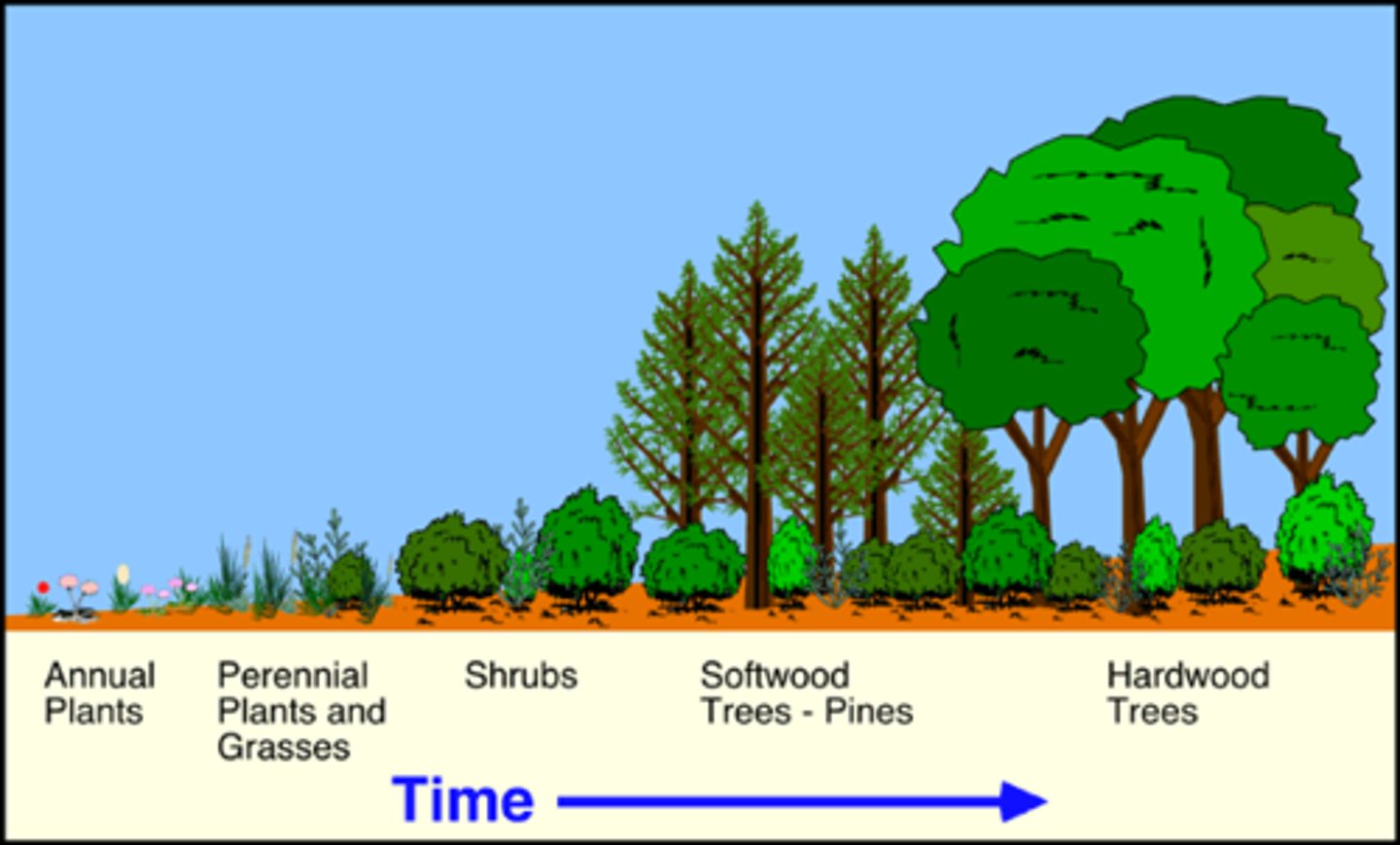
Succession
is the process of development that over time, gradually and predictably changes the biological community
Climax Community
•the stage that will persist as a static ecosystem and will continuously regenerate itself (until a disturbance).
Primary Succession
Starting from bare rock
Secondary Succession
Starting with at least some soil
Sometimes Secondary Succession is referred to as Old Field Succession
Where Do We Find Primary Succession?
•Mountain Tops
•Glacial Retreat
•Parking Lots
•Granite Outcrops
Succession increases _______ over time
Complexity
Types of Complexity
•Structural Complexity
-Vertical
-Horizontal
•Soil Complexity
•Biodiversity
Horizontal Complexity
Patchiness, more heterogenous = more horizontally complex, increases with disturbance
Vertical Complexity
increases w/ succession, is a measure of the height/variation of height
Disturbance
Acts as a reset for succession, INCREASES horizontal complexity, decreases vertical
dynamic equilibrium
•an ecosystem in a constant state of flux (change) due to disturbance and succession
•Develops over time
•Contains patches in different successional stages
Forest Gaps
•Openings in a forest canopy (disturbance) where new trees can grow
Early Successional Trees
High Max GR
Low Persistence
Low Shade Tolerance
Low Longevity
Late Successional Trees
Low Max GR
High Persistence
High Shade Tolerance
High Longevity
Biodiversity
how many kinds of organisms are in a place
Intermediate Disturbance Hypothesis
•biodiversity is highest when disturbance is present but not too frequent
Why are some places more biodiverse than others?
•Time/Age (Succession and Dynamic Equilibrium)
•Ecosystem Complexity (Horizontal/Vertical and topographic)
-Mountains have high biodiversity
-Lots of climate zones = lots of species
Simpson Index (D)
1/(sum of Pi^2)
Shannon Index (H)
-(Sum of Pln(P))
Resistance
ability to prevent impacts from disturbance
-Ecosystems with high biodiversity change less
Stability
resistance and resilience contribute to fewer fluctuations in an ecosystem
Resilence
ecosystem's stability and capability of tolerating disturbance and restoring itself
Alien/Exotic/Introduced Species
•nonnative species introduced by people
 Note
Note  Flashcards (31)