Factors that Limit Distributions II Abiotic
 Studied by 0 people
 Call Kai
 Learn
Learn Practice Test
 Spaced Repetition
 Match
Match Flashcards
 Knowt Play
1/13

There's no tags or description
Looks like no tags are added yet.
Name | Mastery | Learn | Test | Matching | Spaced | Call with Kai |
|---|
No analytics yet
Send a link to your students to track their progress
14 Terms
What are the key concepts for the factors that limit distributions?
Temperature and moisture are the main limiting factors for both plants and animals on a global scale.
•Light, fire, pH, and other physical and chemical factors can limit distributions on a local scale.
•Species may evolve adaptations that overcome the limitations set by physical and chemical factors.
•Some of these adaptations may allow a species to extend its geographical range.
•Climactic warming in this century will have major impacts on the geographical ranges of species that are currently limited by temperature and moisture.
What is climatology?
This is the study of climate and how it changes overtime, in order to understand atmospheric conditions that cause weather patterns and temperature changes over time .
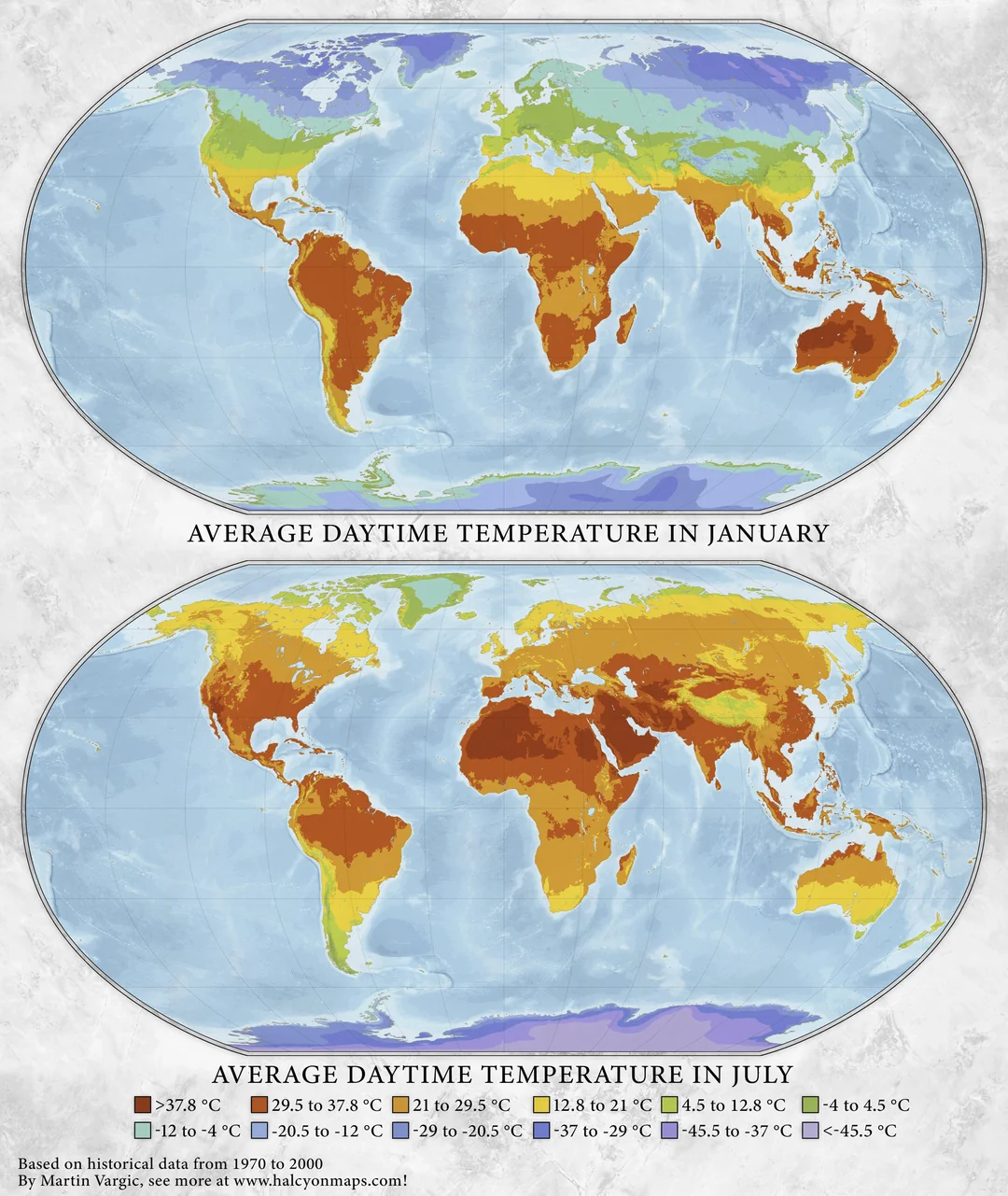
The large temperature over the Earth are a reflection of two variables, what are they and what do they affect?
1) Incoming Solar radiation: (sunlight)- Due to the tilt of the Earth axis. Solar Radiaition is concentrated on a small area (summer), and when its lower it’s spreading the same energy over a larger area- results in a lower intensity and colder temps trues and cooler temperatures (winter)
2) Distribution of land and water- Water doesn’t heat up as easily as land
What is the water cycle and how can water the be the most important physical factor affecting ecology of terrestrial organisms?
What is the process of the water cycle?
How are Temperature and Moisture limiting factors and what are a few examples of this?
Organisms will either tolerate or escape via some adaptations, and reasons how is because organisms will have both an upper and a lower lethal temperature (varies)
Organisms can acclimate physiologically to different conditions, which these would be a local acclimation (humans acclimating to temperature and becoming dry and shy during winter)
For example: Elephants- adapted to smell water through desert-like terrain , Birds-adaptations for nitrogen process and insects- evolution of protein waste
When can temperature and moisture affect and organism and how can measure to show that its limiting this distribution?
May act on any stage of the life cycle by affecting survival, reproduction, development. Ex: Reptiles and having different temperature fluctuations in development as an embryo affects the gender
To Measure:
1) is to determine which phase of life is moist sensitive
2) Identify physiological tolerance range
3) Show that the temps true or moisture range in the microclimate.
How can moisture and temperature requirements restrict geographic distributions regarding plants and what is an example of this effect?
Soil drought:Common notion of drought in which soil moistures is deficient and Frost Drought: occurs when water is present but unavailable because of low soil temperatures and the roots inability to take up water while the leaves continue to lose water by transpiration.
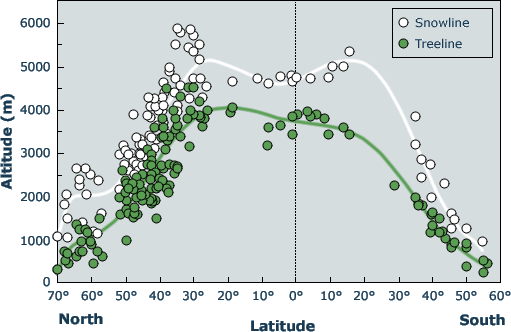
An example is Treelines
What are treelines and what are some good examples about how temperature and moisture affect these?
Treelines is where vegetation ends, found at high elevations
Lack of soil
•Desiccation of leaves in cold weather
•Short growing season
Wind
•Lack of snow, exposing plants to winter drying
•Excessive snow lasting through the summer
•Mechanical effects of high winds
•Rapid heat loss at night
•Excessive soil temperatures during the day
•Drought
What is an ecotype
Is a genetic variety within a single species, tries to separate the phenotypic and genotyping components of variations , that is adapted to the particular environmental conditions, such as climate, soil or habitat type.
Ecological genetics tries to separate the phenotypic and genotypic components of variation, what is an example of this and how can they differ?
plants of the same species growing in diverse habitats can differ in morphology and physiology in three ways:
•All differences are phenotypic, and seeds transplanted from one situation to the other will respond exactly as the resident individuals.
•All differences are genotypic, and if seeds are transplanted between areas, the mature plants will retain the form and physiology typical for their original habitat.
•Some combination of phenotypic and genotypic determination produces an intermediate result.
How is light important and what is it shown as?
Used as a cue for the timing of daily and seasonal rhythms. (photoperiodism)
•Essential for photosynthesIs
Shade tolerance: maximize light vs Shade intolerance:requires nearly full sunlight - meaning individuals can’t maximize for all traits, and which to maximize is to pull from anther trait
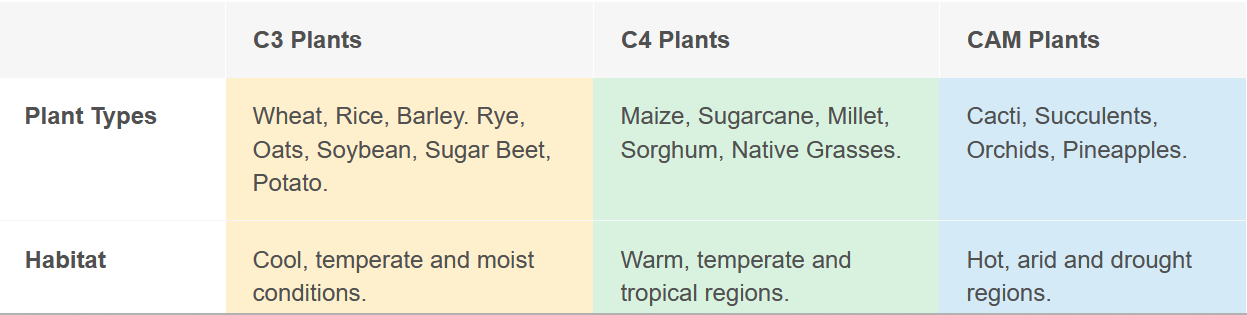
What are the three types of Dark Reactions?
C3 – typical pathway taught in biology courses, initial step utilizes RuDpcarboxylase to fix CO2 to ribulose-diphosphate (RuDp) making phosphoglyceric acid
•C4 – can use the C3 pathway or they do a different initial step, where they utilize PEP carboxylase to phospho-enolpyruvate (PEP) to make malic acid and aspartic acid
•CAM – Crassulacean Acid Metabolism – can use C3 pathway during the day but take up CO2 at night and store it as malic acid
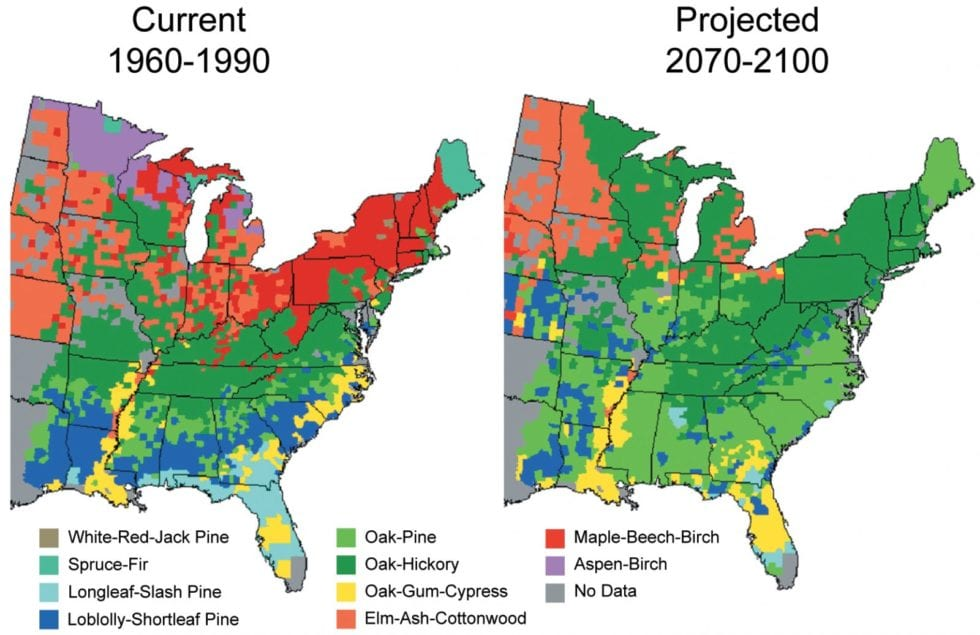
How does climate change affect species distributions?
The geographic ranges of species are not static, but dynamic, and as climate changes in the future, species will move into new areas that become climatically suitable.
•The major concern is the speed of climate change which may out pace slow moving/colonzing species and the loss of genetic tolerance to local temperature and rainfall patterns may disappear.
 Note
Note  Flashcards (290)