CH10: Motivation & Emotion
 Call Kai
 Learn
Learn Practice Test
 Spaced Repetition
 Match
Match Flashcards
 Knowt Play
1/43

There's no tags or description
Looks like no tags are added yet.
Name | Mastery | Learn | Test | Matching | Spaced | Call with Kai |
|---|
No analytics yet
Send a link to your students to track their progress
44 Terms
Motivation
State in which an organism experiences an inducement or incentive to do something.
Motivation
The “why”
Motives
State that activates us to behavior in a way that moves us toward our goals
Needs
Basic physiological things that we need for survival, such as food, water, and air
Needs create?
Drives
Drives
Arouse us to action and tend to be stronger when we have been deprived longer
Incentives
An object, person, or situation that can satisfy a need or something that is desirable for its own sake
Types of Motivation
Intrinsic Motivation
Extrinsic Motivation
Intrinsic Motivation
Internal factors
performed because they bring PERSONAL satisfaction
Extrinsic Motivation
Performed in order to RECEIVE something from others (Praise or approval)
Overjustification effect
Intrinsic motivation is diminished when extrinsic is given
Examples of Overjustification
From volunteering (intrinsic) you become unmotivated because you are now paid(extrinsic) to do the job
Overjustification Effect
People focusing more on the external rewards rather than internal which lead to personal satisfaction
Different Types of Overjustification
Reinforcement
Expectation of Extrinsic reward
Types of Reinforcement
Tangible Rewards
Intangible Rewards
Tangible Rewards
Money or Promotions
Appears to decrease intrinsic motivation
Intangible Rewards
Praise or Recognition
Appear to increase motivation
Expectation of Extrinsic Reward
Intrinsic motivation is more likely to decrease if extrinsic reward is expected
Intrinsic Theory of Motivation
William James (1842 - 1910)
William James
Biological Perspective
Behavior is driven by instinct aided by survival
Biological Perspective
Certain human behaviors are innate and due to evolutionary programming
Major Criticism of William James’ Intrinsic Theory
Only describes behavior and unable to explain why people do what they did
Ignores the role of learning in shaping human behavior
Instincts
Biologically determined and innate patterns of behavior that exist both in people and animals
Arousal Approact to Motivation
Another explanation for human motivation
Arousal Theory
Suggests that there is an optimal level of tension/stress to maintain by increasing or decreasing stimulation
Environtment
Can affect arousal levels
Environment:
Temperature, Noise, and Lighting
Underaroused
Bored, wants to seek stimulation
Overaroused
Excessive physiological or emotional stimulation
The person would likely engage in behavriours to reduce the arousal
Moderate Arousal…
Is the optimal arousal level for performance
Yerkes and Dodson (1908)
Optimal arousal level depends on the complexity and difficulty of the task to be performed
Task Performance
Middle range
Difficult task
Lower levels of arousal
Simple tasks
Higher levels of arousal
Self-Efficacy
An individual's belief in her own capability to complete a task
Bandura theorized
That self-eddicacy plays a role in motivating behavior
Social Motives
Need for achieve (nAch)
Need for Affiliation (nAff)
Need for Intimacy (nInt)
Need for Achievement (nAch)
Drive that people to feel succeed
Need for Affiliation (nAff)
Encourages positive interactions with others
Need for Intimacy (nInt)
Building friendships and relationships
Maslow’s Hierarchy of Needs
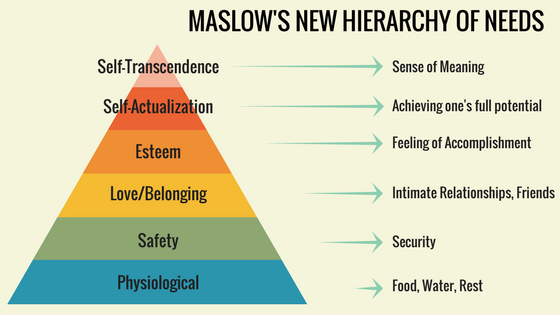
Emotion
A subjective state used to describe our feelings
Relatively Instense
Conscious of it
Influenced by experience
Components of Emotion
Physiological Arousal
Psychological Appraisal
Subjective Experiences
Mood
Prolonged, less intense
May not be consciously recognized
Does NOT occur in response to experience

