4.6 Pediatric Dehydration Stuff - Tice
 Call Kai
 Learn
Learn Practice Test
 Spaced Repetition
 Match
Match Flashcards
 Knowt Play
1/27

Earn XP
Description and Tags
Tice
Name | Mastery | Learn | Test | Matching | Spaced | Call with Kai |
|---|
No analytics yet
Send a link to your students to track their progress
28 Terms
dehydration symptoms in adults and children
headache
dizzy
tired
dry mouth
thirst
cranky
dark colored pee
dry skin
constipation
dehydration symptoms in infants
fever
no tears
unusual tiredness
dry mouth
no wet diapers
MILD dehydration s/s in infants:
UOP
weight loss
capillary refill
normal or decreased
3-5%
2-3 seconds
MODERATE dehydration s/s in infants:
pulse
systolic BP
slightly increased
normal to low
MODERATE dehydration s/s in infants:
UOP
weight loss
thirst
marked decrease
6-10%
moderate
MODERATE dehydration s/s in infants:
mucosa
tears and fontanelle
eyes
dry
reduced
deep set
MODERATE dehydration s/s in infants:
skin turgor
skin temperature
capillary refill
behavior
decreased
cool
>5 seconds
irritable
SEVERE dehydration s/s in infants:
pulse
systolic BP
UOP
rapid and weak
shock
anuric (no peepee)
SEVERE dehydration s/s in infants:
weight loss
thirst
mucosa
9-15%
intense
extremely dry
SEVERE dehydration s/s in infants:
tears
eyes
skin turgor
skin temperature
absent
markedly sunken
tenting/increased
cool/ mottling
SEVERE dehydration s/s in infants:
fontanelle
capillary refill
behavior
sunken
>8 seconds
irritable / lethargic
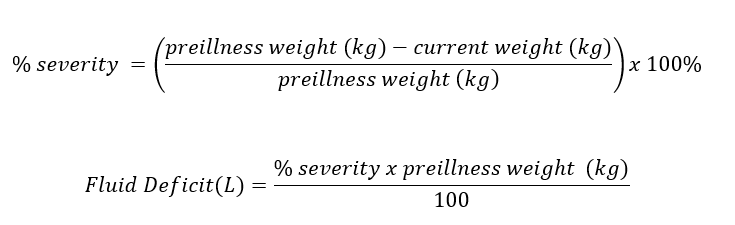
A 1 year old patient who weighed 10 kg prior to illness is now 9.4 kg. She has had three stools and two episodes of emesis.
what is her severity?
what is her % dehydration / severity?
what is the fluid deficit?
moderate dehydration
6%
0.6 L
mild dehydration classification:
infant % severity
child % severity
1-5%
1-3%
moderate dehydration classification:
infant % severity
child % severity
6-9%
4-6%
severe dehydration classification:
infant % severity
child % severity
>10%
>6%
severe (shock) dehydration classification:
infant % severity
child % severity
>15%
>9%
oral rehydration therapy is only if the patient is _____ dehydrated
mild or moderate
oral rehydration therapy is NOT indicated if the pt has _____ dehydration
severe or shock
oral rehydration therapy commercial product example
pedialyte
what should be discouraged from giving in oral rehydration therapy?
juices
ginger ale
sodas
sports drinks
broths
how to dose (equation) for mild dehydration oral rehydration therapy?
(50 mL / preillness weight) + [(10 mL / preillness weight) x (# of stools + emesis)] = volume given
how to dose (equation) for moderate dehydration oral rehydration therapy?
(100 mL / preillness weight) + [(10 mL / preillness weight) x (# of stools + emesis)] = volume given
when should mild vs moderate dehydration be reassess if giving ORT?
mild: q2h
moderate: q1h
ORT should be given over _____
3-4 hrs
ORT should be given over 3-4 hours in _____ increments every _____
5 mL q1-2 mins
if ORT is given as it should be, then the pt is receiving about _____ mLs per hour
150-300
for testing purposes: when to stop giving ORT?
when the ENTIRE volume has been given
Pediatric advanced life support (PALS):
when should CPR be initiated if a pt has cardiopulmonary arrest
within 10 seconds
Explore top notes

