Homeostasis, Hunger and Motivation
 Call Kai
 Learn
Learn Practice Test
 Spaced Repetition
 Match
Match Flashcards
 Knowt Play
1/24

There's no tags or description
Looks like no tags are added yet.
Name | Mastery | Learn | Test | Matching | Spaced | Call with Kai |
|---|
No analytics yet
Send a link to your students to track their progress
25 Terms
Homeostasis
The physiological process by which the body maintains a stable internal environment (e.g., body temperature, blood glucose) despite external changes.
Set point
The specific value or narrow range that the body "strives" to maintain for a particular physiological variable.
Define Motivation and what are the types?
The driving force that initiates and directs behavior.
Push (Drive-Reduction): Internal physiological needs (like hunger) "push" us to act to restore homeostasis.
Pull (Incentive): External stimuli or rewards (like the smell of fresh pizza) "pull" us toward a behavior regardless of internal need.
Initiation of Hunger
Low levels of glucose and high levels of ghrelin (secreted by the stomach) signal the lateral hypothalamus (LH) to initiate eating. The sympathetic nervous system may increase arousal to seek food.
Initiation of satiety(fullness)
Fat Stores: Fat cells release leptin, which provides long-term signals to the brain to decrease eating
Hormones: The hormone CCK is released by the small intestine during digestion to signal immediate satiety.
Hypothalamus: The ventromedial hypothalamus (VMH) and paraventricular nucleus (PVN) act as "satiety centers" to inhibit feeding/ signal fullness.
Pituitary/Glandular Role in homeostasis
The hypothalamus regulates the pituitary gland, which in turn influences metabolic rate via the thyroid gland.
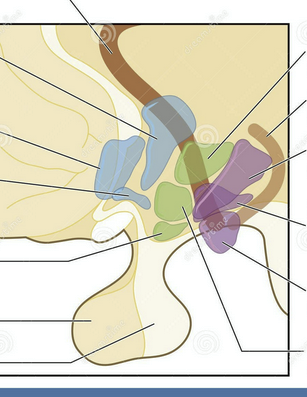
Arcuate nucleus
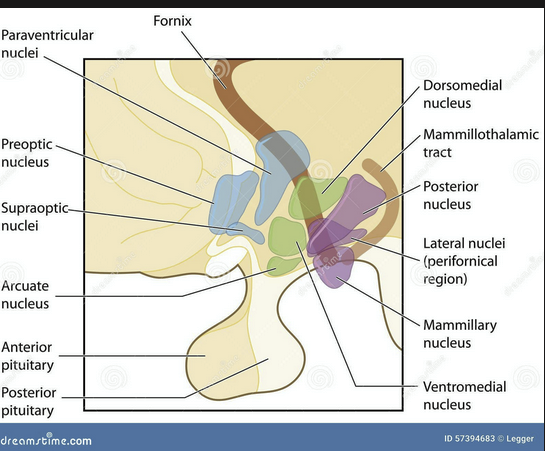
a group of neurons located in the hypothalamus that plays a crucial role in regulating various physiological functions, including appetite, metabolism, and hormone secretion. It is involved in the neuroendocrine system, influencing the release of hormones from the pituitary gland
right above the pons
Integrates signals like leptin and ghrelin to coordinate the LH and VMH.
Where are carbohydrates digested and stired?
Digestion begins in the mouth (salivary amylase) and continues in the small intestine. They are stored as glycogen in the liver and muscles for short-term use.
Where are fats digested and stired?
Digestion primarily occurs in the small intestine with the help of bile and lipases. They are stored as triglycerides in adipose (fat) tissue for long-term energy.
Where are proteins digested and stired?
Digestion begins in the stomach (pepsin) and finishes in the small intestine. Proteins are broken into amino acids, primarily used for structural repair rather than energy storage.
Describe the role of the pancreas and pancreatic hormones in regulating from glucose
The pancreas maintains blood sugar homeostasis through two primary hormones:
Insulin: Released when blood glucose is high (after eating). It allows cells to take up glucose and signals the liver to store it as glycogen.
Glucagon: Released when blood glucose is low (between meals). It signals the liver to break down stored glycogen back into glucose.
List the 3 important hypothalamic nuclei
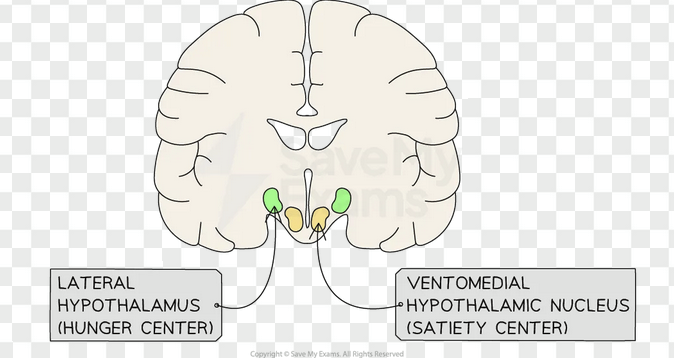
Lateral hypothalamus
Ventromedial hypothalamus
Arcuate Nucleus
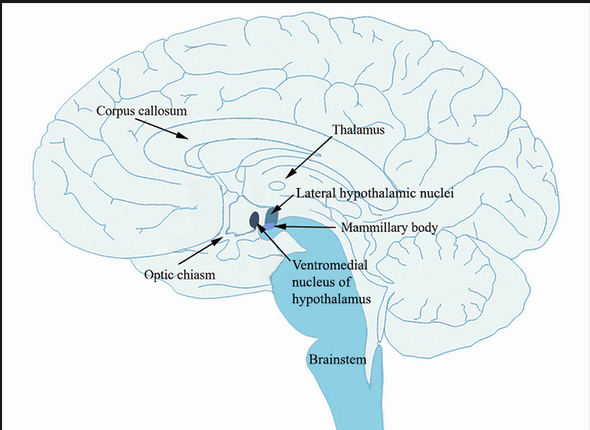
What is the function of lateral hypothalamus and where is it located?
The "hunger center." Destruction leads to aphagia (refusal to eat).
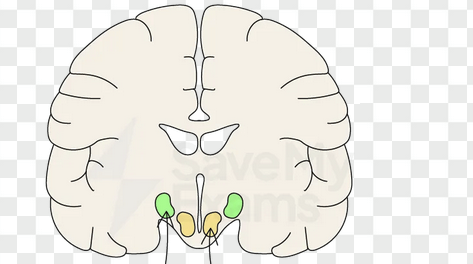
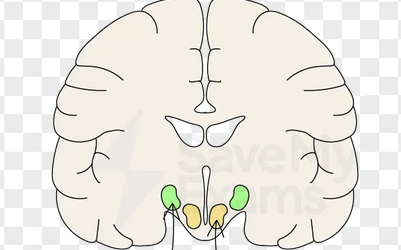
What is the function of lateral hypothalamus and where is it located?
The "satiety center." Destruction leads to hyperphagia (overeating and obesity).
Body Mass Index
a ratio of weight to height (BMI = m²/kg).
What is BMI used for?
A quick screening tool for populations to correlate weight categories with health risks.
Inaccuracies of BMI
It does not distinguish between muscle mass and body fat. An athlete may have a "high" BMI due to muscle but be metabolically healthy. It also ignores fat distribution (e.g., visceral vs. subcutaneous fat).
Causes of Obesity
Environmental: Availability of high-calorie/low-nutrient "hyper-palatable" foods, sedentary lifestyles, and "food deserts."
Biological: Genetics (influencing basal metabolic rate), hormonal imbalances (leptin resistance), and gut microbiome diversity.
Fasting: What happens in the body, key hormones and function
body burns fat for energy instead of glucose.
insulin level drops
fat stores break down
lower metabolic activity
Key hormones: insulin, NPY, ghrelin, leptin
After eating: What happens in the body, key hormones and function
body expends nutrients, higher metabolic activity.
Key hormone: leptin
Function: buildup of fat
Leptin: Function, role in appetite, short-term or long-term?
regulates appetite and satiety. energy balance
increase or decrease appetite.
master regulator of long-term energy balance, appetite, and body weight.
long term
Ghrelin:Function, role in appetite, short-term or long-term?
stimulates feeding behavior
increase appetite
short term
CCK + PYY : Function, role in appetite, short-term or long-term?
digestion and appetite regulation
decrease appetite
short term
release by intestines
Insulin:Function, role in appetite, short-term or long-term?
stores glucose as glycogen to be used for energy
Decrease appetite
long term

