Marketing Research Quiz #2 Study Guide
 Call Kai
 Learn
Learn Practice Test
 Spaced Repetition
 Match
Match Flashcards
 Knowt Play
1/49

There's no tags or description
Looks like no tags are added yet.
Name | Mastery | Learn | Test | Matching | Spaced | Call with Kai |
|---|
No analytics yet
Send a link to your students to track their progress
50 Terms
All surveys are wrong;
But good surveys are useful (i.e., actionable)
What are the sections of a survey?
Request for cooperation, screening, information sought, classification data
What’s a screening question used for?
Determine "terminates"
Target information (key issues being studied)
What is the best flow for a typical survey?
qualifying questions
warm-ups
transitions
difficult and complicated questions
classifying and demographic questions
Survey pretesting guidelines:
Question reliability: Did all respondents interpret it in the same way?
Question validity: Did they understand it?
Survey length: Were respondents bored? fatigued?
Scaling issues: Did they understand the scales? Were scale points clear?
Response Bias: Was there a lot of end-piling going on? (give high ratings on all attributes)
Survey pretesting watchouts:
Do you have to read the question often or repeat several times
Respondents are replying in phrases that are not related to the scale questions
Too many respondents using the same scale category (enough discrimination)
Comments to open-ended questions are inconsistent with responses to close-end questions
High number of "don't know" or "does not apply"
Non-response rate to a question is unusually high (>10% is a rule of thumb)
Bad Questions:
Leading, Loaded, Absolutes, Double-Barreled, No instructions, Bad grammar/typos
Biased questions lead to unreliable results and ultimately wrong decisions
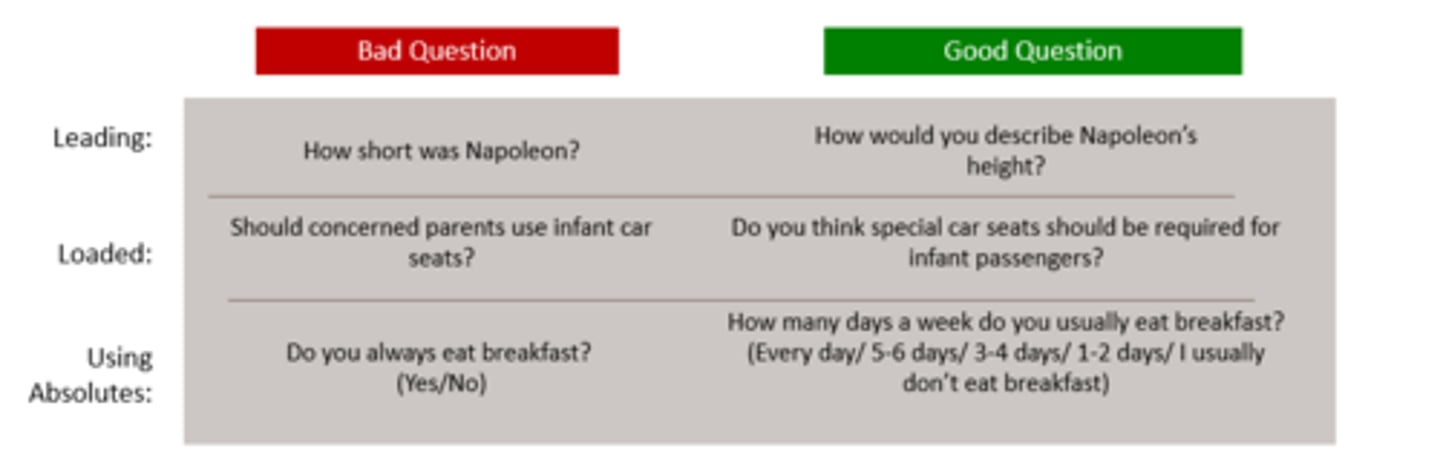
Leading Question
a question that suggests a particular answer (How short was Napoleon?)
Loaded Question
has an assumption in the question (Have you stopped cheating on tests? or What made you decide to ignore the return policies?)
Double Barrel Question
asking for two things in one question, “and” (How often do you visit our website and shops?)
Sampling
The process of obtaining information from a subset of a larger group, we then take the results from the sample and project them to the larger group
Sample
a subset of the population (ex: Surveying some of the U.S. dog owners)
Census
a sample that is the whole population, not very feasible (ex: Surveying all U.S. dog owners)
Population
refers to the entire group of people about whom we need to obtain information (ex: all U.S. dog owners)
Population of Interest
the target population
A population (N) is all cases that meet designated specifications for membership in the group
Be very clear and precise in defining the target population
The more specific your target population definition, the harder and more costly it is to find sample: geographic area, demographics, product or service usage, brand awareness, etc
should also define the characteristics of individuals who should be excluded / Screening criteria
Statistical Notation N
A characteristic or measure of a population
Statistical Notation n
A characteristic or measure of a sample
Sampling Frame
The source material - or list of population elements - from which a sample (n) will be drawn
Commonly used frames: customer databases, lists developed by data compilers, trade associations, media companies
What are Sampling methods?
Nonprobability Sample
Probability Sample
Nonprobability Sample
Relies on personal judgment in the element selection process
Neither sampling error nor the margin of sampling error can be estimated or calculated
Probability Sample
Each target population element has a known, non-zero chance of being included in the sample
The laws of probability allow calculation of the extent to which a sample value can be expected to differ from a population value
This difference is referred to as sampling error
Types of Nonprobability Samples?
Convenience
Judgment
Snowball
Quota
Types of Probability Samples?
Simple Random
Systematic
Stratified
Cluster (Area)
Convenience Sample
nonprobability
the right place at the right time, “on street” interviews
Judgement Sample
nonprobability
handpicking people who are knowledgeable about the issue
Snowball Sample
nonprobability
low-incidence or rare populations, respondents refer others who might be interested
Quota Sample
nonprobability
interview equal # of people in each subgroup, even if it’s not representative of the actual population (50 freshman and 50 sophomores even if there’s more total freshman than sophomore)
Simple Random Sample
probability
everyone has an equal chance of being selected
Probability of selection = sample size / population size
Systematic Sample
probability
counting every kth person that walks in (k = sampling interval, like 2 or 3)
Skip Interval = population size / sample size
Simpler, less time-consuming, less expensive than simple random sampling
Stratified Sample
probability
divide population into subgroups (mutually exclusive), then randomly select from each group using a simple random sample
most used!
Cluster (Area) Sample
probability
sampling units are selected from a number of small geographic areas to reduce data-collection costs
ex: divide the building into floors and randomly choose 10 floors. on each floor, randomly choose 3 apartments and interview it’s occupants
Level of Acceptable Error (E) Impact on Sample Size
inversely related
As the E increases, the sample size (Z) decreases (less precision)
As the E decreases, the sample size (Z) increases (more precision)
As required confidence levels increase/decrease, how does it impact the sample size required?
If you can tolerate a lower level of confidence, it allows for a smaller sample size
if you require a higher level of confidence, you will need a larger sample size
Elements needed to determine appropriate sample size
Margin of error (E)
Confidence level (95%, 99%, etc.) desired (Z)
Variability in population (s [Standard Deviation] or p [Proportion])
What is Rule of thumb / Normal Distribution (n>=30)?
The sampling distribution of the mean for simple random samples that have 30 or more observations has the following characteristics:
The distribution is a normal distribution.
The distribution has a mean equal to the population mean.
The distribution has a standard deviation, the standard error of the mean.
Implications of Sample Sizes that are too big
Transform small differences into statistically significant differences, even when they are, in reality, insignificant.
Expensive
Takes a lot of time to collect data
Implications of Sample Sizes that are too small
Cannot detect differences in the sample at a statistically significant level, even though differences may exist
More variable
Less power
Survey Error
All the stuff that makes the data inaccurate
Sampling Error + Non-Sampling Error = Total Error
Selection error
Incomplete, improper sampling
minimized by developing selection procedures that will ensure randomness and by developing quality control checks
Noncoverage error
missing groups of people in your sample
This error can be minimized by getting the best sampling frame possible and doing preliminary quality control checks
Nonresponse error/bias
This error is minimized by doing everything possible to encourage those chosen for the sample to respond.
Response error
tendency of people to answer incorrectly through either deliberate falsification or unconscious misrepresentation
This error can be minimized by paying special attention to questionnaire design. The impact of culture must be completely understood when creating international surveys.
Recording error
Interviewer/qnr bias/ error
This error is minimized by careful interviewer selection and training. Questionnaire error is minimized only by careful questionnaire design and pretesting.
Office error
Input error / Data error
Use software checks to find illogical response. Data coding or analysis errors.
Response Rates Cost implications
low response rate = higher # of contacts = increased budget
Response Rates Calculation
Survey response rate = (# of people who finished the survey / total # of people you sent it to) * 100
How to improve response rates
Survey length - Shorter is better
Guarantee of confidentiality or anonymity
Interviewer characteristics and training - Develop an effective script and provide training
Personalization
Response incentives
Follow-up surveys
Incentives
A gift or payment made to respondents in return for them taking part in a research project
Pros of Incentives:
Incentives help attract participants, hard to find targets, spend more time (a longer survey or an interview)
Cons of Incentives
Introduce bias to those that are motivated by the reward vs the broader target population

