Equine Conformation and Biomechanics Midterm
 Studied by 3 people
 Call Kai
 Learn
Learn Practice Test
 Spaced Repetition
 Match
Match Flashcards
 Knowt Play
1/128

There's no tags or description
Looks like no tags are added yet.
Name | Mastery | Learn | Test | Matching | Spaced | Call with Kai |
|---|
No analytics yet
Send a link to your students to track their progress
129 Terms
determine soundness, longevity in a career, athletic ability
Why do we evaluate conformation?
Balance, structural correctness, muscling, breed/sex character, quality
What 5 things do we evaluate when looking at a horse’s conformation?
balance
the overall symmetry, blending of parts together
-results from correct skeletal structure
True
true/false: a horse should divide equally into thirds
high
a horse’s neck should be long and ____ tying
long
the horse should have a ____ hip
potential soundness problems
evaluating structural correctness can give insight into _________
65%
what percentage of a horse’s weight is on its front legs at rest
-may be more when the horse is in motion
front leg
this leg is constructed for a larger supportive role
hind leg
this leg is constructed for a more propulsive role
scapula
the ____ generally moves in one plane only
True
true/false : there is no bony connection between the front leg and the axial body
balance
a longer shoulder contributes to greater _____
(though shoulder angle contributes more than length)
dressage and showjumping
a long shoulder is found in both elite ___ and ____ horses
knee action
in general, a steeper angle of the should results in more ________
flatter stride
a flatter angle of the shoulder contributes to a _______
slope of shoulder, stride length
there is a positive correlation between _____ and ____
(quality of gaits)
concussive
this kind of damage is associated with a more upright shoulder angle
-along with synovitis in knee and fetlock joints
humerus
this bone facilitates lateral movement
scope and stability
a longer humerus contributes to more of this
choppy
a horse with a short humerus will have a ____ stride
freedom of shoulder
comes primarily from increased flexion of elbow and carpus
flatter
a flatter angled humerus will cause a ____ stride
higher
a steeper angled humerus will lead to a ____ ability to raise knees
90
ideally, the angle between the scapula and the humerus should be ___ degrees
-will be greater in jumpers and high-stepping horses
large, square, flat
the carpus should appear ____, ___ and ____ from the front
center
the cannon should exit directly out of the _____ of the knee
short
cannons should be ___ in length
same
cannons should be the ____ circumference at the top as the bottom
shock absorption
a longer pastern allows for more _____ and elastic rebound of the limb
ringbone, arthritis
too long of a pastern can break down and predispose the horse to ______ or ______ of the pastern and coffin joints
shock absorbing
a short, upright pastern loses its ______ abilities and is more prone to concussive injuries
shoulder and pastern
the angle of the pastern should be similar to the angle of the ____ and_____
broken-back hoof-pastern axis
term for a long toe, low heel
-often extensive toe length
-predisposes horse to
sole bruises
contracted heels
ligament strains
need to shorten toe and/or support the heel
broken-forward hoof-pastern axis
term for a short toe, long heel
-predisposes horse to
sesamoid injuries
coffin joint arthritis
suspensory ligament strains
-club foot (usually asymmetric)
need to adjust dorsal hoof angle to match the pastern and lower the heel
straight pastern
what is wrong with B
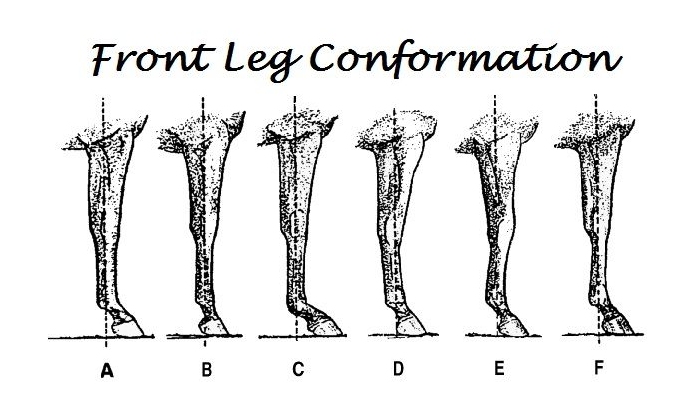
too long pastern
what is wrong with C
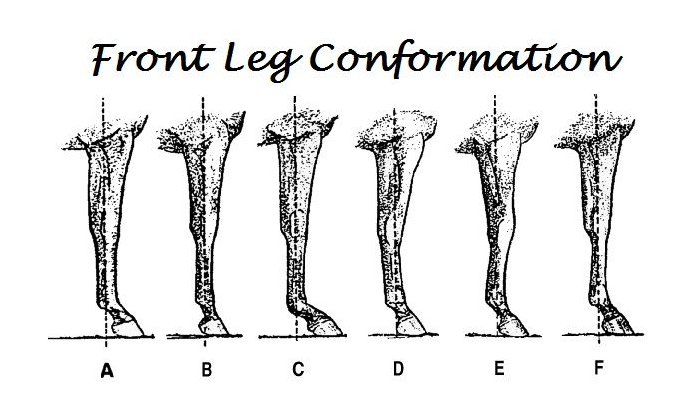
calf kneed
what is wrong with D
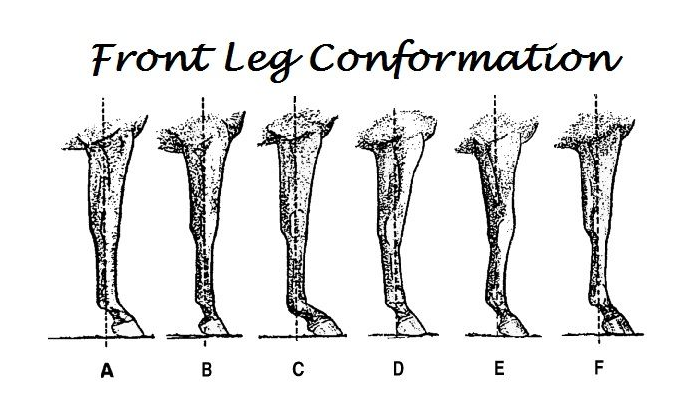
buck kneed (over at the knee)
What is wrong with E
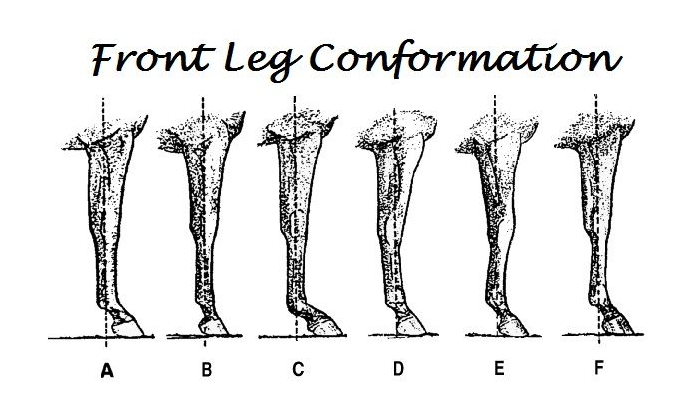
tied in at the knee
What is wrong with F
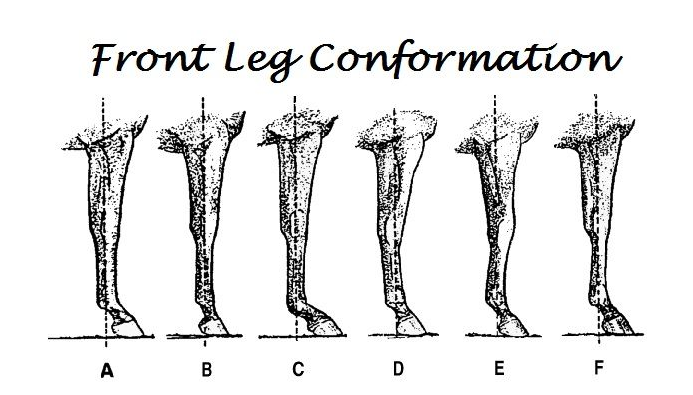
base narrow
horses that are _____ will
lack adequate base of support
will have difficulty balancing when turning
will interfere
wing-in
horses that are toed out will _____ when moving
paddle
horses that are toed in will ____ when moving
rope walk
horses that are base narrow will _____ when moving
carpal
knock-kneed horses will have increased _____ stress
hindquarters
this is the engine for the rest of the body
hindlimbs
conformation of the _____ determines potential for speed, agility, power, stopping ability, and collection
less
hind limbs are ___ prone to lameness than the front limbs
positively
a longer pelvis is ____ corelated with stride length and jumping ability
better
a longer hip contributes to _____ balance
false
true/false : pelvic and croup angle are the same
flatter
a _____ angled pelvis allows the horse to push behind, but hard to step forward under their body
-often seen with a high set tail
femur
this bone should be long and forwardly-sloping
-allows the horse to balance and carry more weight on its hindlimbs
-places stifle under point of hip
long
a ____ femur results in lower stifle and deeper-tying, stronger muscling
-also gives lower hocks and more power
positive
there is a ____ correlation between pelvic and femur length and the length of the stride
hocks
the ____ are one of the most complex and hardest worked joints in the body
-propulsion, turning, shock dissipation
friction/strain
large, well-conformed hocks have less _____ than small, narrow, poorly-conformed hocks
small angle
HOCK: a _____ angle has an increased risk of lameness and back pain
large angle
HOCK: a ____ angle has an increased risk of lameness and concussive damage
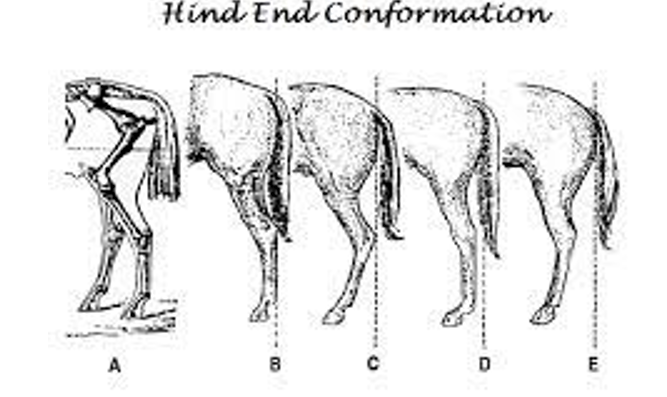
Sickle-hocked
What is wrong with C
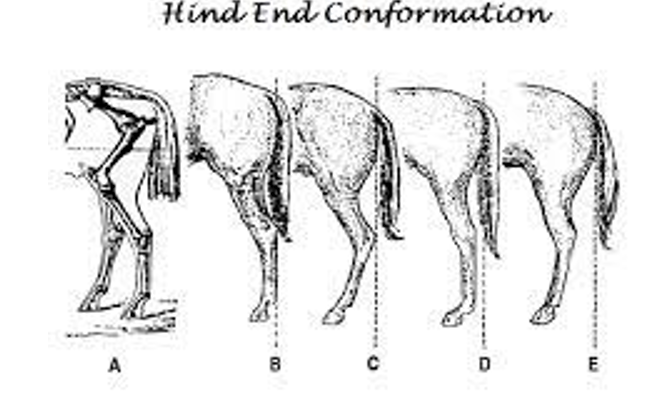
Post-legged
what is wrong with D
camped under
what is wrong with E
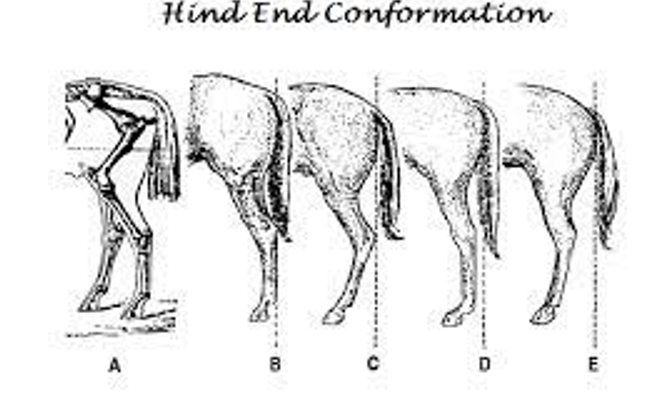
cow hocks
hocks point towards each other, with cannons and fetlocks deviating to the outside
type
certain physiological characteristics can distinguish between breeds or between sexes
proportional to body, broad forehead, large eye set on corners of head, refined, small muzzle, large nostrils
what are 6 things to look for on a horse’s head?
roman nose, large ears, pig eyes, small nostrils, overshot or undershot jaw
what are 6 head faults?
dished profile
a dish below the eyes that is often associated with slightly bulging forehead
-seen in horses with arabian descent
roman nose
when the nose of a horse “bumps” outwards
-associated with cold-blooded breeding
-may have advantage in cold climates
pig eye
small eye that is associated with coarse features
-may be associated with a smaller field of vision
-advantages in cold climates
carcinoma
the white skin around a blue eye can predispose the horse to ____
-reduce their exposure to UV
narrow head
a lack of width between the eyes
-may be narrow in the jaw
-any restriction to air intake can limit performance ability
overbite
top of mouth is over the jaw
-parrot mouth
underbite
bottom of jaw is over the top of mouth
-sow/monkey mouth
A-O joint
this spinal joint allows for flexion at the poll
C-T joint
this spinal joint has a relative location that can influence how well a horse can shift its center of gravity
L-S joint
when this spinal joint is flexed, the hindlimb comes under the body; lateral flexion
S-I joint
this spinal joint aids in shock absorption, transfers forces from hindlimb to vertebral column
1/3
the neck should be about ____ the body length
ewe neck
the widest part of the neck is at the bottom
-hypertrophy of underside of the neck
-associated with
low base of the neck
straight shoulder
stargazing
horse that evades rider
low back/back pain
fallen crest
this occurs when fat deposits accumulate above the nuchal ligament
-may get top heavy and fall
-horse may lose weight, but neck fat dissipates slower
-often associated with obesity/equine metabolic syndrome
knife neck
a long, skinny neck with poor muscle
-horizontally set onto the shoulder
-can be seen with low body condition
mutton withers
low, flat withers
-may be associated with wide backs and downhill conformation
-can cause saddle fit issues, difficulty shifting back center of gravity
high withers
serve as lever for muscles of the neck and back. Attachment point for nuchal ligament
-makes it easier for horses to round back, or use head and neck
-exacerbated with low body condition
-saddle fit issues
roach back
kyphosis of the back
-bump on back of horse
-occurs occasionally in young horses that grow rapidly
-sometimes acquired as a result of trauma or chronic pain
sway back
lordosis of the back
-often seen in older horses and those with a long, weak loin
-weakening of ligaments of back can cause sagging over time
-can be congenital
widows peak
horse appears to have a hollow area between lumbar span and tuber sacral
-rough coupling can be more aesthetically displeasing rather than functionally significant
-may be associated with weak, poorly muscled loin or mild roach back
hunters bump
visible bump at the high point of croup due to SI strain or injury
-dislocation or partial dislocation of SI joint
-sometimes caused by tearing of associated ligaments
wry tail
tail carried to one side
-typically does not affect health or usefulness
stallions vs. geldings
-shorter
-shorter ear
-neck crest
-more muscle
mares vs. males
-broody facial features
-longer ears
-longer body length
bowed tendon
usually a tearing of tendon fibers of SDFT or DDFT
-occasionally due to uneven compression (bandage bow)
-more common in front limbs
-fetlock joint overextends, usually due to fatigue
-conformation risk factors
long toe/low heel/broken back axis
long, weak pasterns
long cannon bones
tied in behind knee
osselets
traumatic arthritis of the fetlock
-begins as swelling in front of joint, pain
-usually bilateral
-periosteum and articular cartilage turns to bone
-conformation risk factors
short, upright pasterns
uneven stresses to the fetlock
ringbone
degenerative arthritis of pastern and/or coffin joint
-one or multiple limbs
-conformation risk factors
short, upright pasterns (can be deviated)
big horse, little feet
sidebone
calcification of lateral cartilage in hoof
-some ossification normal with age
-not usually lame
splints
injury to the interosseous ligament or periosteum of the splint bone or cannon
-starts out soft and painful, then becomes bony and no longer painful
-may be caused by trauma or heavy training in young horses
-conformation risk factors
offset/bench knees
base narrow
toe out
bone spavin
arthritis of the lower hock joints due to cartilage compression and/or uneven loading
-usually in older horses
-can cause lameness
-conformation risk factors
sickle hocks
cow hocks
bog spavin
excess fluid/edema in the tibiotarsal joint
-usually not lame
-may be due to underlying OCD or trauma
-conformation risk factors
straight hocks
long back/loin
curb
enlargement of plantar ligament due to inflammation or tearing
-may be due to trauma
-conformation risk factors
sickle hocks
stride cycle
consists of the stance phase and the suspension phase
limb cycle
consists of the stance phase and the swing phase
 Note
Note  Flashcards (130)