1 Introduction / Medieval Literature
 Studied by 0 people
 Call Kai
 Learn
Learn Practice Test
 Spaced Repetition
 Match
Match Flashcards
 Knowt Play
1/13

Earn XP
Description and Tags
gain an overview over all major periods of British literary history from the Anglo-Saxon period to present ➢ learn to think about the role of literature in wider social, political and cultural contexts ➢ be familiarized with particularly important writers and their works
Name | Mastery | Learn | Test | Matching | Spaced | Call with Kai |
|---|
No analytics yet
Send a link to your students to track their progress
14 Terms
British settlement (Old English / Anglo-Saxon Literature)
oldest english is not native Germanics
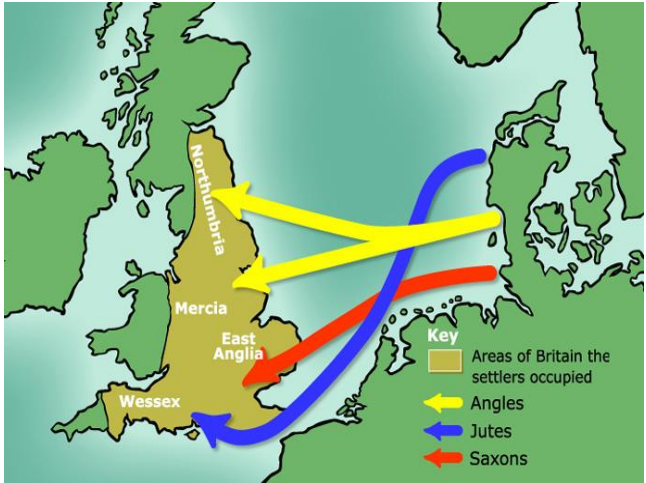
politics of periodization: Old English vs. Anglo-Saxon Literature (since 19th c.)
(Old English / Anglo-Saxon Literature)
~ never neutral always exclusive as a label (patriotic)
~ English was shaped by different cultures
Re- Christianisation & the Introduction of the Roman Alphabet
(Old English / Anglo-Saxon Literature)
- late 6th c.: Christian missionaries (pope Gregory the Great, 7th c.)
- Germanics: own religions, cultures, runes but not literary
- Christians: literature important (e.g. Cuthbert's Gospel: pocket gospel from 7th c. AD, is oldest intact european book)
Anglo -saxon verse
(Old English / Anglo-Saxon Literature)
initially purely oral form of literature performed at public gatherings
· before scribes produced written collections of Anglo Saxon verse in the 10th
century
· c. 30000 lines of Anglo-Saxon verse survive
· c. 20000 lines contained in the 4 most
significant volumes today:
Junius manuscript
Exeter book
Vercelli book
Nowell codex (Beowulf)
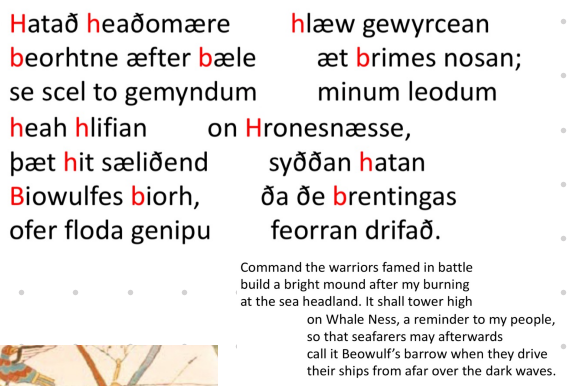
Epic Poetry BEOWULF
(Old English / Anglo-Saxon Literature)
→ christianized paganism? Paganized christianity?
· epic: a long poem usually about exploits of warriors & heroes
· manuscript produced in the late 10th or early 11th century (oral version much earlier,
since ca. 6th c.)
Beowulf's poetic form: alliterative verse
can contain any number of syllables
falls into 2 half lines
each half line has 2 stressed sounds→ no fixed metre
alliterations linking two half lines
Beowulf: The Transition from Oral to Written Literature
Beowulf’s Nowell Codex Intertext: Wonders of the East
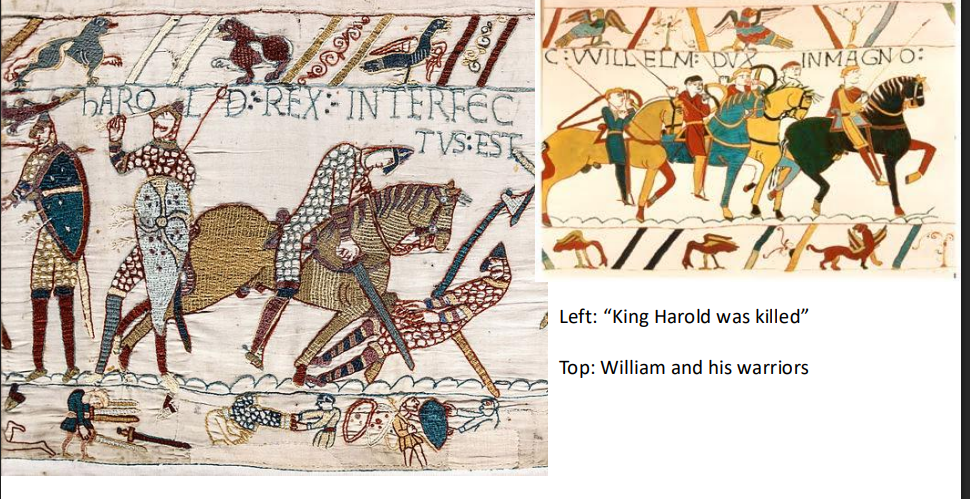
the Norman Conquest & the Bayeux Tapestry
(Middle English Literature ; 11th-15th ct.)
Battle of Hastings 1066: Normans, led by William the Conqueror (Duke of Normandy) invade England (last
Anglo-Saxon ruler Harold is killed)
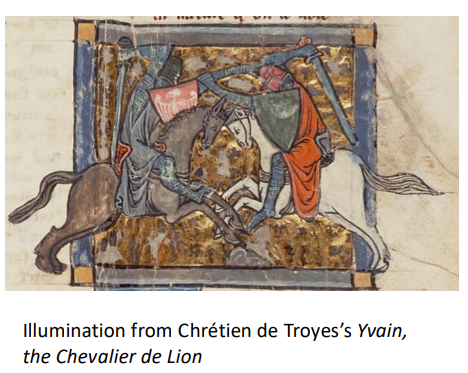
Middle-English Romances
(Middle English Literature ; 11th-15th ct.)
Mainly drew on three different historical subjects:
➢ The “matter” of Rome (classical legend)
➢ The “matter” of France (tales of Charlemagne and his knights; the French struggle against the Saracens)
➢ The “matter” of Britain (Arthurian legend)
Middle-English Romances: Sir Gawain and the Green Knight (late 14th century)
(Middle English Literature ; 11th-15th ct.)
➢ anonymous middle English romance; author probably came from Midlands
➢ deals with matter of Britain: partly set at the court of mythical King Arthur
➢ ambivalent exploration of the idea and practice of chivalry
‘I am at your command, to kiss when you like;
you may lip when you will, and leave when you wish
in a space.’
The lady bends her adown
and sweetly she kisses his face;
much speech they there expound
of love, its grief and grace.
[…]
‘I am at your comaundement, to kysse quen yow lykez,
Ȝe may lach quen yow lyst, and leue quen yow þynkkez,
in space.
' Þe lady loutez adoun,
And comlyly kysses his face,
Much speche þay þer expoun
Of druryes greme and grace.
→powerful, confident woman!
![<p>➢ anonymous middle English romance; author probably came from Midlands </p><p>➢ deals with matter of Britain: partly set at the court of mythical King Arthur </p><p>➢ ambivalent exploration of the idea and practice of chivalry</p><p></p><p></p><p>‘I am at your command, to kiss when you like;<br> you may lip when you will, and leave when you wish <br>in a space.’ <br>The lady bends her adown<br> and sweetly she kisses his face; <br>much speech they there expound <br>of love, its grief and grace. </p><p>[…] <br>‘I am at your comaundement, to kysse quen yow lykez, <br>Ȝe may lach quen yow lyst, and leue quen yow þynkkez, <br>in space.<br>' Þe lady loutez adoun, <br>And comlyly kysses his face, <br>Much speche þay þer expoun <br>Of druryes greme and grace.</p><p>→powerful, confident woman!</p>](https://knowt-user-attachments.s3.amazonaws.com/e9dbabdd-41c3-44f9-9e24-5fb59e96acd0.png)
Courtly Epic: Idealism vs. Realism
(Middle English Literature ; 11th-15th ct.)
courtly epic
-only chivalric courtly society is worthy of adventure
→they alone can undergo serious & significant experiences
-later, (esp. in italy) social strata of urban background took over courtly ideal and refashioned it
→concept of nobility became more personal, often contrasted with other concept of nobility based solely on lineage
→ideal did not turn less exclusive nontheless
!emphasis on inner values did not bring a closer approach to earthly realities!
Auerbach, Mimesis: The Representation of Reality in Western Literature (Princeton: Princeton UP, 2003), p. 139.
Geoffrey Chaucer’s Canterbury Tales (c. 1387-1400)
(Middle English Literature ; 11th-15th ct.)
➢ narrates story-telling contest between ca. 30 pilgrims traveling from Tabard Inn, London → shrine of Thomas Becket, Canterbury Cathedral
➢ each pilgrim introduces him/herself & tells a story (stories written in style of different contemporary literary genres incl. legend, courtly romance, bawdy tale, etc.)
➢ heroic couplets (rhyming pairs of iambic pentameters)
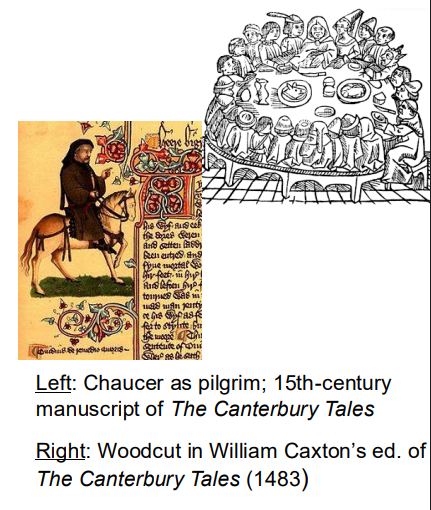
Geoffrey Chaucer’s Canterbury Tales (c. 1387-1400) From the Prologue to the “Wife of Bath’s Tale”:
(Middle English Literature ; 11th-15th ct.)
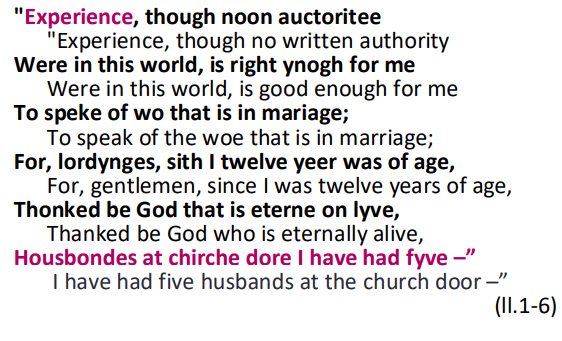
Late Medieval Mystery Plays
(Middle English Literature ; 11th-15th ct.)
➢ mostly based on biblical stories
➢ performed the middle ages (esp. 13th -15th centuries)
➢ staged on pageant wagons (movable carts, open air), audience typically surrounding the stage
➢ organised by medieval guilds
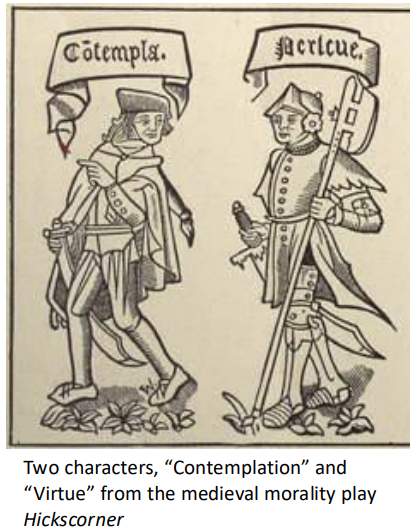
Late Medieval Morality Plays
(Middle English Literature ; 11th-15th ct.)
➢ surviving texts date from 15th and early 16th centuries
➢ didactic: how to live a Christian life; how to lead a virtuous life; how to prepare for death; etc.
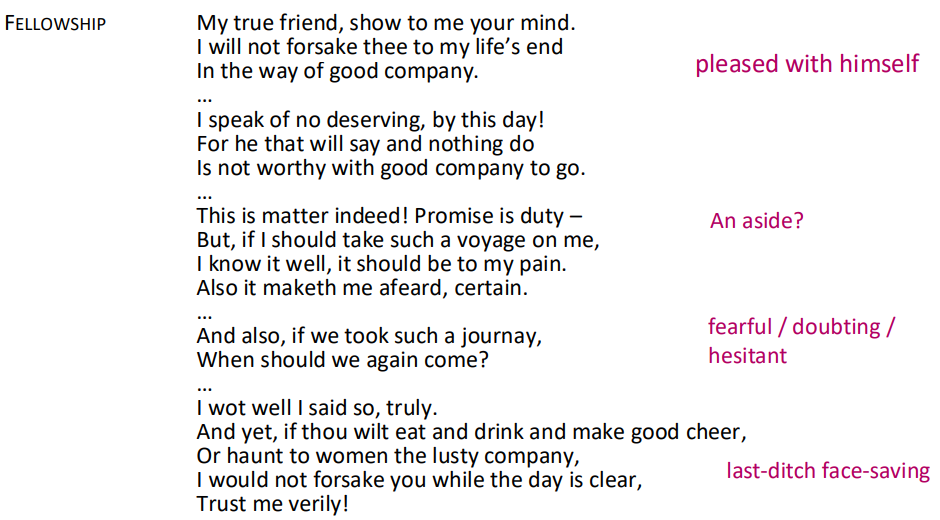
➢ Important morality play: anonymously authored Everyman (c. 1495), featuring Everyman and cast of allegorical characters (incl. Fellowship, Kindred, Cousin)
Late Medieval Morality Plays text example
(Middle English Literature ; 11th-15th ct.)
 Note
Note  Flashcards (31)