Scalars and Vectors
 Studied by 0 people
 Call Kai
 Learn
Learn Practice Test
 Spaced Repetition
 Match
Match Flashcards
 Knowt Play
1/22

There's no tags or description
Looks like no tags are added yet.
Name | Mastery | Learn | Test | Matching | Spaced | Call with Kai |
|---|
No analytics yet
Send a link to your students to track their progress
23 Terms
What are the types of quantites?
a scalar
a vector
What are scalars?
quantities that have magnitude but not direction
What are vectors?
quantities that have both magnitude and direction
What is distance?
measure of how far an object has travelled, regardless of direction
What is displacement?
a measure of how far it is between two points in space, including the direction
What is speed?
a measure of the distance travelled by an object per unit time, regardless of the direction
What is velocity?
a measure of the displacement of an object per unit time, including the direction
What are the types of scalars?
Distance, speed, mass, time, energy, volume, density, pressure, electric charge, temperature
What are the types of vectors?
Displacement, velocity, acceleration, force and momentum
How are vectors represented?
Vectors are represented by an arrow
The arrowhead indicates the direction of the vector
The length of the arrow represents the magnitude
How can vectors be combined?
Vectors can be combined by adding them to produce the resultant vector
The resultant vector is sometimes known as the ‘net’ vector (eg. the net force)
What are the two methods of adding vectors?
Calculation – if the vectors are perpendicular
Scale drawing – if the vectors are not perpendicular
How can the magnitude of a resultant vector be found?
Pythagoras theorem
How can the angle of a resultant vector be found?
Calculating the angle of this resultant vector from the horizontal or vertical can be done using trigonometry
How can a resultant vector be draw and calculated?
Step 1: Link the vectors head-to-tail if they aren’t already
Step 2: Draw the resultant vector using the triangle or parallelogram method
Step 3: Measure the length of the resultant vector using a ruler
Step 4: Measure the angle of the resultant vector (from North if it is a bearing) using a protractor
What are the parts of a vector?
Horizontal and vertical components
How can two vectors be represented?
a single resultant force
What is the trigonometric function for horizontal component
cos0
What is the trigonometric function for vertical component?
sin0
What is the diagram for object on a inclined plane?
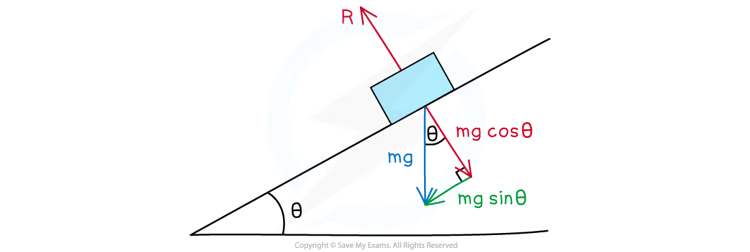
How are coplanar forces represented?
Coplanar forces can be represented by vector triangles
When are forces in equilibrium?
Forces are in equilibrium if an object is either
At rest
Moving at constant velocity
How are coplanar forces represented in equilibrium?
In equilibrium, coplanar forces are represented by closed vector triangles
 Note
Note  Flashcards (355)