Chapter 2: Personality Assessment
 Studied by 0 people
 Call Kai
 Learn
Learn Practice Test
 Spaced Repetition
 Match
Match Flashcards
 Knowt Play
1/24

There's no tags or description
Looks like no tags are added yet.
Name | Mastery | Learn | Test | Matching | Spaced | Call with Kai |
|---|
No analytics yet
Send a link to your students to track their progress
25 Terms
The imp of personality assessment
Prevalent/common:
Coming in many shapes & forms
Some scientific & validated, many not
Impacts far beyond academia: Companies — hiring, retention, & promo decisions
Expensive: It’s a billion dollar industry
How to measure personality
It depends on who we think about personality! Examples:
Trait/humanistic approach: people have clear traits / goals that define who they are → we can just ask
Psychodynamic approach: people's behaviours are driven by unconscious processes → can't just ask!
Projective Tests
Important thoughts, feelings, and motives operate outside of conscious awareness
Projective hypothesis: If a person is asked to describe or interpret ambiguous stimuli their responses will be influenced by nonconscious needs, feelings, and experiences
In interpreting such a stimulus people project their unique personality onto the stimulus
Rorschach Inkblots & TATs
Two of the most famous projective personality tests:
Rorschach inkblots: Individuals are asked to interpret symmetrical blots of ink
TAT: Individuals are asked to tell a story based on a series of ambiguous pictures
Idea: whatever they see is not actually on the card / in the pictures, but reflects the contents of their mind
Projective tests: Prevalence
Still frequently used (very common in therapy, court, etc.) even though scholars caution against it
4th most used test in psyc
Projective tests (Rorschach & TAT) Pros
Ice breaker to get clients to open up
Rorschach: Some utility for prediction of outcomes (i.e., suicide, attendance at treatment sessions, commitment to a mental hospital)
TAT: some evidence for assessment of implicit motives
Projective tests (Rorschach & TAT) Cons
Scarce validity evidence
Expensive and time-consuming
No objectivity: unclear what they really mean
Other, less expensive tests work as well or better
Objective Tests
Most familiar and most widely used approach to personality assessment
Idea: personality tests that are more objective and less open to interpretation
Objective personality test = test consisting of a list of questions to be answered using a limited set of response options (e.g., true or false; strongly disagree, slightly disagree, slightly agree, strongly agree)
Responses to these items then are scored in a standardized, predetermined way
Illustration: self-ratings on items assessing talkativeness, assertiveness, sociability, adventurousness, and energy can be summed up to create an overall score on the personality trait of extraversion
Varieties of Objective Tests (and pros)
Type S, I, or B data
Comprehensiveness: unidimensional (e.g., Rosenberg Self-Esteem Scale) or multidimensional (e.g., Big Five Inventory 2)
Length: Short vs full scale
Principle of aggregation: Averaging answers to multiple items decreases error and increases stability and reliability
Breadth of target characteristics: Big Five dimensions versus facets versus nuances
Principle of aggregation
Averaging answers to multiple items decreases error and increases stability and reliability
Constructing objective personality: Rational method
Write items that seem directly, obviously, and rationally related to what is to be measured
Generates S-data
Items are developed based on theory and expert knowledge
Ideally informed by elaborate theory on the concept that is to be measured; in practice this is sometimes less systematic
2 Steps of rational method(example: wanderlust)
definition and specification of the construct (what behaviours, experiences, emotions etc. are manifestations of wanderlust?)
item generation (collect indicators that can be assessed through statements or questions; example: “I like to discover new cities.”; “When I am away from home, I like to explore the local vibe.”
4 conditions for validity for rationally constructed pers tests to work
Items mean the same thing to the test taker and creator
Test taker is able to make an accurate self-assessent (cognitively able)
Test taker is willing to make an accurate and undistorted report
The items are valid indicators of what the test is trying to measure
Even tho most rationally constructed pers tests do not meet all 4 conditions, this remains the most common form of test construction
Constructing objective personality: Factor analytic method
identifies groups of items that have something in common (factor: the property that ties the together)
Used to decide how many fundamental traits exist (e.g. Big Five: Openness, conscien., etc)
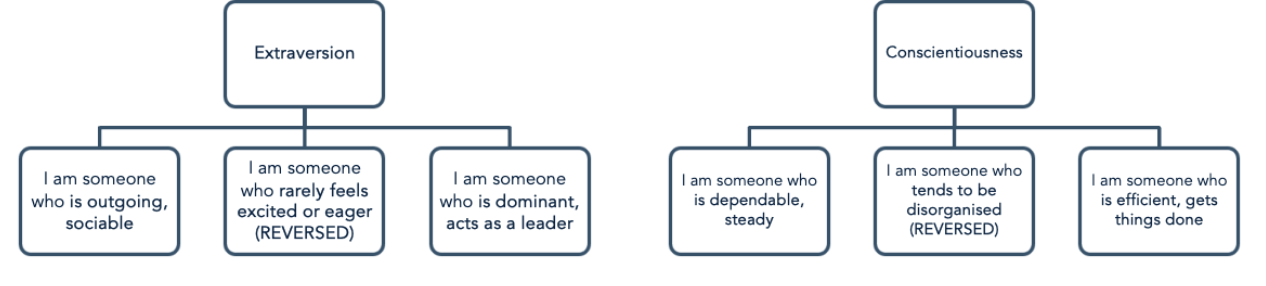
4 steps to apply factor analysis
Generate a long list of objective items
Administer these items to a large number of ppl
Analyze w a factor analysis
Consider what the items that group tgt have in common and name the factor
Constructing objective personality: Empirical method
Select items that distinguish most clearly between pre-determined groups
5 steps of empirical method
Gather lots of items
Have a sample of ppl alr divided into groups (e.g. based on occupation or diagnostic criteria)
Run the test
Compare the answers of the diff groups, select the items that are most useful to differentiate the diff groups
Cross-validation: Check whether the selected items distinguish equally well in a diff sample
Empirical construction method example
MMPI-2; used for clinical assessment
Compare items between two groups (psychiatric diagnosis vs no diagnosis)
Based on statistical parameters, selection of the 556 items that best distinguish between the two groups
Best use for each test (Rational, factor analytic, empirical)
Rationally constructed tests: Best when you want a clear, theory-based measure of a specific construct (e.g., BDI for depression)
Factor-analytic tests: Best when you want to discover/confirm underlying dimensions of personality or traits. (Big five).
Statistical correlations.
Identifies clusters of things that have something in common
Empirical tests: Best when you need a test that predicts real-world group differences (e.g., clinical vs. non-clinical) (e.g. MMPI)
Digital Footprints as Personality Measures – Procedure
volunteers complete a classic self-report personality questionnaire to assess the Big Five and provide sociodemographic characteristics.
Researchers gain access to the individuals' personal Facebook profiles and collect data on Facebook likes (with consent).
A machine learning algorithm learns which likes are associated with which personality traits.
The machine learning algorithm can now apply this knowledge to new Facebook profiles and predict users’ personality traits based on their publicly accessible likes.
How Accurate Are These Measures? (Assessing personality from activities on Facebook)
Half as accurate than using typical test-retest reliability for survey-based self-report measure, especially the Big Five, Satisfaction with Life, Intelligence (Proved that the generic S data is much accurate)
Openness is the only component that shows similar (r) in Facebook Likes and traditional questionnaire
Digital footprint’s prevalence
S-data assess big 5, sociodemographic characteristics
Access & collect data from personal facebook profile & likes
Machine learning algorithm learns association between likes & personality traits
Algorithm applies knowledge to new profiles & predicts personality based on likes
Personality can be reliably inferred on social media from…
Facebook likes
Flickr images
GPS data
Instagram captions
Music preferences on spotify
Smartphone usage patterns
Spending records
Twitter usage
Common pitfalls of studying personality thru social media activity
Models can be very culturally specific or get outdated and predictions may fail
Ground-truth problem: Is alignment w self-report necessarily the best metric for accurate personality assessment? (social media might not be your true self)
Ethics and privacy concerns surrounding data sourcing
Can Language Models judge public figures’ personality?
Chat-GPT’s ratings were highly and consistently correlated w the avg human ratings
 Note
Note  Flashcards (34)