Art History Final
 Studied by 0 people
 Call Kai
 Learn
Learn Practice Test
 Spaced Repetition
 Match
Match Flashcards
 Knowt Play
1/16

There's no tags or description
Looks like no tags are added yet.
Name | Mastery | Learn | Test | Matching | Spaced | Call with Kai |
|---|
No analytics yet
Send a link to your students to track their progress
17 Terms
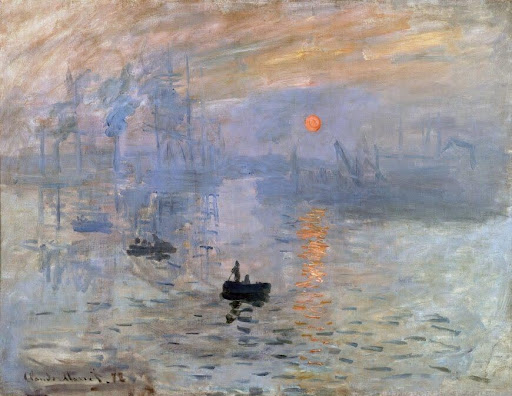
Sunrise
Artist = Claude Monet
Style = Impressionism
Material = Oil on Canvas
Period = 1872
Monet - painted the same subject multiple times throughout the year to capture the changes in season and light
Captures the speed of modern life- the swift brushstrokes and suggestions of figures represent the artist’s attempt to capture fleeting moments
Fleeting effect of light on the water and figures- this image wouldn’t look the same if it weren’t for the exact time and place Monet chose to create
Monet strips away the details of the scene to a bare minimum: the dockyards, ships, and human figures are only suggested by a few loose brushstrokes
The closer you look at the painting, the more things start to disappear into a few ununified brushstrokes
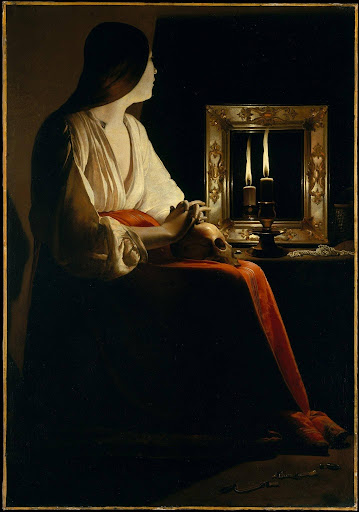
The Penitent Magdalen
Artist = Georges de La Tour
Style = French Baroque
Medium = Oil on canvas
Date = 1640
Profile Perdu (lost profile)- she is barely looking in our direction
Painting is characterized by a bold contrast of light and dark (tenebrism and spotlighting) with extreme contrasts of candlelight and shadow
Subject = Mary Magdalen- shown with a mirror in front of her (symbol of vanity and virtue of truth), a skull (mortality- nothing lives forever), and a burning candle (fragility of life- may flicker and extinguish at any moment)
The purpose of the objects shown = to impress upon the viewer that Mary is reflecting on the fleeting emptiness of worldly possessions
Still life painting known as VANITAS, from the Latin meaning “emptiness.”
This version of Mary focuses more on the act of silent and solitary meditation. As a demonstration of her devotion, she has discarded her worldly possessions (her pearl necklace on the dressing table and her other jewelry onto the floor)
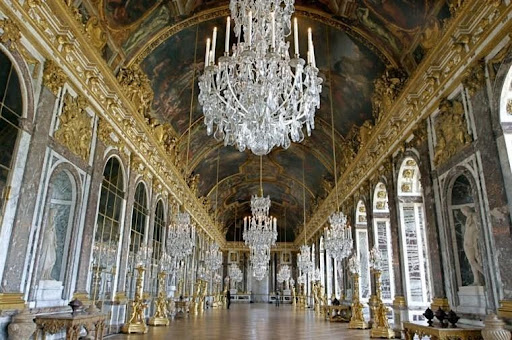
Palace of Versailles (The Hall of Mirrors)
Artists/Designers = designed by Jules Hardouin-Mansart
Artists/Designers = ceiling painted by Charles Le Brun
Mirrors on one side, windows on the other- King Louis XIII refers to himself as the “sun king,” or literally the center of the universe
Used this room for the rituals of the king because the lighting is so extraordinary
Ceiling paintings done by Charles Le Brun
Shows off the victories of the king
All images shown are propaganda to make the king look powerful/glorious
Gardens = Andre Le Notre
French gardens = very trimmed and perfect in every aspect (symmetry, clean, everything aligned, and carefully attended)
Overall Goal = Make the king look lavish, wealthy, and powerful
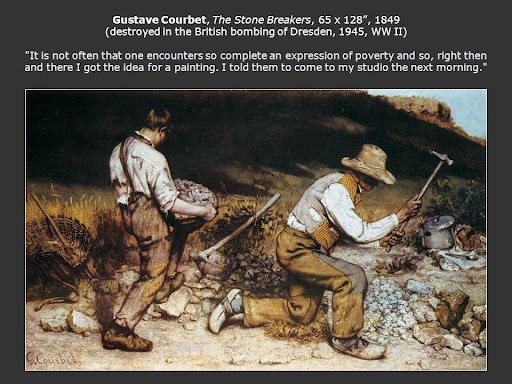
The Stone Breakers
Artist = Gustave Courbet
Style = Realism
Medium = Oil on canvas
Period = 1849
Dimensions = 65” × 128”
“It is not often that one encounters so complete an expression of poverty.”
Subjects - two extremely poor men, doing the backbreaking job of stone breaking (crushing stones into pebbles for the roadbed)
Man 1) bent over, we are not sure of his age, in tattered clothing
Little Boy) also bent over despite his young age, in tattered clothing
Created to portray the intense labor that the poorer portion of the French population endured daily
Massive proportions- unusual for French artists of the time, as bigger canvas spaces were not meant for ordinary people
This is not the kind of scene you’d see in a painting of this size (usually reserved for royal or idealized subjects)
Tiny patch of bright blue sky- this effect is to isolate the laborers and to suggest that they are physically and socio-economically trapped by their work
Courbet wants to show what is “real,” and so he depicts a man who seems far too old and a boy who seems still too young for such back-breaking labor
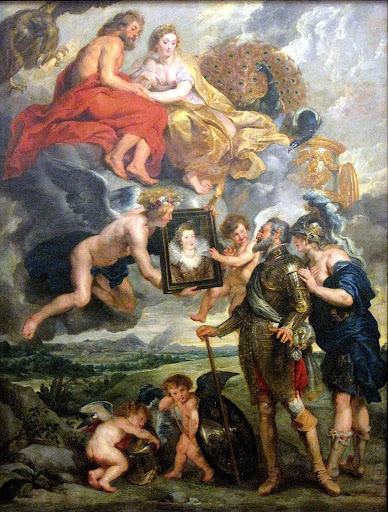
Henry IV Receives the Portrait of Marie de’ Medici
Artist = Peter Paul Rubens
Style = Flemish Baroque
Material = Oil on canvas
Date = 1622-25
Middle figure- Henry IV- who had already died by the time of painting
Dressed as a warrior and decked out in gold (possibly still wearing his armor from battle)
Receiving a portrait of Marie, stands riveted to her regal image- he is thrilled to see how beautiful she is
He is so lovestruck that he drops all armor and weapons, as he is encouraged to abandon war for love (love conquering war)
Below him, two putti play with the rest of his armor (represented through ripe colors, lavish textures, and dramatic diagonals)
Personification of France (Marianne)
Standing to the right of Henry, Marianne counsels him to focus on the portrait of Marie
She is wearing a blue silk garment embroidered with gold fleur-de-lys and a helmet encircled by a gold crown
Jupiter and Juno (Zeus and Hera)
Looking down on the scene of love approvingly from the clouds
Peacock = symbol of Hera (wisdom)
Eagle = symbol of Zeus
On Hera’s chariot, a gilded Cupid tramples an eagle, reinforcing the theme of love’s triumph over war
Draperies worn by Zeus and Hera
Idealized portrayal of marriage negotiations
Main theme = propaganda run by France- theme of peace
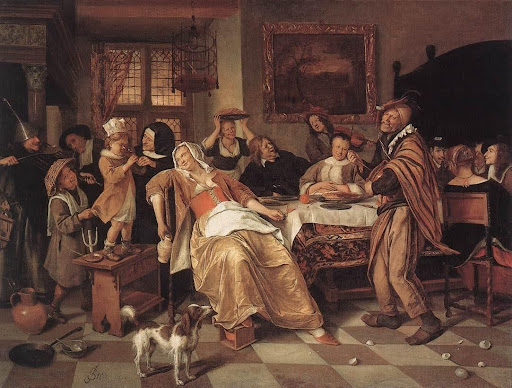
The Bean Feast
Artist = Jan Steen
Style = Baroque
Material = Oil on canvas
Date = 1668
Very messy/sloppy scene of cheerful people assembled to enjoy a feast set on the Twelfth Night (The Epiphany)
Drunk men, women, and children form a cheerful crown around the dining table
Everything has gone wrong in this scene
A young boy who has earned the title of “king” is seen standing on a bench wearing a paper crown (whoever receives a cake slice with a bean in it earns the title for a day)
Nun giving the child an alcoholic drink (dig at the Catholic church)
The man chosen to be the court jester is playing an instrument for the crowd
Broken eggs on the floor = lost virtue
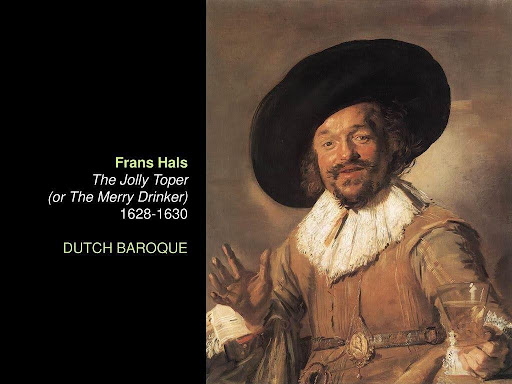
The Jolly Toper
Artist = Frans Hals
Style = Baroque
Medium = Oil on canvas
Date = 1628-30
Genre Scene- no name, no specific subject, representation of an archetype
Very loose brushstrokes (will disappear the closer you look)
Wavering/gesturing to the viewer, with beer/alcohol in the other hand (maybe suggesting a toast)
Portrays a jovial man, his face illuminated with a warm, expressive smile
The light falls subtly to create a gentle contrast, enhancing the texture of fabrics and skin tones
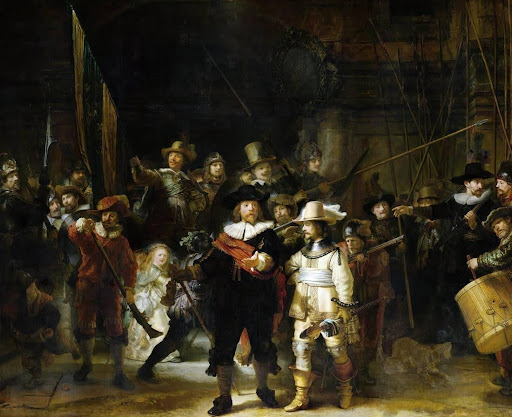
The Night Watch
Artist = Rembrandt
Style = Baroque
Medium = Oil on canvas
Date = 1642
Group portrait- shows militia group (parade scene)
Open composition- the scene looks like it extends past what is shown in the canvas
Tenebrism- many shades of darkness
Immense sense of movement, sound, and energy generated as citizens spring to action in response to their captain’s command (Frans Banning Cocq)
Movement- diagonals shown in the flags, pistols, and bodies of people
Sound- huge crowd, a lot of movement, a man beating a drum, and people shouting
Child with a chicken- maybe because the captain’s name is Cocq (play on his name because Cocq = chicken)
A lot of technical skill- seen in clothing details, shows, and anatomy
Loose brushstrokes, but a lot of control and skill
Golden girl- mysterious girl who emerges from the darkness just behind the musketeer in red. With flowing blond hair and a fanciful gold dress, the young girl in all her brilliance draws considerable attention. The girl is not a real person but acts as a personification of the company.
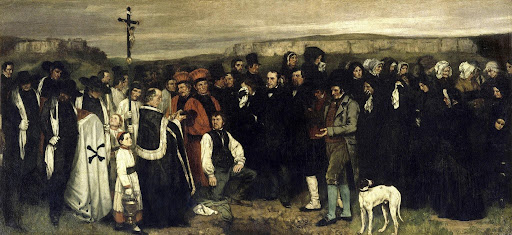
The Burial at Ornans
Artist = Gustave Courbet
Style = Realism
Medium = Oil on canvas
Dimensions = 10’ × 22’ (massive)
Massive size- highly unusual for French artists/the Academy because bigger canvas spaces were reserved for royal or idealized subjects, not ordinary people
Not Idealized- men aren’t too good-looking, ordinary expressions, everyday themes
Courbet used poses from paintings of King Charles on the same people burying the body
Realism- about capturing life the way it really was, without idealization, without escapism
Courbet’s technique- thickly layered paint and the dark tones dominated the scene
Colors bring out the atmosphere of the scene: sadness, nostalgia, and melancholy
The picture plane is made deliberately narrow and crowded in order to accentuate the monumentality and solidarity of the occasion
Through the use of muted colors (set off by the white bonnets, handkerchiefs, and clerical vestments) as well as the evening gloom, and the sober restraint shown by mourners and priests alike, the artist underlines the importance and dignity of an ordinary life and death
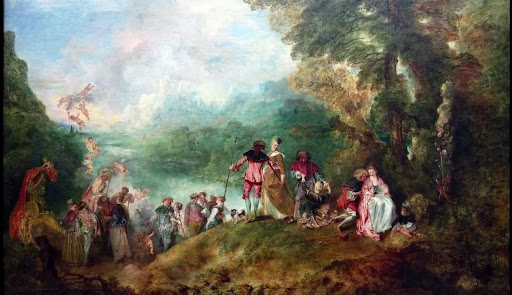
Pilgrimage to Cythera
Artist =Antoine Watteau
Style = Rococo
Medium = Oil on canvas
Painting has many vibrant colors, bold brushstrokes, and a hazy atmosphere. The lush landscape is idyllic and infused with bright blue skies, soft green leaves, and warm brown earth.
The beautiful people are fashionably dressed in silk and velvet. Hats, fans, and walking canes add to their glamorous appearance
The background to these flirtatious aristocrats is the sacred Greek island of Cythera, where Aphrodite, the Goddess of Love, was allegedly born. A statue of the goddess stands on the right side of the painting, overlooking all who visit her island.
First couple
On the man’s shoulder, his blue cape is embroidered with a heart pierced by an arrow. It symbolizes his love-struck intentions with this young lady
The woman is not rejecting his advances- They are having a flirtatious conversation, and at this particular moment, the man whispers in her ear while she glances down demurely, blushes red, and says nothing
Second couple
Stood in the immediate foreground
The lady is blonde with rosy cheeks, a full bosom, and an ever-so-chic scarf at her neck
The gentleman has his back to the viewer and wraps his right arm around her waist. He gently tugs her to the left away from the first two couples
Composition:
Fluid and dynamic, with a soft, pastel color palette that heightens the feel of an idyllic and frolicsome environment
Figures seem to be in various states of arrival or departure, which creates a narrative ambiguity
Masterful use of brushwork is evident in the textures of the garments and the foliage, imbuing the scene with a sense of movement and grace
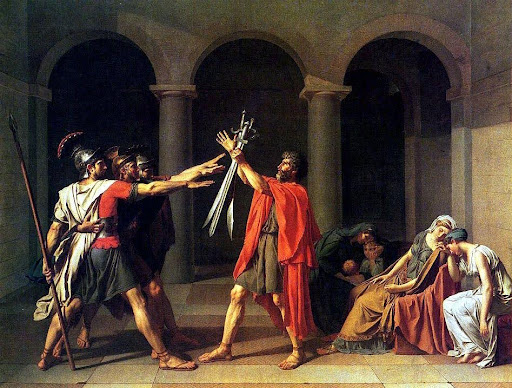
Oath of the Horatii
Artist = Jacques-Louis David
Style = Neoclassicism (darker shades and a serious subject/mood)
Medium = Oil on canvas
Three distinct groups of people, all categorized under Roman Arches
The straight lines are evident in the men’s upright and often-described “rigid” postures, more specifically, the horizontal lines created by their outstretched arms
Diagonal lines created from the legs, and the straight vertical lines implied by the swords, spears, and, importantly, the three vertical columns in the background
Beautiful contrast between light and dark- the background is in darker shadows compared to the foreground, which is lit up by an unknown light source, possibly coming from the left, illuminating all the figures as well as casting the men’s shadows and the wall on the right
Left = the sons of the Horatii
Reaching up toward the swords their father is holding to take an oath
Standing close next to one another in power poses, their legs are wide apart, and their feet are planted on the tiled floor
The middle brother has his other arm around the waist of the brother closest to us in the foreground; the latter grips a long spear in his left hand, held behind his back
Middle = Their Father
Also standing in a power pose with his right leg in front of him, almost touching his son’s feet, and his leg behind him
His body posture is slightly bent backward, and he appears to have an upward gaze while his three sons stand in a salute towards the swords
Holding the swords and looking up towards the gods
Right = The women
Women and children are distraught by the incoming war
In contrast to the men’s poses, they are all seated and appear saddened
consoling each other because they undoubtedly know what is about to take place between the Horatti and Curiatii
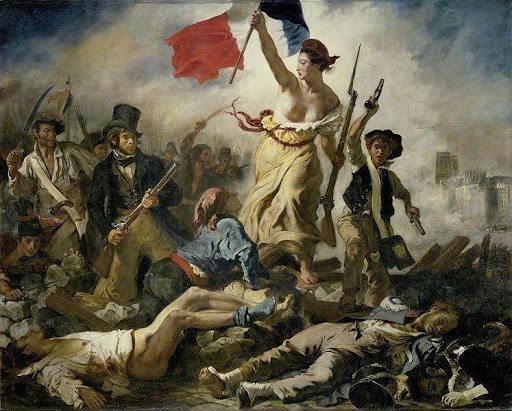
Liberty Leading the People
Artist = Eugene Delacroix
Style = Romanticism
Material = Oil on canvas
Middle figure- Marianne (symbol of liberty, justice, and brotherhood in France)
She is holding a tricolored French Flag
Phrygian Bonnet- popularized in the French Revolution: symbol of freedom, liberty, equality, and fraternity- a reference to freed people in the ancient world
The mound of corpses and wreckage acts as a kind of pedestal from which Liberty strides, barefoot and bare-breasted, out of the canvas and into the space of the viewer
Accompanied by a young boy brandishing a pistol in each hand
Leads a group of various people forward over a barricade and the bodies of the fallen while holding the flag of the French Revolution
Very gruesome and violent scene
Notre Dame de Paris is seen in the background of the painting
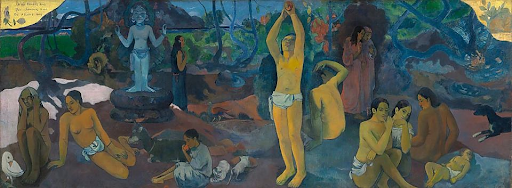
Where Do We Come From? What Are We? Where Are We Going?
Artist = Paul Gauguin
Period/Style = Post-Impressionist (1897-97)
Material = Oil on Canvas
Represents the cycle of life- starts on the right with an infant, then follows along to younger women (birth to death and afterlife)
Boy in the middle- picking an apple from a tree (Adam and Eve) (Destruction of innocence through knowledge)
People who live in complete innocence are going to be corrupted by religion and the outside world
Interested in showing the world through his fevered imagination- not as it really is- strange and unusual use of color
Gauguin had the idea that these individuals were simple and any introduction to the Western world would destroy them- small-minded thinking
Shows an older woman on the far left contemplating her own mortality- a younger woman directly next to her with a similar expression
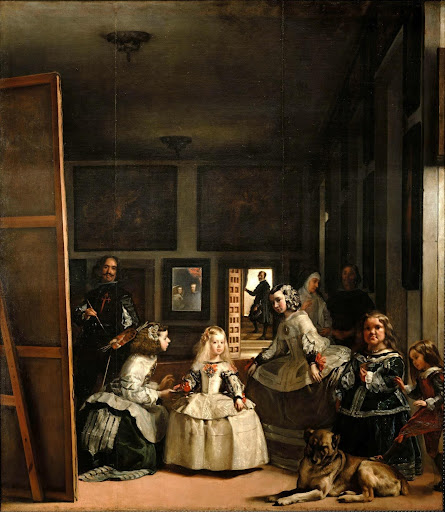
Las Meninas
Artist = Diego Velazquez
Style = Spanish Baroque
Medium = Oil on canvas
Date = 1656
The title translates to "girls of the court” or maids of honor
The girls of the court were other young women in charge of entertaining the princess
Dwarfism is represented in the woman and the boy on the right
Multiple people stop what they are doing to look toward the King and Queen, who just walked into the room and are on the other side of the painting (outside of view)
17th-century painting styles = fast brush strokes that blur once you look closer- meant to be viewed from a distance- catching something in the moment
Velázquez places himself within the painting- he paints us who are looking at him, or rather, those who are going to receive the painting: the royal couple, who are looking at him, reflected in the mirror in the background
Two guardians are conversing, and in the background, facing the door in a very elegant pose
All the figures appear preoccupied, either in discussion with one another, in deep reflection, or gazing at us, the viewers, with a quiet, almost unnerving, curiosity
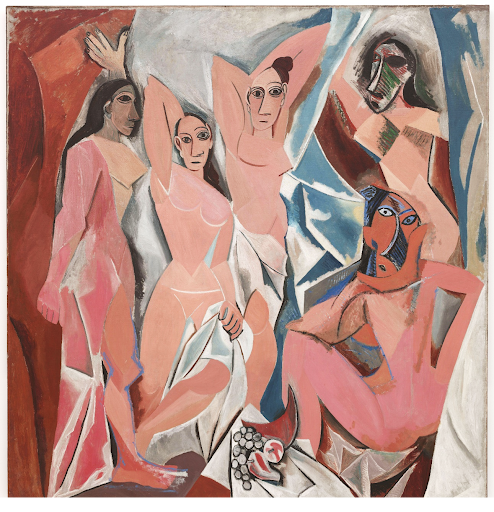
Les Demoiselles d’Avignon
Artist = Pablo Picasso
Style = Cubism
Medium = Oil on canvas
Date = 1907
Presents us with five nude women, four are standing, and one is sitting
The women are all looking directly at us, the viewers
Compression of time allows other elements to be seen from different angles. The woman on the left is shown in profile, and different angles reveal her with her robe on or off
Sitting woman = has her back facing us, but her face is looking toward the viewer
Shows a slight moment where she looks behind to see who walks in the room (turning around in space)
Two middle women = both wrapped in sheets
Shows that they are lying down in bed, despite being viewed as if they are standing up
Small still life shown at the bottom
Everything is happening all at once
Facial expressions and shapes were inspired by African mask art
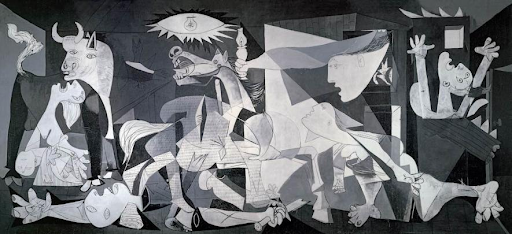
Guernica
Artist = Pablo Picasso
Style = Cubism
Medium = Oil on canvas
Date = 1937
Picasso painted this piece in response to a horrible event: the bombing of the Basque in an innocent town that the leader of Spain allowed to be destroyed by Germany (Under Hitler)
Very anti-war and anti-fascist
Picasso wanted to paint what the aftermath of this bombing would look like- the destruction of lives, history, and complete chaos
Bull = symbol of Spain and war (both the aggressor and the victim)
Compression of time = the sun and the moon in one piece- primitive forms of light (torch) and modern (lightbulb)
Soldier holding a broken sword and a flower (war and peace)
To the right, a woman is seen wailing as she holds what appears to be a lifeless child in her arms, an embodiment of loss and maternal grief
A horse collapses in anguish in the midst of the room, a massive gaping hole in its side as if it had been run through by a lance or spear
Picasso utilizes black, white, and gray colors to establish a mournful mood and convey distress and chaos
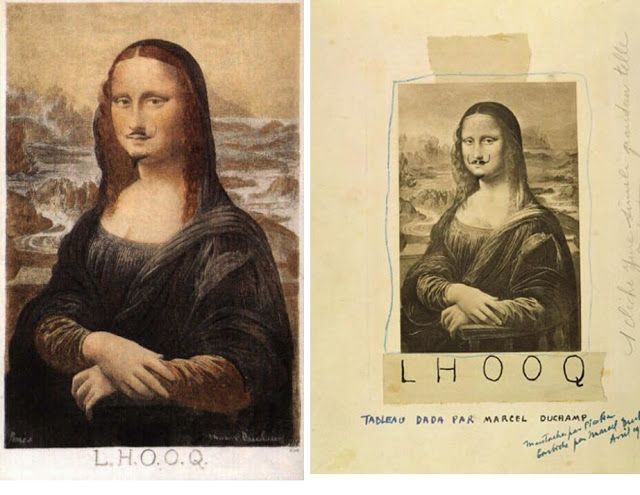
L.H.O.O.Q
Artist = Marcel Duchamp
Style = DaDa
Medium = Ready-made (painting on top of another painting)
Date = 1940 replica of 1919 original
Title = French saying for “she has a nice ass”
Dada and Duchamp didn’t believe in the talent of artists- the point was to essentially “throw a pie at everything” or make fun of famous art pieces
Form of Neoclassicism
Rebelling against anything that came before art
The artwork features a reproduction of Leonardo da Vinci’s famous “Mona Lisa,” to which Duchamp has provocatively added a moustache and goatee. This intervention transforms the iconic portrait into a playful and irreverent commentary.
Duchamp’s choice of a ready-made image and his modest modifications underscore his revolutionary approach to art-making, emphasizing the conceptual over the purely aesthetic
 Note
Note  Flashcards (20)