Cardiovascular system

0.0(0)
Studied by 0 people
call kaiCall Kai
learnLearn
examPractice Test
spaced repetitionSpaced Repetition
heart puzzleMatch
flashcardsFlashcards
GameKnowt Play
Card Sorting

1/44

encourage image

There's no tags or description

Looks like no tags are added yet.

Last updated 5:29 PM on 3/31/26
Name
Mastery
Learn
Test
Matching
Spaced
Call with Kai

No analytics yet

Send a link to your students to track their progress

45 Terms

1
New cards

What is the cardiovascular system? What are the three basic circuits?

Consists of blood pumped by the heart through the blood vessels to the body

Three basic circuits (closed loops)

  • Pulmonary circuit

    • Dumps waste CO2 from blood into lungs for expulsion, enriches red blood cells with O2

  • Systemic circuit

    • pumps O2-enriched blood to body, then brings it back to the heart for rerouting to pulmonary circuit

  • Coronary circuit brings blood to heart tissue

2
New cards

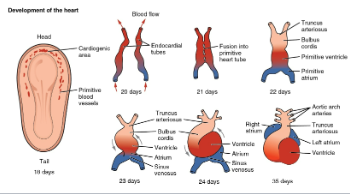
How is the heart developed during weeks 3-4?

  • Myocardium – mesoderm

  • week 3-4

    • embryo too large for diffusion of nutrients

    • Heart has to start working before it completes development

    • Two endocardial tubes fuse by day 21

    • beating ~ day 22

    • Differentiates in 5 distinct regions

    • Bending/folding

  • Sinus venosus

    • Superior vena cava

    • Coronary sinus

    • Portion of right atrium

  • Truncus arteriosus

    • Ascending aorta

    • Pulmonary trunk

<ul><li><p><strong>Myocardium – mesoderm</strong></p></li><li><p>week 3-4</p><ul><li><p>embryo too large for diffusion of nutrients</p></li><li><p>Heart has to start working before it completes development</p></li><li><p>Two <strong>endocardial tubes </strong>fuse by day 21</p></li><li><p>beating ~ day 22</p></li><li><p>Differentiates in 5 distinct regions</p></li><li><p>Bending/folding</p></li></ul></li><li><p>Sinus venosus</p><ul><li><p>Superior vena cava</p></li><li><p>Coronary sinus</p></li><li><p>Portion of right atrium</p></li></ul></li><li><p>Truncus arteriosus</p><ul><li><p>Ascending aorta</p></li><li><p>Pulmonary trunk</p></li></ul></li></ul><p></p>
3
New cards

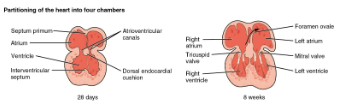
How is the heart developed during weeks 4-8?

  • Partitioning – divided into 4 chambers and great vessels form

  • Atrium

    • Interatrial septum (septum primum and septum secundum)

      • S. primum = one-way valve

      • opening = foramen ovale

    • Connect to endocardial cushion

  • Ventricle

    • Wall grows superiorly

    • AV valves, papillary muscles and chordae tendinae form from wall as well
<ul><li><p><strong>Partitioning </strong>– divided into 4 chambers and great vessels form</p></li><li><p><strong>Atrium</strong></p><ul><li><p>Interatrial septum (septum primum and septum secundum)</p><ul><li><p>S. primum = one-way valve</p></li><li><p>opening = <strong>foramen ovale</strong></p></li></ul></li><li><p>Connect to <strong>endocardial cushion</strong></p></li></ul></li><li><p><strong>Ventricle</strong></p><ul><li><p>Wall grows superiorly</p></li><li><p>AV valves, papillary muscles and chordae tendinae form from wall as well</p></li></ul></li></ul><p></p>
4
New cards

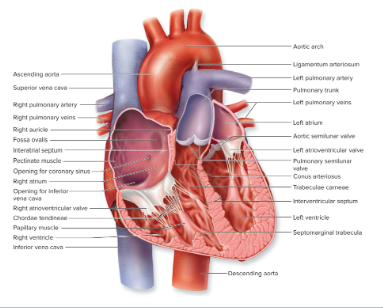
What is the internal heart anatomy?

knowt flashcard image
5
New cards

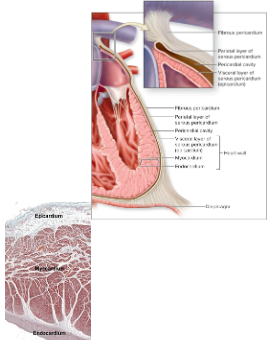
What is the serous membrane of the heart? What tissues are part of the heart wall?

  • Serous membrane = Pericardium

    • double lining of pericardial cavity

    • Visceral pericardium = epicardium

    • Parietal pericardium

    • Pericardial fluid

  • Heart wall

    • Epicardium

      • Visceral pericardium = SSE + loose CT + adipocytes

    • Myocardium - thickest

      • Cardiac muscle

    • Endocardium

      • SSE + loose CT

<ul><li><p><strong>Serous membrane = Pericardium</strong></p><ul><li><p>double lining of pericardial cavity</p></li><li><p><strong>Visceral pericardium = epicardium</strong></p></li><li><p><strong>Parietal pericardium</strong></p></li><li><p><strong>Pericardial fluid</strong></p></li></ul></li><li><p><strong>Heart wall</strong></p><ul><li><p><strong>Epicardium</strong></p><ul><li><p>Visceral pericardium = SSE + loose CT + adipocytes</p></li></ul></li><li><p><strong>Myocardium - thickest</strong></p><ul><li><p>Cardiac muscle</p></li></ul></li><li><p><strong>Endocardium</strong></p><ul><li><p>SSE + loose CT</p></li></ul></li></ul></li></ul><p></p>
6
New cards
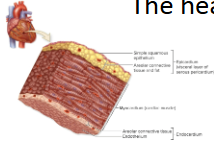
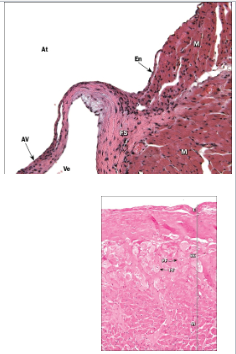
<p>What is the layers of the heart wall?</p>

What is the layers of the heart wall?

The layers of heart wall

  • Endocardium

    • Comparable to tunica interna

    • Endothelium plus a loose connective tissue

      • Folds inward to form valve flaps

  • Subendocardial layer

    • ventricles contain Purkinje fibers for contraction

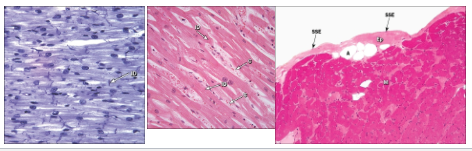
  • Myocardium—middle and thickest layer, cardiac muscle cells, similar to tunica media

  • Epicardium—on outer surface of heart

    • Visceral pericardium

      • Simple squamous mesothelium with underlying fibrous connective tissue

      • Layer in which coronary vessels travel
<p>The layers of heart wall</p><ul><li><p><strong>Endocardium</strong></p><ul><li><p>Comparable to tunica interna</p></li><li><p>Endothelium plus a loose connective tissue</p><ul><li><p>Folds inward to form valve flaps</p></li></ul></li></ul></li><li><p><strong>Subendocardial layer</strong></p><ul><li><p>ventricles contain Purkinje fibers for contraction</p></li></ul></li><li><p><strong>Myocardium</strong>—middle and thickest layer, cardiac muscle cells, similar to tunica media</p></li><li><p><strong>Epicardium</strong>—on outer surface of heart</p><ul><li><p>Visceral pericardium</p><ul><li><p>Simple squamous mesothelium with underlying fibrous connective tissue</p></li><li><p>Layer in which coronary vessels travel</p></li></ul></li></ul></li></ul><p></p>
7
New cards

What does the myocardium and epicardium look like under microscope?
knowt flashcard image
8
New cards

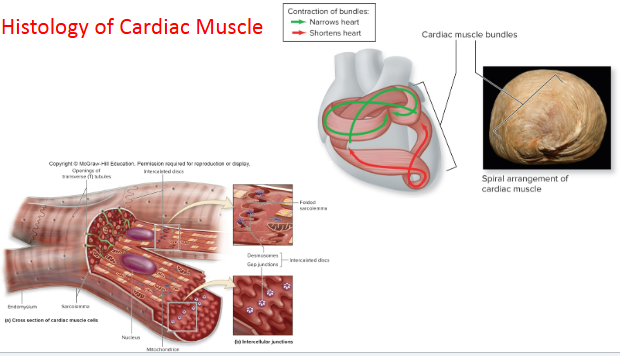
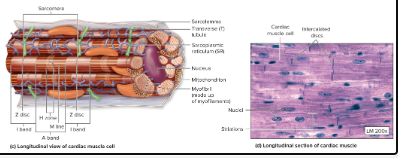
Histology of cardiac muscle images

knowt flashcard image
9
New cards
<p>What is the histology of cardiac muscle?</p>

What is the histology of cardiac muscle?

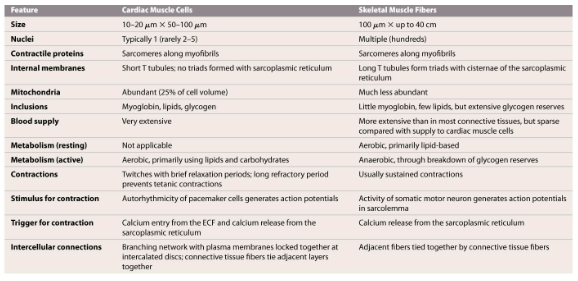
  • Similar to skeletal muscle fiber structure with some notable differences:

    • Cells short and branched

    • 1-2 central nuclei

    • Intercellular connections = intercalated discs

    • T-tubule overlies z-disc

    • Increased mitochondria

    • Less sarcoplasmic reticulum

    • No terminal cisternae

10
New cards

What are the structural and functional differences between cardiac muscle cells and skeletal muscle fibers?
knowt flashcard image
11
New cards

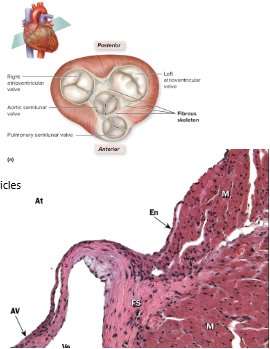
What is the cardiac skeleton?

  • Made of up dense connective tissue

  • Separates atria from ventricles

  • Also found at bases of pulmonary trunk and aorta

    • Provides attachment site for cardiac muscle

    • Prevents transmission of impulses from atria to ventricles

      • EXCEPT via the AV node

<ul><li><p>Made of up dense connective tissue</p></li><li><p>Separates atria from ventricles</p></li><li><p>Also found at bases of pulmonary trunk and aorta</p><ul><li><p>Provides attachment site for cardiac muscle</p></li><li><p>Prevents transmission of impulses from atria to ventricles</p><ul><li><p>EXCEPT via the AV node</p></li></ul></li></ul></li></ul><p></p>
12
New cards

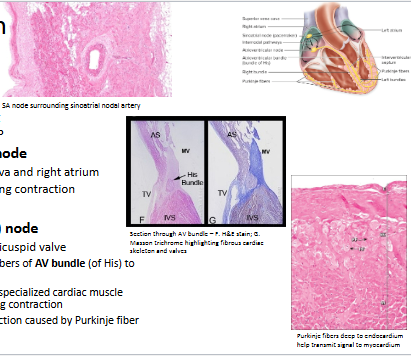
How does the heart contract?

  • Conducting system

    • Modified myocardiocytes

    • More slender and pale staining

    • Can generate and propagate AP

  • Regulated by sinoatrial (SA) node

    • At junction of superior vena cava and right atrium

    • Spreads signal over atria, causing contraction

  • Reaches atrioventricular (AV) node

    • Located in myocardium near tricuspid valve

      • Sends signal via conducting fibers of AV bundle (of His) to heart’s apex

      • Signal spreads upward along specialized cardiac muscle fibers (Purkinje fibers) causing contraction

      • Premature ventricular contraction caused by Purkinje fiber action potential
<ul><li><p><strong>Conducting system</strong></p><ul><li><p>Modified myocardiocytes</p></li><li><p>More slender and pale staining</p></li><li><p>Can generate and propagate AP</p></li></ul></li><li><p>Regulated by<strong> sinoatrial (SA) node</strong></p><ul><li><p>At junction of superior vena cava and right atrium</p></li><li><p>Spreads signal over atria, causing contraction</p></li></ul></li><li><p>Reaches <strong>atrioventricular (AV) node</strong></p><ul><li><p>Located in myocardium near tricuspid valve</p><ul><li><p>Sends signal via conducting fibers of <strong>AV bundle</strong> (of His) to heart’s apex</p></li><li><p>Signal spreads upward along specialized cardiac muscle fibers (<strong>Purkinje fibers</strong>) causing contraction</p></li><li><p>Premature ventricular contraction caused by Purkinje fiber action potential</p></li></ul></li></ul></li></ul><p></p>
13
New cards

What is blood?

  • Specialized connective tissue with cells/formed elements (noncellular) dispersed in extracellular fluid (plasma)

    • Functions as a transport medium for gases, nutrients, and wastes

    • Involved in transporting defenses to needed sites

    • Distributes heat and hormones through the body

14
New cards

What are the formed elements of blood?

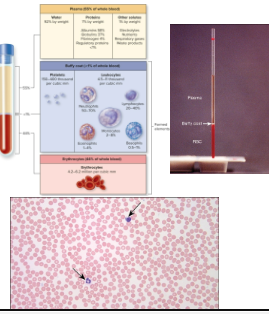
  • Hematocrit (packed cell volume)

    • Liquid = plasma

  • Formed elements portion is 45%

    • Erythrocytes (red blood cells, or RBCs)

      • 4.2–5.4 million/4.7–6.1 million per μl of blood (females/males, respectively)

    • Leukocytes (white blood cells or WBCs)

      • 4,800–10,800 per μl of blood

    • Platelets

      • Between 150,000–350,000 per μl of blood

  • Plasma portion is 55%

  • Clotted blood

    • Liquid = serum = plasma w/out clotting elements
<ul><li><p><strong>Hematocrit </strong>(packed cell volume)</p><ul><li><p>Liquid = plasma</p></li></ul></li><li><p>Formed elements portion is 45%</p><ul><li><p>Erythrocytes (red blood cells, or RBCs)</p><ul><li><p>4.2–5.4 million/4.7–6.1 million per μl of blood (females/males, respectively)</p></li></ul></li><li><p>Leukocytes (white blood cells or WBCs)</p><ul><li><p>4,800–10,800 per μl of blood</p></li></ul></li><li><p>Platelets</p><ul><li><p>Between 150,000–350,000 per μl of blood</p></li></ul></li></ul></li><li><p>Plasma portion is 55%</p></li><li><p><strong>Clotted blood</strong></p><ul><li><p>Liquid = serum = plasma w/out clotting elements</p></li></ul></li></ul><p></p>
15
New cards

What are erythrocytes?

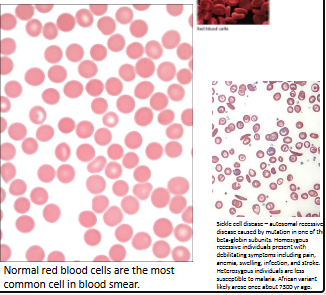
  • Biconcave disc-shaped cells

  • 7–8 μm wide, 2.5 μm thick

  • Develop from cells in bone marrow

    • Lose organelles along the way

    • Mainly contain oxygen-carrying hemoglobin

    • Active enzymes

    • E.g. carbonic anhydrase, glycolytic pathway
<ul><li><p>Biconcave disc-shaped cells</p></li><li><p>7–8 μm wide, 2.5 μm thick</p></li><li><p>Develop from cells in bone marrow</p><ul><li><p><strong>Lose organelles </strong>along the way</p></li><li><p>Mainly contain oxygen-carrying <strong>hemoglobin</strong></p></li><li><p>Active enzymes</p></li><li><p>E.g.<strong> carbonic anhydrase</strong>, glycolytic pathway</p></li></ul></li></ul><p></p>
16
New cards

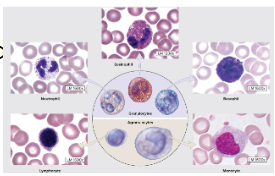
What are leukocytes?

  • Larger than RBCs, nucleated

  • Divided into two major groups

    • granulocytes

      • prominent cytoplasmic granules, possible multilobed nuclei

      • Neutrophils

      • Eosinophils

      • Basophils

    • agranulocytes

      • unlobed nuclei, small and less prominent granules in cytoplasm

      • Lymphocytes

      • Monocytes

<ul><li><p>Larger than RBCs, nucleated</p></li><li><p>Divided into two major groups</p><ul><li><p><strong>granulocytes</strong></p><ul><li><p><strong>prominent cytoplasmic granules, possible multilobed nuclei</strong></p></li><li><p><strong>Neutrophils</strong></p></li><li><p><strong>Eosinophils</strong></p></li><li><p><strong>Basophils</strong></p></li></ul></li><li><p><strong>agranulocytes</strong></p><ul><li><p><strong>unlobed nuclei, </strong>small and less prominent granules in cytoplasm</p></li><li><p><strong>Lymphocytes</strong></p></li><li><p><strong>Monocytes</strong></p></li></ul></li></ul></li></ul><p></p>
17
New cards

What are neutrophils?

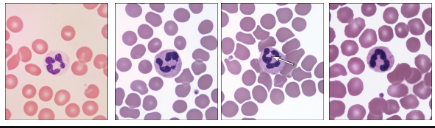
  • Granulocytes—neutrophils

    • Most abundant leukocytes (60–70% of total)

    • Slightly larger than RBCs

    • Multilobed nucleus

    • Small unstained or slightly lavender granules upon staining with Wright’s or Giemsa stains

    • Functionally short-lived phagocytic cells
<ul><li><p>Granulocytes—<strong>neutrophils</strong></p><ul><li><p>Most abundant leukocytes (60–70% of total)</p></li><li><p>Slightly larger than RBCs</p></li><li><p>Multilobed nucleus</p></li><li><p>Small unstained or slightly lavender granules upon staining with Wright’s or Giemsa stains</p></li><li><p>Functionally short-lived phagocytic cells</p></li></ul></li></ul><p></p>
18
New cards

What are eosinophils?

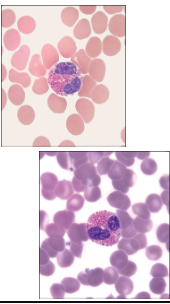
  • Granulocytes—eosinophils

    • Constitute fewer than 5% of total leukocytes

    • Larger than neutrophils

    • Bilobed nucleus

    • Cytoplasmic granules more pronounced and often stain reddish

    • Active in combating parasite infections, phagocytosing antigen- antibody complexes, and tempering allergic reactions
<ul><li><p>Granulocytes—<strong>eosinophils</strong></p><ul><li><p>Constitute fewer than 5% of total leukocytes</p></li><li><p>Larger than neutrophils</p></li><li><p>Bilobed nucleus</p></li><li><p>Cytoplasmic granules more pronounced and often stain reddish</p></li><li><p>Active in combating parasite infections, phagocytosing antigen- antibody complexes, and tempering allergic reactions</p></li></ul></li></ul><p></p>
19
New cards

What are basophils?

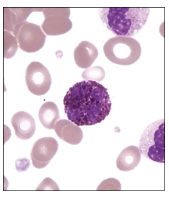
  • Granulocytes—basophils

    • Rare in blood (fewer than 1% of leukocytes)

    • Slightly larger than RBCs

    • Prominent dark-staining cytoplasmic granules

      • Often obscure the S-shaped nucleus

    • Involved in inflammatory responses and hypersensitivity reactions

      • Similar to mast cells

<ul><li><p>Granulocytes—<strong>basophils</strong></p><ul><li><p>Rare in blood (fewer than 1% of leukocytes)</p></li><li><p>Slightly larger than RBCs</p></li><li><p>Prominent<strong> dark-staining cytoplasmic granules</strong></p><ul><li><p>Often obscure the S-shaped nucleus</p></li></ul></li><li><p><strong>Involved in inflammatory responses and hypersensitivity reactions</strong></p><ul><li><p>Similar to mast cells</p></li></ul></li></ul></li></ul><p></p>
20
New cards

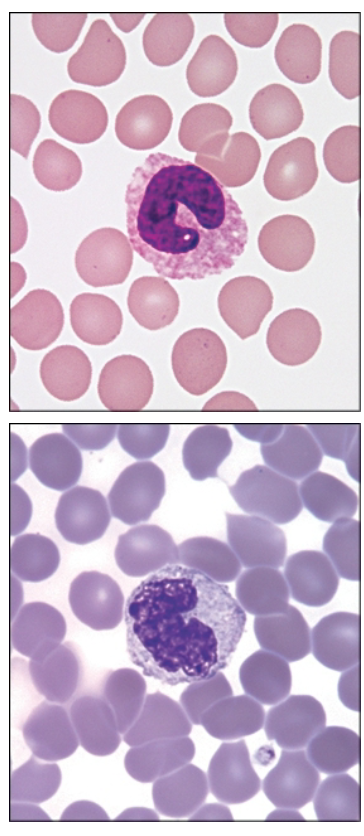
What are monocytes?

Agranulocytes—monocytes

  • 3–8% of all blood leukocytes

  • Roughly two times the size of RBCs

  • Bluish-gray cytoplasm in most stains with an indented/irregular nucleus shape

  • Blood form of tissue macrophages

  • Can be phagocytic and antigen-presenting cells for induction of immune responses
<p>Agranulocytes—<strong>monocytes</strong></p><ul><li><p>3–8% of all blood leukocytes</p></li><li><p>Roughly two times the size of RBCs</p></li><li><p>Bluish-gray cytoplasm in most stains with an indented/irregular nucleus shape</p></li><li><p>Blood form of tissue macrophages</p></li><li><p>Can be phagocytic and antigen-presenting cells for induction of immune responses</p></li></ul><p></p>
21
New cards

What are lymphocytes?

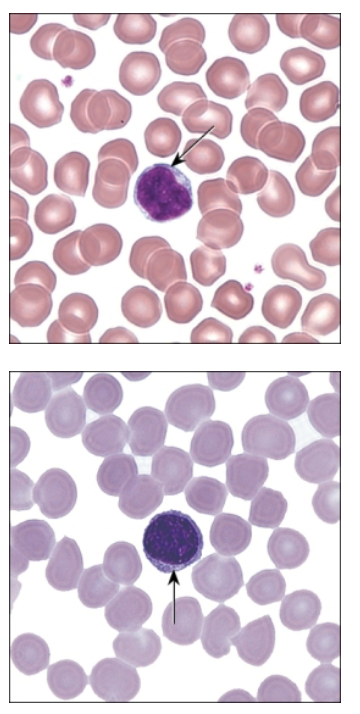
Agranulocytes—lymphocytes

  • 20–25% of total blood leukocytes

  • Slightly larger than RBCs

  • Round nucleus that fills most of cell

    • Tiny ring/crescent of cytoplasm visible

  • Following development enter lymph and establish clones

  • Respond to antigens

<p>Agranulocytes—lymphocytes</p><ul><li><p>20–25% of total blood leukocytes</p></li><li><p>Slightly larger than RBCs</p></li><li><p>Round nucleus that fills most of cell</p><ul><li><p>Tiny ring/crescent of cytoplasm visible</p></li></ul></li><li><p>Following development enter lymph and establish clones</p></li><li><p>Respond to antigens</p></li></ul><p></p>
22
New cards

What are the three functionally distinct subsets of lymphocytes?

  • Three functionally distinct subsets

    • Morphologically indistinguishable!

    • B cells—differentiate into antibody-secreting plasma cells in response to antigens,

      • Bone marrow derived

    • T cells—helper, suppressor, memory, and cytotoxic;

      • Migrate to and mature in Thymus

      • Cell mediated immunity

    • Natural Killer cells—lack membrane markers of B/T cells; “null cells”

      • kill cells missing “self” marker MHC class 1; tumor suppression

  • Lymphomas = cancer of lymphocytes

23
New cards

What are platelets?

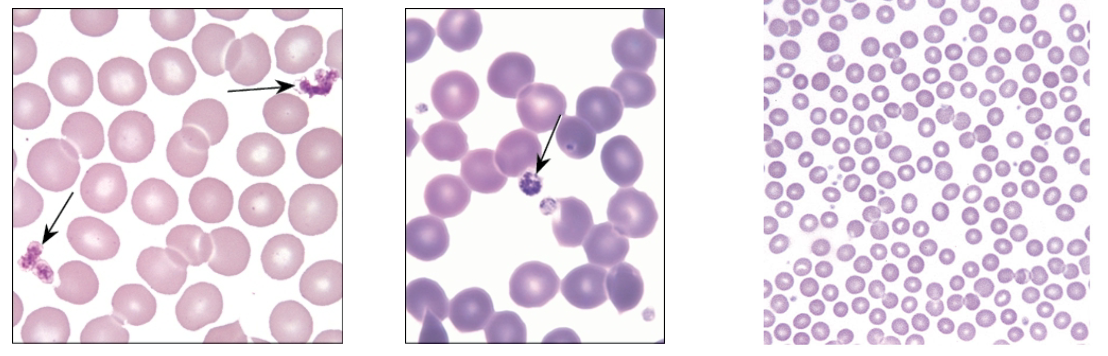
  • Not actually cells—cell fragments

  • Derived from megakaryocytes resident in bone marrow

  • Involved in clotting processes

<ul><li><p>Not actually cells—cell fragments</p></li><li><p>Derived from <strong>megakaryocytes</strong> resident in bone marrow</p></li><li><p>Involved in clotting processes</p></li></ul><p></p>
24
New cards
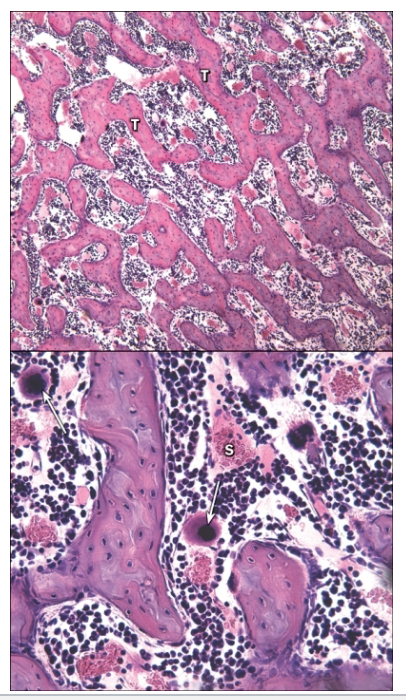
<p>What is the composition of bone marrow?</p>

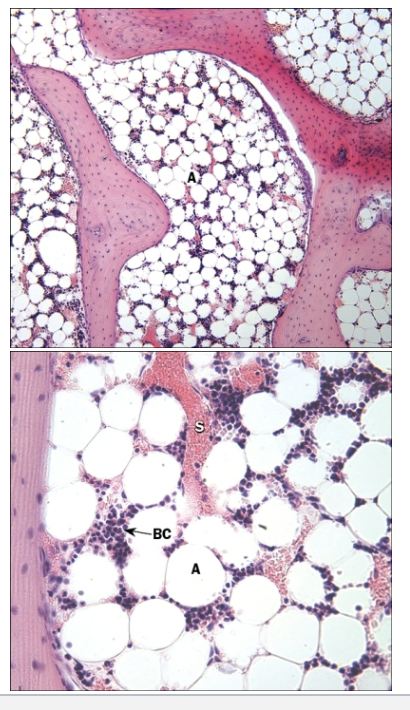
What is the composition of bone marrow?

  • In marrow cavity of long bones, between spongy bone trabeculae

    • Highly vascular; numerous blood sinusoids

      • Framework of reticular fibers; cells of various types

      • Shifts with age from red to yellow bone marrow

    • Responsible for blood cell formation (hemopoiesis)
<ul><li><p>In marrow cavity of long bones, between spongy bone trabeculae</p><ul><li><p>Highly vascular; numerous blood sinusoids</p><ul><li><p>Framework of reticular fibers; cells of various types</p></li><li><p>Shifts with age from red to yellow bone marrow</p></li></ul></li><li><p>Responsible for blood cell formation (hemopoiesis)</p></li></ul></li></ul><p></p>
25
New cards

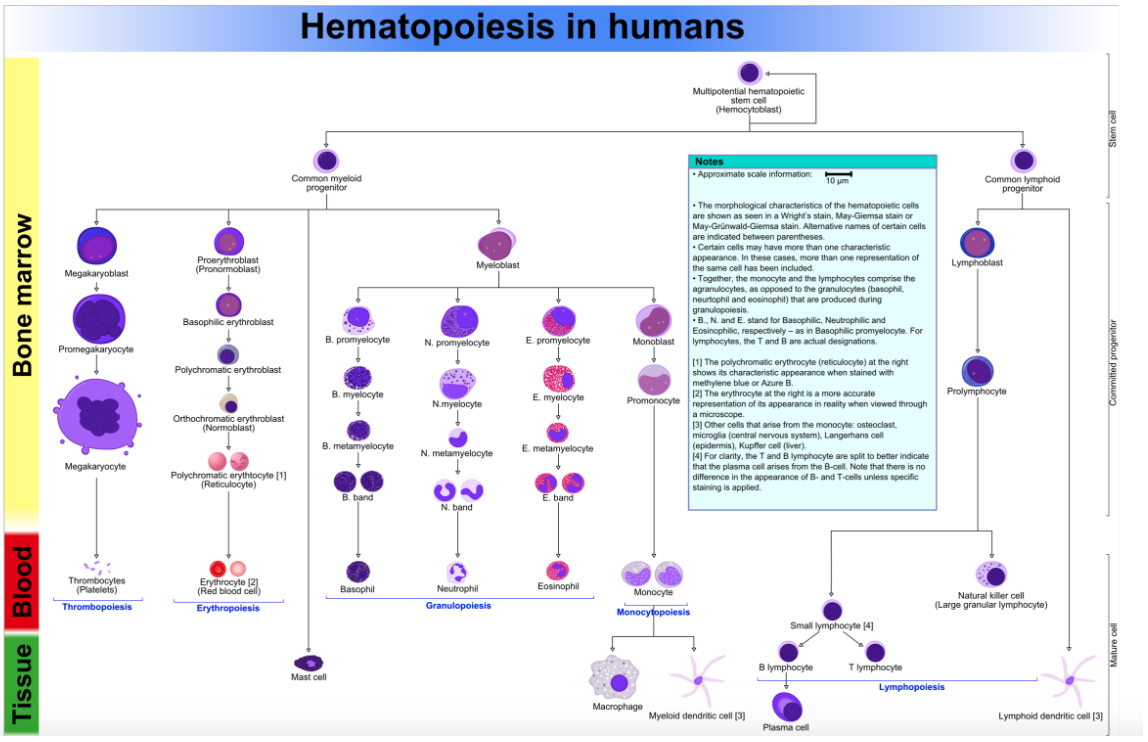
What do pluripotent stem cells in the bone marrow produce?

  • Hemopoiesis is complex

    • Basic scheme

      • Pluripotent stem cells in bone marrow produce two basic types of stem cells

        • Myeloid stem cells

          • eventually produce erythrocytes, megakaryocytes, granulocytes, and monocytes

        • Lymphoid stem cells

          • eventually produce the various subsets of lymphocytes

      • Each stem cell type gives rise to progenitor cells that gradually become more and more differentiated into each cell type under different control cues
<ul><li><p>Hemopoiesis is complex</p><ul><li><p>Basic scheme</p><ul><li><p>Pluripotent stem cells in bone marrow produce two basic types of stem cells</p><ul><li><p><strong>Myeloid stem cells</strong></p><ul><li><p>eventually produce erythrocytes, megakaryocytes, granulocytes, and monocytes</p></li></ul></li><li><p><strong>Lymphoid stem cells</strong></p><ul><li><p>eventually produce the various subsets of lymphocytes</p></li></ul></li></ul></li><li><p>Each stem cell type gives rise to progenitor cells that gradually become more and more differentiated into each cell type under different control cues</p></li></ul></li></ul></li></ul><p></p>
26
New cards
<p>What is <strong>Granulopoiesis?</strong></p>

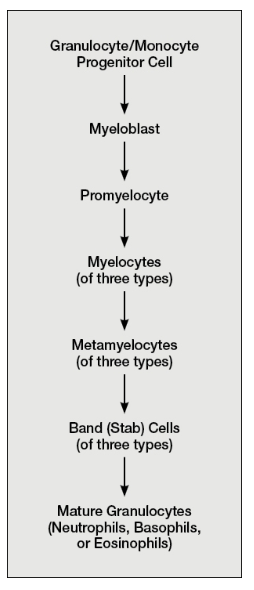
What is Granulopoiesis?

  • Granulopoiesis—production of granulocytes

    • Myeloblasts give rise to promyelocytes with nonspecific granules

    • Myelocytes have developed granules specific to a particular granulocyte subset

    • Metamyelocytes are smaller with an indented nucleus

    • Band (stab) cells are the last stage before they enter blood

    • Fully mature granulocytes

<ul><li><p><strong>Granulopoiesis</strong>—production of granulocytes</p><ul><li><p><strong>Myeloblasts</strong> give rise to <strong>promyelocytes</strong> with nonspecific granules</p></li><li><p><strong>Myelocytes</strong> have developed granules specific to a particular granulocyte subset</p></li><li><p><strong>Metamyelocytes</strong> are smaller with an indented nucleus</p></li><li><p>Band (stab) cells are the last stage before they enter blood</p></li><li><p>Fully mature granulocytes</p></li></ul></li></ul><p></p>
27
New cards
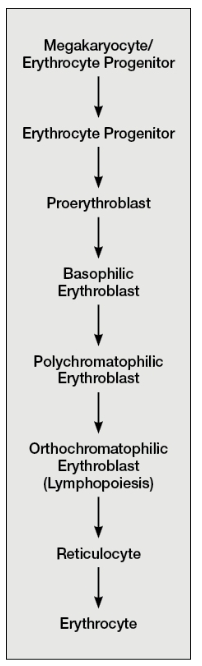
<p>What is <strong>Erythropoiesis?</strong></p>

What is Erythropoiesis?

  • Erythropoiesis—RBC development

    • Development goes through several stages

      • Each stage leads to progressive decrease in size, loss of organelles, and increase in hemoglobin

      • Nucleus is lost at reticulocyte stage

    • Process is estimated to produce 250 billion RBCs each day!
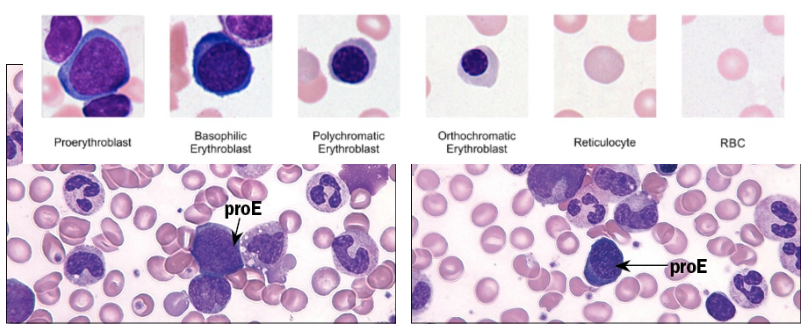
<ul><li><p>Erythropoiesis—RBC development</p><ul><li><p>Development goes through several stages</p><ul><li><p>Each stage leads to progressive decrease in size, loss of organelles, and increase in hemoglobin</p></li><li><p>Nucleus is lost at reticulocyte stage</p></li></ul></li><li><p>Process is estimated to produce 250 billion RBCs each day!</p></li></ul></li></ul><p></p>
28
New cards
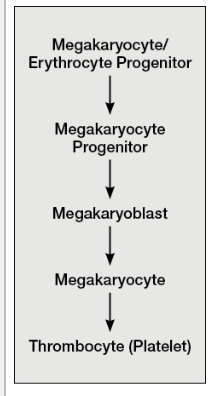
<p>What is <strong>Thrombopoiesis</strong>?</p>

What is Thrombopoiesis?

  • Thrombopoiesis—platelet production

    • Megakaryocytes arise in the bone marrow

      • Develop from megakaryoblasts

      • Large polyploid cells

      • Break off fragments of themselves to form platelets that leave bone marrow and enter periphery

      • Estimated production of 150 billion platelets per day!
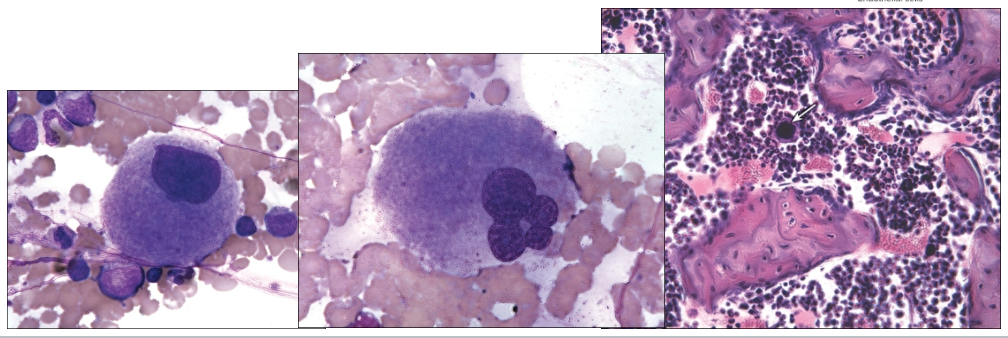
<ul><li><p>Thrombopoiesis—platelet production</p><ul><li><p>Megakaryocytes arise in the bone marrow</p><ul><li><p>Develop from megakaryoblasts</p></li><li><p>Large polyploid cells</p></li><li><p>Break off fragments of themselves to form platelets that leave bone marrow and enter periphery</p></li><li><p>Estimated production of 150 billion platelets per day!</p></li></ul></li></ul></li></ul><p></p>
29
New cards
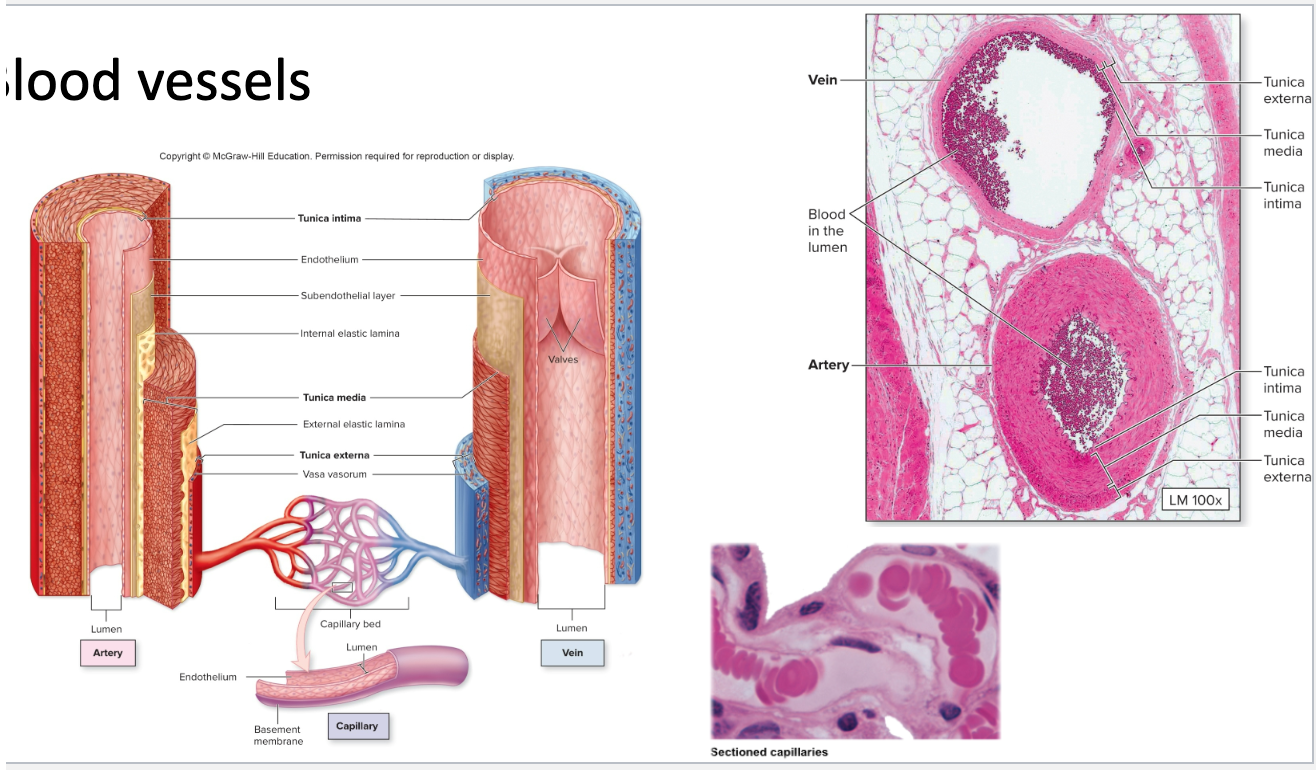
<p>What is the basic blood vessel structure?</p>

What is the basic blood vessel structure?

  • Share a common structure

  • Three layers

    • Innermost = tunica (intima) interna

      • Simple squamous endothelium

        • contain Weibel-Palade bodies

        • Store/release von Willebrand factor

          • Important in platelet adhesion

      • thin layer of connective tissue

      • Internal elastic lamina

    • Middle = tunica media

      • Varying amounts of smooth muscle

      • External elastic lamina

      • Sympathetic innervation

    • Outer = tunica (adventitia) externa

      • Dense irregular CT

      • Largest vessels may be penetrated by smaller vessels (vasa vasorum) to deliver oxygen to large vessel cells
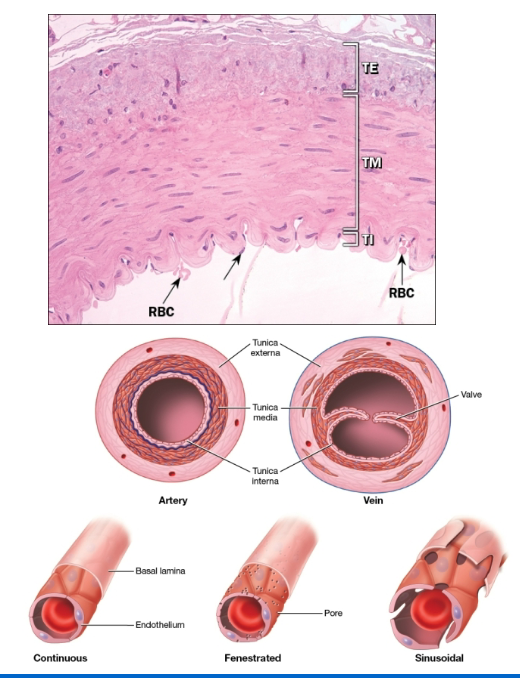
<ul><li><p>Share a common structure</p></li><li><p>Three layers</p><ul><li><p>Innermost = <strong>tunica (intima) interna</strong></p><ul><li><p>Simple squamous endothelium</p><ul><li><p>contain Weibel-Palade bodies</p></li><li><p>Store/release von Willebrand factor</p><ul><li><p>Important in platelet adhesion</p></li></ul></li></ul></li><li><p>thin layer of connective tissue</p></li><li><p>Internal elastic lamina</p></li></ul></li><li><p>Middle =<strong> tunica media</strong></p><ul><li><p>Varying amounts of smooth muscle</p></li><li><p>External elastic lamina</p></li><li><p>Sympathetic innervation</p></li></ul></li><li><p>Outer =<strong> tunica (adventitia) externa</strong></p><ul><li><p>Dense irregular CT</p></li><li><p>Largest vessels may be penetrated by smaller vessels (<strong>vasa vasorum</strong>) to deliver oxygen to large vessel cells</p></li></ul></li></ul></li></ul><p></p>
30
New cards

What are the types of blood vessels?

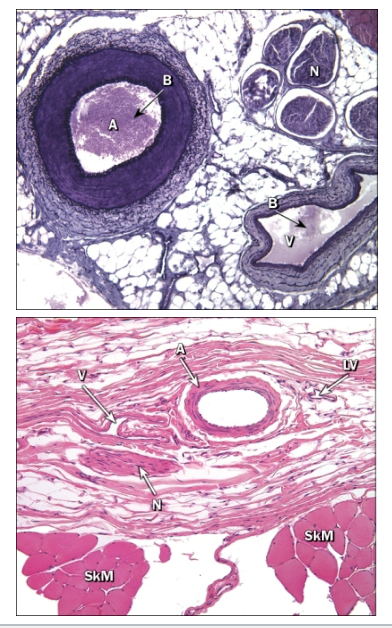
  • Arteries, veins, and nerves typically travel together to form a neurovascular bundle

  • Three main types

  • 1. Arteries

    • Elastic arteries

    • Muscular arteries

    • Arterioles

  • 2. Veins

    • Large veins

    • Medium veins

    • Venules

  • 3. Capillaries

    • Continuous

    • Fenestrated

    • Sinusoidal

<ul><li><p>Arteries, veins, and nerves typically travel together to form a neurovascular bundle</p></li><li><p>Three main types</p></li><li><p>1. Arteries</p><ul><li><p>Elastic arteries</p></li><li><p>Muscular arteries</p></li><li><p>Arterioles</p></li></ul></li><li><p>2. Veins</p><ul><li><p>Large veins</p></li><li><p>Medium veins</p></li><li><p>Venules</p></li></ul></li><li><p>3. Capillaries</p><ul><li><p>Continuous</p></li><li><p>Fenestrated</p></li><li><p>Sinusoidal</p></li></ul></li></ul><p></p>
31
New cards

What is the function of arteries?

  • Carry blood away from the heart at high pressure

    • Thicker walls than veins

    • Aorta and pulmonary trunk exit heart

    • Branch into smaller and smaller arteries

      • Eventually lead to capillaries of systemic and pulmonary circuits, respectively

        • Elastic tissue decreases/smooth muscle increases as arteries get smaller
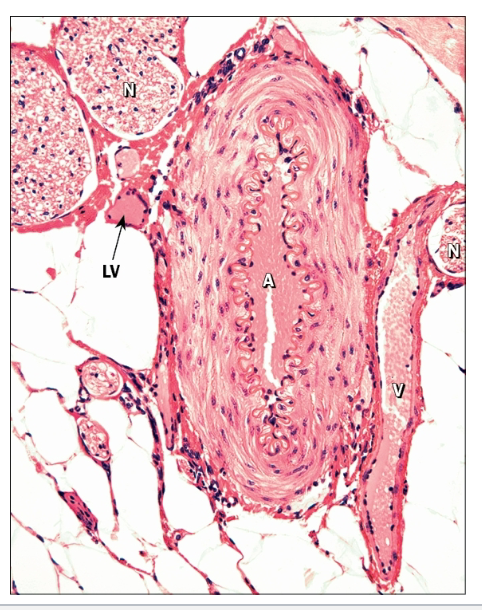
<ul><li><p>Carry blood away from the heart at high pressure</p><ul><li><p>Thicker walls than veins</p></li><li><p>Aorta and pulmonary trunk exit heart</p></li><li><p>Branch into smaller and smaller arteries</p><ul><li><p>Eventually lead to capillaries of systemic and pulmonary circuits, respectively</p><ul><li><p>Elastic tissue decreases/smooth muscle increases as arteries get smaller</p></li></ul></li></ul></li></ul></li></ul><p></p>
32
New cards
<p>What is the function of elastic arteries?</p>

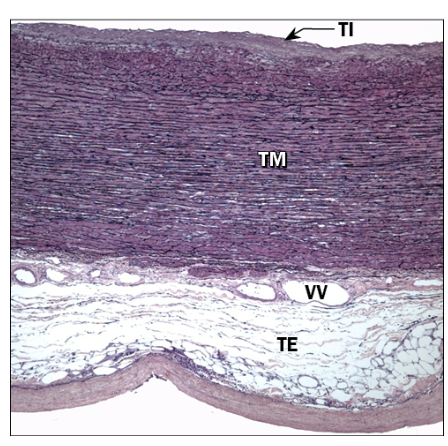
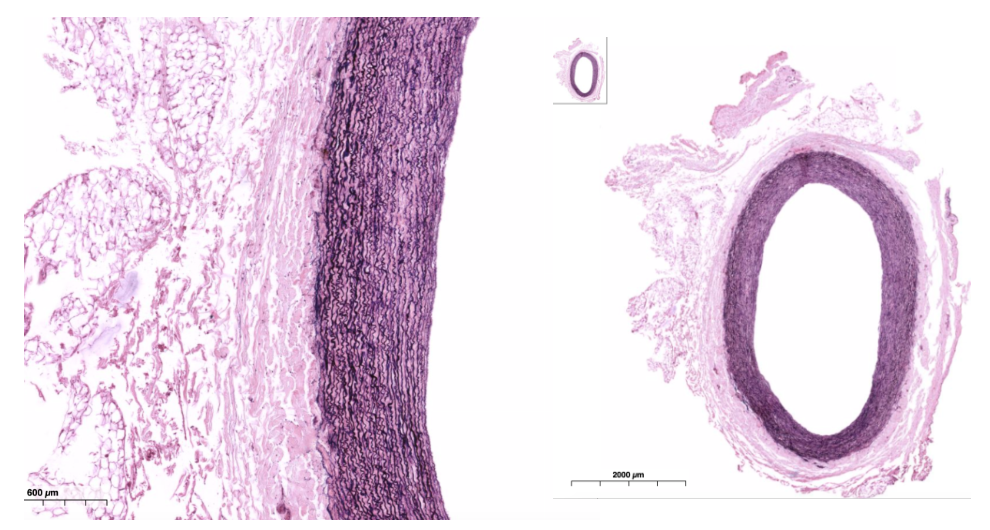
What is the function of elastic arteries?

  • Largest; include pulmonary trunk/aorta

    • Tunica media with fenestrated membranes (lamellae) elastic tissue

      • Alternates with smooth muscle

      • Internal and external elastic membranes also present

        • Allows walls to expand, then recoil to help push blood along

      • Very thin tunica externa, often with vasa vasorum
<ul><li><p>Largest; include pulmonary trunk/aorta</p><ul><li><p>Tunica media with fenestrated membranes (lamellae) elastic tissue</p><ul><li><p>Alternates with smooth muscle</p></li><li><p>Internal and external elastic membranes also present</p><ul><li><p>Allows walls to expand, then recoil to help push blood along</p></li></ul></li><li><p>Very thin tunica externa, often with vasa vasorum</p></li></ul></li></ul></li></ul><p></p>
33
New cards
<p>What are muscular arteries?</p>

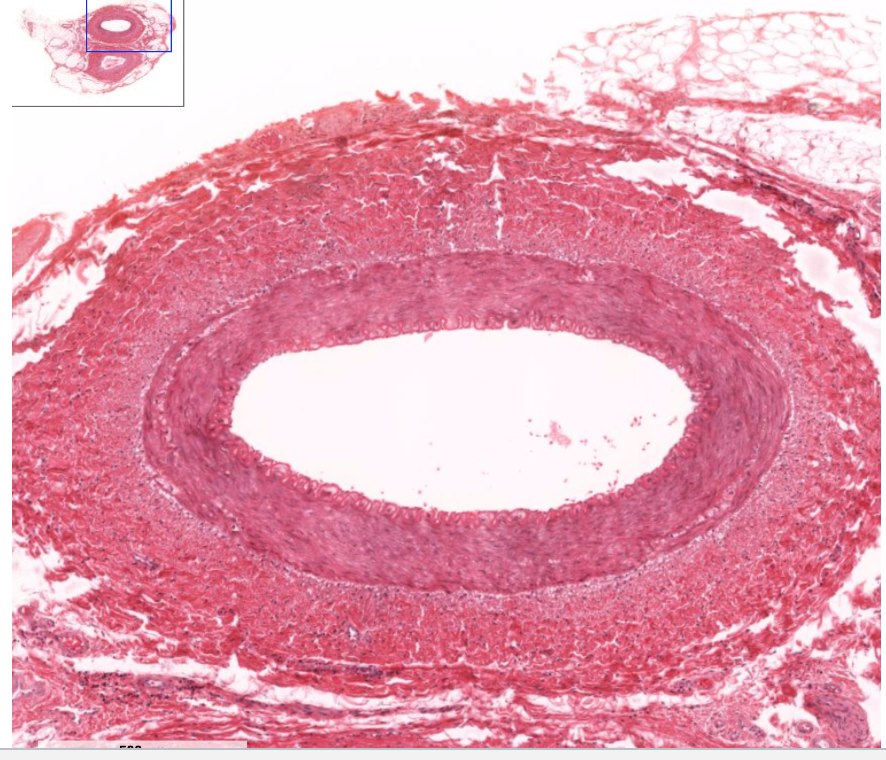
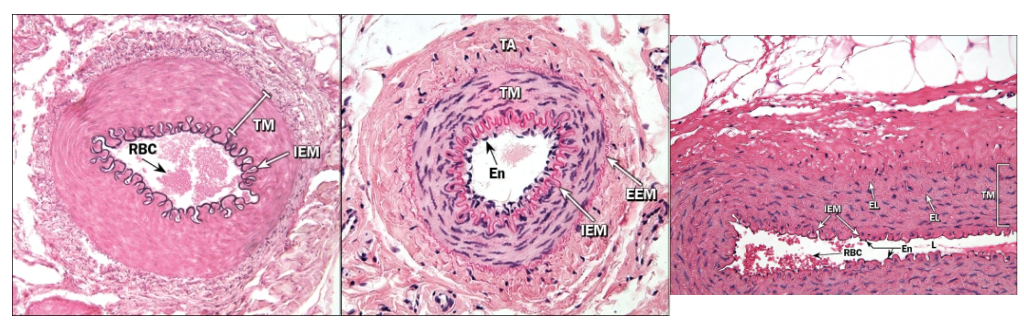
What are muscular arteries?

  • Larger than 0.5 mm in diameter

    • Wavy internal membrane

    • Up to 40 layers of smooth muscle in tunica media

    • Tunica externa has collagen/elastic fibers as well as smooth muscle fibers

Distinct fibers in the tunica intima
<ul><li><p>Larger than 0.5 mm in diameter</p><ul><li><p>Wavy internal membrane</p></li><li><p>Up to 40 layers of smooth muscle in tunica media</p></li><li><p>Tunica externa has collagen/elastic fibers as well as smooth muscle fibers</p></li></ul></li></ul><p>Distinct fibers in the tunica intima</p>
34
New cards
<p>What are arterioles? What connects arterioles to venules?</p>

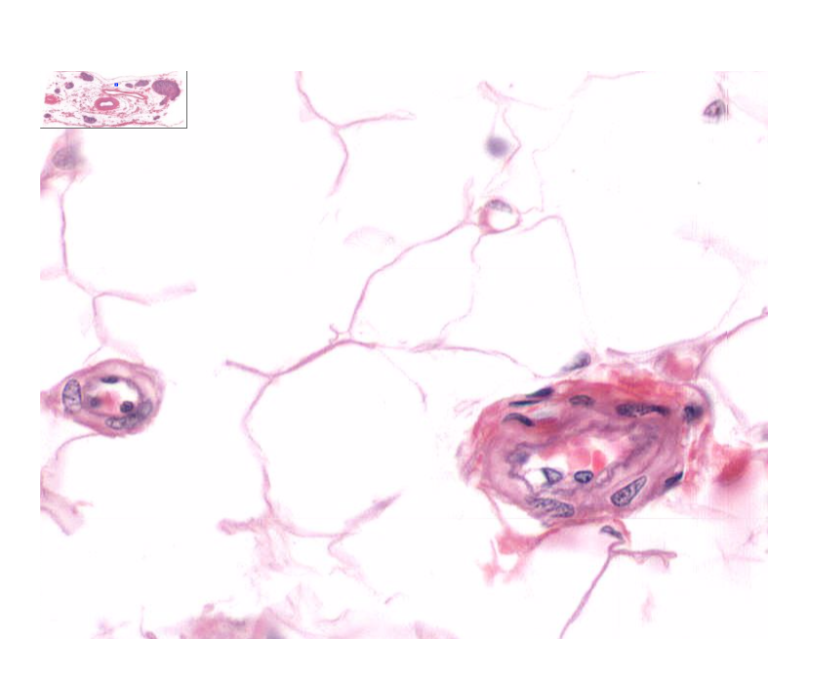
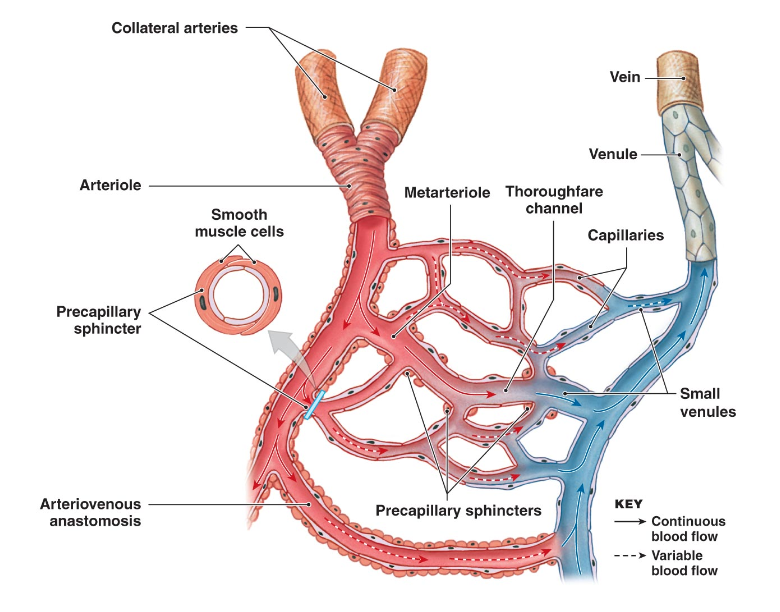
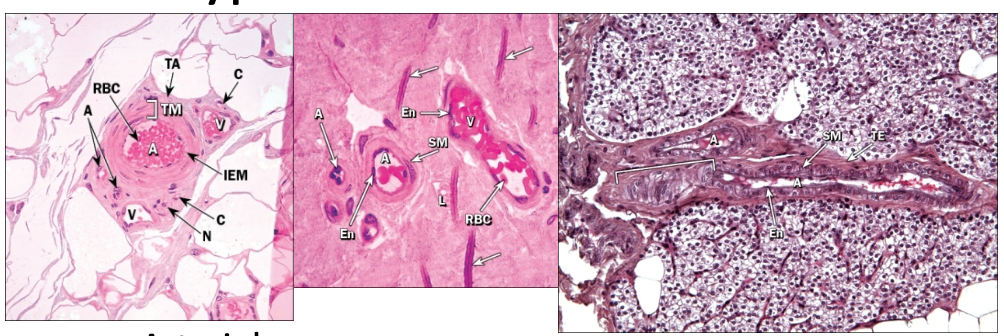
What are arterioles? What connects arterioles to venules?

  • Smallest arteries; 30–200 μm in diameter

    • Tunica media = one to a few layers of smooth muscle

    • Tunica externa roughly same size as tunica media

    • Blood flow into capillaries regulated by precapillary sphincters

      • Arteriovenous anastomosis directly connects arterioles to venules, allows bypass of capillary bed (can be used to regulate body temp
<ul><li><p>Smallest arteries; 30–200 μm in diameter</p><ul><li><p>Tunica media = one to a few layers of smooth muscle</p></li><li><p>Tunica externa roughly same size as tunica media</p></li><li><p>Blood flow into capillaries regulated by precapillary sphincters</p><ul><li><p>Arteriovenous anastomosis directly connects arterioles to venules, allows bypass of capillary bed (can be used to regulate body temp</p></li></ul></li></ul></li></ul><p></p>
35
New cards

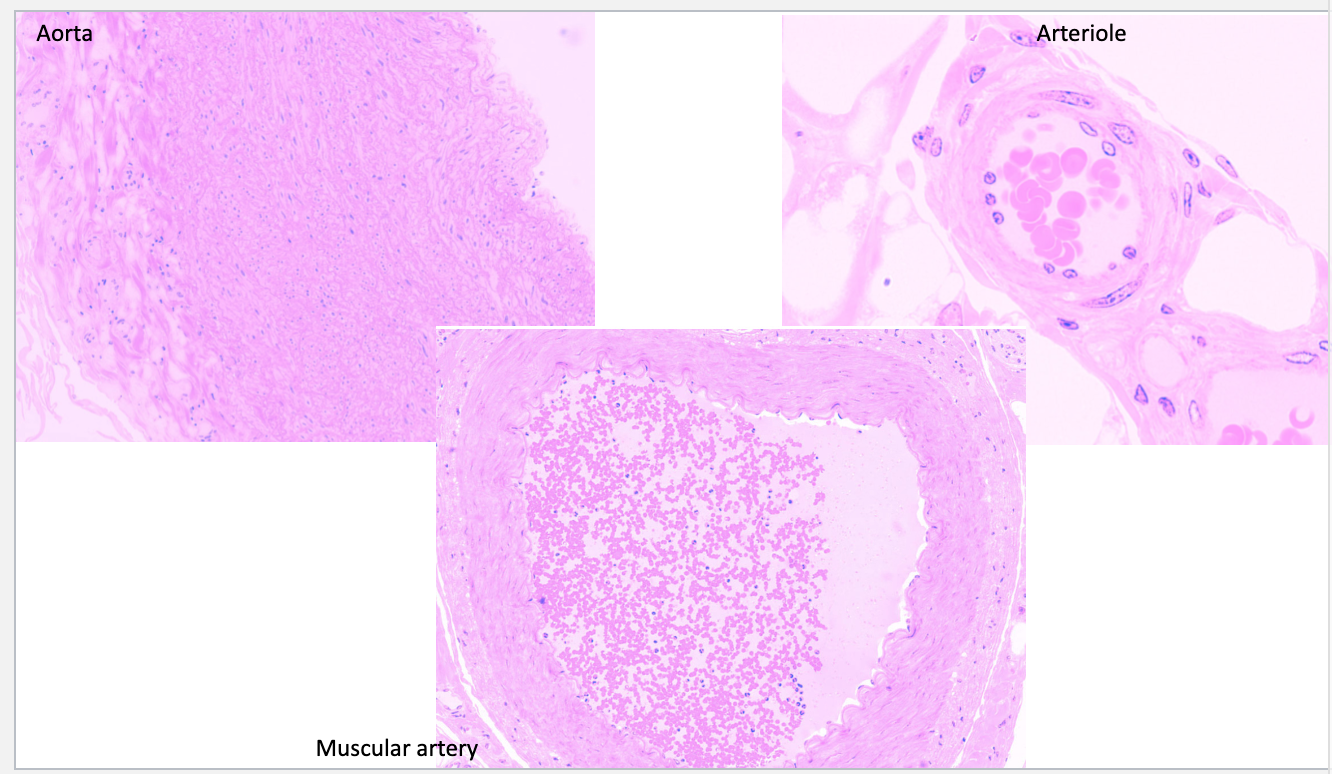
Aorta vs Muscular Artery vs Arteriole

Distinct fibers in the tunica intima
<p>Distinct fibers in the tunica intima</p>
36
New cards
<p>What are capillaries?</p>

What are capillaries?

  • Smallest blood vessels; 4–10 μm in diameter

    • Consist only of endothelium and basal lamina

    • Contractile pericytes may be present to regulate blood flow
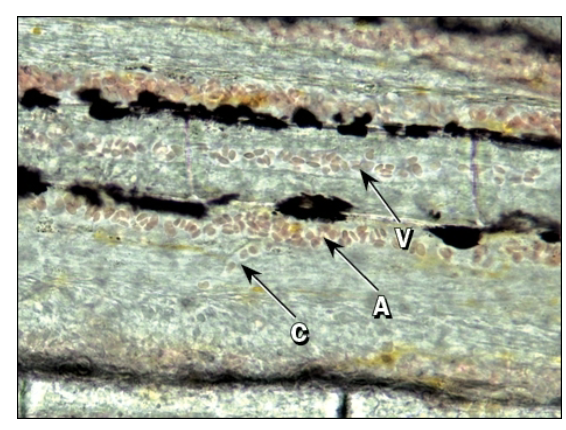
<ul><li><p>Smallest blood vessels; 4–10 μm in diameter</p><ul><li><p>Consist only of endothelium and basal lamina</p></li><li><p>Contractile pericytes may be present to regulate blood flow</p></li></ul></li></ul><p></p>
37
New cards
<p>What are the three types of capillaries?</p>

What are the three types of capillaries?

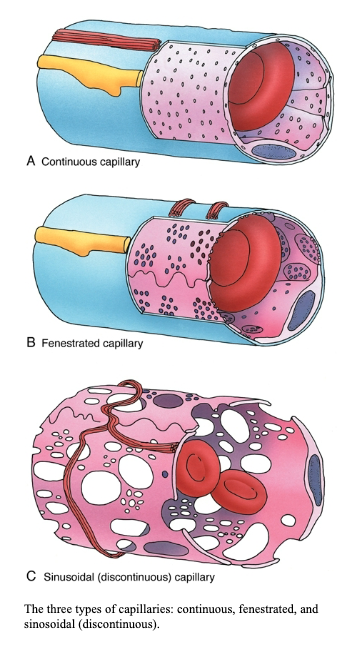
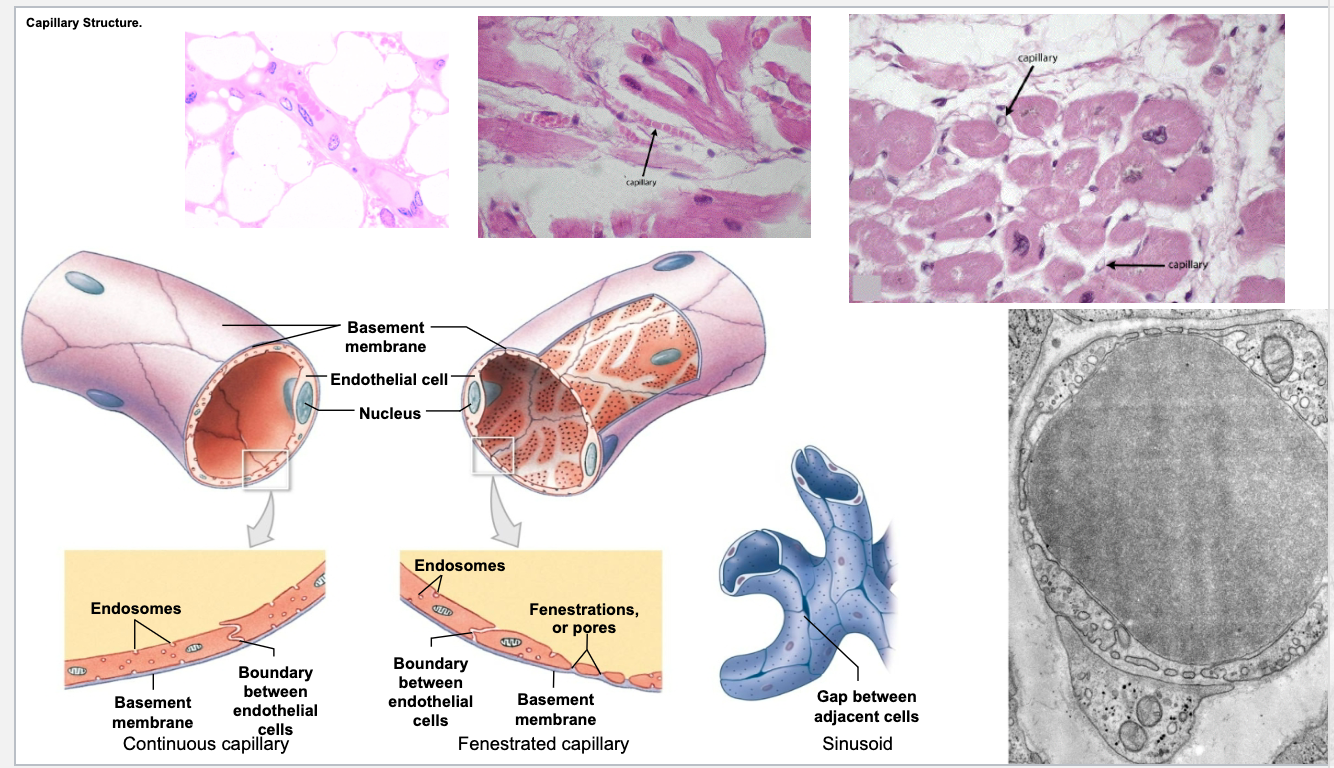
Capillaries are of three types:

  • continuous: muscle, nervous, connective tissues

    • modified continuous: brain tissue

  • fenestrated

  • sinusoidal

Continuous capillaries

  • The intercellular junctions between their endothelial cells are a type of fasciae occludentes, which prevent passage of many molecules. Substances such as amino acids, glucose, nucleosides, and purines move across the capillary wall via carrier-mediated transport. There is evidence that barrier regulation resides within the endothelial cells but is influenced by products formed by the astrocytes associated with the capillaries.

Fenestrated capillaries have pores (fenestrae) in their walls that are 60 to 80 nm in diameter and covered by a pore diaphragm. These capillaries are found in the pancreas, intestines, and endocrine glands.

The pores in fenestrated capillaries are bridged by a diaphragm. Anexception is the renal glomerulus, composed of fenestrated capillariesthat lack diaphragms.

Because of their location, sinusoidal capillaries have an enlarged diameter. They also contain many large fenestrae that lack diaphragms; the endothelial wall may be discontinuous, as is the basal lamina, permitting enhanced exchange between the blood and the tissues.

Sinusoids are lined by endothelium. Although the endothelial cells lack pinocytotic vesicles, macrophages may be located either in or along the outside of the endothelial wall.
<p>Capillaries are of three types:</p><ul><li><p>continuous: muscle, nervous, connective tissues</p><ul><li><p>modified continuous: brain tissue</p></li></ul></li><li><p>fenestrated</p></li><li><p>sinusoidal</p></li></ul><p>Continuous capillaries</p><ul><li><p>The intercellular junctions between their endothelial cells are a type of fasciae occludentes, which prevent passage of many molecules. Substances such as amino acids, glucose, nucleosides, and purines move across the capillary wall via carrier-mediated transport. There is evidence that barrier regulation resides within the endothelial cells but is influenced by products formed by the astrocytes associated with the capillaries.</p></li></ul><p>Fenestrated capillaries have pores (fenestrae) in their walls that are 60 to 80 nm in diameter and covered by a pore diaphragm. These capillaries are found in the pancreas, intestines, and endocrine glands.</p><p>The pores in fenestrated capillaries are bridged by a diaphragm. Anexception is the renal glomerulus, composed of fenestrated capillariesthat lack diaphragms.</p><p>Because of their location, sinusoidal capillaries have an enlarged diameter. They also contain many large fenestrae that lack diaphragms; the endothelial wall may be discontinuous, as is the basal lamina, permitting enhanced exchange between the blood and the tissues.</p><p>Sinusoids are lined by endothelium. Although the endothelial cells lack pinocytotic vesicles, macrophages may be located either in or along the outside of the endothelial wall.</p>
38
New cards

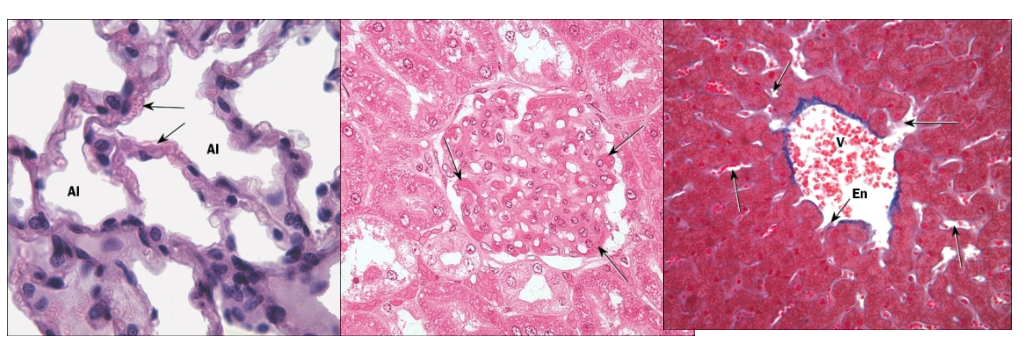
Three types recognized

  • Continuous: complete endothelial lining, most common

  • Fenestrated: 60–80 nm diameter membrane-covered pores present

  • Sinusoidal: larger, discontinuous endothelium promoting exchange
<p>Three types recognized</p><ul><li><p>Continuous: complete endothelial lining, most common</p></li><li><p>Fenestrated: 60–80 nm diameter membrane-covered pores present</p></li><li><p>Sinusoidal: larger, discontinuous endothelium promoting exchange</p></li></ul><p></p>
39
New cards
<p>Longitudinal &amp; transverse sections of capillaries</p>

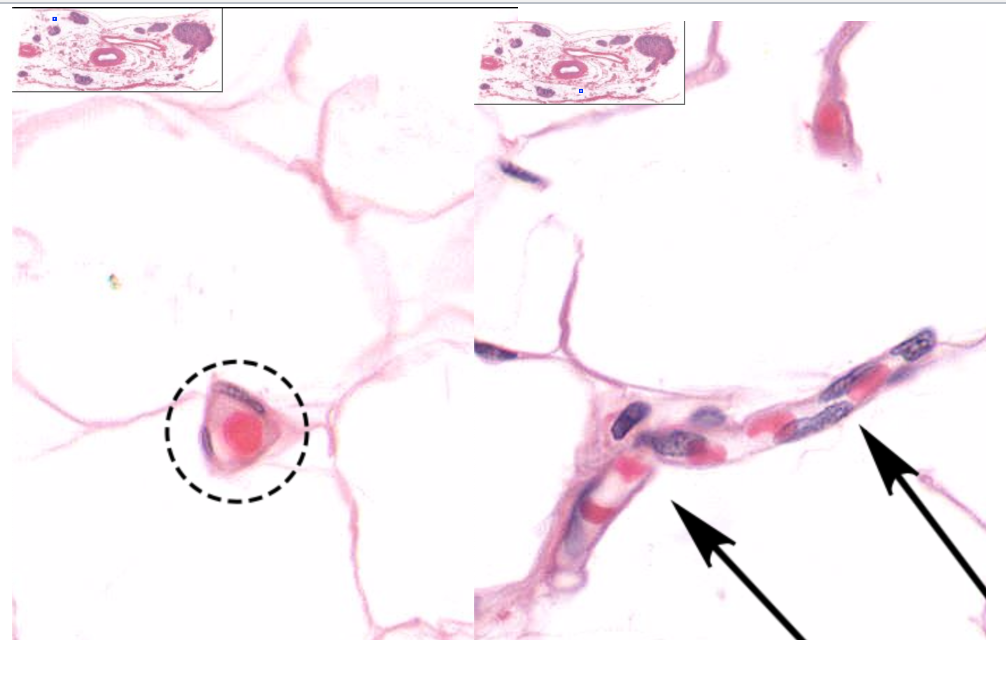
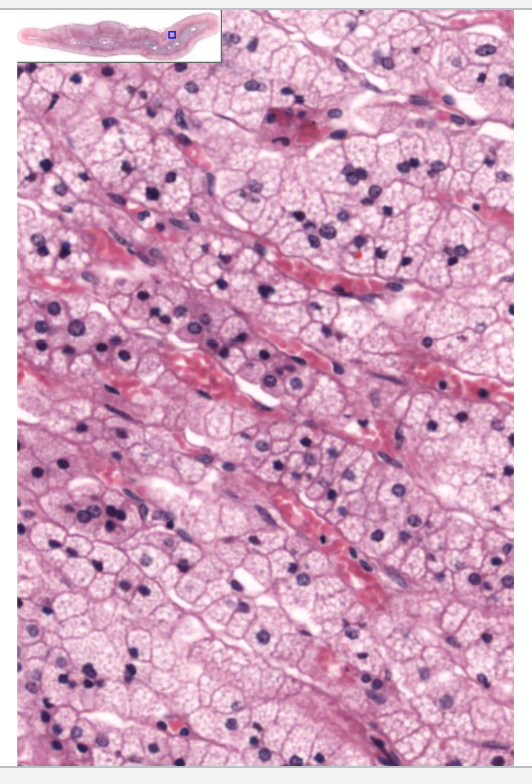
Longitudinal & transverse sections of capillaries

In zona fasciculata in the kidney
<p>In zona fasciculata in the kidney</p>
40
New cards

What is the function of veins?

  • Carry blood toward heart under low pressure

    • Thinner walls than arteries

      • Begin at capillaries, end at heart as either inferior/superior vena cava or one of the pulmonary veins

      • May have endothelial folds that form valves to resist downward pull of gravity

      • Walls are generally thin and indistinct; thickest layer is tunica externa
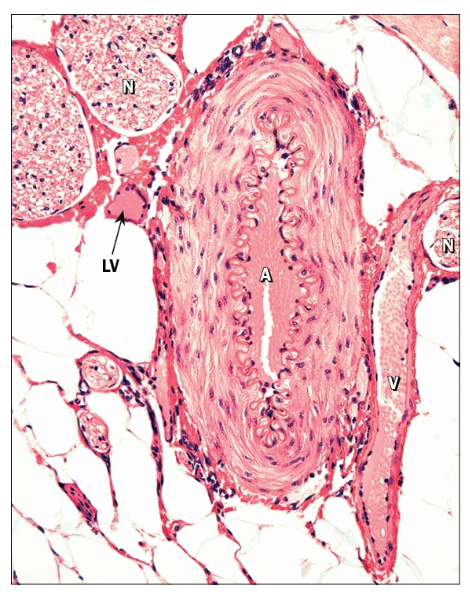
<ul><li><p>Carry blood toward heart under low pressure</p><ul><li><p>Thinner walls than arteries</p><ul><li><p>Begin at capillaries, end at heart as either inferior/superior vena cava or one of the pulmonary veins</p></li><li><p>May have endothelial folds that form valves to resist downward pull of gravity</p></li><li><p>Walls are generally thin and indistinct; thickest layer is tunica externa</p></li></ul></li></ul></li></ul><p></p>
41
New cards

What is the function of venules?

Smallest veins

  • Structurally similar to capillaries, but larger in diameter

  • Pericytes present as they leave capillary beds

  • Replaced with smooth muscle as venules get bigger
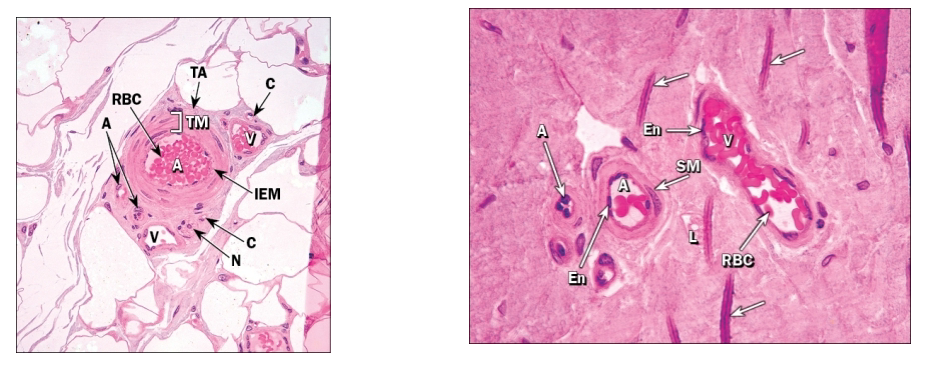
<p>Smallest veins</p><ul><li><p>Structurally similar to capillaries, but larger in diameter</p></li><li><p>Pericytes present as they leave capillary beds</p></li><li><p>Replaced with smooth muscle as venules get bigger</p></li></ul><p></p>
42
New cards
<p>What is the function of medium veins?</p>

What is the function of medium veins?

Medium veins—less than 1 cm in diameter

  • Tunica interna = endothelium and connective tissue, no internal elastic membrane

  • Tunica media = smooth muscle

  • Tunica externa = collagen/elastic fibers

    • Valves present in systemic veins working against gravity
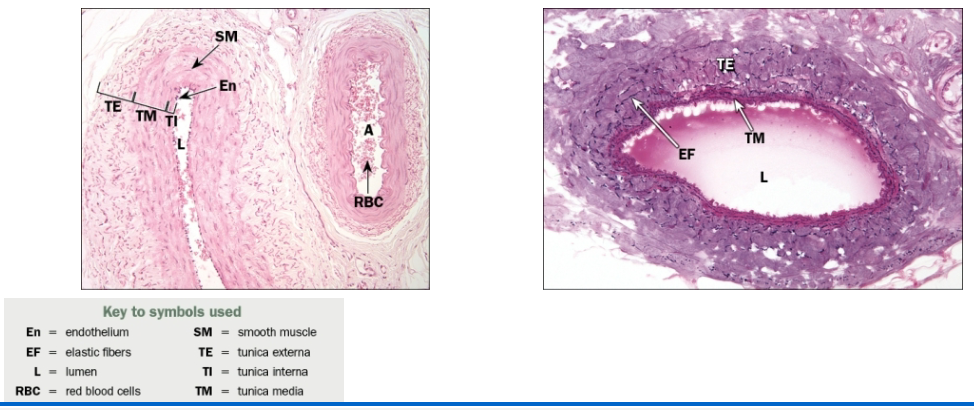
<p>Medium veins—less than 1 cm in diameter</p><ul><li><p>Tunica interna = endothelium and connective tissue, no internal elastic membrane</p></li><li><p>Tunica media = smooth muscle</p></li><li><p>Tunica externa = collagen/elastic fibers</p><ul><li><p>Valves present in systemic veins working against gravity</p></li></ul></li></ul><p></p>
43
New cards

What is the function of large veins?

  • Large veins

    • Thicker tunica interna

      • More connective tissue

    • Tunica media

      • thin

    • Tunica externa thickest layer

      • Composed of elastic/collagen fibers; vasa vasorum
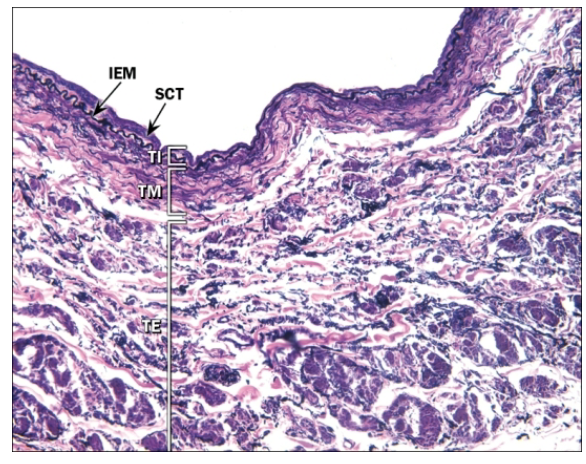
<ul><li><p>Large veins</p><ul><li><p>Thicker tunica interna</p><ul><li><p>More connective tissue</p></li></ul></li><li><p>Tunica media</p><ul><li><p>thin</p></li></ul></li><li><p>Tunica externa thickest layer</p><ul><li><p>Composed of elastic/collagen fibers; vasa vasorum</p></li></ul></li></ul></li></ul><p></p>
44
New cards

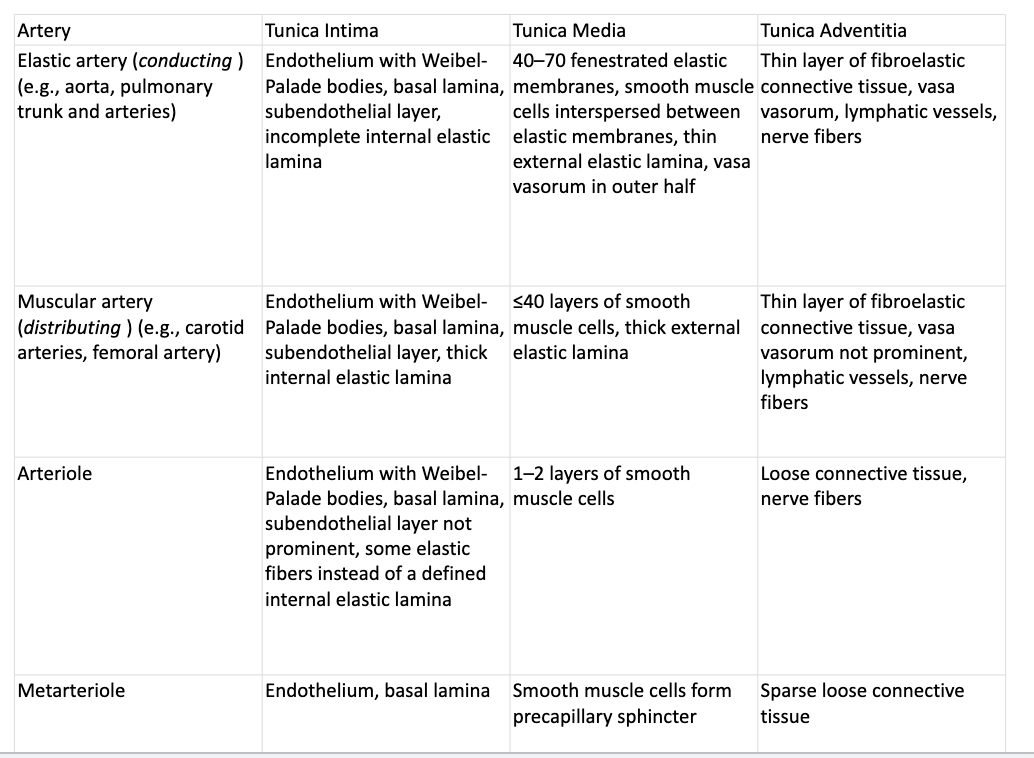
Tunica intima, media, and adventitia within the artery
knowt flashcard image
45
New cards

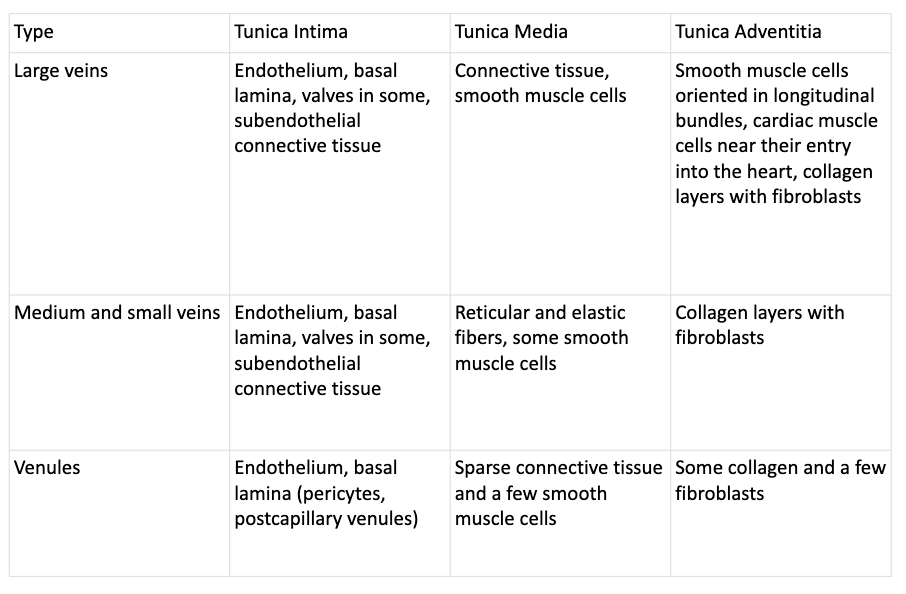
Tunica intima, media, and adventitia within the vein
knowt flashcard image

Explore top flashcards

flashcards
MDC1 Exam 2 Questions & Stuff
175
Updated 953d ago
0.0(0)
flashcards
So sagt man das! Lektion 1
25
Updated 896d ago
0.0(0)
flashcards
unit 1 ap hug
37
Updated 1085d ago
0.0(0)
flashcards
Spanish Test 1
20
Updated 895d ago
0.0(0)
flashcards
QCM Classiques
68
Updated 811d ago
0.0(0)
flashcards
MDC1 Exam 2 Questions & Stuff
175
Updated 953d ago
0.0(0)
flashcards
So sagt man das! Lektion 1
25
Updated 896d ago
0.0(0)
flashcards
unit 1 ap hug
37
Updated 1085d ago
0.0(0)
flashcards
Spanish Test 1
20
Updated 895d ago
0.0(0)
flashcards
QCM Classiques
68
Updated 811d ago
0.0(0)