CO5 CULTURAL, SOCIAL, AND POLITICAL CHANGE
 Call Kai
 Learn
Learn Practice Test
 Spaced Repetition
 Match
Match Flashcards
 Knowt Play
1/76

There's no tags or description
Looks like no tags are added yet.
Name | Mastery | Learn | Test | Matching | Spaced | Call with Kai |
|---|
No analytics yet
Send a link to your students to track their progress
77 Terms
SOCIAL CHANGE
minor or major transformation in the social order of a society
which may include changes in the nature of society, social
institutions, social behavior, or social relations.
SOCIAL CHANGE
It happens when people are unhappy and dissatisfied with
their present situation in the society.
THEORIES OF SOCIAL CHANGE
Heraclitus
a Greek philosopher, said that everything in this world is constantly shifting, changing and becoming something other than what it was before.
THEORIES OF SOCIAL CHANGE
Heraclitus
acc. to him:
everything is constantly changing
opposite things are identical
everything is and is not at the same time
THEORIES OF SOCIAL CHANGE
Heraclitus
“Change is the only constant in life”
THEORIES OF SOCIAL CHANGE
Heraclitus
Universal Flux and the Identity of Opposites entail a denial of the Law of Non-Contradiction
THEORIES OF SOCIAL CHANGE
Hegelian Theory - Georg WIlhelm Friedrich Hegel
places ultimate reality in ideas rather than in things and that uses dialectic to comprehend an absolute idea behind phenomena.
THEORIES OF SOCIAL CHANGE
Hegelian Theory - Georg WIlhelm Friedrich Hegel
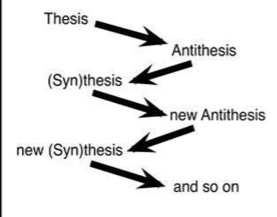
change happens as a new synthesis resulting from the clash of a thesis and antithesis
DIALECTIC
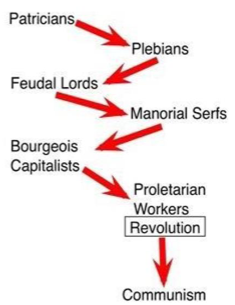
MARXIST DIALECTICAL MATERIALISM
THEORIES OF SOCIAL CHANGE
Conflict Theory - Karl Marx
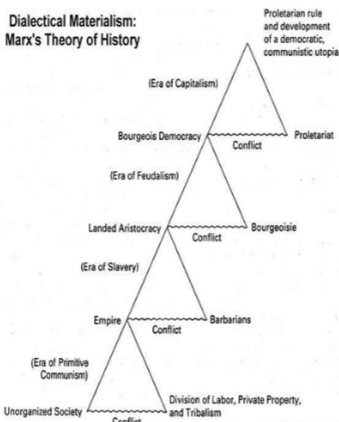
society undergoes evolution when people are not contented with the present economic system
THEORIES OF SOCIAL CHANGE
Conflict Theory - Karl Marx
people change or transform the society they are in to serve their own purposes
DIALECTICAL MATERIALISM: MARX’S THEORY OF HISTORY
CAUSES OF SOCIAL CHANGE
Technology, Social Institutions, Population, Environment
SOURCES OF SOCIAL, CULTURAL, AND POLITICAL CHANGE
Innovation
New techniques or modifications used to achieve an intended goal or end.
SOURCES OF SOCIAL, CULTURAL, AND POLITICAL CHANGE
Innovation
Acc to Everett Rodgers, the success or failure depends on 5 steps:
Relative advantage or surpassing similar ideas in terms of satisfaction and convenience.
Compatibility with the needs and practices of society.
Simplicity
Trialibility/testability
Observability
SOURCES OF SOCIAL, CULTURAL, AND POLITICAL CHANGE
Diffusion
Spreading of ideas that lead to the formation of new concepts.
SOURCES OF SOCIAL, CULTURAL, AND POLITICAL CHANGE
Innovation
Acc. to Everett Rodgers, it has steps:
Knowledge (becomes aware of new innovation but lacks information and inspiration)
Persuasion (interest in the innovation spikes; begins to research)
Decision (weighs positive and negative results of adopting innovation)
Implementation (adapts innovation into system and starts to determine its usefulness)
Confirmation
SOURCES OF SOCIAL, CULTURAL, AND POLITICAL CHANGE
Acculturation and Assimilation
Adopting some aspects of the cultural traits and practices of another group.
SOURCES OF SOCIAL, CULTURAL, AND POLITICAL CHANGE
Acculturation and Assimilation
Fully adopting the culture of another group.
SOURCES OF SOCIAL, CULTURAL, AND POLITICAL CHANGE
Social Contradictions and Tensions
Takes place as the population increases continuously and resources becomes scarce.
SOURCES OF SOCIAL, CULTURAL, AND POLITICAL CHANGE
Social Contradictions and Tensions
Acts of terrorism, power struggle, advocacy groups.
CRITICAL COMPONENTS OF SDG 2030
People
Prosperity
Peace
Partnership
Planet
CRITICAL COMPONENTS OF SDG 2030
People
end poverty and hunger in all forms and ensure dignity and equality
CRITICAL COMPONENTS OF SDG 2030
Prosperity
ensure prosperous and fulfilling lives in harmony with nature
CRITICAL COMPONENTS OF SDG 2030
Peace
foster peaceful, just, and inclusive societies
CRITICAL COMPONENTS OF SDG 2030
Partnership
implement the agenda through a solid global partnership
CRITICAL COMPONENTS OF SDG 2030
Planet
protect our planet’s natural resources and climate for future generation
THREAT TO SUSTAINABILITY
The misuse of technology; carbon emissions, environmental degradation; rapid increase in population causes global warming and climate change to occur.
FEASIBLE SOLUTIONS TO CLIMATE CHANGE AND GLOBAL WARMING
mitigation by emission reduction: led
adaptation
building resilient systems
possible future climate engineering: greenhouse gas removal and solar radiation management
use of renewable energy: solar and wind power
Philippine Overseas Employment Administration (POEA)
Responsible for processing workers’ contracts and pre-deployment checks, licensing, regulating, and monitoring private recruitment agencies.
Overseas Workers Welfare Administration (OWWA)
Provides support and assistance to migrants and their families
PROBLEMS OF OFWs
Excessive placement fees
Unpaid or delayed wages
Involvement in syndicate operations
Tedious process of securing travel documents and requirements
Abusive employers
Professional extortionists
Confiscation of passports by employers
LAWS PROTECTING OFWs
1995 - Migrant Workers and Overseas Filipino Act of 1995 (RA No. 8042)
2003 - Anti-Trafficking in Persons Act of 2003 (RA No. 9208)
2003 - Overseas Absentee Voting Act of 2003 (RA No. 9189)
2003 - Citizenship Retention and Reacquisition Act of 2003 (RA No. 9225)
CITIZENSHIP
Set of Rights = Allegiance, Compliance, and Cooperation to the State
ACTS OF RESPONDING
Fulfilling your responsibilities as human
Educating yourself
Being proactive in various social, cultural, and political issues
Reaching in-needs through different helps
Respecting different members of our society
Sharing educational memes, news, intellectual aids
VOTING
SUFFRAGIUM
vote or political support (latin word)
SUFFRAGE
Constitutional, Civil, and Political Right
SUFFRAGE
Right to vote
SUFFRAGE
Inclusive citizenship and participatory governance
SUFFRAGE
one of the most important elements of democracy
THEORIES OF SUFFRAGE
Suffrage as an attribute of citizenship
Suffrage as vested privilege
Suffrage as a government function
The Ethical Theory
EMBODIMENT OF SUFFRAGE
Universal Declaration of Human Rights (UDHR)
International Covenant on Civil and Political Rights
1987 Philippine Constitution
SCOPE OF SUFFRAGE
Election
Plebiscite
Referendum
Initiative
Recall
SCOPE OF SUFFRAGE
Election
the means by which people choose their leaders and officials.
SCOPE OF SUFFRAGE
Plebiscite
the means by which people expresses their choice over a
proposed law
SCOPE OF SUFFRAGE
Referendum
the means by which people ratify a piece of legislation
passed by Congress
SCOPE OF SUFFRAGE
Initiative
means by which people directly propose laws for the
government to enact
SCOPE OF SUFFRAGE
Recall
an elected public official becomes subject to a process of removal from office
HISTORY OF ELECTION
Precolonial
Band and Tribe system
Datu and Sultanate system
HISTORY OF ELECTION
Spanish Colonization
Male voters only (with discrimination)
HISTORY OF ELECTION
1937
ACT 4112 - granting women the right to suffrage
HISTORY OF ELECTION
1946
First democratic election after WW2
HISTORY OF ELECTION
1992
First synchronous national and local election under the 1987 PH Constitution
HISTORY OF ELECTION
1998
First Party-list election
INITIATIVE
Republic Act No. 6735
Act providing for a system of initiative and referendum through petition papers
Number of Signatories
Autonomous Regions - 2000 registered voters
Provinces and cities - 1000 RV
Municipalities - 100 RV
Barangay - 50 RV
REPUBLIC ACT NO. 6735
Autonomous Regions
2000 RV
REPUBLIC ACT NO. 6735
Provinces and cities
1000 RV
REPUBLIC ACT NO. 6735
Municipalities
100 RV
REPUBLIC ACT NO. 6735
Barangay
50 RV
REPRESENTATION
Republic Act No. 7941
partylist system act in 1995; enables Filipino citizens belonging to the marginalized and under represented sectors, organizations, and parties to become members of the House of Representatives.
HOUSE OF REPRESENTATIVES
District Representatives
Horizontal Representation
HOUSE OF REPRESENTATIVES
Party-list Representatives
bottom-up participatory governance
HOUSE OF REPRESENTATIVES
2% of the toral votes is an entitlement ot 1 seat
Max 3 seats
SOCIAL MOVEMENT
People sharing the same sentiments and aspirations gather and unite as group
COLLECTIVE BEHAVIOR
Refers to social behavior that is relatively spontaneous, transitory, emotional, and unpredictable
THEORIES OF DISPLAYING COLLECTIVE BEHAVIOR
Convergence Perspective
Emergent Norm Perspective
Value-Added Perspective
THEORIES OF DISPLAYING COLLECTIVE BEHAVIOR
Convergence Perspective
Assumes that crowd behavior reflects the pre-existing values and beliefs and behavioral disposition of the individuals who join a crowd.
THEORIES OF DISPLAYING COLLECTIVE BEHAVIOR
Emergent Norm Perspective
nontraditional behavior (such as that associated with collective action) develops in crowds as a result of the emergence of new behavioral norms in response to a precipitating crisis
THEORIES OF DISPLAYING COLLECTIVE BEHAVIOR
Value-Added Perspective
collective behavior results when several conditions exist, including structural strain, generalized beliefs, precipitating factors, and lack of social control
THEORIES OF DISPLAYING COLLECTIVE BEHAVIOR
Convergence Perspective
Crowd behavior reflects the beliefs and intentions that individuals already share before they join a crowd.
THEORIES OF DISPLAYING COLLECTIVE BEHAVIOR
Emergent Norm Perspective
People are not sure how to behave when they begin to interact in collective behavior. As they discuss their potential behavior, norms governing their behavior emerge, and social order and rationality then guide their behavior
THEORIES OF DISPLAYING COLLECTIVE BEHAVIOR
Value-Added Perspective
Collective behavior results when several conditions exist, including structural strain, generalized beliefs, precipitating factors, and lack of social control.
TYPES OF MOVEMENT'
Expressive
Its objective is merely to provide information and for the people to know about an issue. (e.g. Chocolate Hills Resort, Gomburza Movie Review)
TYPES OF MOVEMENT'
Resistance
It does not only provide information but also aims to change the existing social value structures and institutions. (e.g. #BlackLivesMatter , #MeToo, #NoToJeepneyPhaseOut)
TYPES OF MOVEMENT'
Reform
It is directed at changing certain aspects of the existing social structure to make it more efficient. (e.g. CARP , K-12, tax reforms)
TYPES OF MOVEMENT'
Revolution
It aims to change the whole social order. (e.g. Communism, Philippine Revolution)
Explore top notes

Explore top flashcards
