Supply Chain Midterm 2
 Call Kai
 Learn
Learn Practice Test
 Spaced Repetition
 Match
Match Flashcards
 Knowt Play
1/76

There's no tags or description
Looks like no tags are added yet.
Name | Mastery | Learn | Test | Matching | Spaced | Call with Kai |
|---|
No analytics yet
Send a link to your students to track their progress
77 Terms
Four main categories of inventory
Raw Materials
Work-in-Process (WIP) sometimes called Work-in-Progress
Finished Good
Maintenance, Repair and Operating (MRO) supplies
Raw Materials
Purchased items or extracted materials converted via the manufacturing process into components and products.
Work-in-Process
A good or goods in various stages of completion throughout the plant, spanning from raw material that has been released for initial processing up to fully processed material awaiting final inspection and acceptance as finished goods
Finished Goods
Those items on which all manufacturing operations, including final testing, have been completed. These products are available for sale and shipment to the customer
Maintenance, Repair and Operating (MRO)
Items used to support general operations and maintenance, such as maintenance supplies, spare parts, and consumables, and are used in manufacturing and supporting operations.
Service Inventory
Activities carried out in advance of the customer’s arrival
Ex: Restaurants offer dining services, but cannot inventory the actual dining service; they can only begin the dining service when the customers arrive.
Why is Inventory Held
Meet customer demand
Buffer against uncertainty in demand and/or supply
Decouple supply from demand
Decouple dependencies in the supply chain
Cycle Stock
Inventory that a company builds to satisfy its’ immediate demand.
Safety Stock
Inventory that is above and beyond what is actually needed to meet anticipated demand.
Strategic Stock
Additional inventory beyond cycle and safety stock, generally used for a very specific purpose or future event, and for a defined period of time.
Direct Costs
directly traceable to unit produced (e.g., materials, labor, etc.)
Indirect Costs
cannot be traced directly to the unit produced (e.g., overhead; MRO items, buildings, equipment, etc.)
Variable Costs
dependent on the unit volume produced vary with output level (e.g., materials, labor, utility power, etc.)
Fixed Costs
independent of the unit volume produced (e.g., buildings, equipment, rent, allocated overhead costs, etc.
Carrying Costs
costs for physically having inventory on-site and for maintaining the infrastructure needed to store the inventory and to secure and insure it over time.
Order Costs
Labor costs associated with placing an order for inventory and the cost of receiving the order.
Absolute Inventory Value
The value of the inventory at either its cost or its market value.
Inventory Turnover
The number of times that an inventory cycles, or “turns over,” during the year.
Inventory Turnover Ratio
Cost of Goods Sold / Average Inventory at Cost
Reorder Point (ROP)
The lowest inventory level at which a new order must be placed to avoid a stockout
Economic Order Quantity (EOQ) Model
A quantitative decision model based on the trade-off between annual inventory order costs and annual inventory carrying costs
Order Costs
costs that are incurred each time an order is placed
Carrying Costs
costs that are incurred for holding inventory in storage
Examples of Order Costs
Order preparation costs
Order transportation costs
Order receipt processing costs
Material handling costs
Examples of Carrying Costs
Cost of capital - specified by senior management
Taxes - on inventory held in warehouses
Insurance - based on estimated risk or loss over time and facility characteristics
Obsolescence - deterioration of product during storage, and shelf-life
Storage - facility expense related to product holding rather than product handling
EQQ Equation

Other Types of Inventory Systems
ABC System
Bin System
Base Stock Level System
Single-Period” Inventory Mode
ABC System
Classifies inventory based on the degree of importance
1. Determine annual usage or sales for each item.
2. Determine % of total usage or sales that each item represents.
3. Rank items from highest to lowest %.
4. Classify items into groups:
A: Highest Value
B: Moderate Value
C: Least Valuable
Single-Period Inventory Model
type of inventory system in which inventory is only ordered for a one-time stocking
Ex: newspaper stands, christmas tree lots
Linear Barcodes
a series of alternating bars and spaces printed or stamped on parts, containers, labels, or other media, representing encoded information that can be read by electronic readers
2D Bar Codes
a graphical image that stores information both horizontally and vertically
Barcode Reader
An electronic device that can read barcodes and transmit the data to a computer. These might be handheld cordless devices, corded devices that attach directly to a PC’s USB port, or computers with integrated laser scanners
Radio Frequency Identification (RFID)
Successor to the barcode for tracking individual unit of goods, does not require direct line of sight to read a tag, and the information on the tag is updatable.
How Does RFID Automate the Supply Chain
Materials Management – goods automatically counted and logged as they enter the supply warehouse
Manufacturing – assembly instructions encoded on RFID tag provide information to computer controlled assembly devices
Distribution Center – shipment leaving DC automatically updates ERP to trigger a replenishment order and notify customer for delivery tracking
Retail Store – no check out lines as scanners link RFID tagged goods in shopping cart with buyers credit card
Common Metrics for Inventory
Units – the number of units available
Dollars – the amount of dollars tied up in inventory
Weeks of Supply - (avg. on-hand inventory) / (avg. weekly usage)
Inventory Turns - (cost of good sold) / (avg. inventory value)
Purchase Requisition
An Internal Document that defines the need for goods and/or services
Request for Information (RFI)
standard business process whose purpose is to collect written information about the capabilities of various suppliers
Request for Proposal (RFP)
A detailed capabilities document used to determine a supplier's capability and interest in the production of a product or service
Request for Quote (RFQ)
A document used to solicit bids (i.e., price and delivery) from interested and qualified suppliers for goods or services that the organization needs to obtain
Primary Objectives of Purchasing
Ensure an uninterrupted flow of materials and services at the lowest
total cost.
2. Improve the quality of the finished goods produced.
3. Optimize customer satisfaction
Purchasing Process Steps
A need is identified, and a Purchase Requisition is issued
Obtain authorization as necessary
Identify and evaluate potential suppliers
Make supplier selection
Purchase Order (PO) is created and delivered to the supplier
Supplier confirmation of the Purchase Order
Fulfillment
Receipt of Goods
Invoice and Reconciliation
Payment
Close out the Purchase Order
Analysis
Total Cost of Ownership
the sum of all the costs associated with every activity in the supply stream of a product
Make vs Buy Decision
the act of deciding whether to produce an item internally or buy the item from an outside supplier
Make
Producing (i.e., manufacturing) materials or products internally (i.e., in operations owned by the company).
Buy / Outsource
Buying materials, components, or products from a supplier(s) instead of, or in addition to, making them inhouse (i.e., buying from a 3rd-party external source).
Qualitative Reasons for Making
Protect proprietary technology
No competent supplier
Control of lead-time
Use existing idle capacity
Better quality control
Qualitative Reasons for Buying or Outsourcing
Non-Strategic
Insufficient Capacity
Temporary Capacity Constraints
Lack of Expertise
Quality
Multi-Sourcing Strategy
Brand Strategy
Cost Advantage
Inventory Considerations
Backward Vertical Integration
Refers to a company acquiring (i.e., buying) one or more of its suppliers
Ex: a manufacturer buying the key supplier of a critical material to take ownership of this aspect of their supply chain.
Forward Vertical Integration
Refers to a company acquiring (i.e., buying) one or more of its customers.
Ex: manufacturer buying a wholesaler/distributor to take ownership of that aspect of their supply chain
Tariffs
Duties, taxes, or customs imposed by the host country for imported or exported goods
Non-tariff Barriers
Quotas, licensing agreements, embargoes, laws, and regulations imposed on imports and exports.
Countertrade
International trade by exchange of goods rather than by currency
Insourcing
Producing goods or services using a company’s own internal resources
Outsourcing
The traditional definition involves purchasing an item or service externally, which had been produced using a company’s own internal resources previously.
Reasons for a Single Supplier
To establish a good relationship
Less quality variability
Lower cost [100% of volume]
Transportation economies
Proprietary product or process
Volume too small to split
Reasons for Multiple Suppliers
Need more capacity
Spread risk of supply disruption
Create competition
More sources of information
Dealing with special kinds of business
Functional Products
MRO items and other commonly low profit margin items with relatively stable demands and high levels of competition i.e. office supplies, food staples, etc
Innovative Products
characterized by short product life cycles, volatile demand, high profit margins, and relatively less competition i.e. technology products such as the iPhone
Spend Analysis
Categorizing and analyzing expenditure data for the purpose of decreasing costs, improving efficiency, and monitoring compliance.
The basic steps for conducting a spend analysis
1. Defining the scope (e.g., expenditures over a specific time period).
2. Identify all of the data sources.
3. Gathering and consolidating all of the data into one database.
4. Cleansing the data (finding and correcting errors) and standardizing it for easy review.
5. Categorizing the data (e.g., commodity and sub-commodities)
6. Analyzing the data for:
− the best deals per supplier
− to ensure that all purchases are from preferred suppliers
− to reduce the number of suppliers per category.
7. Repeating the process on a regular schedule.
Key areas of a typical spend analysis
1. Total historic expenditures and volumes
2. Future demand projections or budgets
3. Expenditures categorized by commodity and sub-commodity
4. Expenditures by division, department, or user
5. Expenditures by supplier
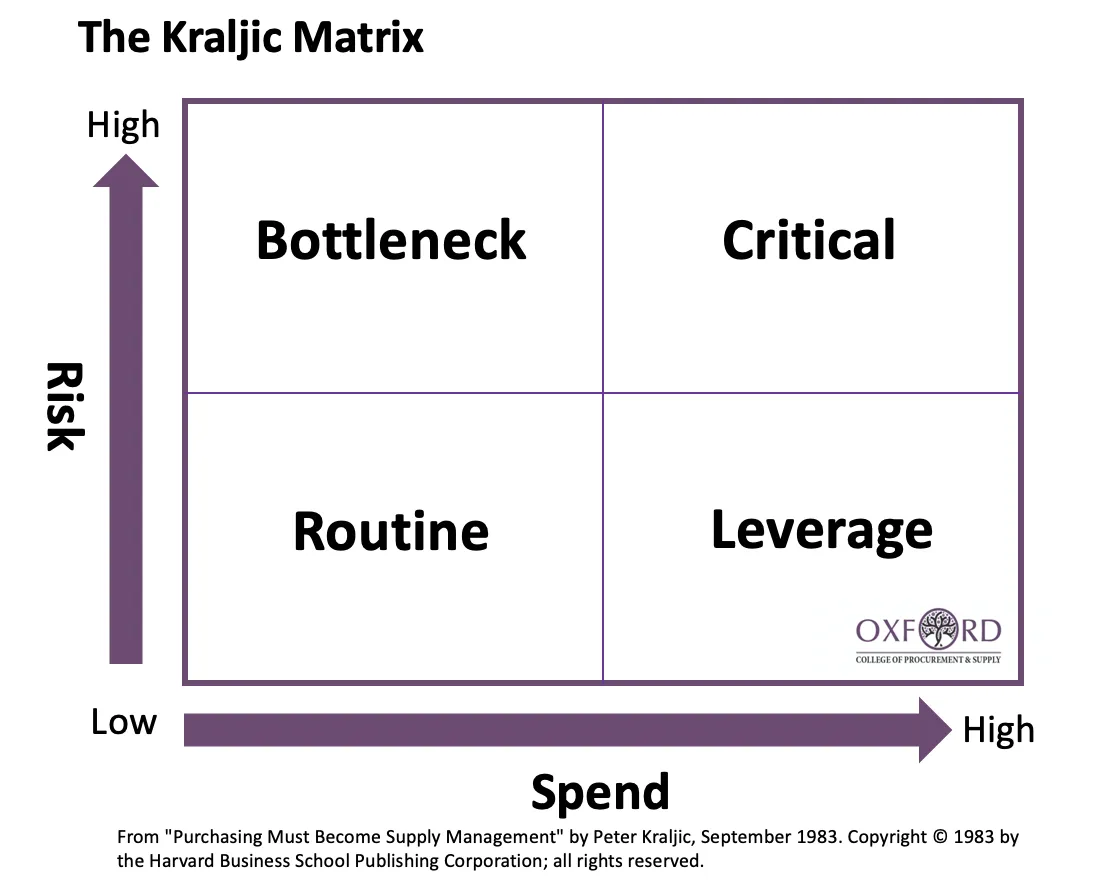
Non-Critical Sourcing
routine items that involve a low percentage of the firms’ total spend and involve very little supply risk. e.g. standard screws in a computer factory.
Bottleneck
unique procurement problems. Supply risk is high and availability is low. Small number of alternative suppliers. e.g. an integral part of technology hardware, the power pack for a laptop.
Leverage
commodity items where many alternatives of supply exist, and supply risk is low. Spend is high and there are potential procurement savings. e.g., plastic or raw material for Lego bricks
Strategic
strategic items and services that involve a high level of expenditure and are vital to the firm’s success. e.g., the Qualcomm chipsets for mobile phones.
Kraljic Model
Preferred Suppliers
Suppliers that best meet your company’s overall purchasing requirements
Distributive Negotiations
Refers to a process that leads to selfinterested, one-sided outcome
Collaborative Negotiations
Both sides work together to maximize the outcome or create a win-win result. Requires open discussions and a free-flow of information between parties
Vendor Managed Inventory
Suppliers directly manage buyer inventories to reduce the buyer’s inventory carrying costs and avoid stockouts for the buyer
Benefits for Buyer in Vendor Managed Inventory
─ Supplier tracks inventories
─ Supplier determines delivery schedules and order quantities
─ Buyer can take ownership at the stocking location
─ Buyer may also be able to avoid taking ownership until the material is actually being used.
Benefits for Supplier in Vendor Managed Inventory
─ Avoids ill-advised customer orders
─ Supplier decides inventory set up and shipments
─ Opportunity for supplier to educate customers about other products
Supplier Co-location
a representative of the supplier is actually embedded in the buyer’s purchasing group to forecast demand, monitor inventory, and place orders
Corporate Social Responsibility
The practice of business ethics
Business Ethics
Application of ethical principles to business
Utilitarianism
an ethical act is that which creates the greatest good for the greatest number of people, and should be the guiding principle of conduct
Rights and Duties:
Some actions are just right in and of themselves,regardless of the consequences. Do the right thing!

