Phylogeny
0.0(0)
Studied by 9 people Call Kai
 Learn
Learn Practice Test
 Spaced Repetition
 Match
Match Flashcards
 Knowt Play
Card Sorting
1/20

Last updated 9:32 PM on 5/23/23
Name | Mastery | Learn | Test | Matching | Spaced | Call with Kai |
|---|
No analytics yet
Send a link to your students to track their progress
21 Terms
1
New cards
the evolutionary history of a species or a group of related species
phylogeny
2
New cards
a population or a group of populations in which the members have the potential to interbreed in nature and produce viable fertile offspring, and do not produce viable fertile offspring with members from another group.
species
3
New cards
* biological species concept
* ecological species concept
* morphological species concept
* phylogenetic species concept
* ecological species concept
* morphological species concept
* phylogenetic species concept
name the species concepts
4
New cards
* this concept defines species as a group of organisms that can interbreed and produce fertile offspring.
* According to this concept, individuals of the same species are reproductively compatible, whereas individuals of different species are reproductively isolated.
* According to this concept, individuals of the same species are reproductively compatible, whereas individuals of different species are reproductively isolated.
briefly explain the biological species concept
5
New cards
* this concept defines a species based on its ecological niche and interactions within the environment.
* it emphasizes the role and adaptations of an organism within its ecological community.
* It highlights the ecological factors that shape a species’ survival, reproduction, and coexistence with other organisms.
* it emphasizes the role and adaptations of an organism within its ecological community.
* It highlights the ecological factors that shape a species’ survival, reproduction, and coexistence with other organisms.
briefly explain the ecological species concept
6
New cards
* this concept defines a species based on observable physical characteristics.
* It suggests that individuals belonging to the same species share similar morphological traits and can be distinguished from other species based on these traits.
* It suggests that individuals belonging to the same species share similar morphological traits and can be distinguished from other species based on these traits.
briefly explain the morphological species concept
7
New cards
* this concept defines a species based on its evolutionary history and genetic relationships
* it considers species as branches on the tree of life, with each species representing a distinct lineage of populations that share a common ancestor
* this concept utilises genetic data and analysis to determine species boundaries
* it considers species as branches on the tree of life, with each species representing a distinct lineage of populations that share a common ancestor
* this concept utilises genetic data and analysis to determine species boundaries
briefly explain the phylogenetic species concept
8
New cards
the degree of variation of life forms within a given ecosystem, biome, or an entire planet
biodiversity
9
New cards
* ecological diversity
* genetic diversity
* organismal diversity
* genetic diversity
* organismal diversity
types of biodiversity
10
New cards
the variation of system level on a given location
what is ecological diversity?
11
New cards
the total amount of genetic characteristics / genes that are contained in the gene pool of a species / group of species
what is genetic diversity?
12
New cards
the number and distribution of species or other taxonomic groups in a given location
what is organismal diversity
13
New cards
it is a hypothesis about evolutionary relationships
what is the tree of life?
14
New cards
* it’s a diagram that represents evolutionary relationships among different species or a group of organisms
they show:
* patterns of descent (not based on phenotypes)
* the points where the branches intersect represent the common ancestor shared by the organisms
* insight on the pattern of speciation
* relationships between different taxonomic groups
they show:
* patterns of descent (not based on phenotypes)
* the points where the branches intersect represent the common ancestor shared by the organisms
* insight on the pattern of speciation
* relationships between different taxonomic groups
what is a phylogenetic tree and its functions?
15
New cards
* it’s when the simplest explanations that are consistent with observations rank higher than more complex observations
* this means that the evolutionary tree that requires the lowest amount of evolutionary changes is the one that maximizes parsimony
* this means that the evolutionary tree that requires the lowest amount of evolutionary changes is the one that maximizes parsimony
principle of maximum parsimony (the simplest tree)
16
New cards
* it’s based on the basic assumptions about how genetic material change in the time it is possible to decide what evolutionary trees reflects the most probable sequence of evolutionary changes
* the assumption based on this principle is that DNA changes have occurred at equal rates at all branches from the common ancestor.
* the assumption based on this principle is that DNA changes have occurred at equal rates at all branches from the common ancestor.
principle of maximum likelihood (the most likely tree)
17
New cards
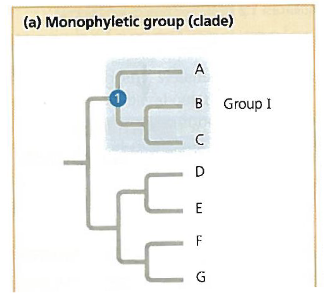
the group consists of ancestral species and all descendants
monophyletic group
18
New cards
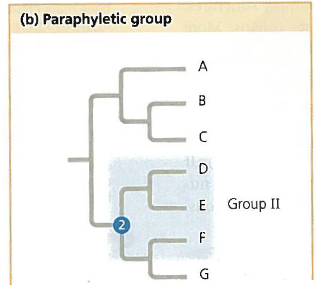
the group consists of ancestral species, but not all descendants
paraphyletic group
19
New cards
the group consists of taxa with different ancestors
polyphyletic group
20
New cards
when the traits are inherited by two different organisms from a common ancestor
homology
21
New cards
when there is a similarity between two species due to convergent evolution, not common ancestry
analogy

