BCSC final study guide
 Studied by 0 people
 Call Kai
 Learn
Learn Practice Test
 Spaced Repetition
 Match
Match Flashcards
 Knowt Play
1/199

There's no tags or description
Looks like no tags are added yet.
Name | Mastery | Learn | Test | Matching | Spaced | Call with Kai |
|---|
No analytics yet
Send a link to your students to track their progress
200 Terms
How do we test cued vs. free recall?
To test cued vs. free recall, researchers compare how much information participants can retrieve when given specific cues (cued recall) versus when they retrieve information without prompts (free recall). This helps assess memory retrieval processes.
In cued recall, what kind of “pairs” will be encoded in semantic memory?
A clear relation in meaning between two
words/concepts/events
Water-melon, cat-dog
In cued recall, what kind of pairs will be encoded in episodic memory?
An opaque relation in meaning between two
words/concepts/events (Cute little monkeys vs.
Introspection)
What are examples of ecological approach in LTM retrieval?
When recalling words, we go through subcategories similar to foraging.
Memory search task - ex. recall as many animals as you are able to
Sub category 1: pets
Sub category 2: wild animals
Sub category 3: farm animals
What is a paired associate learning task?
A learning method in which individuals learn to associate pairs of items, often words, to enhance memory retention.
There is a cue and target word:
Cue: snow
Target: heater
cue: Phone – marker (target)
cue:Tree – memory (target)
cue:Quiz – wire (target)
cue: Note – power (target)
An example of paired associates task
How do we interpret the “forgetting curve”
illustrates the decline of memory retention over time, showing that information is lost rapidly shortly after learning and levels off gradually. It emphasizes the importance of rehearsal and spaced learning to improve long-term retention.
What are retroactive interference
occurs when new information prevents the retrieval of previously learned information, leading to memory loss.
What is proactive interference
occurs when old information interferes with the ability to learn and recall new information, resulting in memory difficulties.
example of retroactive interference
is when learning a new phone number makes it difficult to remember your old phone number.
example of proactive interference
is when your old password interferes with your ability to remember a new password.
How do you test proactice interference
use paired associates task to test for forgetting to test if the subject is unable to recall new pair
How to test retroactive interference
use paired associates task to test for forgetting to test if the subject is unable to recall old pair
What are the key features of the hierarchical model of categories/concepts?
It is the idea that our knowledge and concept are organized like a hierarchy of categories in semantic memory. Two types of nodes, (Sub)- Category labels and features
Examples of property description that support the hierarchical network model?
You think, a canary can sing, the next step might be a canary can fly, last might be a canary has skin, if you jump from the first to the last, the reaction time might be slower.
Examples of category description that support the hierarchical network model?
You think, a canary is a canary, next level is a canary is a bird, next level is a canary is an animal. You wouldnt necessarily jump from a canary is a canary to a canary is a bird without the middle step.
which node has slower response times
the property node
Some features of Hierarchecal model (in terms of speed)
slower responses to properties at the top level
slower responses to categories at the top level
Why way is information retrieved through the hierarchy
low to high
How does the Hierarchecal Model tell us the structure of concept/knowledge in our semantic memory?
It organizes knowledge into a structured format where more general concepts are at the higher levels and more specific concepts are at the lower levels.
What are the features of the classical view of concept?
The classical view of concepts is characterized by the definition of concepts as sets of necessary and sufficient attributes that any instance must possess to be categorized within that concept.
There are no exemplars or prototypes.
What are prototypes and exemplars?
Prototypes are the best or most typical examples of a concept, while exemplars are actual instances of members of a category used for comparison. Together, they help in understanding how concepts are viewed and categorized.
What is knowledge-based categorization?
Different people could categorize things differently based on their experiences. Prior knowledge about these objects is required for categorizing them together. This uses top down processing
Example of Knowledge Based
How would you categorize a camera, a diaper, and hand warmers together? They are all things that you might bring with you to time square for new years count down!
why do we study mental imagery?
Studying mental imagery helps us understand how we visualize concepts, improve memory, and comprehend spatial relationships in our environment. It reveals insights into cognitive processes and contributes to fields like psychology and education.
How do we study mental imagery?
using fMRI
What was the implication of Jessen et al.’s (2000) study for localizing mental images in the brain?
The activation in parietal lobe for concrete words: image of object in space (the "where" stream) This is due to the dorsal stream being in the parietal lobe, even though youre not really seeing it, by thinking of the object, your parietal lobe is activated and tries to find where it is in the real world. Showed that you can mentally "sense" the concrete objects even if the actual object is not presented. Evidence for mental image of concrete word
How do we link word with the
thing that the word represents?
Concreteness of the word:
hard to form mental images
for abstract concepts
Language-specific: pictorial
vs. non-pictorial words
Why do we study mental rotation?
To understand spatial visualization and cognitive processes involved in manipulating objects in space, revealing how we perceive and mentally process physical layouts.
What is the mental rotation study: Cooper & Shepard (1973)?
Letter identification take with various types of cues (conditions). Main task: identify whether the letter in the testing trial is a normal letter or a mirror image of the letter
What are the different conditions of the mental rotation study: Cooper & Shepard (1973)?
N condition you dont give the advance information
I is you give them identity only
O is you give them orientation only
B is you give them both identity and orientation separately
The C condition is the easiest where you have combined identity and orientation
What were the results of the mental rotation study: Cooper & Shepard (1973)?
The results show that the time needed to make judgements in 5 different conditions, no cue is the most difficult with the slowest reaction time. Both cues available and combined cues (condition b & c) are the easiest with the faster reaction time. Time needed to make judgements in condition b (both cues available) with 5 different cue durations. The longer the duration, the faster the reaction time
Where has mental rotation been found to be localized within the brain?
parietal lobe, right hemisphere
What was the second mental rotation task study: Pardo-Vazquez & Hernandes-Rey (2012)?
This study used the same letter judgement task (but only condition N aka no cues available). Working memory task divides Ss into high vs. low span groups
What is the rotation of 3D objects study: Shepard & Metzler (1971)?
First condition has picture-plane pairs. Second condition: has depth pairs. The larger the rotation angle, the larger the reaction time (slower). Rotating by depth a bit easier when rotating by a large angle (although the difference is not very significant).
Implication: we mentally rotate not only 2D but also 3D images!
What was the principles of visual imagery (Finke 1989)?
Implicit encoding
Perceptual equivalence
Spatial equialence
Transformational equivalence
Structural equivalence
Implicit Encoding
Implicit encoding has a lot to do with implicit memory. You could describe the layout of a room but when in that room you probably werent paying a lot of attention to it. The process by which you encode all of these things in your memory can be an unconscious process.
Perceptual Equivalence
Imagining an object similar to actually perceiving it. Activation of fusiform face area (FFA) while seeing the actual face AND forming a mental image of it
Spatial Equivalence
The amount of time it takes to mentally scan from A to B is a function of the actual distance A-B in the image. Try to remember the locations of the NY logo, the scoreboard, and the first base. The longer the distance in the image, the longer the scanning reaction time. The distance between objects on the image is just like the distance between objects in our mind
Transformational Equivalence
Rotating an object similar to rotating a mental image. If you are going to scan a persons brain while they are rotating an object in their head, you can still see activation in premotor cortex. They are still moving, even if its just moving something in their head
Structural Equivalence
It is the features of imaged object similar to actual object. More about the details and features of the mental image. How do we test this? Imagine a dessert or a novel object. It's hard for you to have all the details but you can still have some in your head. If you were to draw on a piece of paper, you would draw the equillavent of what you have in your head which should be similar to the actual object.
How do we test each principle of visual imagery?
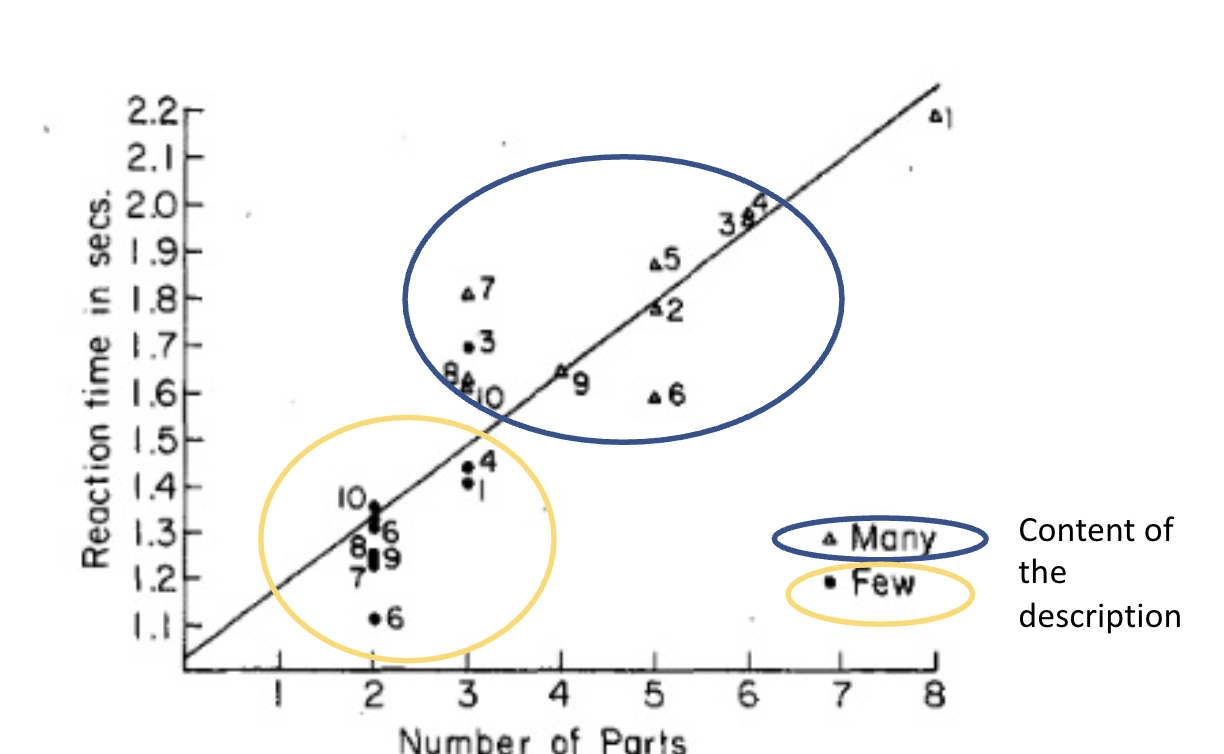
What was the study on structural equivalence: Kosslyn et al (1983)?
You get a description of object to be imaged, then you see a geometric object, you form a mental image of it, and press a button when done.
Key manipulation: complexity of the verbal description: one group receives a complex descriptions and another receives simple ones
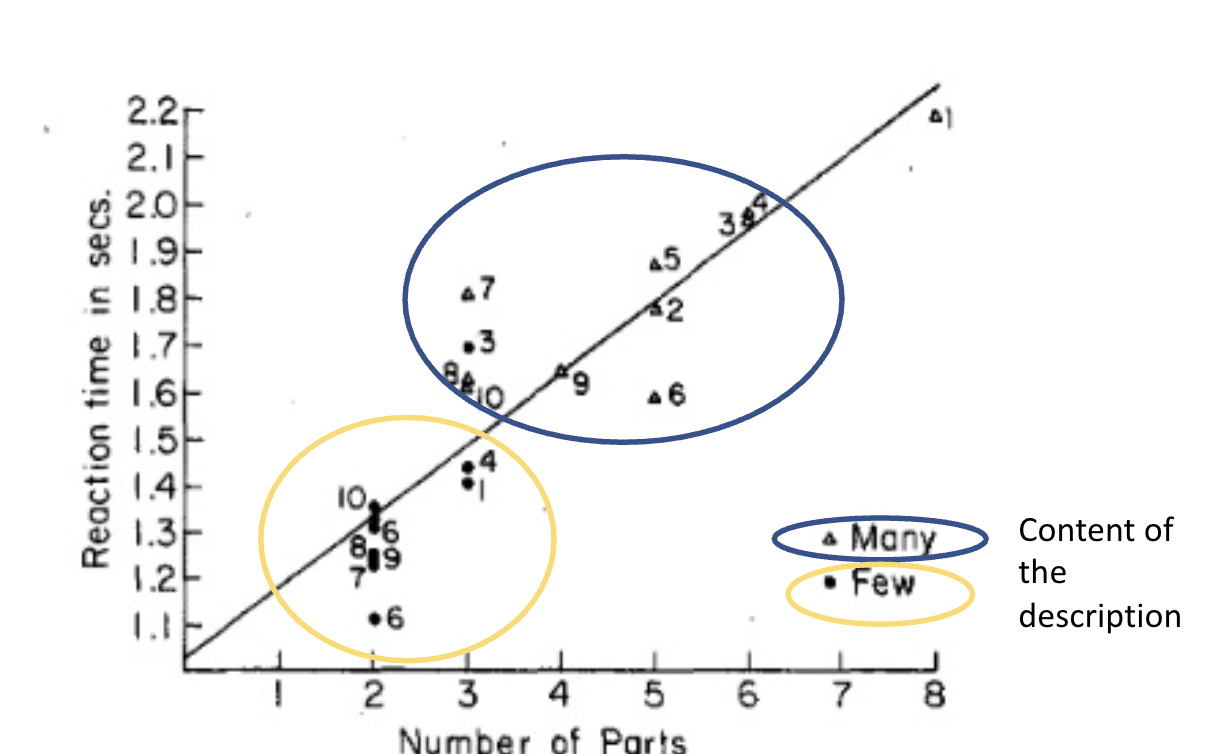
What were the results of Kosslyn's structural equivalence Experiment?
The first findings were that there was a positive correlation between reaction time and the number of parts (complexity of the stimulus). Complex objects require a longer time to image.
The second findings were taht complex descriptions had slower reaction times. This shows the effect of language on structural complexity.
Given these principles of visual imagery, it sounds like we have a mental 3D space!
What is spatial cognition and when do we use it?
Interaction between the mental 3D space and the actual environment
Us knowing where we are
Us knowing where to go
Situated in the context physically and/or mentally
The interaction of our mental space with the real world
List from low to high cognition
Lowest- sensory input
You perceive it
You give it attention
Memory, specifically short term and working memory and longterm bc it is after attention so it doesnt include sensory memory.
After there is higher level cognition, so reasoning, problem solving, and decision making
Then language at the top bc language is intertwined with every domain of cognition
role of language
Effective communication
• Survival: signaling food
resource and danger
• Socialization
• Passing down the knowledge
• Verbalizing emotions and
thoughts
Chomsky’s views on language
Nativism
• Universal Grammar: the principle that humans are born with an innate set of principles that govern all languages
Skinner’s views on language
Behaviorism
• Reinforcement and conditioning
• Stimulus-response
• Behavioral studies of verbal behavior
What’s the role of language in storing an event in long-term memory (and what kind of long term memory)
Language plays a critical role in storing an event in long-term memory by providing a framework to encode, organize, and retrieve information, especially when the event is stored as episodic memory
Higher level cognition according to Ragni & Stolzenburg (2015) includes what?
Includes language, reasoning, problem solving, decision making
What are some interactions between language and cognitive functions?
Labeling of objects- recognition
Categorization
Long-term memory
Working memory- phonological loop
Etc...
Who was Koko the gorilla and what question did she raise?
The was a gorilla that leaned to speak over 1000 signs in sign language. This raised the question of if she actually used this language to think.
Who was Kanzi the ape?
He was an ape that memorized lexigrams and used them to communicate. The fact that he was able to learn and combine them shows that he had a lot of higher cognitive functions.
What is the Clever Hans effect?
Hans was a horse that was seemingly able to do simple addition math by tapping foot for answers, however it was discovered later that the owner was giving him cues of when to start and stop tapping. What this means now is when it seems as if an animal is comprehending language when they are not in reality.
What are at least two major features that differentiate human language from animal communication?
POLICE DEPARTMENT
Productivity of utterance which is unlimited in humans.
Displacement which is the ability to talk about space and time freely as human can discuss the future, past, here, and there while animals are very limited in this.
What are the strongest, weaker and weakest versions of the hypothesis?
The strongest version suggests that language directly influences thought and behavior, while the weaker version states that language influences certain thoughts without enforcing total control. The weakest version asserts that language is simply one of many factors affecting thought processes.
linguistic determinism
The form of our language determines our cognition: how we think, remember and perceive. Basically without language, we wouldn't be able to think. This is a very strong hypothesis.
What is linguistic relativism?
Different languages generate different cognitive structures (e.g. categorization, description of objects etc). It is less strong than the other theory.
What is an example of linguistic relativism?
The language Hopi has two different words for different types of water, a river is a different word than a bottle of water. Also, in English, we have one word for all types of snow, Eskimo has three different words
In the song version, linguistic determinism, what does language affect?
Language determines thought and every aspect of our cognition.
In the weaker version, linguistic relativism, what does language affect?
Language affects only perception/categorization.
In the weakest version, linguistic relativism, what does language affect?
The influence of language is "task-dependent" (tasks requiring language).
why is it difficult to find evidence for linguistic determinism
because it asserts that language restricts thought entirely, making it difficult to test or isolate language's influence from other cognitive and environmental factors.
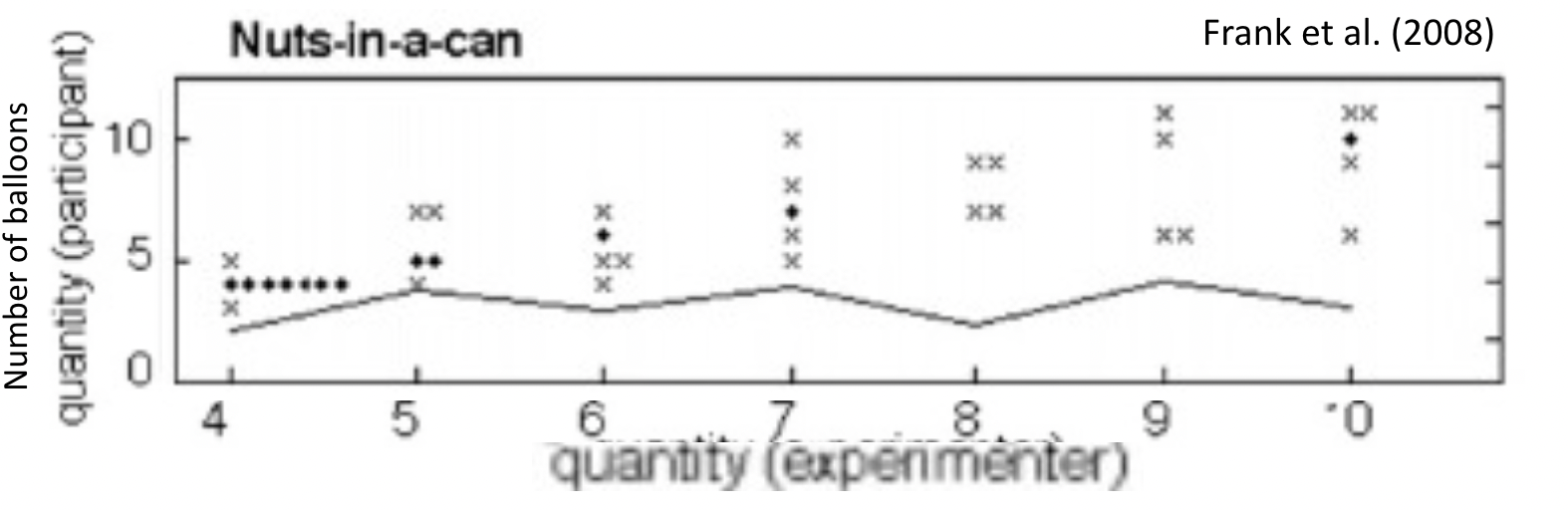
How to test Sapir-Whorf using Piraha language?
The Piraha language has three words for counting, one, two, and many. In this study, subjects respond by showing a matching number of balloons, sense of quantity influenced by their language: evidence for relativism: the larger the quantity, the larger the error rate. Most participants get this right when it is smaller numbers but the more you increase, they start getting it wrong.
Impact of aphasia on abstract thinking, Renzi et al (1966)
4 groups of Ss
Normal
Aphasics
Right-hemipshere damaged but non-aphasic
Left-hemisphere damaged but non-aphasic
Task: Weigl Sorting test - in this task theres different cards that you can sort by three different ways shape, color, pattern inside card
1. Sort all cards in any way (e.g. color, shape, or object inside card)
2. Verbalize sorting strategy
3. Sort in an alternative way
results of Impact of aphasia on abstract thinking, Renzi et al (1966)
Normal peoples performance was good
Right hemisphere damaged but non aphasic, not much different but maybe a little worse than normal
Left hemisphere damaged but not apshasic was way worse bc of the language component in the task however it was much much better than aphasic
This supports relativism (weak or weakest version)
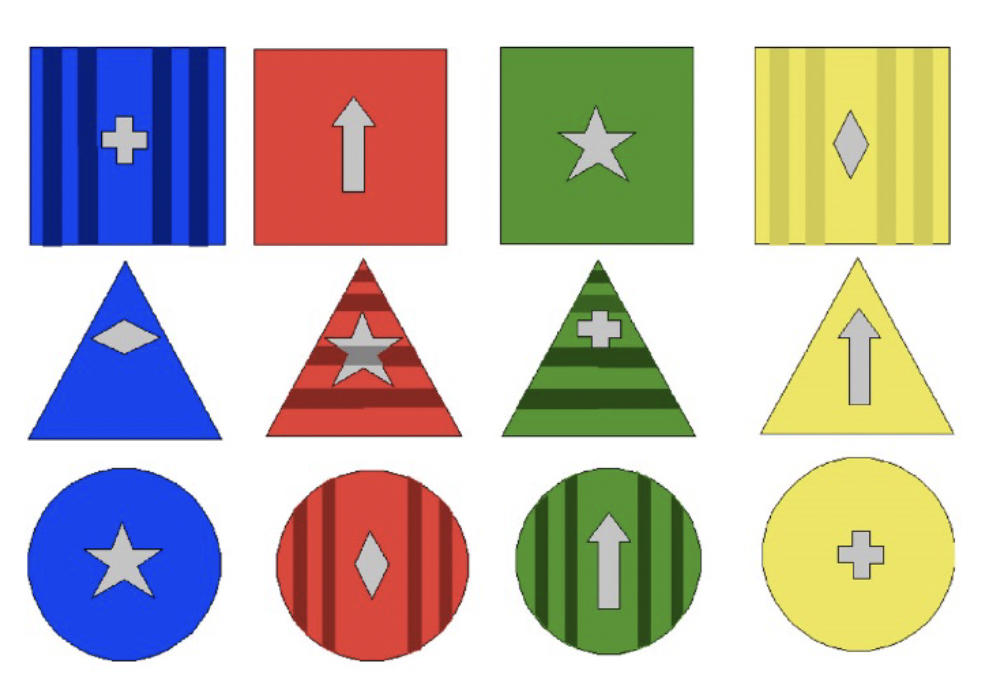
Weigle Sorting test
1. Sort all cards in any way
(e.g., by color, shape, or
object inside the card)
2. Verbalize sorting strategy
3. Sort in an alternative way
Supplementary genstures
add information
for example, pointing to an apple and saying eat
complementary gestures
redundant
for example, pointing to an apple and saying apple
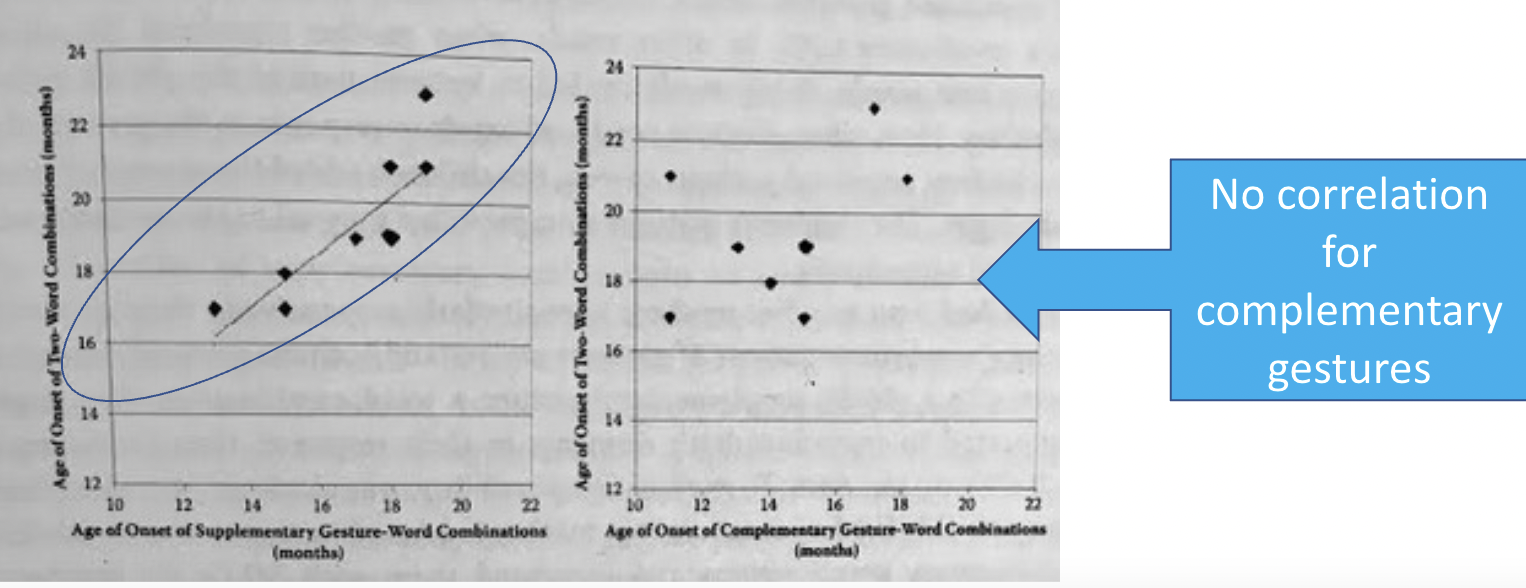
Iverson & Goldin-Meadow (2005)
Positive correlation between onset age of supplementary
gestures and onset of two-word stage
No correlation for complementary gestures
Cross-modal binding task:
associate a visual with an
auditory input
Phonological binding task:
auditory with auditory
underextension
failure to generalize from one exemplar to others (being to specific (e.g. you are only exposed to huskies so you think that is a dog, but other kinds of dogs, like german shepherds, are not dogs)
overextension
overgeneralize one label to all other members in the broader category (e.g animals, a girafe, a zebra, and an elephant are also all dogs)
Working memory and vocabulary learning, Gathercole & Baddeley (1990)
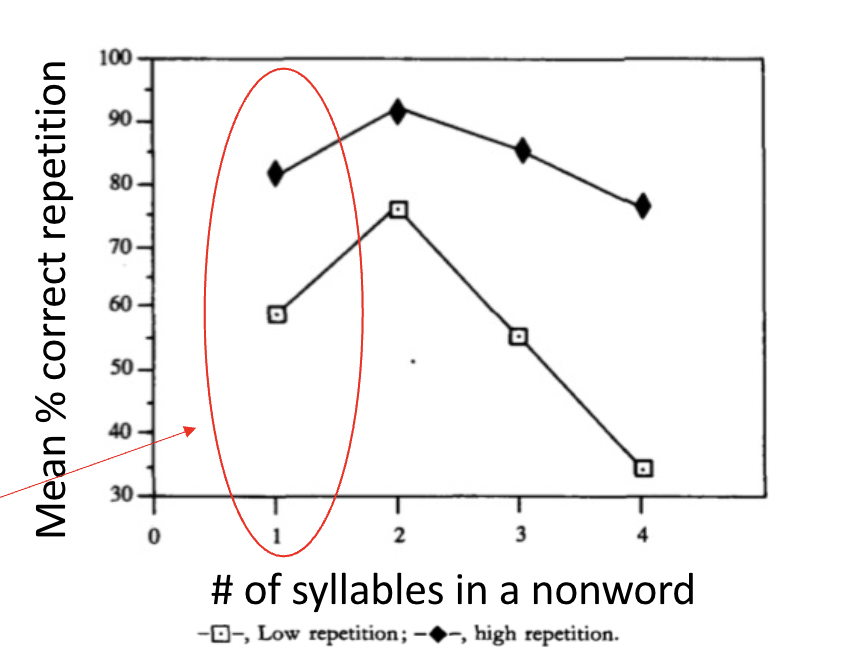
Had 5-6 year old children divided into low vs high repetition of nonword repetition (a WM measure)
Main task:
Objects name association task, basically a paired associated learning task
Pair objects with real names like martine, jenny etc and names from nonwords like sommel
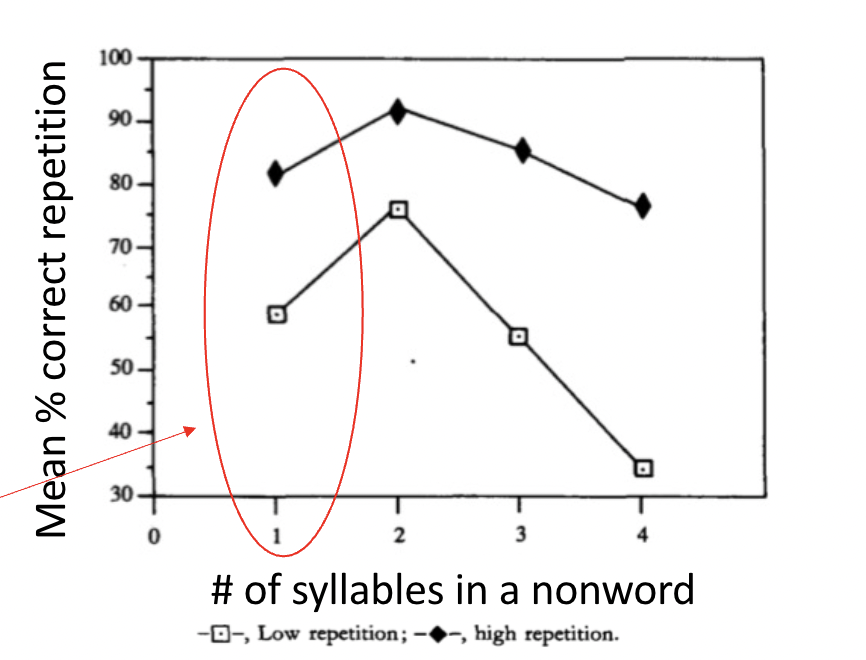
results from Working memory and vocabulary learning, Gathercole & Baddeley (1990)
Basically, if you have higher working memory, you will need less time to memorize
What is a low vs high repetition group in Gathercole & Baddeley
The low repetition group consists of children who practice nonword repetition fewer times, while the high repetition group practices more frequently, allowing for better retention and recall in vocabulary tasks.
What is an object-name association task
A paired associative learning task where participants learn to associate object names with their corresponding labels, either real or nonwords.
What does the graph tell us?
Monosyllables repeated less accurately than disyllables?!
Harder to pronounce than disyllables due to stimuli selection
Results from object names association smaller number is better, high repetition group needs less time for learning
What they focus on is how many trials the groups needed to learn, this is more important than how many correct or not
High rep. Group scored higher than low rep
which group learns faster
The high repetition group learns faster than the low repetition group, needing fewer trials to associate object names with their labels.
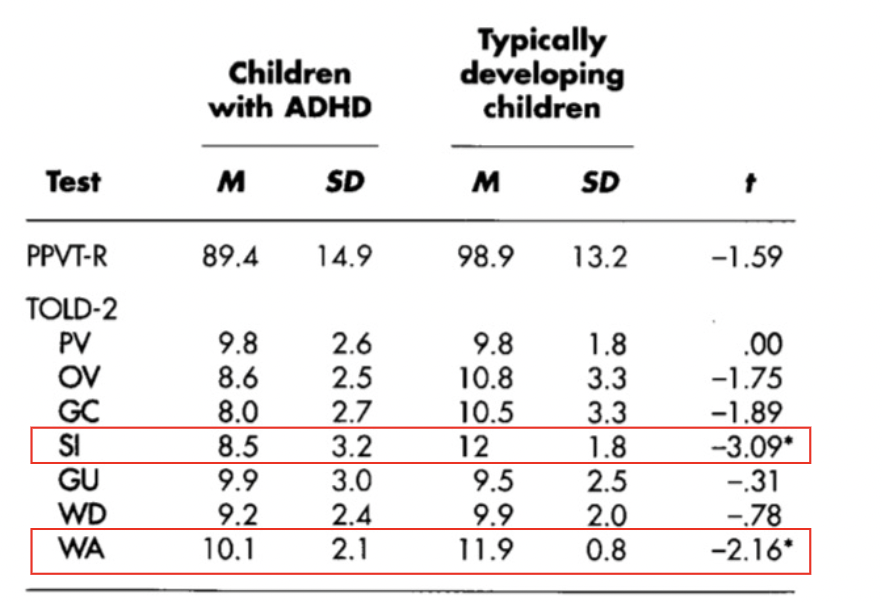
Why do children with ADHD do the worst in SI (sentence imitation) and WA (word articulation) in the TOLD-2 test?
Children with ADHD often struggle with sentence imitation and word articulation due to challenges in attention and working memory, which negatively impact their ability to process and reproduce language accurately.
benefits of bilingualism
Evidence that biliguals experience better executive control: suppressing influence from L1 while speaking L2
Metalinguistic awareness: ability to figure out and describe patterns and rules
Better performance in cognitive tasks: attention shift/control task means a shift between L1 and L2
Metalinguistic awareness
The ability to understand and analyze language as a system, including detecting patterns, rules, and the structure of languages.
What are the two possibilities of representation of concepts in bilinguals?
Bilinguals may represent concepts using either a single, integrated system for both languages or separate systems for each language, leading to different levels of access and processing efficiency depending on the context.
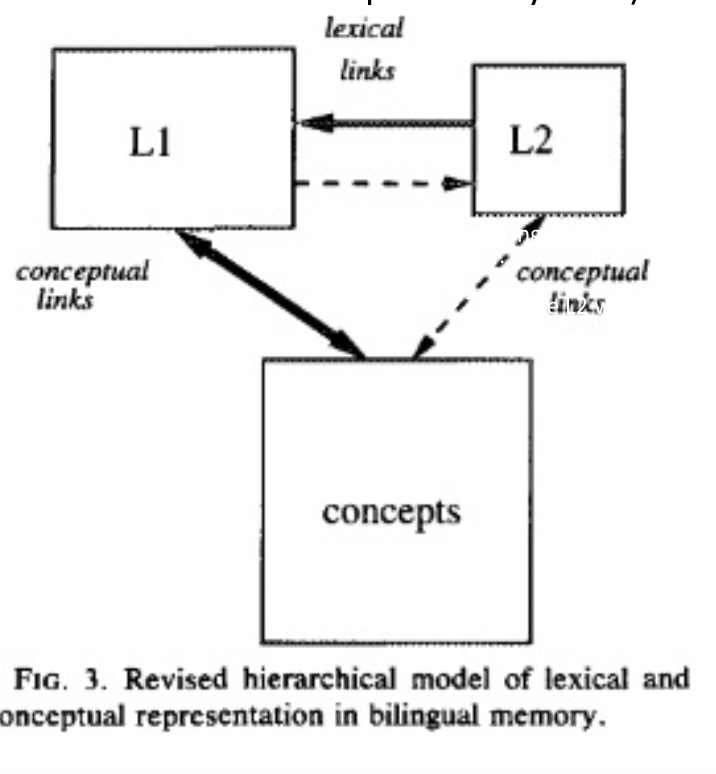
what is hierarchical model of bilingual memory’s assumption
Assuming one unified conceptual
representation for both languages
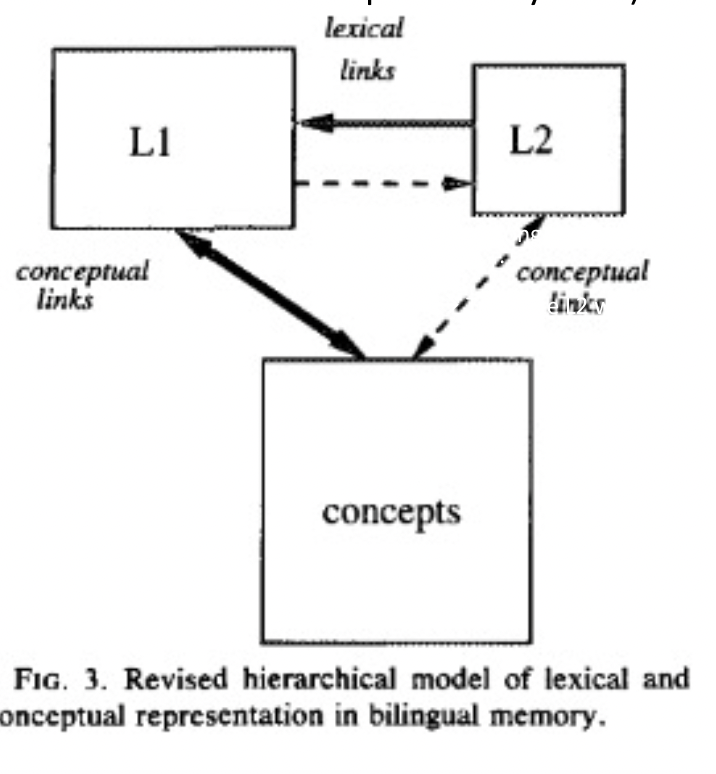
Why does L1 have a stronger connection with concepts?
Because it is typically acquired first and used more frequently in various contexts, leading to deeper cognitive associations.
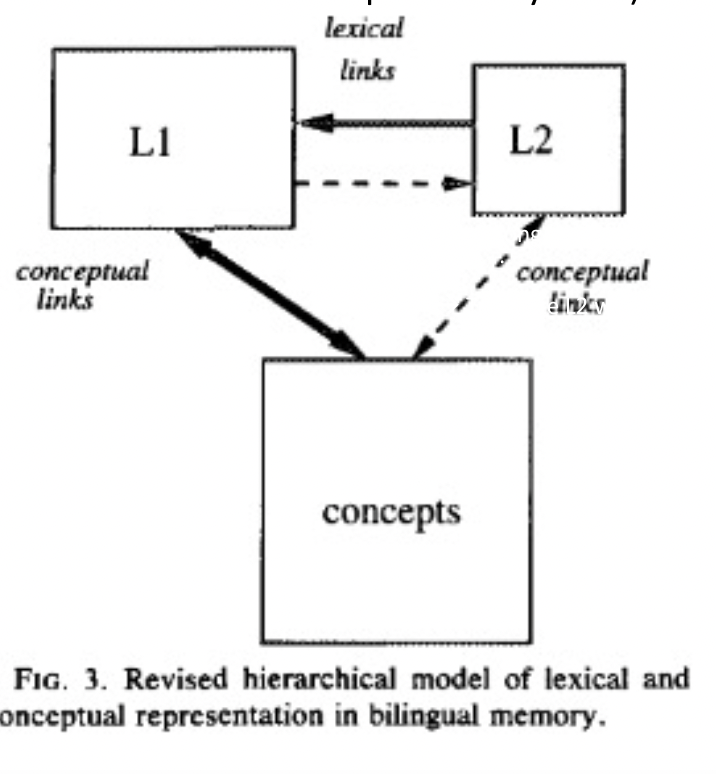
How are words in L2 translated to L1?
Words in L2 are translated to L1 by accessing the shared conceptual representations in the bilingual's memory, often relying on their stronger L1 connections.
Test attention shift in mono vs bilinguals
Trial 1: feature 1 then respond
Trial 2: feature 2 then respond based on feature 1: preservation
Switch cost: RT(F2)-RT(F1)
Controlled process instead of automatic
Say you present the word lion
Then you ask if it is a word
Then you present bilak
And ask upper case?
The answer is yes but some people might get stuck on the first question and say no
What is perseveration?
Perseveration is the repetition or continuation of a response, even when it is no longer relevant or appropriate, often observed in tasks requiring cognitive flexibility.
How do we calculate switch cost?
RT(F2) – RT (F1)
RT (upper case?) - RT (word?)
What does switch cost imply?
Switch cost implies that there is a cognitive cost associated with shifting attention or tasks, indicating decreased efficiency when transitioning from one task to another.
is switching controlled or automatic process
controlled
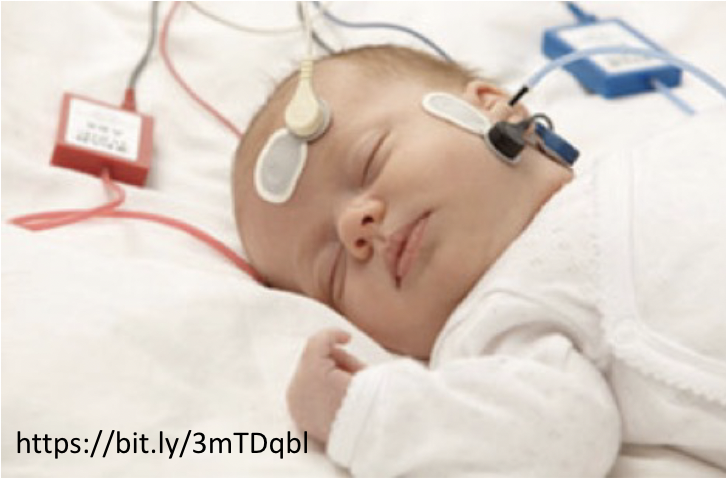
Krizmen et al
Basically looked at spanish (bilingual) vs monolignuial english speaking babies
measured Neurophysiological measure: “auditory
brainstem response to complex sounds
(cABR)
What is sustained selective attention, how do we test it?
Sustained selective attention is the ability to maintain focus on a specific task or stimulus for an extended period, filtering out distractions and irrelevant information.
What is cABR? What does it measure?
cABR stands for cortical Auditory Brainstem Response, which measures the brain's neural responses to auditory stimuli, reflecting the brain's processing of complex sounds.
For listening, is cABR a passive or active task?
passive
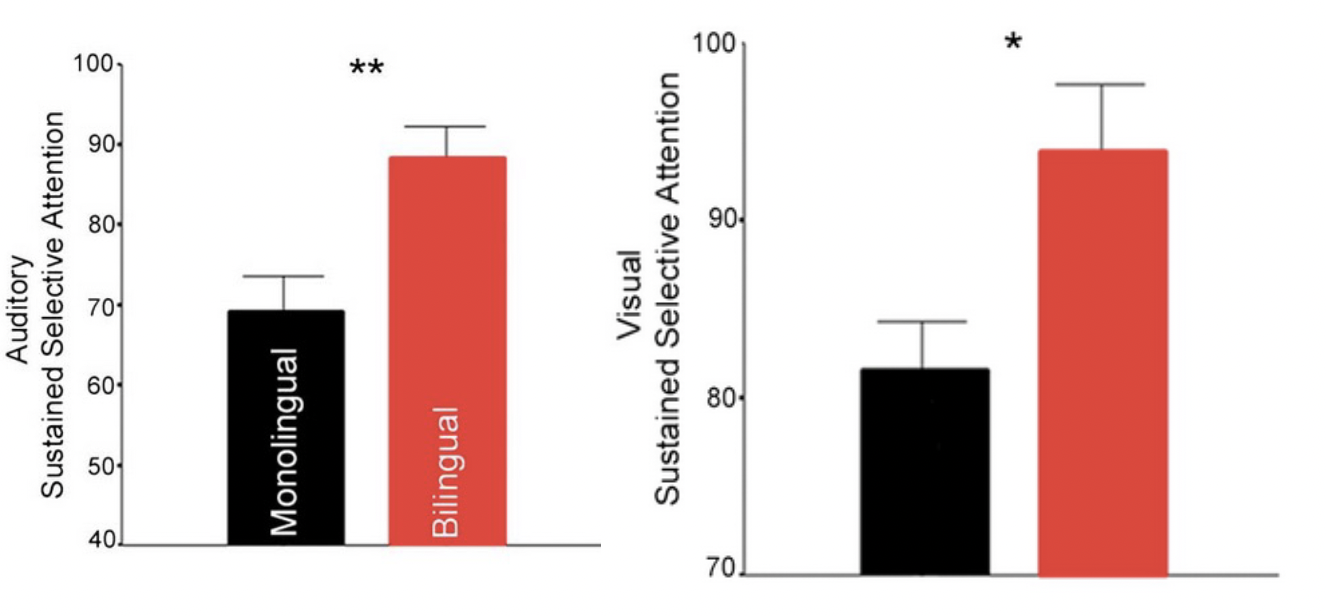
What are the results of Krizmen- auditory and visual?
Behavioral results (standardized scores)
from attention task: billing. > mono. in both visual and auditory
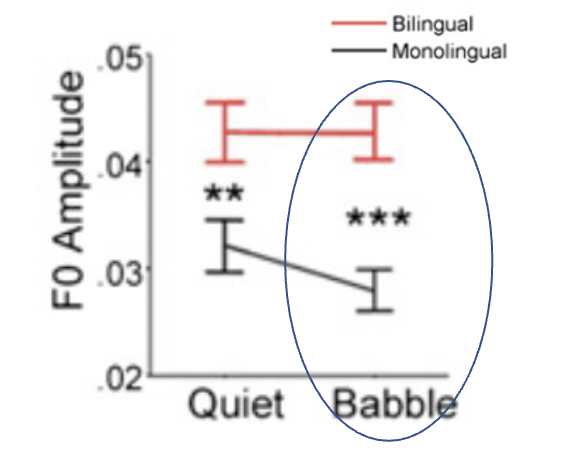
How do bilingual and monolingual people perceive pitch in the quiet vs. babble environment?
Bilingual individuals may be more adept at pitch perception in both quiet and noisy environments compared to monolingual individuals, potentially due to their enhanced auditory discrimination skills.
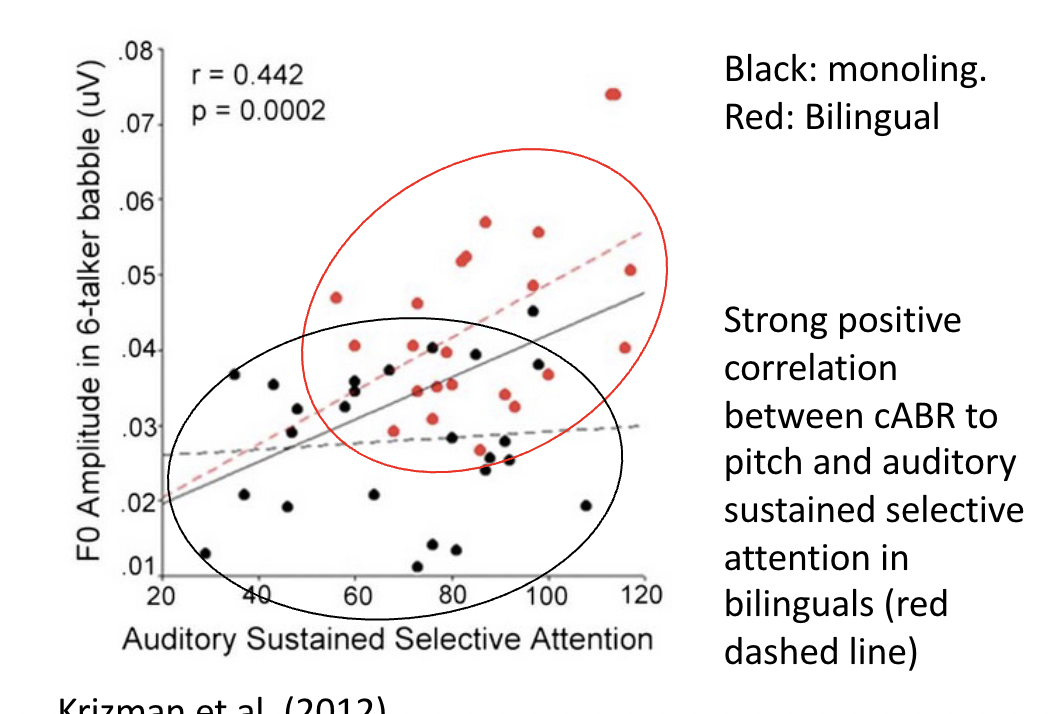
What is the relationship between cABR and auditory sustained selective attention? How is this relationship different in monolingual vs. bilingual group?
cABR may reflect the efficiency of auditory sustained selective attention, with bilingual individuals showing enhanced attention-related effects compared to monolinguals.
 Note
Note  Flashcards (56)