embryology (complete)
0.0(0)
 Studied by 0 people
 Call Kai
 Learn
Learn Practice Test
 Spaced Repetition
 Match
Match Flashcards
 Knowt Play
Card Sorting
1/263

Earn XP
Description and Tags
Last updated 4:13 PM on 2/5/23
Name | Mastery | Learn | Test | Matching | Spaced | Call with Kai |
|---|
No analytics yet
Send a link to your students to track their progress
264 Terms
1
New cards
what is a **pathological** result of pregnant women taking **thalodomide**?
**thalodomide** is given as an anti-nausea and antidepressant drug
\
shortened forelimbs if drug was given during the 4th week
shortened hindlimbs if drug was given during the 5th week
\
shortened forelimbs if drug was given during the 4th week
shortened hindlimbs if drug was given during the 5th week
2
New cards
which body system of the embryo is the first to reach its functional state?
cardiovascular system
3
New cards
at which stage do all vertebraes of differnet species look the same?
during the phylotypic stage
4
New cards
what are the 4 major steps in animal evolution?
1. Tissues
2. Symmetry
3. Body cavities (for organs etc)
4. Segmentation (not that much in humans)
2. Symmetry
3. Body cavities (for organs etc)
4. Segmentation (not that much in humans)
5
New cards
where does segmentation take place and is visible?
in the paraxial mesoderm
6
New cards
what does segmentation lead to?
somites formation
7
New cards
which are the two major events of the 4th week?
folding and segmentation
8
New cards
what is the purpose of segmentation?
determining the basic body plan
=> manifestation of expression of gene (can be seen)
later contribution to organ development
=> manifestation of expression of gene (can be seen)
later contribution to organ development
9
New cards
what is an example of results of segmentation in the adult body?
vertebral column
=> divided into segments
=> originates from somites
=> divided into segments
=> originates from somites
10
New cards
from which side to which side does somitogenesis proceed?
from rostral to caudal
=> driven by gradients
=> driven by gradients
11
New cards
how many pairs of somitomers do we have (prior to somitogenesis)?
42-44 pairs
12
New cards
when does somitogenesis start and when does it end?
it starts on the 20th day and ends on the 30th day
13
New cards
what is the final count of somites after the somitogenesis?
35-37
14
New cards
what are the somites going to give rise to?
each somite gives rise to three main compartments:
sclerotome
myotome
dermatome
sclerotome
myotome
dermatome
15
New cards
where do each the axial bones, limb bones and craniofacial bones originate?
axial bones: somites
limb bones: lateral plate mesoderm
craniofacial bones: mesoderm of the head and neural crest cells
limb bones: lateral plate mesoderm
craniofacial bones: mesoderm of the head and neural crest cells
16
New cards
which domains derive from the sclerotome?
ventral domain: vertebral bodies and their intervertebral disks
lateral domain: distal ribs, some tendons
dorsal domain: dorsal part of neural arch, spinous process
central domain: pedicles and ventral parts of neural arches, proximal ribs, or transverse processes of vertebrae
medial (meningotome) domain: meninges and blood vessels of meninges
lateral domain: distal ribs, some tendons
dorsal domain: dorsal part of neural arch, spinous process
central domain: pedicles and ventral parts of neural arches, proximal ribs, or transverse processes of vertebrae
medial (meningotome) domain: meninges and blood vessels of meninges
17
New cards
which domains derive from the arthrotome?
intervertebral disks, vertebral joint surfaces, proximal ribs
18
New cards
which domains derive from the dermatome?
dermis, blade of the scapula
19
New cards
which domains belong to the myotome?
dorsomedial: intrinsic back muscles (epaxial)
ventrolateral: limb muscles or muscles of ventrolateral body wall (hypaxial)
ventrolateral: limb muscles or muscles of ventrolateral body wall (hypaxial)
20
New cards
which domains belong to the syndetome?
tendons of epaxial mesculature
21
New cards
where do the axial bones originate?
somites
22
New cards
where do the limb bones originate?
lateral plate mesoderm
23
New cards
where do the craniofacial bones originate?
mesoderm of the head and neural crest cells
24
New cards
in which three categories are the bones of the body divided?
axial bones, limb bones, craniofacial bones
25
New cards
which structure forms the nucleus polposus of the intervertebral disks?
the notochord
26
New cards
how many vertebrae derive from one somite?
two vertebrae from one somite
27
New cards
what does the vertebral canal encase?
the spinal cord
28
New cards
in which two domains can the myotome be divided and what specifically does each domain give rise to?
epimere (more dorsal) and hypomere (more ventral)
epimere: epaxial muscles (intrinsic muscles of the back)
hypomere: hypaxial muscles (lateral body walls and limbs)
epimere: epaxial muscles (intrinsic muscles of the back)
hypomere: hypaxial muscles (lateral body walls and limbs)
29
New cards
what is the process of the formation of the limb muscles?
progenitor myogenic cells migrate into the limb bud from the ventral portion of the myotome
formation of a ventral muscle mass (mainly flexors, pronators, and adductors) and a dorsal muscle mass (mainly extensors, supinators, and abductors)
formation of a ventral muscle mass (mainly flexors, pronators, and adductors) and a dorsal muscle mass (mainly extensors, supinators, and abductors)
30
New cards
what is included in the ventral muscle mass during the formation of the limb muscles?
mainly flexors, pronators, and adductors
31
New cards
what is included in the dorsal muscle mass during the formation of the limb muscles?
mainly extensors, supinators, and abductors
32
New cards
into which functional segments is the neural tube divided during segmentation?
into the spinal chord segments
33
New cards
which compartments and domains are being innervated by each segment of the neural tube?
cutaneous territory (dermatome)
muscular territory (myotome)
tendineous territory (sclerotome)
muscular territory (myotome)
tendineous territory (sclerotome)
34
New cards
what are body cavitites lined by?
a serosa
35
New cards
which other structure is the development of the primitive circulation connected to?
the endocardial tube
36
New cards
where does the formation of bloof vessels begin?
in the extraembryonic mesoderm of the yolk sac, in the
connecting stalk and chorion
connecting stalk and chorion
37
New cards
to which three symmetric networks of vessels is the heart connected?
• embryonic network
• vitelline (yolk sac) network
• umbilical network (to placenta)
• vitelline (yolk sac) network
• umbilical network (to placenta)
38
New cards
what is the definition of an artery?
the arteries bring blood from the heart to the periphery
39
New cards
what is the definition of the vein?
the veins bring blood from the periphery to the heart
40
New cards
which veins carry blood to the inflow portion of the cardiac tube of the embryo?
Umbilical vein/s
Vitelline veins
Cardinal veins: Segmental veins
Vitelline veins
Cardinal veins: Segmental veins
41
New cards
how oxygenated is the blood of the umbiblical vein?
richly oxygenated
42
New cards
how oxygenated is are the vitelline veins?
poorly oxygenated
43
New cards
how oxygenated is the blood of the cardinal veins?
poorly oxygenated
44
New cards
Considering blood that is entering the inflow portion of the heart tube, which type of blood is the heart pumping out and to where?
the cardiac tube pumps out medium oxygenated blood to the pharyngeal arch arteries and then to the dorsal aortae
45
New cards
which arteries are the vessels of the outflow portion of the cardiac tube and where do they go?
Vitelline arteries (blood to the sac and to the primitive intestine)
Umbilical arteries: from the body of the embryo to the placenta
Segmental arteries (not shown): perfuse the body of the embryo
Umbilical arteries: from the body of the embryo to the placenta
Segmental arteries (not shown): perfuse the body of the embryo
46
New cards
what is angiogenesis?
the development of blood vessels
47
New cards
the erythrocytes of the human adult body are produced in the bone marrow. which structures produce them in the embryo?
the yolk sac and the AGM
the the plasma, the spleen and the liver
the the plasma, the spleen and the liver
48
New cards
which are the two processes involved in the formation of blood vessels?
vasculogenesis and angiogenesis
49
New cards
what is vasculogenesis?
the formation of blood vessels ex novo (from scratch)
50
New cards
what are the phases of **gametogenesis**?
**phase 1**: migration of primordial germ cells
**phase 2**: increase in the number of primordial germ cells by mitosis
**phase 3**: reduction in chromosomal number by meiosis
**phase 4**: structural and functional maturation of egg and sperm - spermatogenesis and oogenesis
**phase 2**: increase in the number of primordial germ cells by mitosis
**phase 3**: reduction in chromosomal number by meiosis
**phase 4**: structural and functional maturation of egg and sperm - spermatogenesis and oogenesis
51
New cards
what happens during the **first phase** of **gametogenesis**?
the **primordial germ cells (PGC)** migrate from the endoderm of the **yolk sac** to the **gonads**
52
New cards
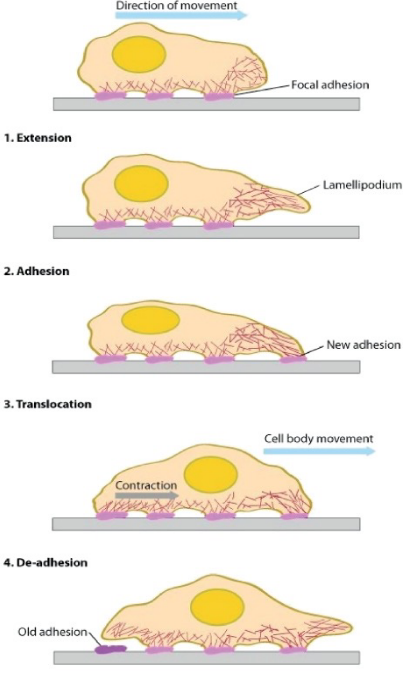
how do the **primordial germ cells** migrate?
the migration requires a dynamic **rearrangement** of the **cytoskeleton**: the actin filaments in the cytoskeleton are polymerised at the leading edge => are translated into protrusion force
**transmembrane cell surface receptors** bind to the substratum components (facilitated by the membrane protrusion)
**retrograde actin movemen**t and contractile forces of stress fibres generate tension which pulls the cell body forward => trailing cell edge is retracted through F-actin disassembly
**transmembrane cell surface receptors** bind to the substratum components (facilitated by the membrane protrusion)
**retrograde actin movemen**t and contractile forces of stress fibres generate tension which pulls the cell body forward => trailing cell edge is retracted through F-actin disassembly
53
New cards
which are the two ways of dating pregnancy?
1. by the day of fertilisation: which is basically impossible, it is rarely used
2. by the last menstrual period (LMP): first day of LMP + 280 = EDD (expected date of delivery). this method assumes a regular menstrual cycle of 28 days with ovulation on the 14th
54
New cards
what are **teratogens**?
chemical, physical or biological agents that can possibly alter the **fetal morphology** or **function**
55
New cards
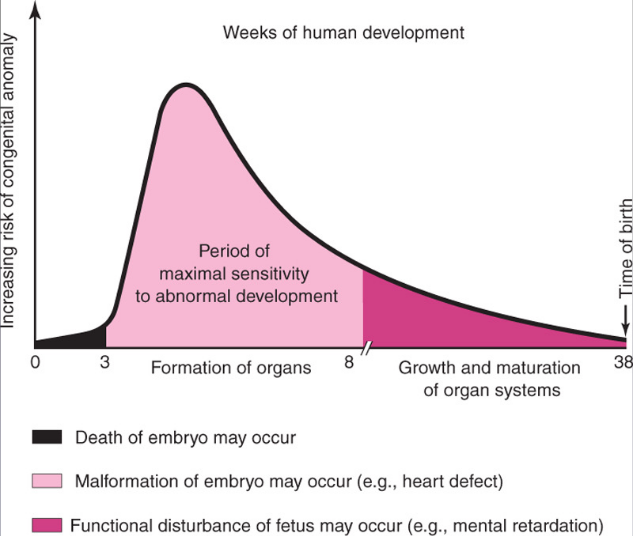
when is the embryo most and least susceptible to **teratogens**?
**resistance period (1st - 2nd week)**: embryo either dies or survives unaffected
**maximum susceptibility period (3rd - 8th week)**: all organs undergo morphogenesis
=> lots of potential for damage
**lower susceptibility period (9th - 38th week)**: the bases of the organs are already formed; functional damage is possible
**maximum susceptibility period (3rd - 8th week)**: all organs undergo morphogenesis
=> lots of potential for damage
**lower susceptibility period (9th - 38th week)**: the bases of the organs are already formed; functional damage is possible
56
New cards
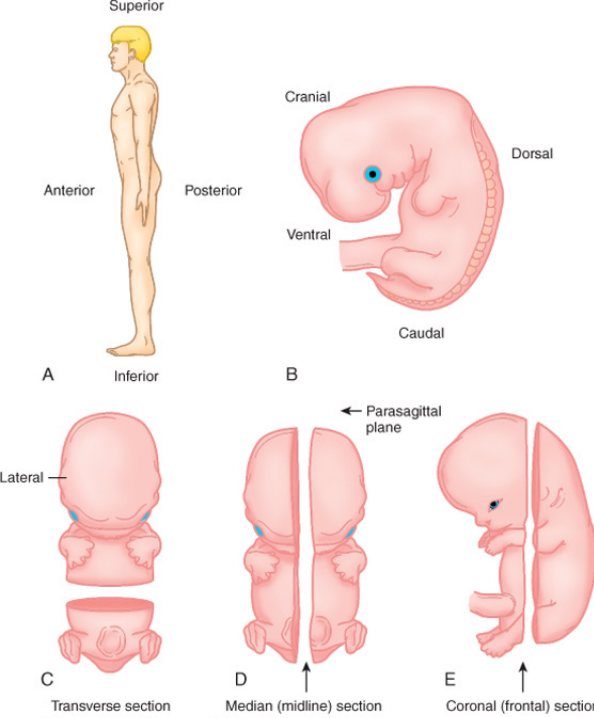
body axes and planes for the embryo: what is **anterior** and **posterior** in the embryo?
ventral and dorsal, respectively
57
New cards
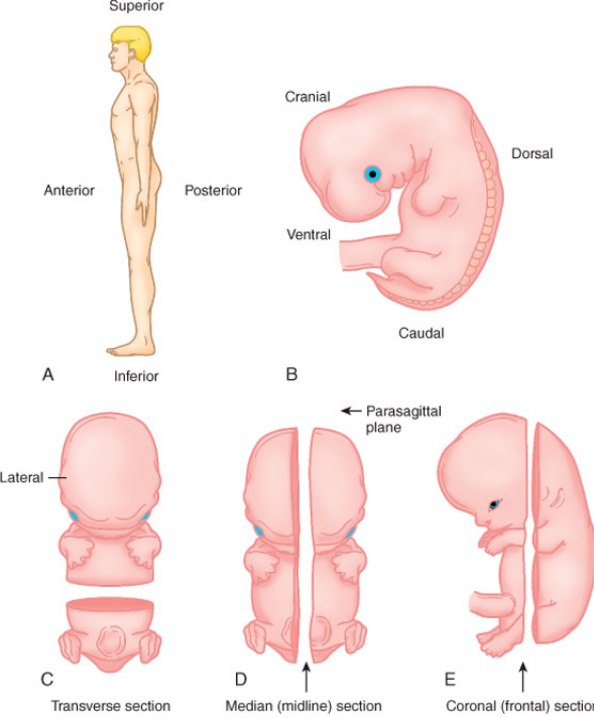
body axes for the embryo: what are **superior** and **inferior** in the embryo?
cranial and caudal, respectively
58
New cards
how do **teratomas** in the primordial germ cells develop?
they are the result of a mistake in the process of **maturation** or **migration** of the **primordial germ cells**. the tumours include components or tissues that are derived from the 3 embryonic layer. they can form in the **gonads** or in an **extragonadal** site and can be mature and immature.
59
New cards
which structure do **primordial germ cells** use during migration to reach their destination?
they follow along the sympathetic nerve fibres towards the **genital ridge**
=> the genital ridge will later form the gonads
=> the genital ridge will later form the gonads
60
New cards
is the **second phase** of **gametogenesis** the same for males and females?
no
61
New cards
what happens during the **second** **phase** of **gametogenesis** in females?
the primordial germ cells in the ovary are invested by support cells and become oogonia
by the 5th month they have entered the prophase of the first meiotic division
numbers of primodrial germ cells in the body:
5th month: 7 million
birth: 2 million
puberty: 40.000
ovulated: 400
=> the rest die
by the 5th month they have entered the prophase of the first meiotic division
numbers of primodrial germ cells in the body:
5th month: 7 million
birth: 2 million
puberty: 40.000
ovulated: 400
=> the rest die
62
New cards
what happens during the second phase of gametogenesis in males?
the primordial germ cells proliferate during the early embryonic period and become spermatogonia
from the 6th week onward the spermatogonia become dormant until puberty
from puberty onward they continuously proliferate throughout life
from the 6th week onward the spermatogonia become dormant until puberty
from puberty onward they continuously proliferate throughout life
63
New cards
what generally happens during the third phase of gametogenesis?
the number of chromosomes is reduced through meiosis
=> paternal and maternal chromosomes are reassorted
during the crossing over (prophase I), the maternal and paternal genetic information is redistributed
is differently paced for males and females
viable gametes are formed
=> 4 in males and 1 in females
=> paternal and maternal chromosomes are reassorted
during the crossing over (prophase I), the maternal and paternal genetic information is redistributed
is differently paced for males and females
viable gametes are formed
=> 4 in males and 1 in females
64
New cards
to which condition can mistakes during the second phase of gametogenesis (reduction in chromosomal number through meiosis) lead?
down-syndrome
65
New cards
what happens during the third phase of gametogenesis in females?
by the 5th month all the oogonia begin meiosis
=> they are now called primary oocytes
they also store material for the first needs of the embryo
=> they are now called primary oocytes
they also store material for the first needs of the embryo
66
New cards
when does meiosis I happen in the oocyte?
it begins during the 5th month of fetal development and completed at ovulation (may take up to 50 years)
=> the oocyte is arrested in the meantime
=> the oocyte is arrested in the meantime
67
New cards
how long can meiosis I take in females?
up to 50 years
68
New cards
when does meiosis II happen in the oocyte?
it happens only if the egg is fertilised
69
New cards
what happens during the third phase of gametogenesis in males?
is initiated through a surge of testosterone during puberty
the sertoli cells (somatic cells) mature into seminiferous tubules
the primordial germ cells proliferate and form spermatogonia
=> mature asynchronous: they constantly mature, like waves
the sertoli cells (somatic cells) mature into seminiferous tubules
the primordial germ cells proliferate and form spermatogonia
=> mature asynchronous: they constantly mature, like waves
70
New cards
what are sertoli cells?
they form the blood-testis barrier
they secrete the tubular fluid and the androgen-binding protein (also other proteins)
other proteins:
=> inhibin for feed-back loop to hypothalamus (inhibits FSH production)
=> mullerian inhibiting factor (prevents development of female reproduction organs)
=> retinol-binding protein
they secrete the tubular fluid and the androgen-binding protein (also other proteins)
other proteins:
=> inhibin for feed-back loop to hypothalamus (inhibits FSH production)
=> mullerian inhibiting factor (prevents development of female reproduction organs)
=> retinol-binding protein
71
New cards
which structure compose the wall of the seminiferous tubules in the testis?
setoli cells and spermatogonia or spermatozoa in various stages of differentiation
72
New cards
what are Leydig cells and what is their function?
they are interstitial cells, adjacent to the seminiferous tubules
they secrete testosterone under the control of the lutenising hormone (LH) secreted by the hypophysis/pituitary gland
they secrete testosterone under the control of the lutenising hormone (LH) secreted by the hypophysis/pituitary gland
73
New cards
which cells are responsible for the secretion os testosterone in the testis?
the Leydig cells
74
New cards
where can the stroma or interstitial space be found in the testis and what is it composed of?
it surrounds the seminiferous tubules
is composed of:
=> connective tissue
=> Leydig cells
=> (endocrine) blood vessels
=> lymphatic vessels
=> nerves
=> cells of the immune system
is composed of:
=> connective tissue
=> Leydig cells
=> (endocrine) blood vessels
=> lymphatic vessels
=> nerves
=> cells of the immune system
75
New cards
what is the purpose of the adluminal compartment?
it creates an immunosuppressive environment for the innumologically different developing sperm cells
76
New cards
what separates the luminal compartment from the basal compartment in the testis?
the sertoli cells connected through tight junctions
77
New cards
which stage of sperm cells can be found in the basal compartment of the testis?
spermatogonia and early primary spermatocytes
78
New cards
what makes the testis an immune-privileged organ?
it protects itself from auto-antigens and associated immune responses through the formation of the blood-testis barrier
prevents immune attacks
prevents immune attacks
79
New cards
what does a disruption of the blood-testis barrier result in?
infertility
=> the blood in the testis is exposed to antigens which in turn start an immune response
=> the blood in the testis is exposed to antigens which in turn start an immune response
80
New cards
what are type A spermatogonia?
a stem cell population that mitotically maintains the propter numbers of spermatogonia throughout life
81
New cards
what is an additional function of the primary spermatocytes?
they produce molecules that will be needed later on in advance
=> for example a variety of RNA molecules (e.g. protamines, proteins that later replace the histones)
=> for example a variety of RNA molecules (e.g. protamines, proteins that later replace the histones)
82
New cards
what happens during spermatogenesis (phase 4 of gametogenesis)?
the development from spermatogonia to spermatids
it takes place in the seminiferous tubules
formation of type A spermatogonia which give rise to type B spermatogonia
type B spermatogonia leave the mitotic cylce and enter the meiosis
=> become primary spermatocytes
the primary spermatocytes migrate to the adluminal compartment
=> an immunosuppressive environment is necessary, because after meiosis I begins, the spermatocytes become immunologically different
after the primary spermatocytes complete meiosis I, they become secondary spermatocytes and enter meiosis II without delay
each secondary spermatocyte produces two spermatids (immature haploid gametes)
in total: from each spermatogonium come four spermatids
it takes place in the seminiferous tubules
formation of type A spermatogonia which give rise to type B spermatogonia
type B spermatogonia leave the mitotic cylce and enter the meiosis
=> become primary spermatocytes
the primary spermatocytes migrate to the adluminal compartment
=> an immunosuppressive environment is necessary, because after meiosis I begins, the spermatocytes become immunologically different
after the primary spermatocytes complete meiosis I, they become secondary spermatocytes and enter meiosis II without delay
each secondary spermatocyte produces two spermatids (immature haploid gametes)
in total: from each spermatogonium come four spermatids
83
New cards
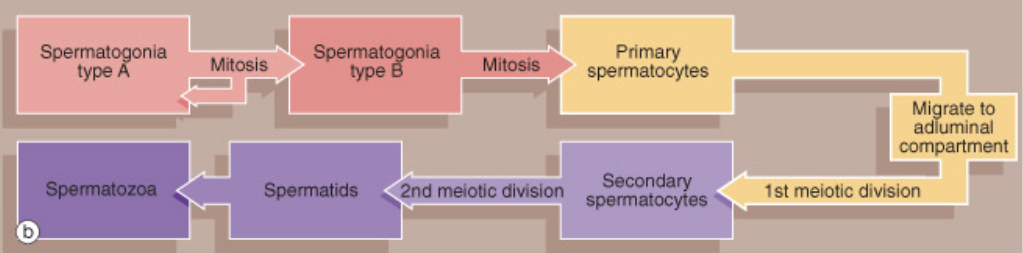
what are the different stages of sperm cells during spermatogenesis (overview)?
spermatogonia type A
=> mitosis
spermatogonia type B
=> mitosis
primary spermatocytes
=> migration to adluminal compartment
=> meiosis I
secondary spermatocytes
=> meiosis II
spermatids
spermatozoa
=> mitosis
spermatogonia type B
=> mitosis
primary spermatocytes
=> migration to adluminal compartment
=> meiosis I
secondary spermatocytes
=> meiosis II
spermatids
spermatozoa
84
New cards
which are the nuclear events during spermatogenesis?
the size of the nucleus is reduced and its shape changes
the chromosomal material is condensed through protamines
the chromosomal material is condensed through protamines
85
New cards
which are the cytoplasmic events during spermatogenesis?
they cytoplasm is eliminated to make the spermatids lighter
=> cytoplasm is shed along the developing tail and phagocytosed by the sertoli cells
a head is formed
=> the Golgi apparatus is condensed at the apical end (ultimately gives rise to the acrosome)
=> cytoplasm is shed along the developing tail and phagocytosed by the sertoli cells
a head is formed
=> the Golgi apparatus is condensed at the apical end (ultimately gives rise to the acrosome)
86
New cards
what are the morphological changes that occur during spermatogenesis?
the formation of a flagellum that grows out of the centriole
a spiral arrangement of the mitochondria in the proximal flagellum
a spiral arrangement of the mitochondria in the proximal flagellum
87
New cards
what characteristics do spermatozoa have?
they are not yet motile
they are propelled through the epididymis through pressure generated in thee seminiferous tubules, muscle contraction and ciliary movements
they are propelled through the epididymis through pressure generated in thee seminiferous tubules, muscle contraction and ciliary movements
88
New cards
where do spermatozoa mature and acquire motility?
they acquire motility in the epididymis through the factor motility protein (FMP)
=> the FMP is produced by the epididymis cells
they also undergo biochemical maturation: gain a glycoprotein coat
=> the FMP is produced by the epididymis cells
they also undergo biochemical maturation: gain a glycoprotein coat
89
New cards
how is the flagellum activity regulated?
through phosphorylation of tubulin, an increase in the Ca²⁺ content and an increase in cAMP (cyclic adenosine monophosphate) activity
90
New cards
which structures undergo capacitation and what happens during it?
spermatozoa undergo capacitation
=> without it they are unable or poorly able to fertilise
the changes occurring during capacitation are mainly unknown
=> allows for the acrosomal reaction to happen
=> they are associated with the removal of the sperm plasma membrane, proteins, reorganisation of the plasma membrane lipids and proteins
capacitation happens in the female reproductive tract
=> without it they are unable or poorly able to fertilise
the changes occurring during capacitation are mainly unknown
=> allows for the acrosomal reaction to happen
=> they are associated with the removal of the sperm plasma membrane, proteins, reorganisation of the plasma membrane lipids and proteins
capacitation happens in the female reproductive tract
91
New cards
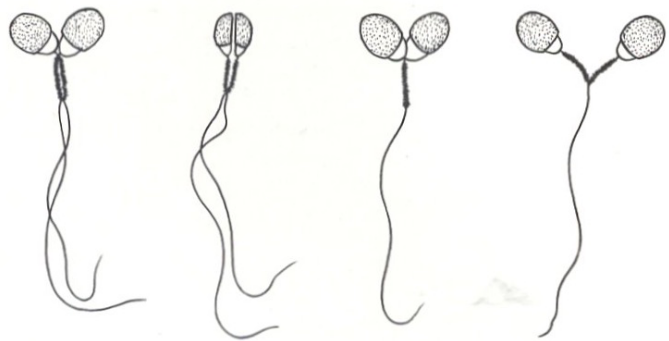
approximately how many of the spermatozoa are abnormal? what does this result in?
normal: about 10%
more than 20% of spermatozoa being abnormal can result in reduced fertility
defects in the axonemal structure cause defects in the sperm motility
=> this often leads to male infertility
more than 20% of spermatozoa being abnormal can result in reduced fertility
defects in the axonemal structure cause defects in the sperm motility
=> this often leads to male infertility
92
New cards
hormomal regulation in the testis: which cells are stimulated by the follicle stimulating hormone (FSH) and where is it secreted?
FSH is secretedin the hypophysis/pituitary gland
it stimulates the sertoli cells to secrete the androgen-binding protein (ABP) and the anti-mullerian hormone (AMH)
it stimulates the sertoli cells to secrete the androgen-binding protein (ABP) and the anti-mullerian hormone (AMH)
93
New cards
hormomal regulation in the testis: which cells are stimulated by the lutenising hormone (LH) and where is it secreted?
LH is secreted in the hypophysis/pituitary gland
it stimulates the Leydig cells (interstitial cells) to produce testosterone
it stimulates the Leydig cells (interstitial cells) to produce testosterone
94
New cards
describe the hormonal regulation in the testis
the hypophysis/pituitary gland secretes FSH and LH
=> FSH stimulates the sertoli cells which in turn secrete ABP and AMH
=> LH stimulates the Leydig cells which in turn synthesise testosterone
=> FSH stimulates the sertoli cells which in turn secrete ABP and AMH
=> LH stimulates the Leydig cells which in turn synthesise testosterone
95
New cards
what is semen composed of?
sperms (less than 10%)
secretions from the prostate glands and seminal vesicles
secretions from the prostate glands and seminal vesicles
96
New cards
what are examples of common causes of male infertility?
number of sperms (less than 10 million/ml)
motility
abnormality
altered genome
medication and drugs
endocrine disorders
environmental pollutants
cigarette smoking
obstruction of the genital duct system
motility
abnormality
altered genome
medication and drugs
endocrine disorders
environmental pollutants
cigarette smoking
obstruction of the genital duct system
97
New cards
what is a follicle (in oogenesis)?
an egg with its surrounding cells
98
New cards
how long is the growth period of the egg?
between 110 and 120 days
99
New cards
how are the follicular cells of the primordial follicle structured and what do they secrete?
they are somatic cells that are arranged in a squamous layer with granulosa cells
the granulosa cells produce AMH (anti-mullerian hormone)
the granulosa cells produce AMH (anti-mullerian hormone)
100
New cards
how do the follicular cells communicate with the oocyte and what is the purpose of this communication?
they communicate through paracrine signaling from the oocyte to the follicular cells across the zona pelucida through transzonal projections (TZP)
through this communication, the oocyte instructs the follicular cells to produce materials that the oocyte needs
=> these interactions also maintain the arrest of the oocyte in meiosis I
=> the signalling is still bidirectional
through this communication, the oocyte instructs the follicular cells to produce materials that the oocyte needs
=> these interactions also maintain the arrest of the oocyte in meiosis I
=> the signalling is still bidirectional
 Note
Note  Flashcards (106)