Sports Physiology Exam 1
 Studied by 0 people
 Call Kai
 Learn
Learn Practice Test
 Spaced Repetition
 Match
Match Flashcards
 Knowt Play
1/29

There's no tags or description
Looks like no tags are added yet.
Name | Mastery | Learn | Test | Matching | Spaced | Call with Kai |
|---|
No analytics yet
Send a link to your students to track their progress
30 Terms
Muscle fiber types; basic characteristics of each and their determinants; be able to apply this to different sports/activities
Type 1: endurance oriented, slower contraction speed, lower force and power, highly fatigue resistant, important for repeated efforts and recovery, common in endurance dominant activities, aerobic. Type 2: faster contraction speed, higher force and power, fatigue more quickly, strength and power type athlete, produce atp anaerobically
How to determine fiber type
Genetic factors, training factors, aging: loss of type 2 motor units
Basic understanding of the size principle and effort
Muscles activate fibers based on task demand, you cannot recruit. Size principle: order of recruitment related directly to size of a-motor neuron, muscle fibers are recruited in a consistent order, ask intensity increaser larger and faster fibers are added
Power as it relates to muscle fiber types
type one is not oriented for power, but peak power occurs and moderate force and high speed, that doesn't mean you use a super heavy intensity at a slow pace. You have to move fast and be concerned about the rate instead. Apply to sport: sprinters, they don't put a ton of force on the ground they are just doing it fast
Muscular contraction types and examples of each
concentric: shorten muscle coming up from bench/squat,
eccentric: squat lengthen muscle,
Isometric: muscle produces force without movement holding position wall sit dead hang. Most sport movements involve all three
substrates
fuel sources from which we make energy, Atp; carbs, fats, proteins
bioenergetics
conversion of substrates into energy
metabolism
catabolic and anabolic, the complex set of life-sustaining chemical reactions in your body's cells that convert food into energy for essential functions like breathing, thinking, and movement
What are the main energy substrates?
Carbs: high intensity, all coveted to glucose, glycolysis/krebs cycle, glucose molecule, more atp produced.
fats: low to moderate intensity, chlorically dense, a lot stored in the body, beta oxidation and krebs cycle, takes the body a bit longer to break it down that the body goes to atp.
Protein: is used in dire situations, recovery and immune system
Identify the characteristics and structure of ATP.
help provide energy for body
Adenine: A nitrogenous base (specifically a purine) that is connected to the first carbon of the sugar.
Ribose: A five-carbon (pentose) sugar that serves as the central backbone of the molecule.
Three Phosphate Groups: A chain of three phosphate molecules attached to the fifth carbon of the ribose. These are labeled as alpha (α), beta (β), and gamma (γ) based on their proximity to the sugar.
Identify the 3 energy systems, approximate time frame for each, and basic characteristics of each.
1. ATP-PC System (Immediate)
Fuel Source: Stored ATP and Phosphocreatine.
Intensity: Maximal (e.g., 100m sprint, powerlifting, jumping).
Byproducts: None (alactic).
Recovery: Requires roughly 2–5 minutes of rest for full replenishment.
0-10 secs
2. Glycolytic System (Short-Term)
Fuel Source: Blood glucose and stored muscle glycogen.
Intensity: High (e.g., 400m dash, interval training, boxing rounds).
Byproducts: Lactate and hydrogen ions (causing the "burning" sensation).
Efficiency: Yields 2–3 molecules of ATP per glucose molecule.
Anaerboic
10 sec-3 min
3. Oxidative System (Long-Term)
Fuel Source: Primarily fats and carbohydrates.
Intensity: Low to Moderate (e.g., marathons, long-distance cycling, hiking).
Byproducts: Water and carbon dioxide.
Efficiency: Highly efficient, yielding up to 36–38 ATP molecules per glucose molecule.
Aerobic
3 min-hours
What are some of the key differences between glycolysis and oxidative phosphorylation?
Glycolysis: cytoplasm, no oxygen, faster
Oxidative phsphorylation: in mitochondria, oxygen, longer
Where in the cell does aerobic production of ATP occur? Anaerobic?
Aerobic Production: Occurs primarily within the mitochondria. The Kreb's Cycle takes place in the mitochondrial matrix, while the Electron Transport Chain (the largest ATP producer) is located on the inner mitochondrial membrane.
Anaerobic Production: Occurs in the cytosol (the fluid portion of the cytoplasm). This is where glycolysis takes place, breaking down glucose into pyruvate or lactate without the need for oxygen.
Identify which energy systems would be most important for various activities (ex.100 m sprint, 800 m run, 1500 m run, 5 k run)
100 m Sprint (~10–12 seconds):
Primary System: ATP-PC (Phosphagen) System.
Role: This system provides the immediate, explosive energy needed for the start and the bulk of the race. While anaerobic glycolysis begins to contribute toward the end, the ATP-PC system is the dominant factor for this duration.
800 m Run (~1:45–2:15 minutes):
Primary System: Anaerobic Glycolytic System.
Role: The 800m is often described as a "long sprint." It relies heavily on anaerobicglycolysis for high-speed maintenance, but the aerobic system contributes significantly (roughly 60–70%) to help sustain pace as the race progresses.
1500 m Run (~3:30–5:00 minutes):
Primary System: Aerobic (Oxidative) System.
Role: For a race of this duration, the aerobic system becomes the dominant energy provider (contributing about 75–85%). However, the anaerobic system remains critical for tactical surges and the final "kick" to the finish line.
5 k Run (~13:00–25:00+ minutes):
Primary System: Aerobic (Oxidative) System.
Role: The aerobic system provides roughly 90–95% of the total energy needed for a 5k. Performance is limited largely by oxygen delivery (VO2 max) and the ability to maintain a high aerobic pace without excessive lactate buildup.
Describe the difference between lactate and lactic acid.
Lactic acid has an additional hydrogen and the body builds up .
Lactate is a byproduct of glycolysis and it causes fatigue, it can also be reused as fuel.
Figure 2.14
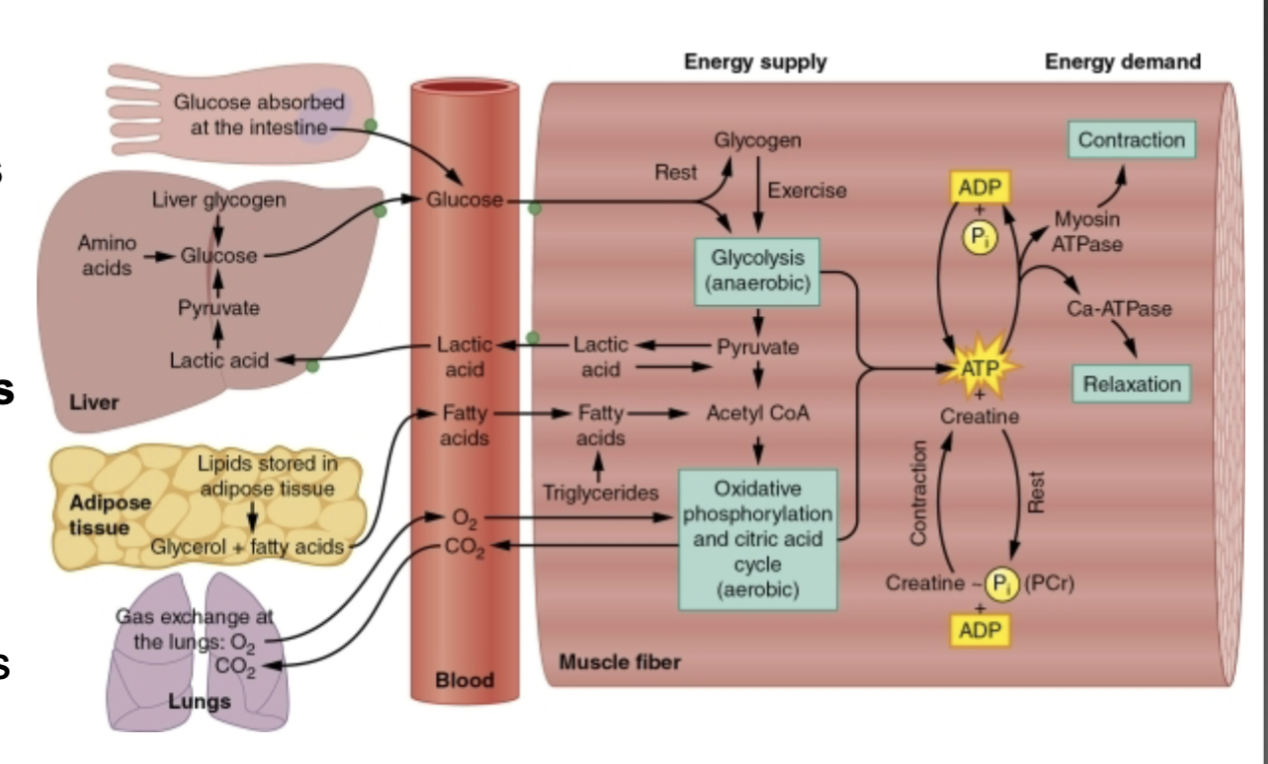
What is the crossover concept?
Muscles make atp through cards and fats, lower intensity we are using fats, as we gradually increase energy over time, we use carbs. There is a balance when carbs/fats are used.
Neuron
basic structural unit of the nervous system
What is the basic step-by-step process of the central nervous system to muscle?
The brain sends a massage to the central nervous system to the muscle to make it contract.
What is a motor unit? How does this relate to muscle fiber types? Force? Fatigue?
A motor unit is a single motor neuron and all the muscle fibers it controls.
Muscle Fiber Types: All fibers in a unit are the same type. Type S units control slow-twitch (Type I) fibers, while Type FF units control fast-twitch (Type IIx) fibers.
Force: Controlled by the Size Principle. The body recruits small units first for light tasks and larger, more powerful units as the demand for force increases.
Fatigue: Small units (Type I) are highly fatigue-resistant and can work for hours. Large units (Type IIx) produce massive force but exhaust their energy stores in seconds.
Fatigue; what happens from a sport and physiology standpoint?
Physiology
Fuel Depletion: Running out of phosphocreatine (sprints) or glycogen (endurance).
Metabolic Buildup: Accumulation of hydrogen ions and phosphate increases muscle acidity, interfering with the calcium release needed for contraction.
Neural Drive: The Central Governor (brain) reduces signals to muscles to prevent injury, causing a perceived "wall."
Sport Impact
Performance Drop: Reduced speed, power, and vertical leap.
Technical Failure: Loss of fine motor control and coordination, leading to "sloppy" play.
Decision Making: Increased mental errors as the brain prioritizes basic movement over complex strategy.
Rate coding
speed matters, rate at which motor units are being activated and the amount of them, slower bat speed late in the game
Reflexes
protect muscles and joints from injury, under fatigue muscles may put in protection to make sure there is no injury
Sensory receptors
stop from too much tendons from stretching to far, golgi tendons
Neuromuscular junction
consistent training and adaptations occur here. Start someone that is uncoordination and then they start to become more synchronized between the muscles and brain. Acedochonile, as a neurotransmitter, turns into a chemical.
Why does the structure and function of exercising muscle matter for coaches? Why does Muscle physiology matters to coaches?
Muscle fatigue limits late-game performance. Fast fibers create explosive actions but fatigue quickly, recruitment depends on task intensity, training improves tolerance to fatigue, physiology explains what coaches observe.
Why does neural control matter for coaches and sport?
Acknowledge the things that are really fatiguing, and make sure to figure out the muscles that are fatiguing and make sure there is recovery time.
What training implications can you take away from knowing more about the neural control of exercising muscle?
Maximal Recruitment: To hit the most powerful Type IIx fibers, you must lift heavy (85%+ 1RM) or move explosively. Light, slow reps only recruit small, endurance-based units.
Neural Adaptation: Initial strength gains in a program come from the brain "learning" to fire motor units in sync. This explains why you get stronger before your muscles actually grow.
Rate Coding: Power training (plyometrics) teaches your brain to send signals faster, increasing your Rate of Force Development—essential for sprinting and jumping.
Efficiency: Complex movements improve intermuscular coordination, allowing you to lift more weight with less wasted energy.
CNS Recovery: High-intensity neural work fatigues the Central Nervous System more than the muscles, requiring longer rest periods between heavy sessions.
Explain the concept of, “why technique breaks down first,” regarding neural fatigue
Technique breaks down first because the nervous system fatigues faster and more subtly than the muscles themselves.
Loss of Precision: As the brain tires, it loses the ability to coordinate the exact timing and sequence of motor unit recruitment.
Neural Noise: Fatigue increases "noise" in the neural signal, leading to jerky or inefficient movements instead of smooth, automated patterns.
Compensatory Patterns: When high-threshold motor units stop firing, the brain recruits "backup" muscles to finish the movement, causing poor form and substitution errors.
Safety Mechanism: The Central Governor reduces signal intensity to protect the body, which dulls your fine motor control before your muscles actually fail.
Describe the basics of the interaction of energy systems
It's not all super black and white. It doesn't shut off and go to the next one, there is a transition from one to another.
 Note
Note  Flashcards (76)