Cultural dimensions
 Call Kai
 Learn
Learn Practice Test
 Spaced Repetition
 Match
Match Flashcards
 Knowt Play
1/6

There's no tags or description
Looks like no tags are added yet.
Name | Mastery | Learn | Test | Matching | Spaced | Call with Kai |
|---|
No analytics yet
Send a link to your students to track their progress
7 Terms
What are Hofstede’s cultural dimensions?
Model that compares cultural tendencies based on 6 scales (dimensions that measure cultural norms/tendencies)
What are cultural norms?
Expectations of behaviour based on shares beliefs in a culture
What are dimensions?
How values of society effect behaviour → shows behaviour trend in culture
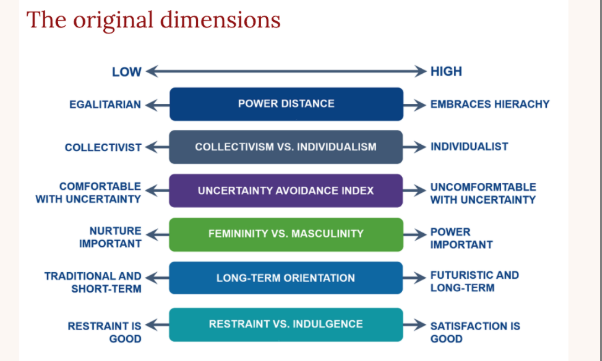
What are the 6 ‘cultural dimensions from Hofstede?
Individualism vs collectivism: Whether culture prioritise individual or group
Power distance index: How a culture accepts inequality & hierarchy
Uncertainty avoidance index: Comfortable with ambiguity & uncertainty
Masculine vs feminine: competition, power, being strongest vs caring, cooperation
Long term vs short term orientation: Focus on future, persistence vs focus on tradition, present & quick results
Indulgence vs restraint: allow people people to enjoy life & have fun vs strict control and regulations
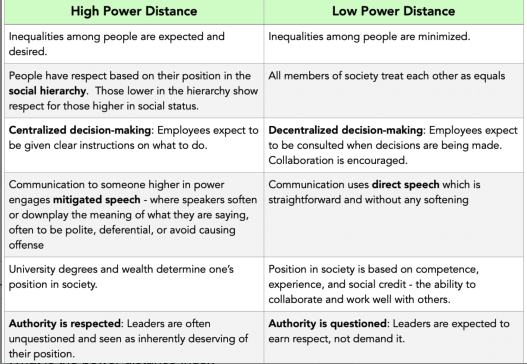
What is the power distance index (what is high & low)
Dimensions measuring extent people accept/expect unequal power distribution
High: People accept authority without questioning (eg, teacher is always right)
Low: People question authority (eg. students openly discuss & criticise teachers question)
Explain the study Korean air study
Aim: Investigate high number of Korean air plane crash
Procedure: Analysis flight data & communication -→ Cop-pilots used indirect language to speak to pilot (hierarchy) → High power distance culture in South Korea
Conclusion: High power distance = poor communication (co-pilots avoided challenging authority) → Power distance influences behaviour
Apply Korean Air case study to Dimensions (Power distance)
High power distance: Co-pilots avoided questioning authority (pilot)
Cultural norms: Indirect. polite language instead of clear communication (Mitigated speech)

