1A Anatomical Terms
 Studied by 0 people
 Call with Kai
 Learn
Learn Practice Test
 Spaced Repetition
 Match
Match Flashcards
 Knowt Play
1/96

There's no tags or description
Looks like no tags are added yet.
Name | Mastery | Learn | Test | Matching | Spaced | Call with Kai |
|---|
No study sessions yet.
97 Terms
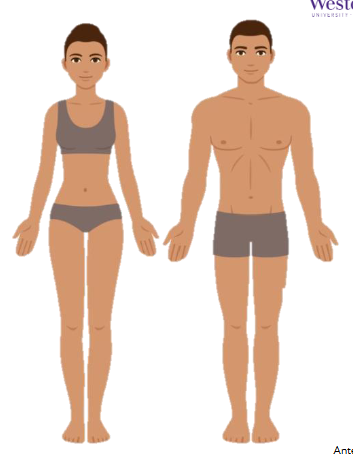
Anatomical position (reference position)
Standing upright facing forward
arms at side with palms facing forward
feet flat and forward
Frontal (coronal) plane
Divides the body into anterior (front) and posterior (back) parts
rotates about the sagittal axis
Sagittal plane
Divides the body into left and right portions either symmetrically (median sagittal) or unsymmetrically (parasagittal)
about the frontal/coronal axis
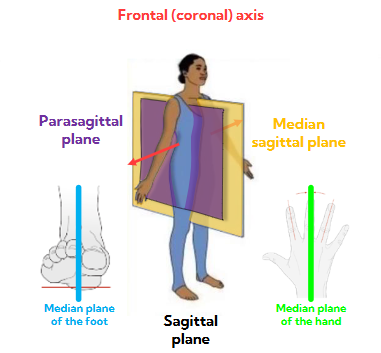
Median sagittal plane
Divides the body into equal left and right halves
Parasagittal plane
Divides the body into unequal left and right portions
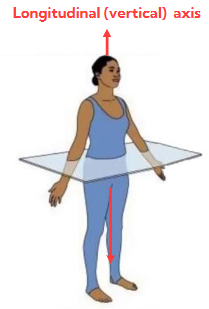
Transverse (horizontal, axial) plane
Divides the body into superior (top) and inferior (bottom) portions
about the longitudinal (vertical) axis
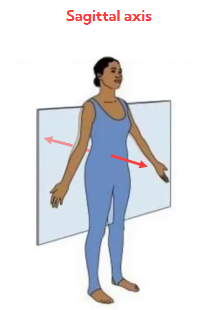
Sagittal axis
Runs anterior to posterior
Frontal axis
Runs medial to lateral
arrows moves away from the midline of the body
Longitudinal axis
Runs superior to inferior
Plane axis relationship
Movement occurs in planes and about axes
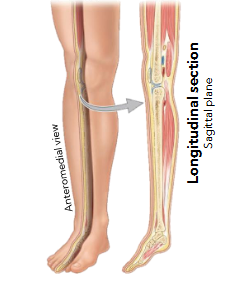
Longitudinal (saggital) section
Section cut lengthwise
goes front to back so that the body is divided into left and right
anteromedial view
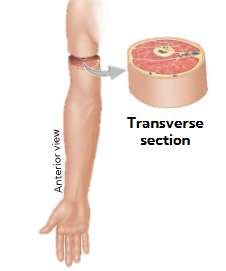
Transverse section
Section cut horizontally across
divides the body into superior and inferior parts
cross-section of bone, muscles and vessels
anterior view
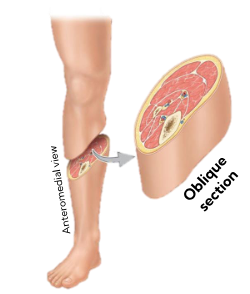
Oblique section
Section is being cut at an angle
doesn’t follow standard anatomical planes
anteromedial view
Anterior
Toward the front
Posterior
Toward the back
Ventral
Toward the front of the body
Dorsal
Toward the back of the body
Superior
Higher up
Inferior
lower down
Cranial
Toward the head
Caudal
Toward the tail or feet
Medial
Toward the midline
Lateral
Away from the midline
Proximal
Closer to the trunk
Distal
Farther from the trunk
Superficial
Closer to the surface
Deep
Farther from the surface
Internal
Inside
External
Outside
Central
Toward the center
Peripheral
Toward the edges
Bilateral
On both sides
Unilateral
On one side
Ipsilateral
On the same side
Contralateral
On the opposite side
Palmar
Palm side of the hand
Dorsal hand
Back of the hand
Plantar
Sole of the foot
Dorsal foot
Top of the foot
Basal
Toward the base
Apical
Toward the tip
Cranial cavity
Contains the brain
Thoracic cavity
Contains the lungs and heart
Pulmonary space
Space containing a lung
Mediastinum
Central compartment of the thoracic cavity
Diaphragm
Muscle separating thoracic and abdominal cavities
Abdominopelvic cavity
Contains abdominal and pelvic organs
Abdominal cavity
Superior portion of the abdominopelvic cavity
Pelvic cavity
Inferior portion of the abdominopelvic cavity
Right hypochondriac region
Upper right abdominal region
Epigastric region
Upper central abdominal region
Left hypochondriac region
Upper left abdominal region
Right lumbar region
Middle right abdominal region
Umbilical region
Central abdominal region
Left lumbar region
Middle left abdominal region
Right inguinal region
Lower right abdominal region
Pubic region
Lower central abdominal region
Left inguinal region
Lower left abdominal region
Midclavicular line
Vertical reference line through the clavicle
Subcostal line
Horizontal reference line at vertebral level L1
Transtubercular line
Horizontal reference line at vertebral level L5
Deltoid region
Shoulder
Axillary region
Armpit
Arm
Region between shoulder and elbow
Cubital fossa
Anterior elbow
Forearm
Region between elbow and wrist
Carpal region
Wrist
Palmar hand
Palm side of the hand
Dorsal hand
Back side of the hand
Scapular region
Upper back
Gluteal region
Hip or buttock
Thigh
Region between hip and knee
Knee
Joint between thigh and leg
Popliteal fossa
Posterior knee
Leg
Region between knee and ankle
Ankle
Joint between leg and foot
Dorsal foot
Top of the foot
Plantar foot
Sole of the foot
Abduction
Movement away from the midline
Adduction
Movement toward the midline
Lateral flexion
Side bending of the trunk or neck
Inversion
Sole of the foot turns inward
Eversion
Sole of the foot turns outward
Scapular movement
Movement of the shoulder blades
Flexion
Decrease in joint angle
Extension
Increase in joint angle
Dorsiflexion
Foot moves upward
Plantarflexion
Foot moves downward
Rotation
Movement around a longitudinal axis
Medial rotation
Rotation toward the midline
Lateral rotation
Rotation away from the midline
Protraction
Forward movement
Retraction
Backward movement
Circumduction
Combination of flexion extension abduction and adduction
Opposition
Thumb moves to contact fingers
Reposition
Thumb returns to anatomical position
Compound movement
Movement produced by multiple muscle groups working together
 Note
Note  Flashcards (50)