intracellular transport
 Studied by 0 people
 Call Kai
 Learn
Learn Practice Test
 Spaced Repetition
 Match
Match Flashcards
 Knowt Play
1/37

Earn XP
Description and Tags
last unit
Name | Mastery | Learn | Test | Matching | Spaced | Call with Kai |
|---|
No analytics yet
Send a link to your students to track their progress
38 Terms
what is intracellular transport (general term)
the process of the cell deciding where to put things. (the movement of substances in the cell)
what are the 3 main types of transport
transport through nuclear pores
transport across membranes (getting things into ER)
transport by vesicles
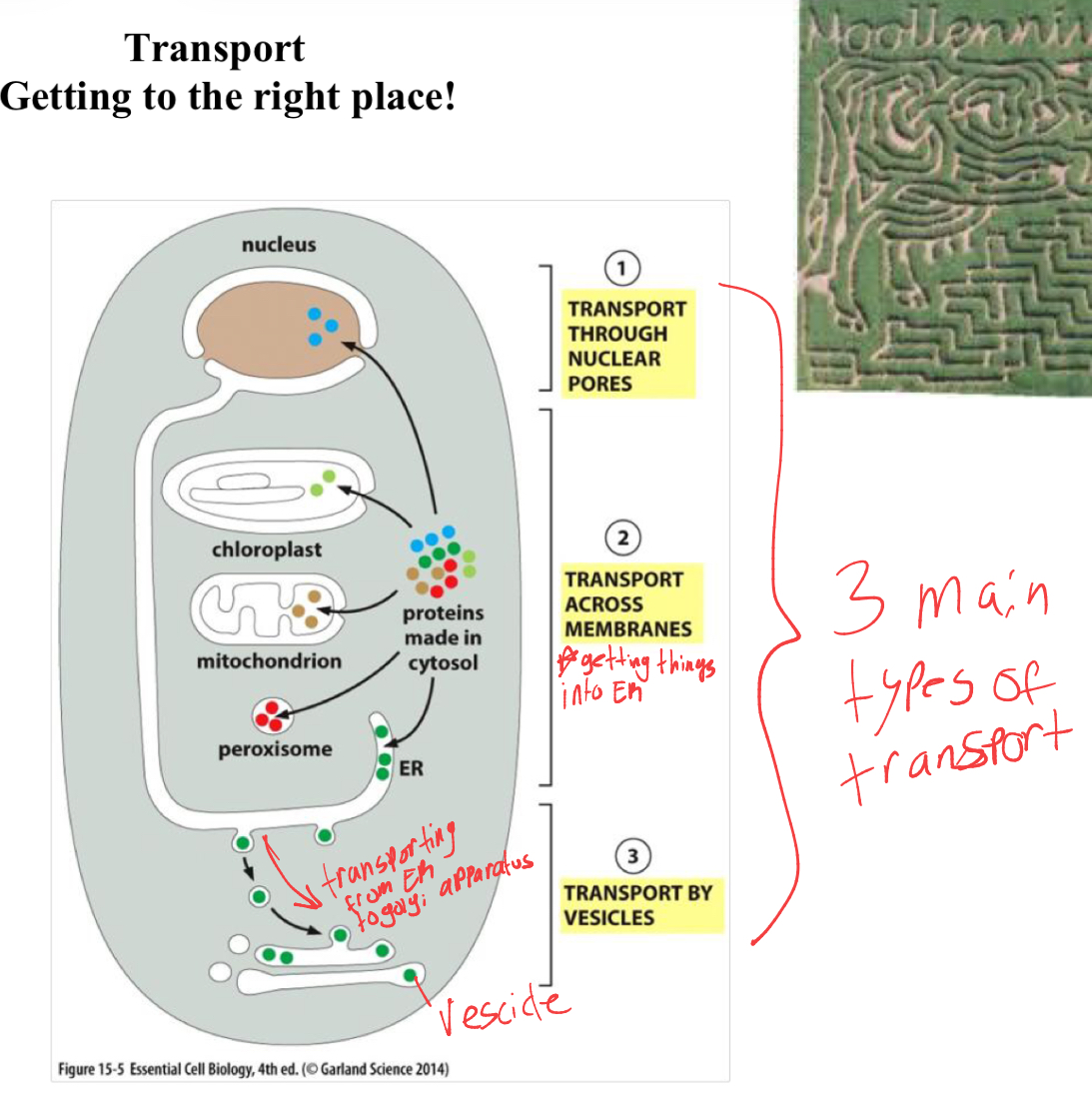
what do proteins use to get somewhere specific within the cell and how long is it
sorting signals/ signal sequences, that are 15-60 amino acids long
in a cell, what is the term for a protein that sits in the cytosol, with no signal sequence
a cytosolic protein, (this is the default when a protein has no signal sequence)
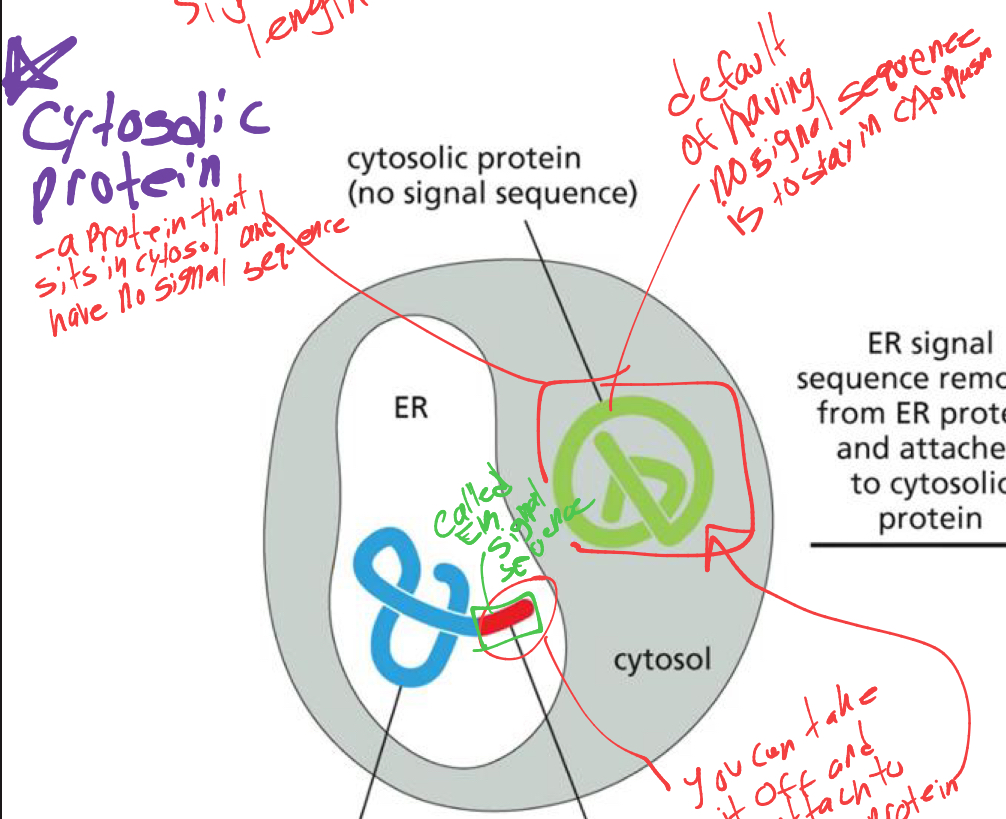
(in the case of ER) what would occur if a protein had the ER signal sequence
it would be an ER protein and enter the ER’s membrane
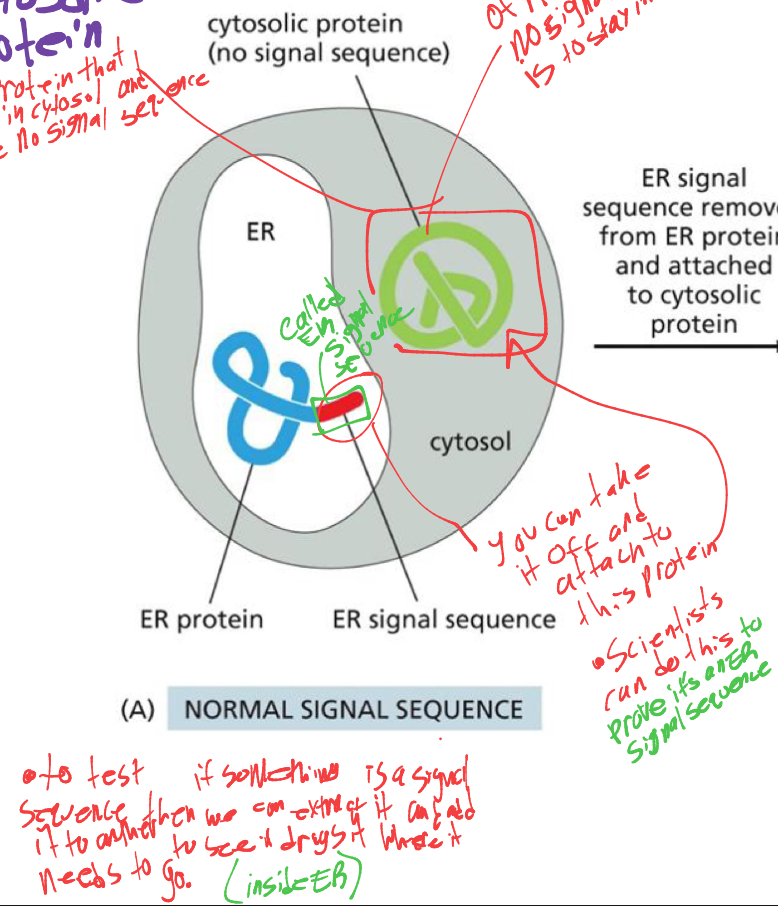
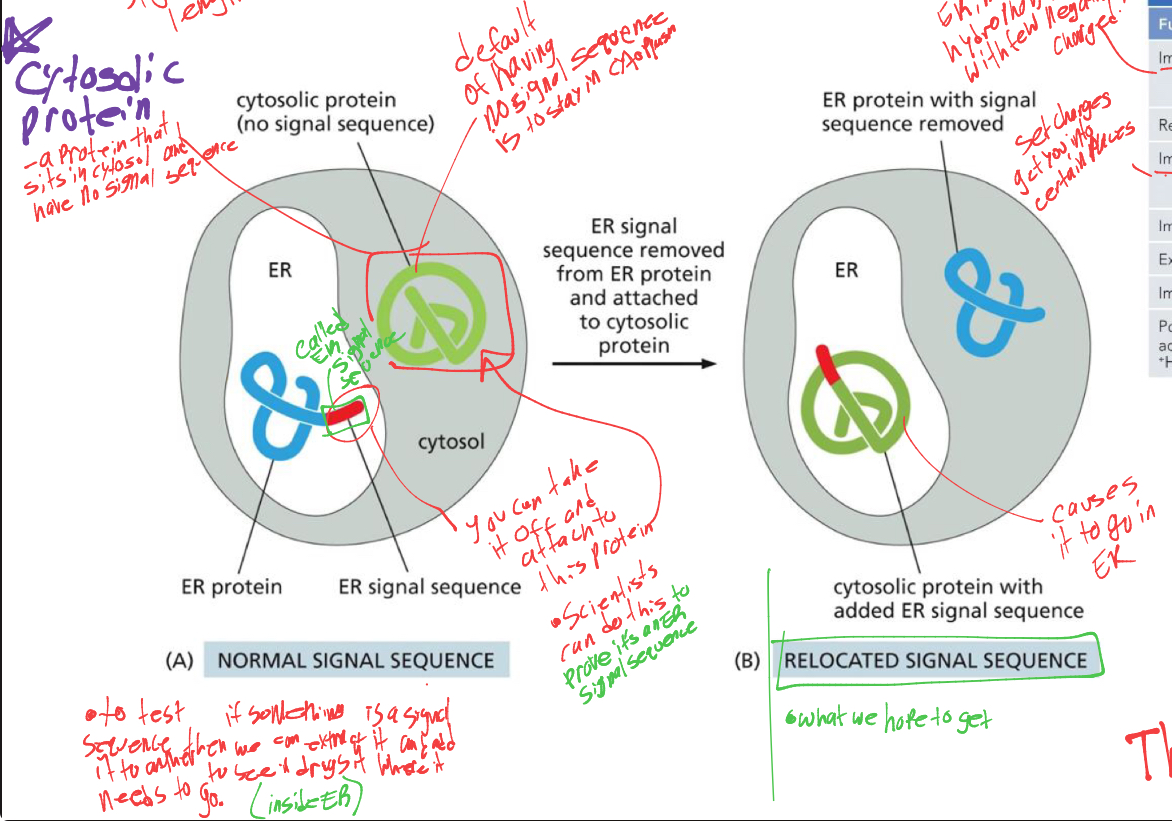
what occurs with a relocated signal sequence (IN THE CASE OF ER)
it is when scientists extract the ER signal sequence from one protein and add it to the cytosolic protein to see if it travels into the ER
what determines where signal sequences go
the hydrophobicity and placement of the charges determine what the signal is signaling for/ location.
what does it mean for smth to be hydrophobic
they are non polar which means they have no charge/ and are neutral
being non polar are why the thing doesn’t like water (hydrophobic)
what does it mean for something to be polar
means they have a charge to it (+ or -), unlike non polar which don’t have any charge and are neutral.
what does having a charge mean for polar things
it makes them hydrophilic (like water)
to enter a membrane (with any organelle) would a signal sequence need to be hydrophobic or hydrophilic
hydrophobic in order to bypass the phospholipid layer in the membrane since they are hydrophobic.
what is the exception of hydrophobic signal sequences
the nuclear localization sequence, which must polar because they have a positive charge, and they rely on protein transporters.
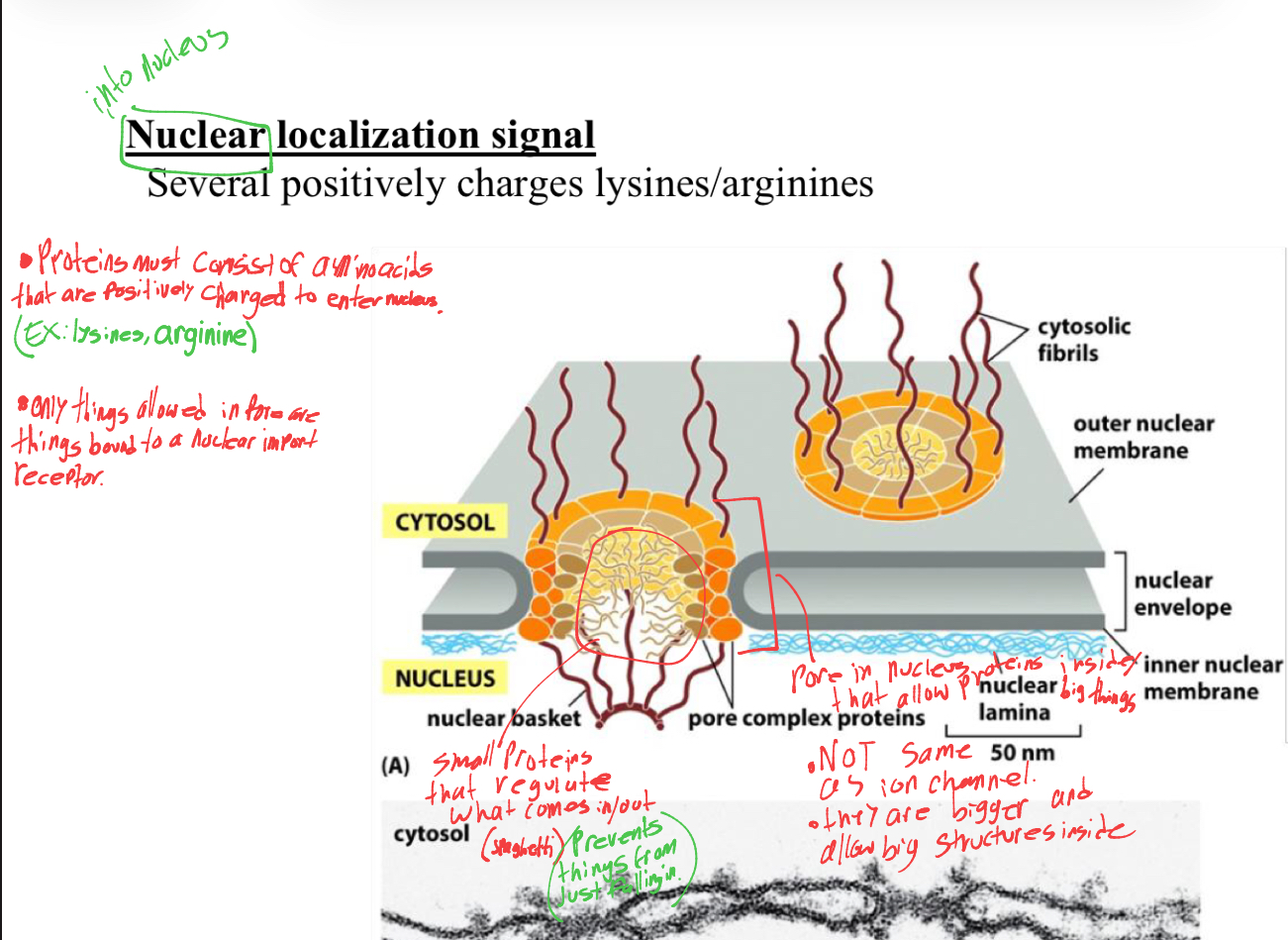
whats the nuclear localization signal (its a type of signal sequence)
the signal sequence that signals a protein need to go into the nucleus (isn’t the thing that allows it In, it just says it needs to go)
protein must be positively charged with amino acids in order to even ENTER nucleus
where does the protein with the nuclear localization signal enter the nucleus from,
and what are its characteristics
and what type of things does it let inside
from its pore, that’s aligned with small proteins (like spaghetti) that regulates what comes in,
they are NOT the same as ion channels
they are bigger and allow bigger things inside (big papa)
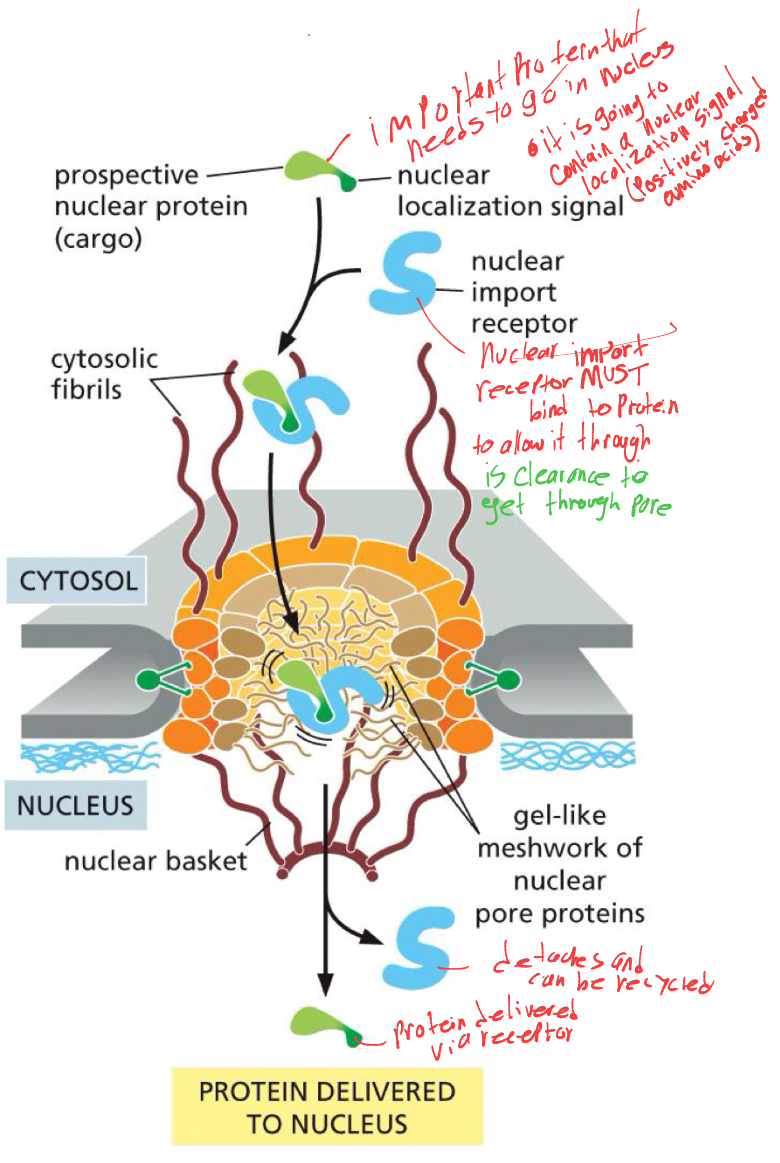
after you have your protein with its nuclear localization signal, what needs to bind to it in order for it to be allowed in the nucleus pore (the bouncers at the door bruh)
the nuclear import receptor, must bind to the protein as clearance into the nucleus,
and once it gets through it detaches and can be recycled for the next protein.
and protein is now delivered inside nucleus
this next section of cards will be about the transport across membranes., but specifically what membrane
specifically entering the organelle ER membrane
for entering the ER what does the protein need, and how long is it
the ER signal sequence which is 8 or more hydrophobic amino acids long.
what is the protein attached to as it enters the ER
the ribosome it is being made out of (if protein is still being made, it could already be formed it depends)
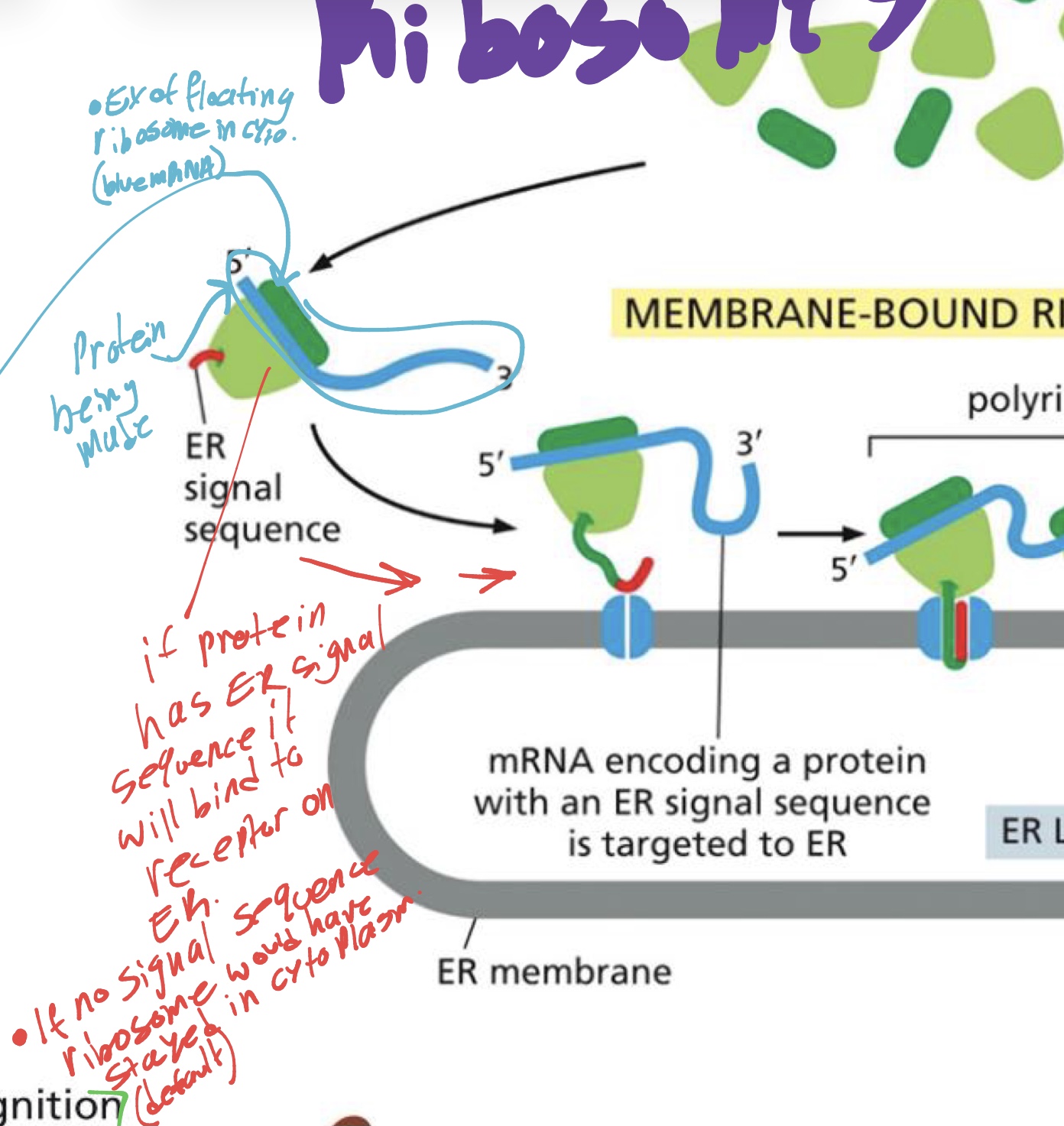
what happens if the protein does not have an ER signal sequence
if it does not have this then the ribosome would remain floating in cytoplasm (this is the default)
and once the ribosome finishes the protein it returns back into the cytoplasm
what binds to the ribosome once ER signal sequence emerges
the signal receptor particle (SRP), as it binds to the ribosome once the signal sequence is detected.
it is the clearance to enter the membrane, without it the protein cannot enter.
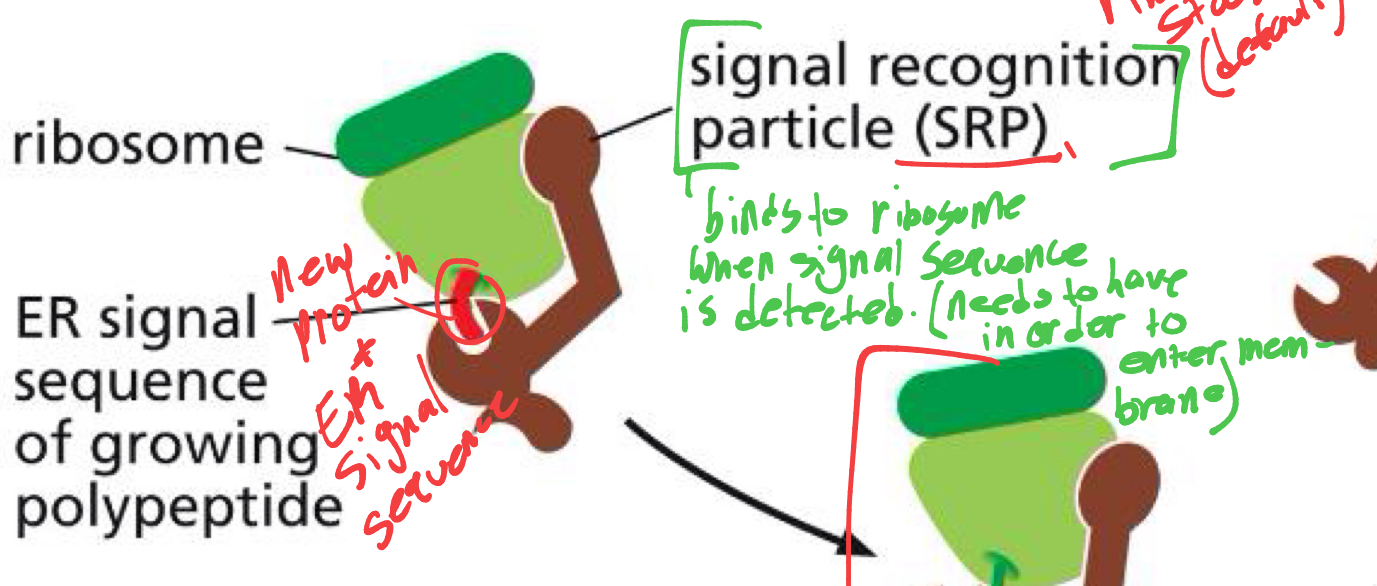
once the SRP binds what is the next step for entering the ER membrane
the SRP binds to the SRP receptor on the membrane.
and the proteins signal sequence begins to enter the protein translocator.
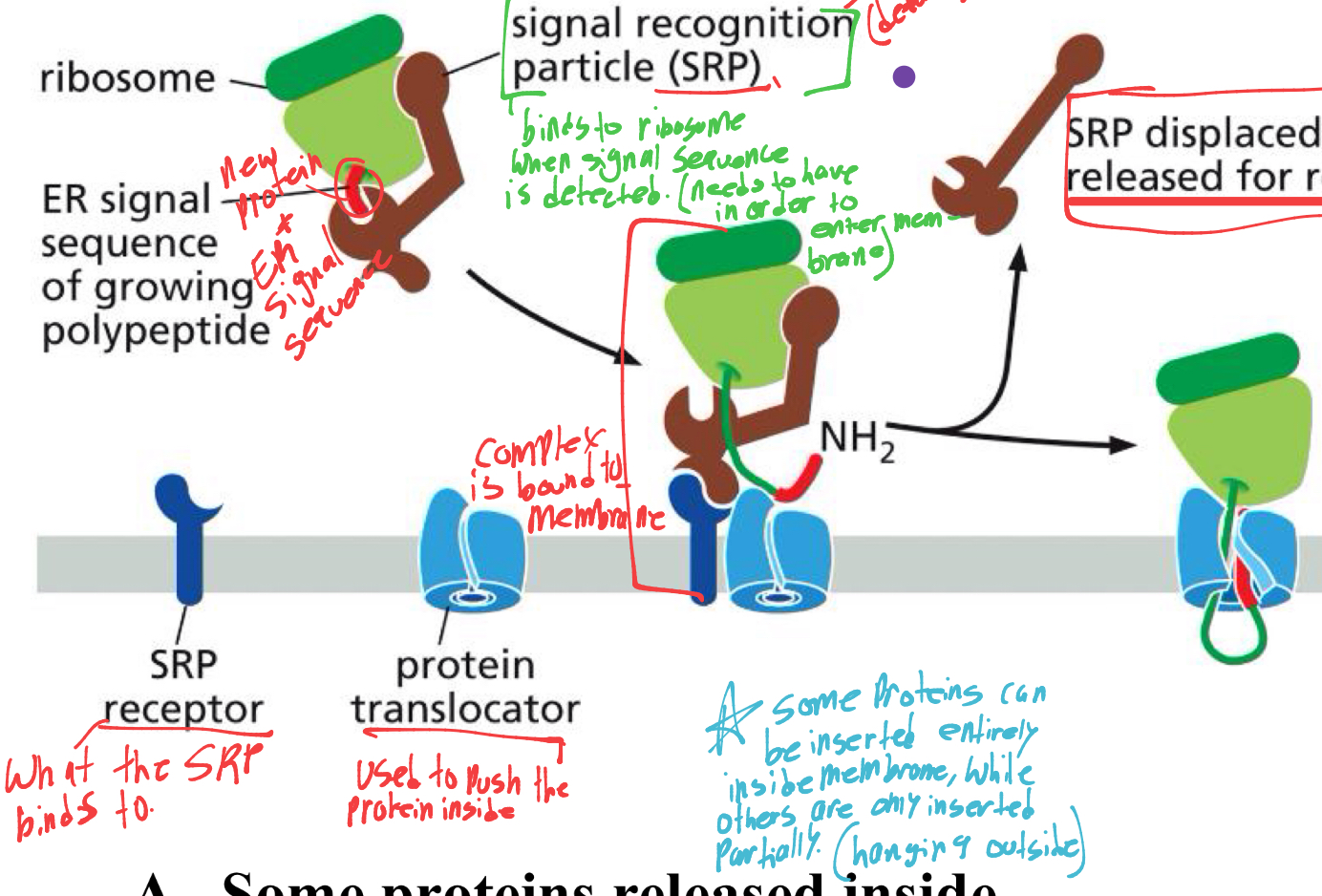
what does the protein translocator do
It pushes the protein inside the membrane.
and the SRP is released so it can be recycled.
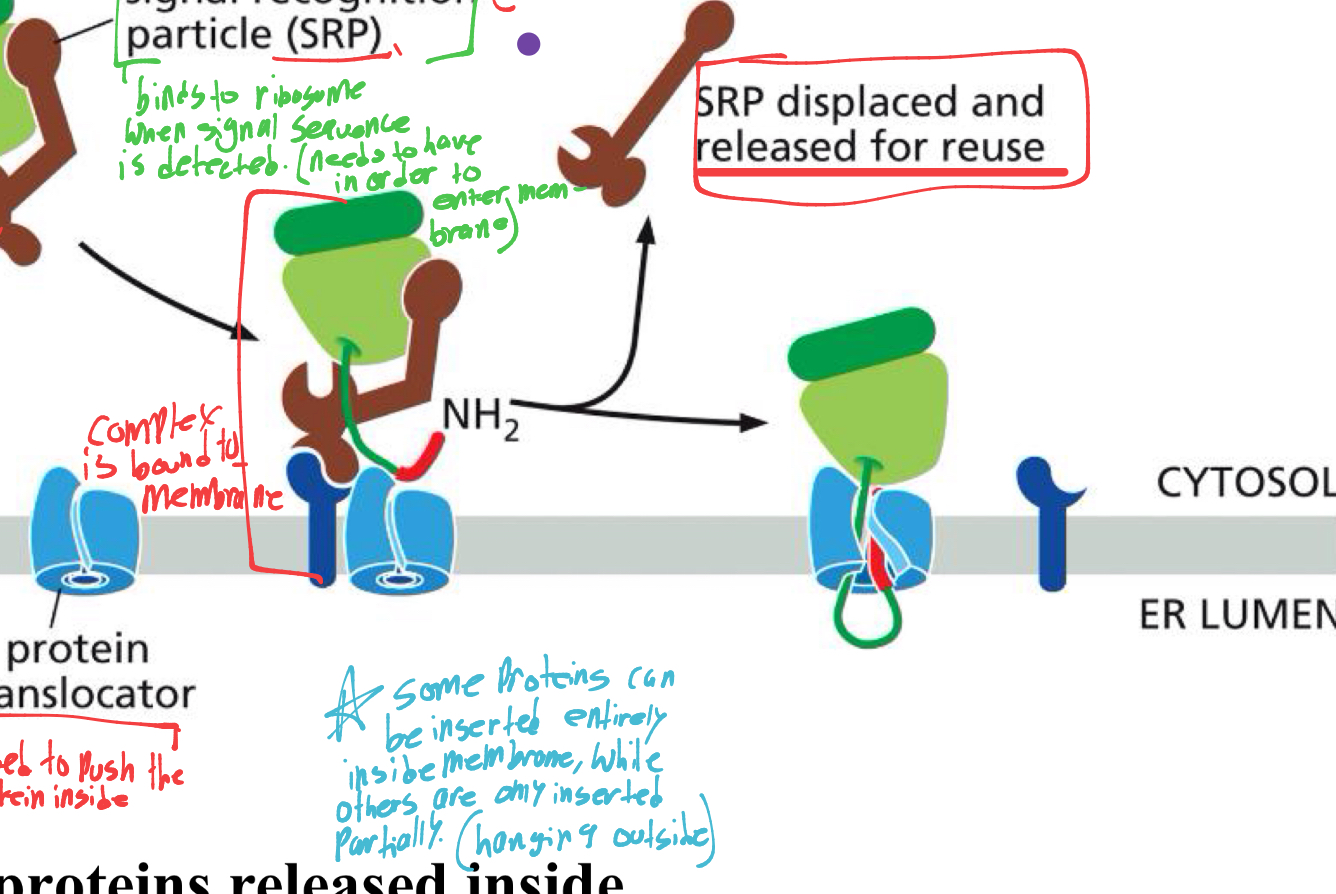
in this case for proteins entering the ER is the protein always fully inside the ER?
no, sometimes only some of the protein is inside and the rest can hang out outside.
as the protein is inside the protein translocator, what occurs after is it fully inside the membrane. and what happens to the ER signal sequence.
another enzyme will come called signal peptidase, and cleave the protein at the N-terminus to detach it from the ER signal sequence
and protein translocator will close. while ER SS is degraded.
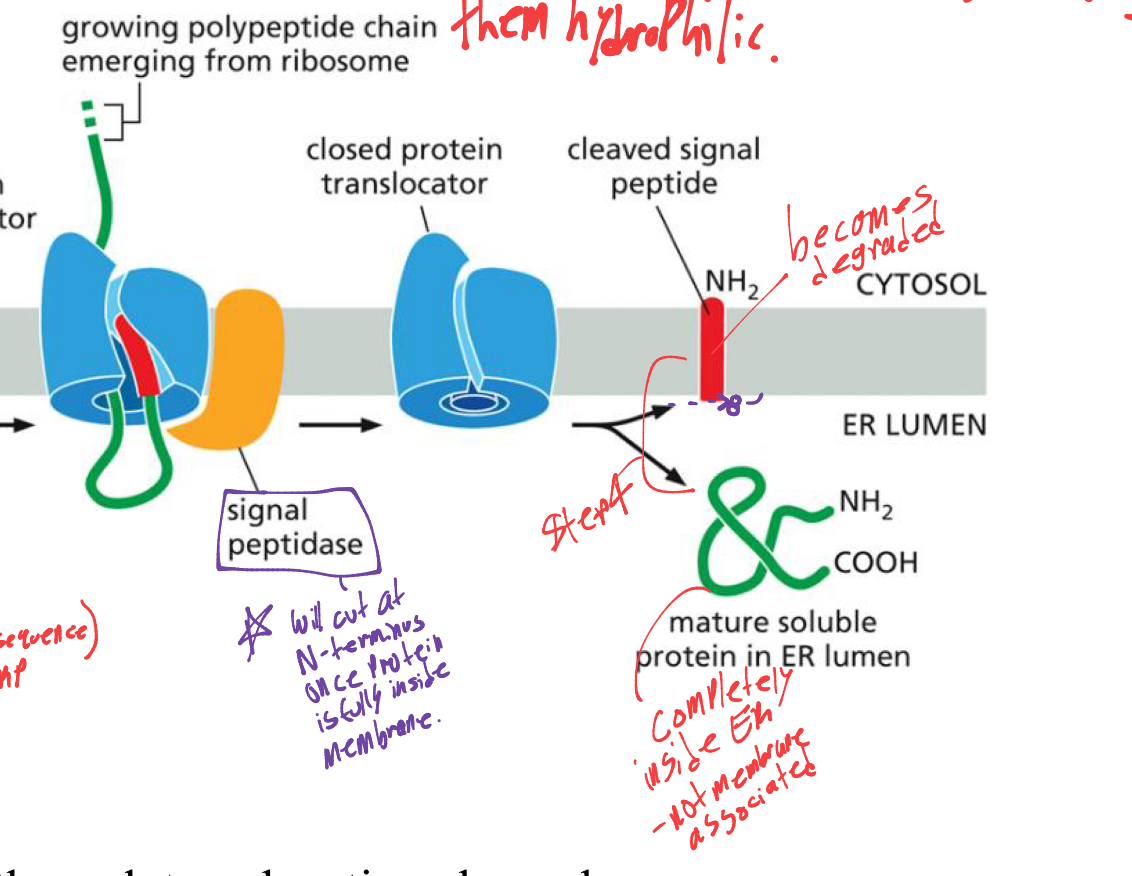
what is the N- terminus and C- terminus of a protein
the amino group Is the N- terminus bc of the nitrogen, and the carboxyl group is the C- terminus bc of the Carbon
when a protein is set to be anchored in the membrane where will the signal sequence be, and what other sequence can it contain
either
in the beginning of the protein
or internal (THIS MEANS MIDDLE OF PROTEIN)
and it can contain a stop transfer sequence or not. depends.
What are the first steps regarding the protein entering the membrane to anchor
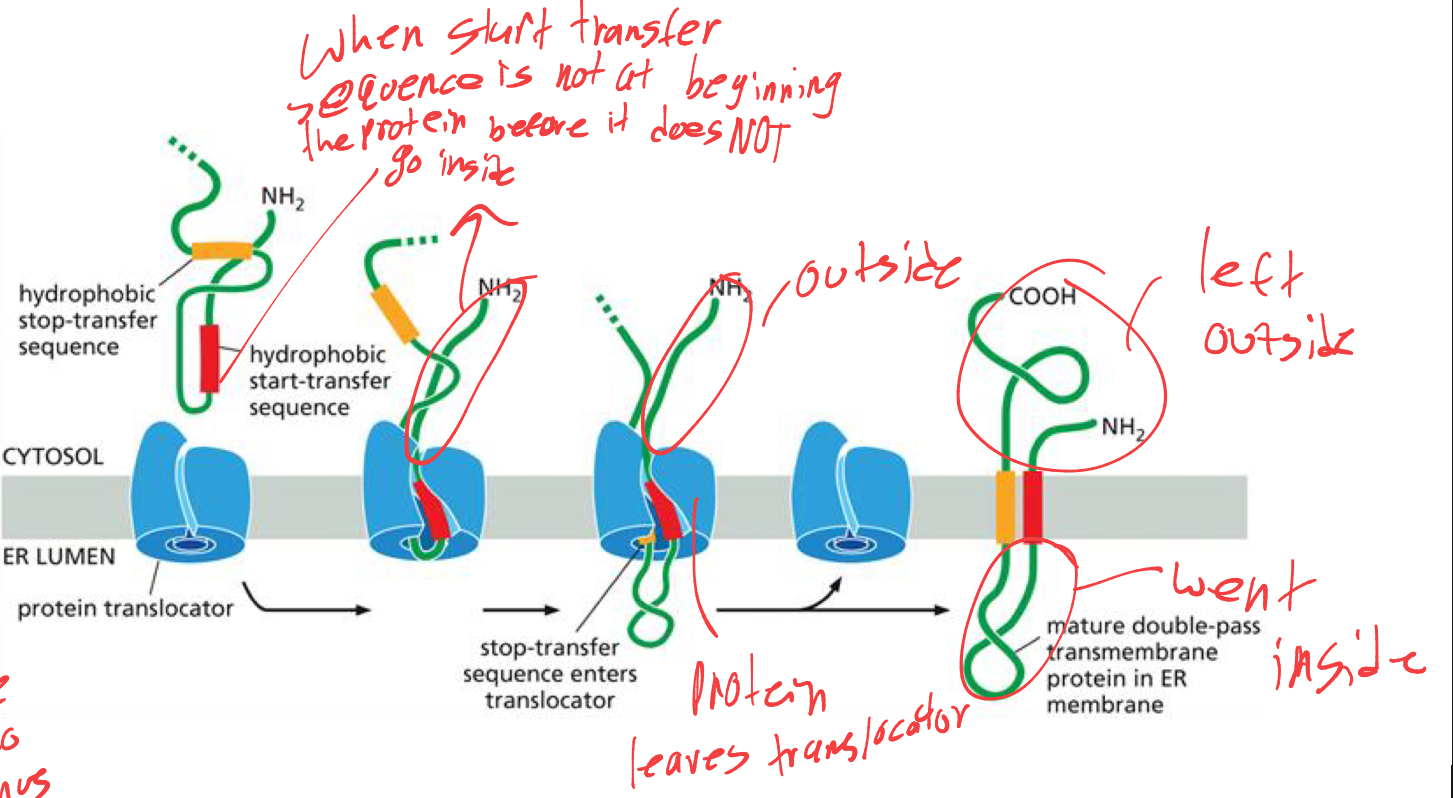
its the same steps as a protein entering the membrane fully, expect, once the stop transfer sequence enters the translocator, it makes the translocator stop pushing the protein inside.
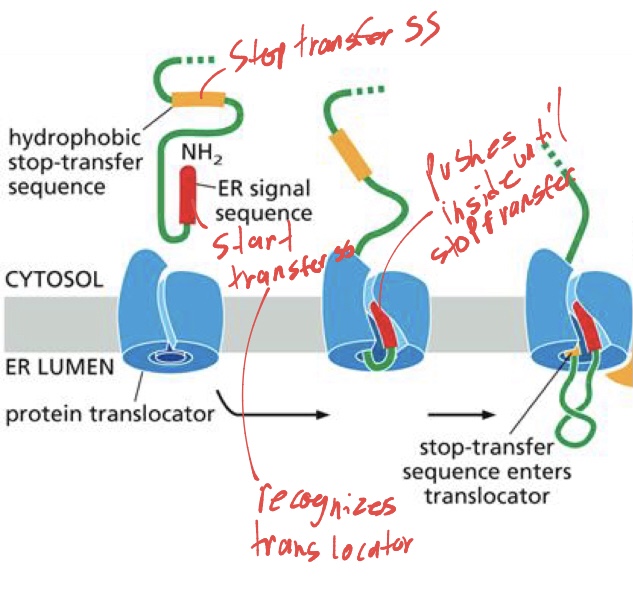
what is the final step that is optional,
the signal peptidase can come and cleave the protein at N- terminus, so that the N-terminus end hangs inside of ER.
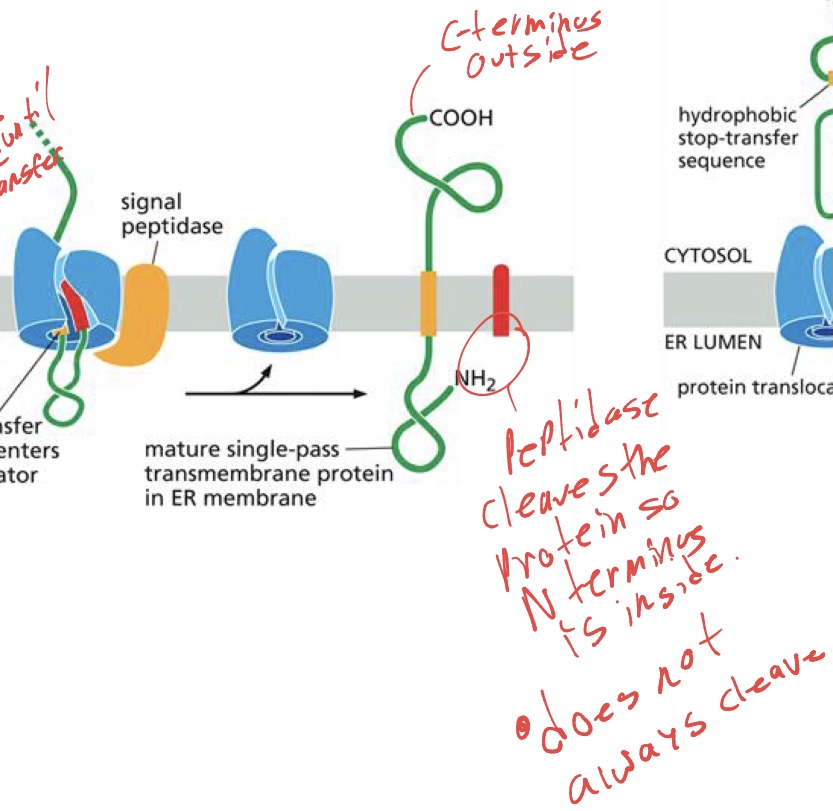
if the proteins ER Signal sequence is internal then what will be the end result of the protein anchored in the membrane, if there is no cleave
the first half of protein will remain outside since the ER signal sequence will enter first always, and anything after it will enter until the stop sequence.
what is the main role of vesicles
to transport things, mainly proteins, as they bud off of the ER into the cytoplasm, traveling where they will eventually bind to the golgi apparatus.
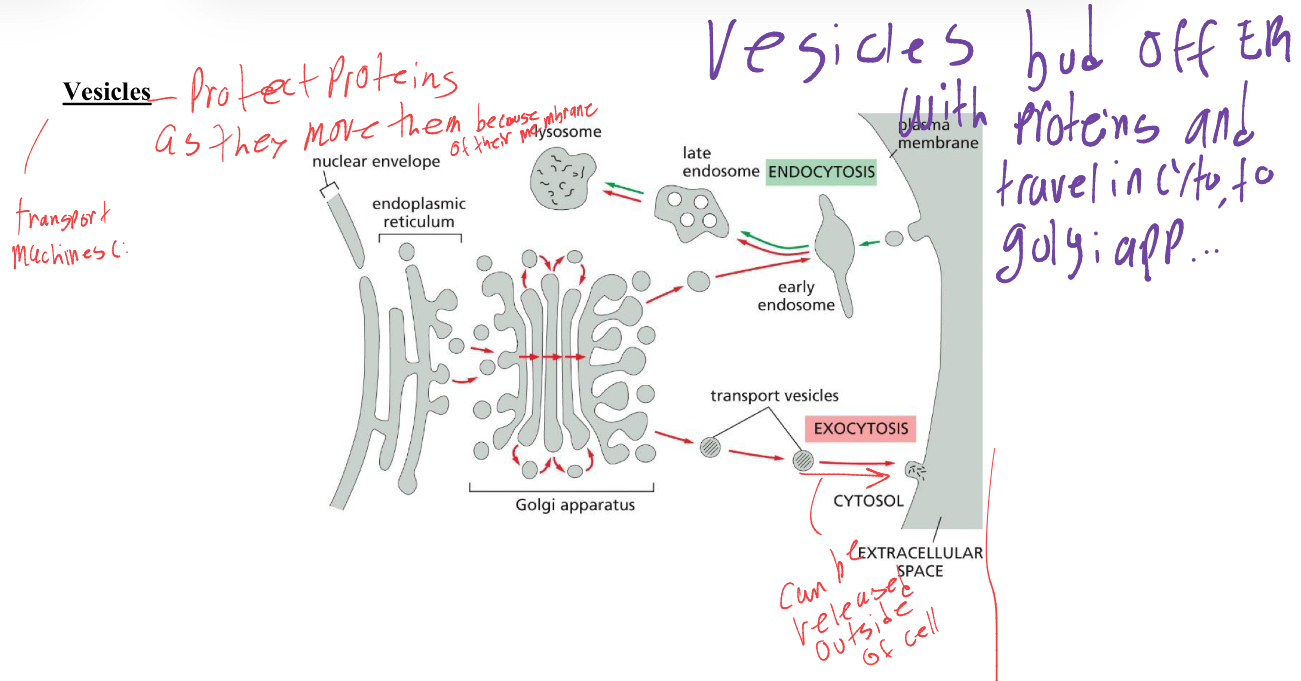
what are 2 terms for the functions of vesicles
Exocytosis: where vesicle exits cell with cargo
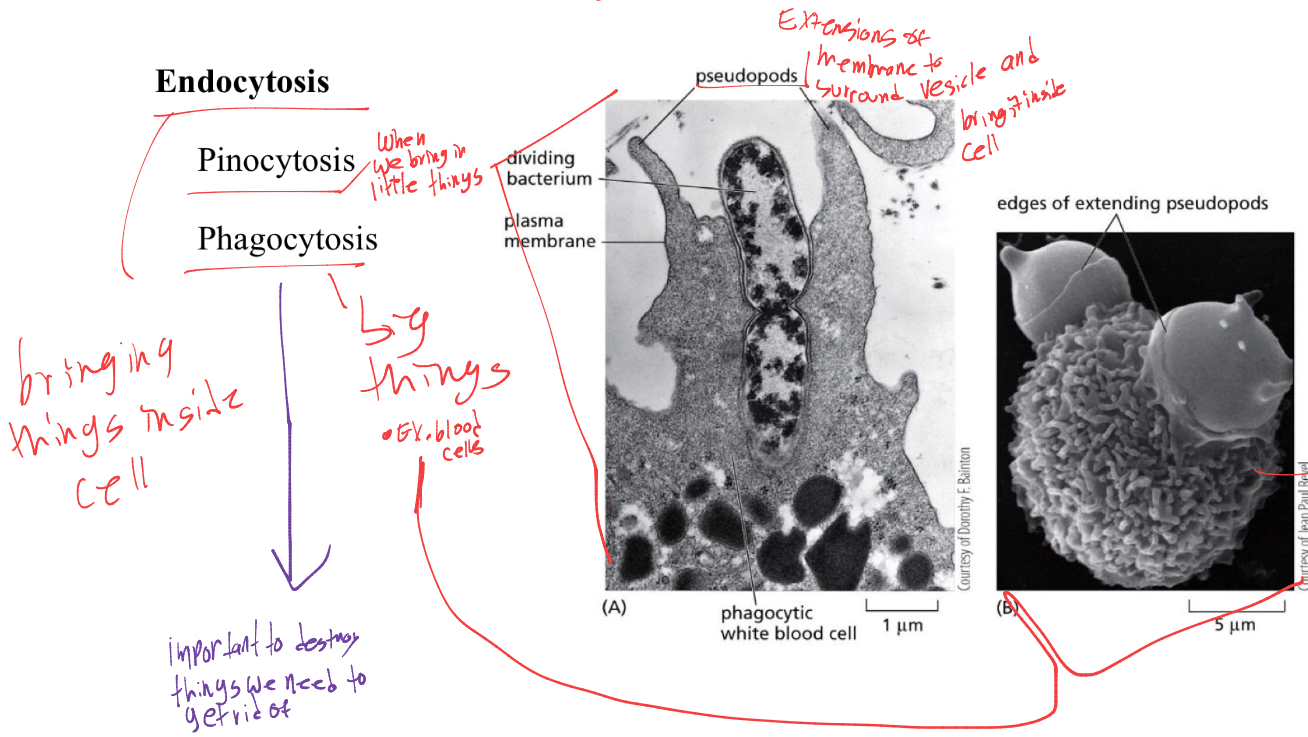
Endocytosis: where vesicle brings cargo inside cell. by the PSEUDOPODS which are extensions of membrane that surround the vesicle
what are the two types of Endocytosis
Pinocytosis: when we bring little things inside of cell
Phagocytosis: brings in big things (ex. blood cells) and the membrane eats it. (this is important for things we need to get rid of.
what are the 3 beginning stages to how a vesicle forms
first there is a CARGO RECEPTOR, that is used to make sure were moving correct cargo.
cargo begins to bind to cargo receptors. Where ADAPTIN will bind to the outsides of cargo receptors as it emerges more from the membrane.
as vesicle begins to form bud form, CLATHRIN will assemble on the outer part of the vesicle
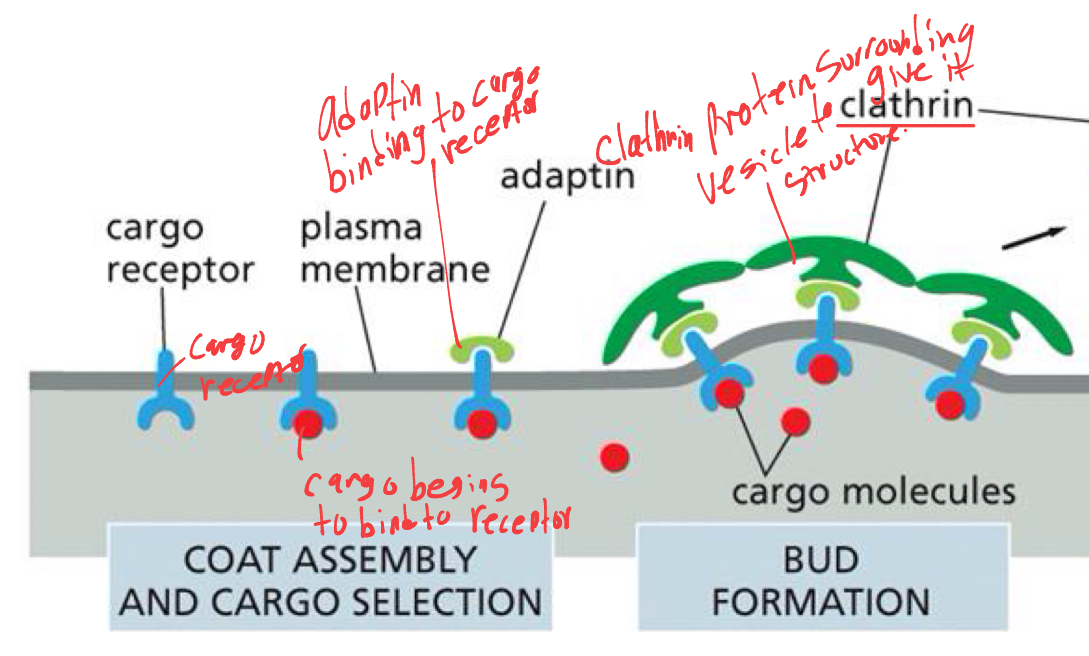
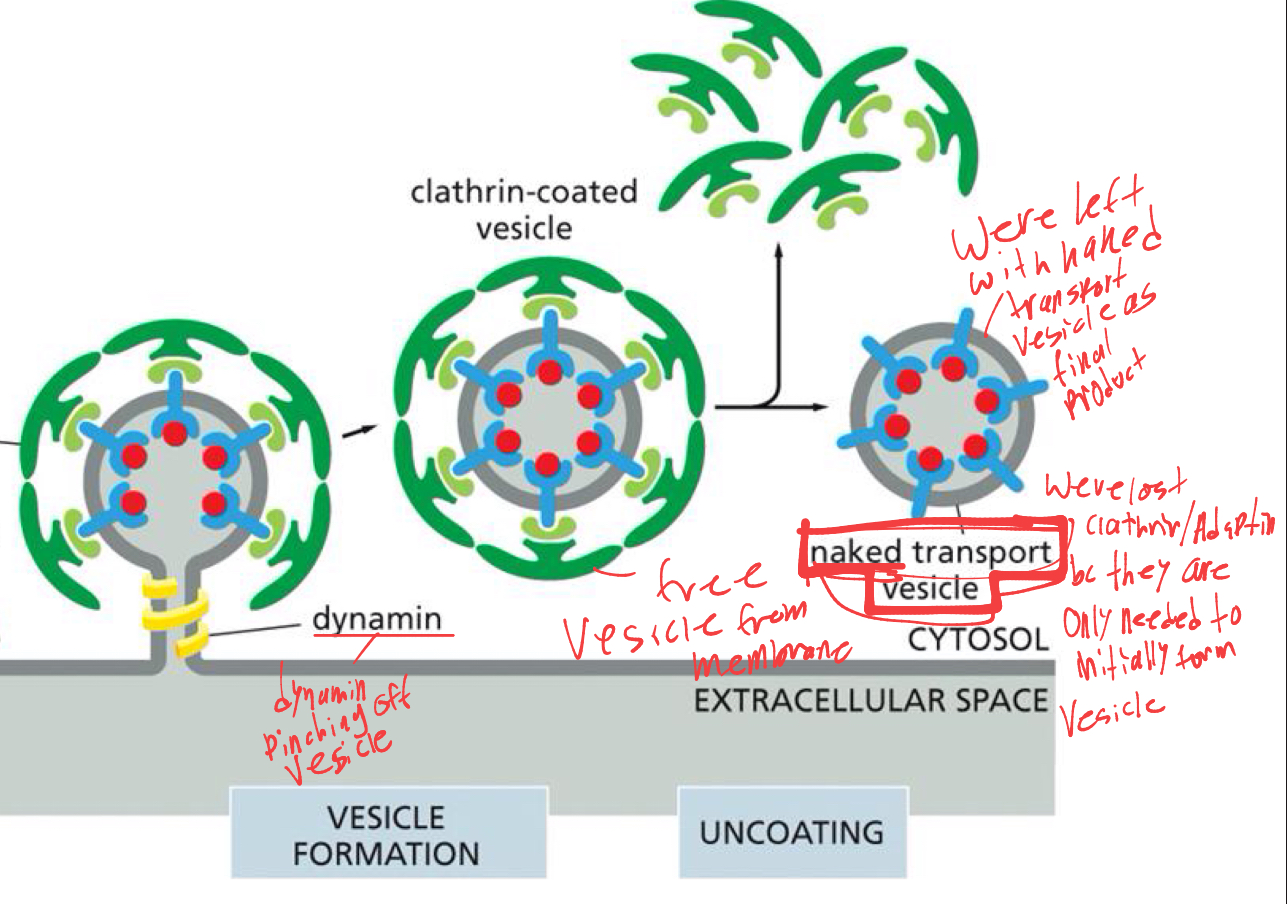
last 3 steps of vesicle formation
once vesicle is fully formed, DYNAMIN will pinch off the vesicle from the membrane.
once vesicle is free in cytoplasm, clathrin and adaptin will fall off bc they are only needed to initially form
we are left with naked transport vesicle in cytosol as final product
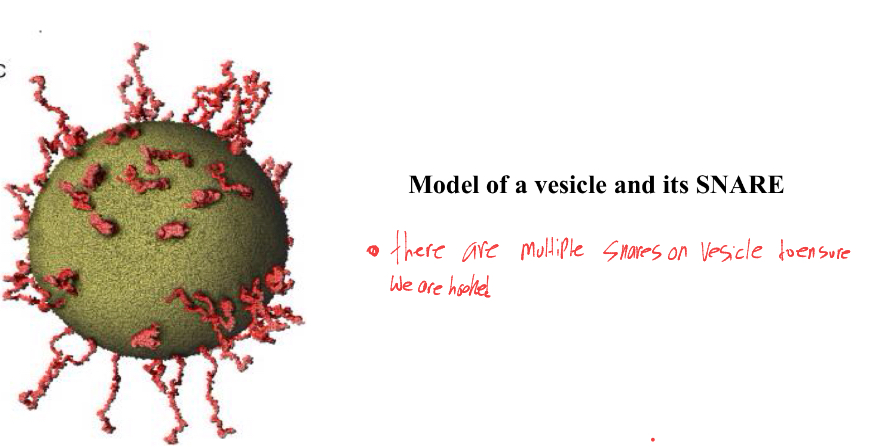
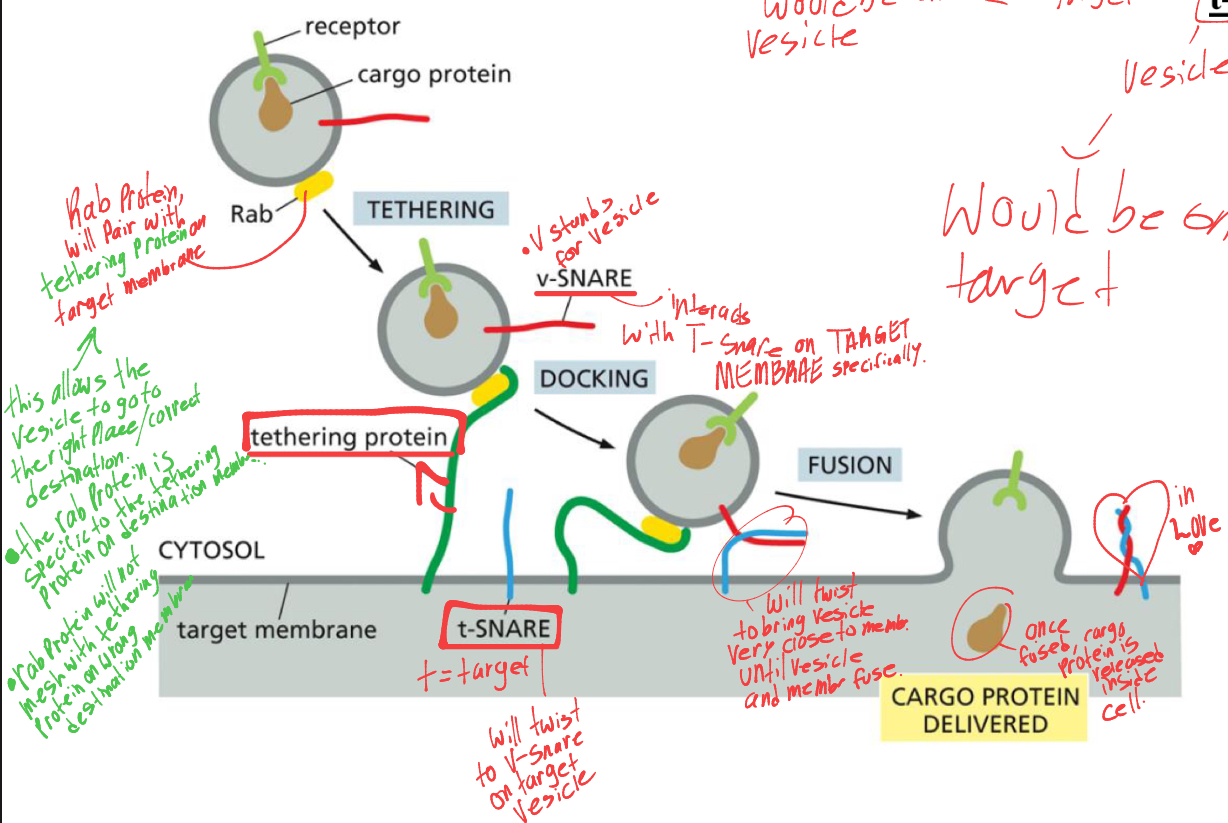
what are the proteins on the naked vesicle when it is docking into a membrane, and what will they interact with
rab protein will interact with tethering protein on membrane
V-snare (which are all around the vesicle) will interact with t-snare on membrane
what is the significance of the Rab protein
it is specific to the tethering protein on the target membrane.
it is essential to guide vesicle to correct membrane, as it will not mesh with any other tethering protiein
what are the steps for the vesicle joining the membrane
the rab protein will bind to specific tethering protein like a hook,
the vesicle will dock and the v-snare will twist with t-snare to bring vesicle close to fuse with membrane.
once fused, cargo inside vesicle will release
if a vesicle is responsible for carrying a bad cell out of an organelle, but did not have the receptor for the cell to. bind, what would occur
the bad cel would remain in the organelle and likely lead to disease
 Note
Note  Flashcards (97)