Virology Final Exam Review
0.0(0)
 Studied by 0 people
 Call Kai
 Learn
Learn Practice Test
 Spaced Repetition
 Match
Match Flashcards
 Knowt Play
Card Sorting
1/102

There's no tags or description
Looks like no tags are added yet.
Last updated 4:59 AM on 5/8/23
Name | Mastery | Learn | Test | Matching | Spaced | Call with Kai |
|---|
No analytics yet
Send a link to your students to track their progress
103 Terms
1
New cards
Characteristics of All Viruses
\-viruses are not living
\-they have to be infectious to endure in nature (survive)
\-viruses must be able to use host cell processes to produce their components (viral mRNA, protein, identical copies of the genome)
\-must encode any required process not provided by the cell
\-viral components have to self-assemble
\-they have to be infectious to endure in nature (survive)
\-viruses must be able to use host cell processes to produce their components (viral mRNA, protein, identical copies of the genome)
\-must encode any required process not provided by the cell
\-viral components have to self-assemble
2
New cards
Defective Viruses
viruses which lack a complete genome, so they cannot completely replicate or form a protein coat
\
\-can replicate only when their genetic defect is complemented by a helper virus
\
\-can replicate only when their genetic defect is complemented by a helper virus
3
New cards
Abortive Infections
failed infections of a cell
4
New cards
Non-Permissive Cells
host cells that will not allow replication of a particular type or strain of virus
5
New cards
Permissive Cells
host cells that provide the biosynthetic machinery the virus needs to complete it its replication cycle
6
New cards
Cells in Culture
\-animal cells in culture are derived from living animal tissue
\
\-%%adherent cell culture: cells need contact with solid surface for division (anchorage dependent)%%
\-%%suspension cell culture: cells are suspended in a medium (ex. agar)%%
\
\-%%adherent cell culture: cells need contact with solid surface for division (anchorage dependent)%%
\-%%suspension cell culture: cells are suspended in a medium (ex. agar)%%
7
New cards
Types of Cells in Cell Culture
\-%%primary cells:%% cells taken from a living animal or human person (ex vivo)
\
\-%%continuous cell lines:%% population of cells that can be grown/divide in culture indefinitely; immortal
* continue to express telomerase activity = elongating telomeres
* a type of continuous cell line; group of stem cells (self-renewing) that is cultured in vitro and can be propagated indefinitely
\
\-%%continuous cell lines:%% population of cells that can be grown/divide in culture indefinitely; immortal
* continue to express telomerase activity = elongating telomeres
* a type of continuous cell line; group of stem cells (self-renewing) that is cultured in vitro and can be propagated indefinitely
8
New cards
In vitro
cell culture maintenance on glass
9
New cards
In vivo
experiments in live animals, not cell cultures
in humans = clinical translational research
in humans = clinical translational research
10
New cards
Ex vivo
cell culture using cells taken from a living animal or human person
11
New cards
The Cell Cycle
\-Interphase: period during which cells grow
* G1: growth
* \*G0: the cell is just doing its job
* S: DNA synthesis
* G2: growth and preparation for mitosis
\-Mitosis: period during which a cell divides into two daughter cells
* G1: growth
* \*G0: the cell is just doing its job
* S: DNA synthesis
* G2: growth and preparation for mitosis
\-Mitosis: period during which a cell divides into two daughter cells
12
New cards
G0 Phase
within the G1 phase; serum deprivation stops protein synthesis and thus, cell proliferation; cell growth arrest
13
New cards
G1 Checkpoint
control mechanism that ensures everything is ready for DNA synthesis
14
New cards
G2 Checkpoint
control mechanisms that ensures everything is ready to enter the M phase and divide
15
New cards
M Checkpoint
control mechanism that ensures the cell is ready to start cell division
16
New cards
Viruses have the greatest…?
genetic diversity in nature
\-%%Viral genome modification processes: mutation, recombination, and reassortment%%
* increase genome variability
* natural selection decides if these changes in the viral genome will promote survival; if lethal changes result, virus will disappear; if beneficial changes result, trait will be fixed in the genome
\-%%Viral genome modification processes: mutation, recombination, and reassortment%%
* increase genome variability
* natural selection decides if these changes in the viral genome will promote survival; if lethal changes result, virus will disappear; if beneficial changes result, trait will be fixed in the genome
17
New cards
Viral Mutations
can be spontaneous, induced, or engineered
18
New cards
Spontaneous Mutations
\-due to mistakes in the normal replication of viral nucleic acid
\*accumulate in viral genomes and introduce variations in phenotypes that are subjected to selection pressure during evolution
\*%%mutation rates much higher in RNA viruses than DNA viruses because of lack of proofreading activity in RNA replication enzymes%%
* %%Ex. influenza, you have to get a new vaccine every year%%
\*accumulate in viral genomes and introduce variations in phenotypes that are subjected to selection pressure during evolution
\*%%mutation rates much higher in RNA viruses than DNA viruses because of lack of proofreading activity in RNA replication enzymes%%
* %%Ex. influenza, you have to get a new vaccine every year%%
19
New cards
Class I
double-stranded DNA (+/-)
20
New cards
Class II
single-stranded DNA (+)
%%-ssDNA → dsDNA → mRNA strand%%
%%-ssDNA → dsDNA → mRNA strand%%
21
New cards
Class III
double-stranded RNA (+/-)
22
New cards
@@Class IV@@
single-stranded RNA (+)
RNA (-)?
RNA (-)?
23
New cards
Class V
single-stranded RNA (-)
24
New cards
Class VI
single-stranded RNA (+)
\-reverse transcribing virus %%(retrovirus)%%
\-reverse transcribing virus %%(retrovirus)%%
25
New cards
Class VII
double-stranded DNA (+/-)
\-reverse transcribing virus
\-reverse transcribing virus
26
New cards
DNA Viruses
\-virus that has a genome made of DNA that is replicated by a DNA polymerase
\-genome is replicated by either host or virally encoded DNA polymerases
\-stability of DNA allows for genomes to be much larger than RNA viruses
\-mostly replicate in the nucleus, except for Poxvirus
\-genome is replicated by either host or virally encoded DNA polymerases
\-stability of DNA allows for genomes to be much larger than RNA viruses
\-mostly replicate in the nucleus, except for Poxvirus
27
New cards
Class I dsDNA Virus Families
\-Adenoviridae (human adenovirus C, respiratory disease)
\-Herpesviridae (varicella zoster virus, chickenpox)
\-Papillomaviridae (HPV, warts, cervical cancer)
\-Polyomaviridae (JC virus, PML)
\-Poxviridae (variola virus, smallpox)
\-Herpesviridae (varicella zoster virus, chickenpox)
\-Papillomaviridae (HPV, warts, cervical cancer)
\-Polyomaviridae (JC virus, PML)
\-Poxviridae (variola virus, smallpox)
28
New cards
Class II ssDNA Virus Family
Parvoviridae (parvovirus, B19 fifth disease)
29
New cards
Class VII Viruses Families
\-dsDNA/RNA
\-Hepadnaviridae (hepatitis B)
\-Hepadnaviridae (hepatitis B)
30
New cards
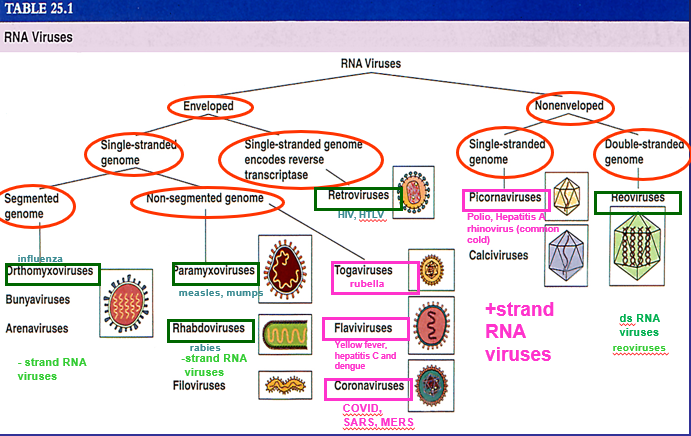
RNA Viruses
\-RNA is labile and transient (DNA is not)
\-most replicate in the cytoplasm
\-RNA viruses must encode an RNA-dependent RNA polymerase because host cells can’t replicate RNA
\-genome structure determines mechanisms of transcription and replication
\-highly prone to mutations and lack proofreading activity
\-make up majority of human viral pathogens
\-most replicate in the cytoplasm
\-RNA viruses must encode an RNA-dependent RNA polymerase because host cells can’t replicate RNA
\-genome structure determines mechanisms of transcription and replication
\-highly prone to mutations and lack proofreading activity
\-make up majority of human viral pathogens
31
New cards
Positive RNA Viruses
\-Picornaviruses: polio, common cold, Hepatitis A
\-Togaviruses: rubella
\-Flaviviruses: yellow fever, hepatitis C, dengue fever
\-Coronaviruses: COVID, SARS, MERS, common cold
\-Togaviruses: rubella
\-Flaviviruses: yellow fever, hepatitis C, dengue fever
\-Coronaviruses: COVID, SARS, MERS, common cold
32
New cards
Negative RNA Viruses
\-Paramyxoviruses: measles, mumps
\-Rhabdoviruses: rabies
\-Orthomyxoviruses: influenza
\-Bunyaviruses: respiratory distress hemorrhagic fevers
\-Rhabdoviruses: rabies
\-Orthomyxoviruses: influenza
\-Bunyaviruses: respiratory distress hemorrhagic fevers
33
New cards
RNA Retroviruses
\-HTLV
\-HIV (carry reverse transcriptase within the viral particle)
\
\-Reverse Transcriptase = RNA-dependent DNA polymerase that makes DNA intermediate
\-First retrovirus discovered: Rous sarcoma virus (Peyton Rous, 1910)
* oncogene = src
\-First human retrovirus case = two patients w/ T cell lymphomas (HTLV-I, human T lymphotropic virus), 1978
\-HIV/AIDS discovered 1983
\-HIV (carry reverse transcriptase within the viral particle)
\
\-Reverse Transcriptase = RNA-dependent DNA polymerase that makes DNA intermediate
\-First retrovirus discovered: Rous sarcoma virus (Peyton Rous, 1910)
* oncogene = src
\-First human retrovirus case = two patients w/ T cell lymphomas (HTLV-I, human T lymphotropic virus), 1978
\-HIV/AIDS discovered 1983
34
New cards
Double-Stranded RNA Viruses
\-Reoviruses: respiratory and gastrointestinal infections
35
New cards
Detection of Viral Proteins
detect:
\-protein patterns w/ electrophoresis
\-enzyme activities
\-hemagglutination and hemadsorption
\-antigen detection (ELISA, western blot, immunofluorescence, antigen rapid tests)
\-protein patterns w/ electrophoresis
\-enzyme activities
\-hemagglutination and hemadsorption
\-antigen detection (ELISA, western blot, immunofluorescence, antigen rapid tests)
36
New cards
Detection of Viral Nucleic Acids
\-Restriction endonuclease cleavage patterns
\-Electrophoresis (segmented RNA viruses)
\-DNA genome hybridization (*in situ* hybridization)
\-Southern, Northern, and dot blots
\-Polymerase chain reaction (PCR, RT-PCR)
\-Electrophoresis (segmented RNA viruses)
\-DNA genome hybridization (*in situ* hybridization)
\-Southern, Northern, and dot blots
\-Polymerase chain reaction (PCR, RT-PCR)
37
New cards
Immunofluorescence
\-%%Direct: fluorochrome labeled antibody directly binds to the target tissue antigen%%
\-%%Indirect: an unlabeled antibody binds to the target tissue antigen, then a fluorochrome labeled antibody (anti-Ig) against the unlabeled antibody binds%%
* stronger signal than direct
\-%%Indirect: an unlabeled antibody binds to the target tissue antigen, then a fluorochrome labeled antibody (anti-Ig) against the unlabeled antibody binds%%
* stronger signal than direct
38
New cards
Type I Interferon
Type I IFN: %%cytokines which play essential roles in inflammation, immunoregulation, tumor cell recognition and T cell responses%%
* bind specific cell surface receptor complex on target cells called IFN-a/B; %%leads to expression of proteins that will prevent the virus from producing and replicating its RNA and DNA%%
* produced when the body recognizes that a virus has invaded it (recognition of viral components like nucleic acids)
* induced in virtually all cell types upon recognition of viral components
* bind specific cell surface receptor complex on target cells called IFN-a/B; %%leads to expression of proteins that will prevent the virus from producing and replicating its RNA and DNA%%
* produced when the body recognizes that a virus has invaded it (recognition of viral components like nucleic acids)
* induced in virtually all cell types upon recognition of viral components
39
New cards
Type II Interferon
\-IFN y in humans
\-%%known as the immune IFN, activated by interleukin-12%%
\-%%released by cytotoxic T cells (CD8) and type-1 T helper cells (TH1 CD4)%%
\-induced by cytokines like IL-12; %%expression restricted to immune cells%% like T cells, NK cells, macrophages, and dendritic cells
\-%%known as the immune IFN, activated by interleukin-12%%
\-%%released by cytotoxic T cells (CD8) and type-1 T helper cells (TH1 CD4)%%
\-induced by cytokines like IL-12; %%expression restricted to immune cells%% like T cells, NK cells, macrophages, and dendritic cells
40
New cards
Modes of Transmission of Communicable Diseases
Direct:
\-horizontal contact (ex. kissing, sex)
\-airborne droplets between people (ex. sneezing, coughing)
\-vertical contact (through pregnancy, birth canal)
\-disease vectors
\
Indirect:
\-contact with fomites
\-fecal-oral contamination
\-food, water, biological products
\-airborne (ex. soil that has been kicked up)
\-horizontal contact (ex. kissing, sex)
\-airborne droplets between people (ex. sneezing, coughing)
\-vertical contact (through pregnancy, birth canal)
\-disease vectors
\
Indirect:
\-contact with fomites
\-fecal-oral contamination
\-food, water, biological products
\-airborne (ex. soil that has been kicked up)
41
New cards
Inapparent Infection
presence of infection in a host without occurrence of recognizable clinical signs or symptoms
42
New cards
Acute Infection
\-localized infection: infection remains in one specific area or organ
\-generalized infection: infection spreads across the body
\-congenital infection: caused by viruses that may be picked up by the baby at any time during the pregnancy up through the time of delivery
\-generalized infection: infection spreads across the body
\-congenital infection: caused by viruses that may be picked up by the baby at any time during the pregnancy up through the time of delivery
43
New cards
Persistent Infection
virus is not cleared but remains in specific cells of infected individuals; virus may become latent and stay in the body
44
New cards
Transformation Infection
change in growth, phenotype, or indefinite reproduction of cells caused by the introduction of inheritable material. Through this process, a virus causes harmful transformations of an in vivo cell or cell culture.
45
New cards
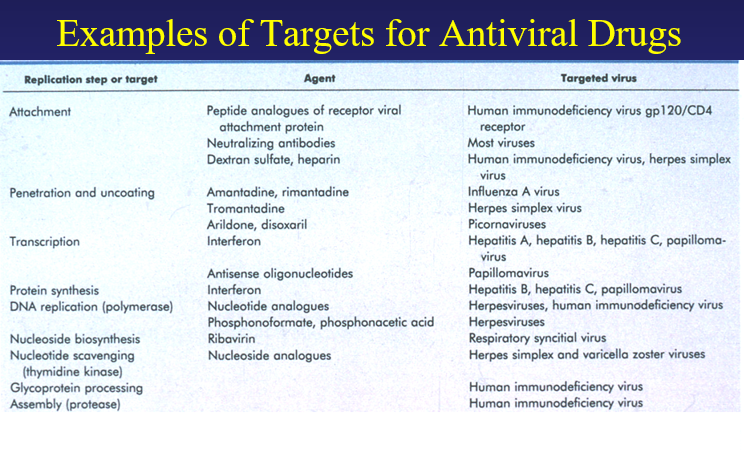
Characteristics of Antiviral Agents
%%Desirable:%%
\-metabolic stability
\-ready to transport to infected target organs
\-chemical and thermal stability
\-good solubility at or close to physiologic pH
\-low cost of preparation
\
%%Undesirable:%%
\-causes acute toxicity
\-causes chronic pathogenesis effects
* teratogenesis: congenital malformations
* mutagenesis: DNA may experience physical changes that induce mutations
* carcinogenesis: cause cancer
\-immunosuppressive
\-incorporates into DNA of the noninfected cell
\-develops into resistant mutant
\-causes activation of latent viruses
\-metabolic stability
\-ready to transport to infected target organs
\-chemical and thermal stability
\-good solubility at or close to physiologic pH
\-low cost of preparation
\
%%Undesirable:%%
\-causes acute toxicity
\-causes chronic pathogenesis effects
* teratogenesis: congenital malformations
* mutagenesis: DNA may experience physical changes that induce mutations
* carcinogenesis: cause cancer
\-immunosuppressive
\-incorporates into DNA of the noninfected cell
\-develops into resistant mutant
\-causes activation of latent viruses
46
New cards
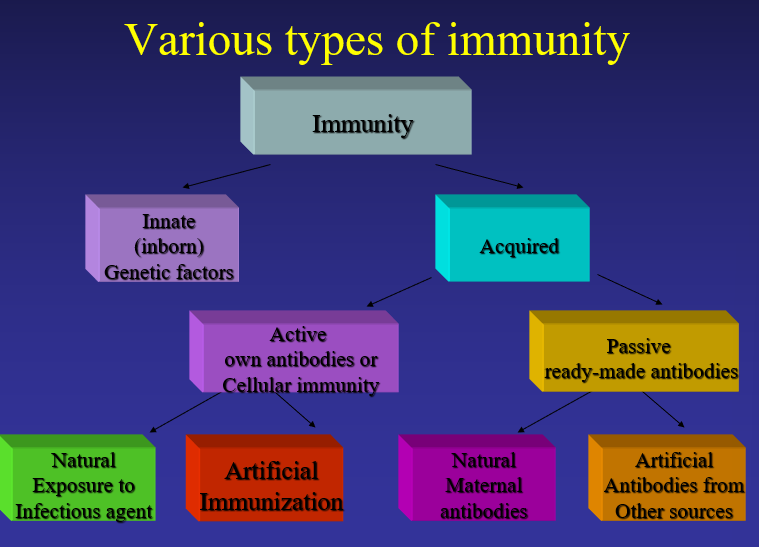
Types of Immunity
47
New cards
Viral Escape Mechanisms
\-poor or absent immune response to pathogen
\-intercellular spread of viruses
\-rapid changes in antigenic composition of some viruses
\-genetically determined susceptibility
\-growth of viruses on lymphoretiuclar cells
\-viral induced immunosuppression
\-antibody modulation of virus antigens on cells
\-viral latency
\-mimicry of host cell’s molecules or ligands
\-hiding their binding sites from antibodies
\-virokines
\-intercellular spread of viruses
\-rapid changes in antigenic composition of some viruses
\-genetically determined susceptibility
\-growth of viruses on lymphoretiuclar cells
\-viral induced immunosuppression
\-antibody modulation of virus antigens on cells
\-viral latency
\-mimicry of host cell’s molecules or ligands
\-hiding their binding sites from antibodies
\-virokines
48
New cards
Types of Viral Vaccines
\-inactivated vaccines
\-live attenuated vaccines
\-recombinant vaccines
\-subviral particle vaccines
\-anti-idiotypic vaccines
\-live attenuated vaccines
\-recombinant vaccines
\-subviral particle vaccines
\-anti-idiotypic vaccines
49
New cards
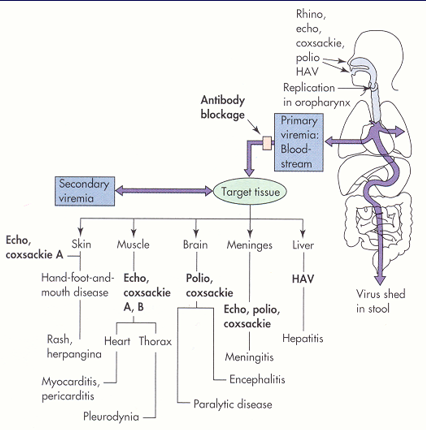
Picornaviruses
\-%%positive, single-stranded RNA genome%%
\-%%naked, small, icosahedral capsid%%
\-Enteroviruses are resistant to pH 3 to 9, detergents, mild sewage treatment, and heat
\-Rhinoviruses are labile at acidic pH; optimum growth temperature is 33 degrees Celsius
\-%%replicates in cytoplasm%%
\-%%viruses are cytolytic%% (get out by breaking the host cell)
\-%%naked, small, icosahedral capsid%%
\-Enteroviruses are resistant to pH 3 to 9, detergents, mild sewage treatment, and heat
\-Rhinoviruses are labile at acidic pH; optimum growth temperature is 33 degrees Celsius
\-%%replicates in cytoplasm%%
\-%%viruses are cytolytic%% (get out by breaking the host cell)
50
New cards
Togaviruses
\-%%positive, single-stranded RNA genome%%
\-%%enveloped, non-segmented%%
\-@@Alphaviruses@@
* @@transmitted by arthropods (arthropod borne = arboviruses)@@
* 27 known, 11 cause disease in humans
\-@@Rubivirus = causes rubella@@
\-%%enveloped, non-segmented%%
\-@@Alphaviruses@@
* @@transmitted by arthropods (arthropod borne = arboviruses)@@
* 27 known, 11 cause disease in humans
\-@@Rubivirus = causes rubella@@
51
New cards
Flaviviruses
\-%%positive, single-stranded RNA genome%%
\-%%enveloped, non-segmented%%
\-%%causes anywhere from febrile illnesses to life-threatening hemorrhagic fevers, encephalitis, and hepatitis (hep C)%%
\-70 types, 13 infect humans
\
Some of the Most Important Viral Pathogens in Developing World:
\-@@yellow fever@@
\-@@dengue fever@@
\-Japanese encephalitis
\-St. Louis encephalitis
\-%%enveloped, non-segmented%%
\-%%causes anywhere from febrile illnesses to life-threatening hemorrhagic fevers, encephalitis, and hepatitis (hep C)%%
\-70 types, 13 infect humans
\
Some of the Most Important Viral Pathogens in Developing World:
\-@@yellow fever@@
\-@@dengue fever@@
\-Japanese encephalitis
\-St. Louis encephalitis
52
New cards
Bunyaviruses
\-%%negative, single-stranded RNA genome%%
* %%half positive and half negative RNA strands (ambisense)%%
\-%%enveloped, segmented%%
\-most are arboviruses (spread by mosquitoes, ticks, or flies)
* endemic to the environment of the vector
\-at least 200 exist
* %%half positive and half negative RNA strands (ambisense)%%
\-%%enveloped, segmented%%
\-most are arboviruses (spread by mosquitoes, ticks, or flies)
* endemic to the environment of the vector
\-at least 200 exist
53
New cards
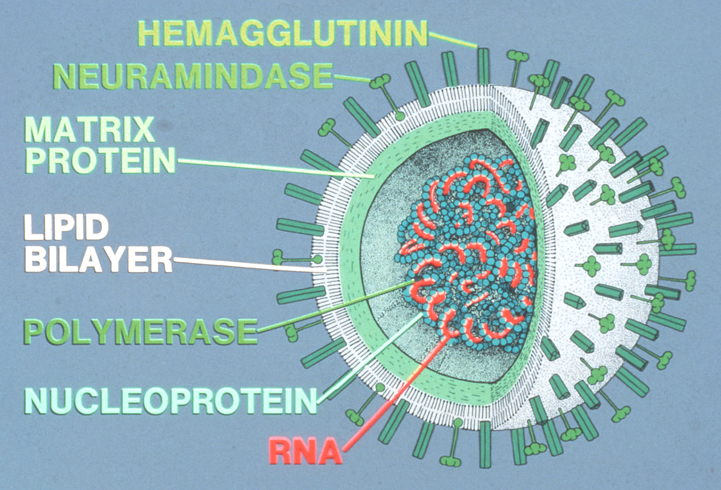
Parts of the Virus
\-hemagglutinin: glycoproteins on surface of the cell important for binding
\-neuraminidase: enables the virus to be released from the host cell; on surface of the cell
\-matrix protein
\-lipid bilayer
\-polymerase
\-nucleoprotein: proteins conjugated with nucleic acids (either DNA or RNA);typical nucleoproteins include ribosomes, nucleosomes and viral nucleocapsid proteins
\-RNA
\-neuraminidase: enables the virus to be released from the host cell; on surface of the cell
\-matrix protein
\-lipid bilayer
\-polymerase
\-nucleoprotein: proteins conjugated with nucleic acids (either DNA or RNA);typical nucleoproteins include ribosomes, nucleosomes and viral nucleocapsid proteins
\-RNA
54
New cards
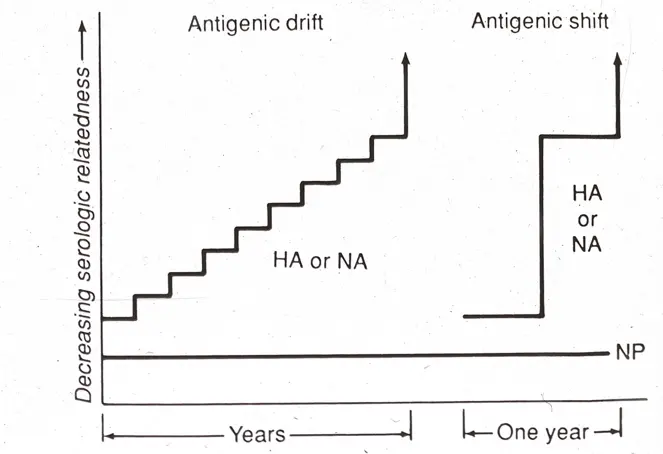
Influenza Antigenic Drifts and Shifts
Drifts: little mutations that occur in the virus; overtime the accumulation of these mutations makes the virus a completely different thing
\
Shifts: recombination between two different influenza viruses that are coinfecting a species cause significant changes that create a new virus species; occur in less than a year
\
\*influenza viruses change so quickly because of these types of mutations
\
Shifts: recombination between two different influenza viruses that are coinfecting a species cause significant changes that create a new virus species; occur in less than a year
\
\*influenza viruses change so quickly because of these types of mutations
55
New cards
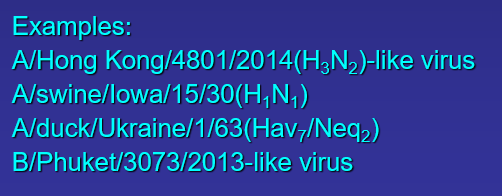
Influenza Strains Nomenclature
\-%%Type%%
\-%%Host of origin%%
\-%%Geographic origin%%
\-%%Strain number%%
\-%%Year of isolation%%
\-%%Antigenic descriptions%%
\-%%Host of origin%%
\-%%Geographic origin%%
\-%%Strain number%%
\-%%Year of isolation%%
\-%%Antigenic descriptions%%
56
New cards
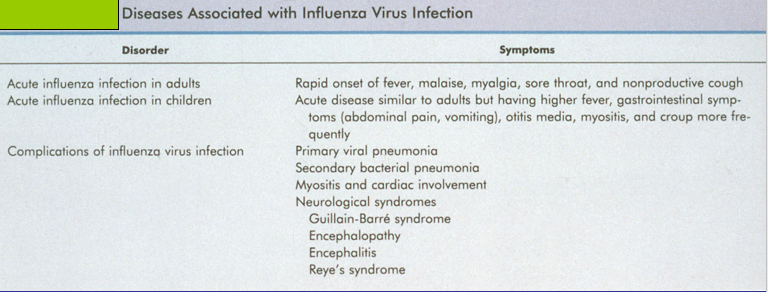
Diseases Associated with Influenza Virus Infection
%%Influenza in Adults:%%
\-rapid onset fever
\-malaise
\-myalgia
\-sore throat
\-nonproductive cough
\
%%Influenza in Children:%%
\-acute disease similar to adults
\-higher fever
\-gastrointestinal symptoms (abdominal pain, vomiting)
\-otitis media
\-myositis
\-croup
\-rapid onset fever
\-malaise
\-myalgia
\-sore throat
\-nonproductive cough
\
%%Influenza in Children:%%
\-acute disease similar to adults
\-higher fever
\-gastrointestinal symptoms (abdominal pain, vomiting)
\-otitis media
\-myositis
\-croup
57
New cards
Influenza Modes of Control
\-vaccines with predicted yearly strains of influenza A and B viruses
* @@important vaccine = neuraminidase vaccine@@
\-several antiviral treatments have been approved against influenza for prophylaxis or early treatment
* @@important vaccine = neuraminidase vaccine@@
\-several antiviral treatments have been approved against influenza for prophylaxis or early treatment
58
New cards
Coronaviruses
\-%%large, positive, single-stranded RNA genome%%
\-%%enveloped, non-segmented%%
* studded with long petal-shaped spikes
\-nucleocapsids are long, flexible helices
\-%%second most frequent etiologic agents of common cold in US%%
\-%%causative agent of severe acute respiratory syndrome (SARS-COV1)%% that emerged in Asia in winter of 2002 and Middle East respiratory syndrome (MERS) first reported in 2012
\-play a role in some human enteric infections
\-could also cause viral pneumonia and myocarditis
\-%%enveloped, non-segmented%%
* studded with long petal-shaped spikes
\-nucleocapsids are long, flexible helices
\-%%second most frequent etiologic agents of common cold in US%%
\-%%causative agent of severe acute respiratory syndrome (SARS-COV1)%% that emerged in Asia in winter of 2002 and Middle East respiratory syndrome (MERS) first reported in 2012
\-play a role in some human enteric infections
\-could also cause viral pneumonia and myocarditis
59
New cards
Coronavirus Pandemic
\-SARS-COV2 appeared in Wuhan, China in 2019
\-COVID-19 disease
%%-USA: 105,394,979 cases, about 1.2 million deaths (1,146,735 deaths)%%
\-%%Global: 674,622,359 cases, about 6.9 million deaths (6,875,314 deaths)%%
\-COVID-19 disease
%%-USA: 105,394,979 cases, about 1.2 million deaths (1,146,735 deaths)%%
\-%%Global: 674,622,359 cases, about 6.9 million deaths (6,875,314 deaths)%%
60
New cards
Vaccine and Treatments Against COVID-19 Approved in USA
Vaccines:
\-Pfizer = mRNA vaccine
\-Moderna = mRNA vaccine
\-Johnson & Johnson = a DNA vaccine
\
Treatments
\-Remdesivir and other antiviral FDA approved drugs
\-monoclonal antibody treatments
\-Pfizer = mRNA vaccine
\-Moderna = mRNA vaccine
\-Johnson & Johnson = a DNA vaccine
\
Treatments
\-Remdesivir and other antiviral FDA approved drugs
\-monoclonal antibody treatments
61
New cards
Orthomyxoviruses
\-%%negative, single-stranded RNA genome%%
\-%%enveloped, segmented%%
\-influenza A, B, and C viruses
\-%%enveloped, segmented%%
\-influenza A, B, and C viruses
62
New cards
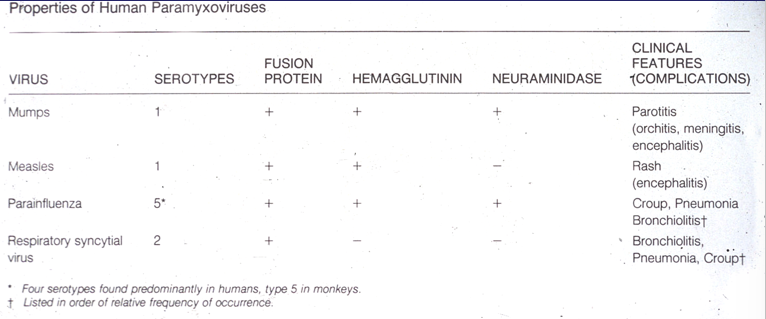
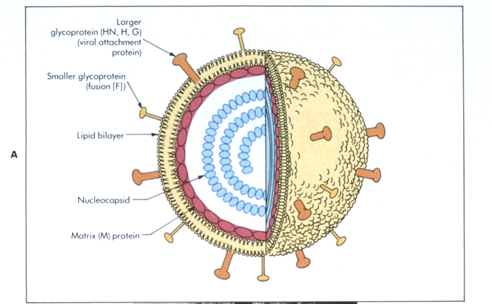
Paramyxoviruses
\-%%single-stranded, negative RNA genome%%
\-%%enveloped, non-segmented%%
\-mumps (1 serotype)
\-measles (1 serotype)
\-parainfluenza 1-5 (5 serotypes)
\-respiratory syncytial virus (2 serotypes)
\-%%enveloped, non-segmented%%
\-mumps (1 serotype)
\-measles (1 serotype)
\-parainfluenza 1-5 (5 serotypes)
\-respiratory syncytial virus (2 serotypes)
63
New cards
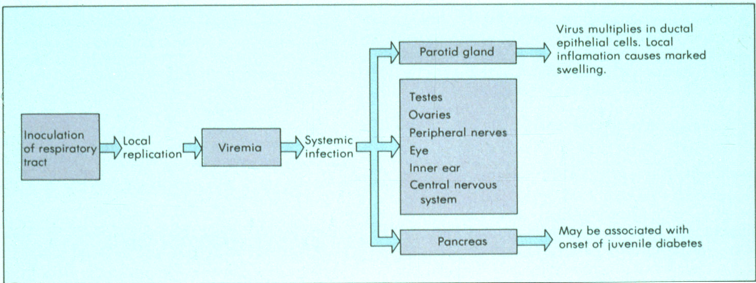
Paramyxoviruses: Spread of Mumps
1. Inoculation of respiratory tract
2. Local replication
3. Viremia
4. Systemic infection around various parts of the body (in image)
64
New cards
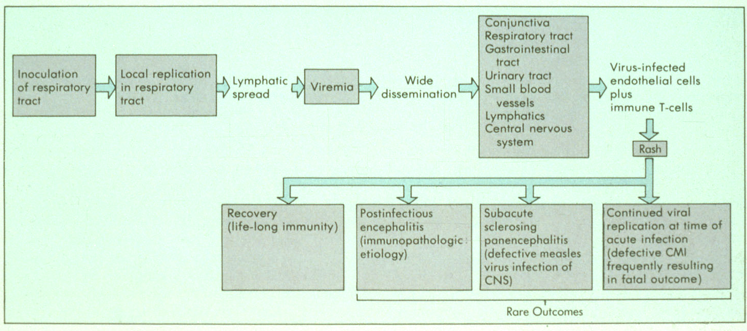
Paramyxoviruses: Spread of Measles
1. Inoculation of respiratory tract
2. Local replication in respiratory tract
3. Lymphatic spread
4. Viremia
5. Wide dissemination to different parts of the body (view image)
65
New cards
Koplik spots and exanthem are diagnostic indicators of?
measles (NOT rubella)
\-small, white spots (often on a reddened background) that occur on the inside of the cheeks
\-small, white spots (often on a reddened background) that occur on the inside of the cheeks
66
New cards
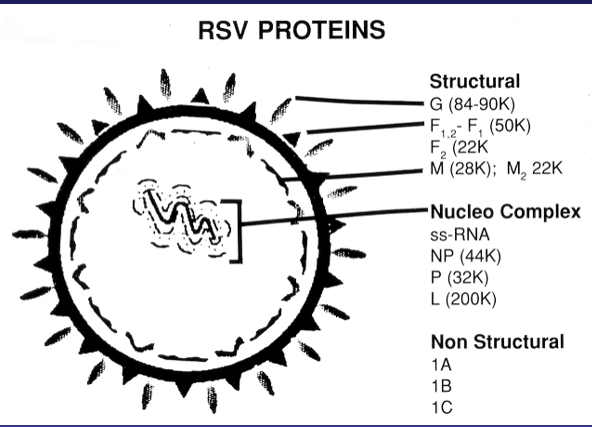
@@Respiratory Syncytial Virus Proteins@@
\*
67
New cards
Clinical Consequences of Respiratory Syncytial Virus Infection
%%Children less than 1 year old:%%
\-bronchiolitis, pneumonia, fever, cough, dyspnea, cyanosis
\
%%Children older than 1 year old:%%
\-febrile rhinitis and pharyngitis
\
%%Older children and adults:%%
\-common cold
\-bronchiolitis, pneumonia, fever, cough, dyspnea, cyanosis
\
%%Children older than 1 year old:%%
\-febrile rhinitis and pharyngitis
\
%%Older children and adults:%%
\-common cold
68
New cards
Rubella
\-remember this is a %%Togavirus NOT a Paramyxovirus%%
\-respiratory virus
\-different pathogenesis in children or adults than in fetuses
\-Symptoms (quite similar to measles except measles has Koplik’s spots)
* rash
* swollen lymph nodes
* malaise
* conjunctivitis
* coryza
\-respiratory virus
\-different pathogenesis in children or adults than in fetuses
\-Symptoms (quite similar to measles except measles has Koplik’s spots)
* rash
* swollen lymph nodes
* malaise
* conjunctivitis
* coryza
69
New cards
Clinical Findings in %%Congenital%% Rubella Syndrome
\-Cataracts and other ocular defects (due to teratogenesis)
\-Heart defects
\-Deafness
\-Intrauterine growth retardation
* newborn has failure to thrive
* mortality within the first year
\-Microcephaly
* mental retardation
\-Heart defects
\-Deafness
\-Intrauterine growth retardation
* newborn has failure to thrive
* mortality within the first year
\-Microcephaly
* mental retardation
70
New cards
Measles, Mumps, Rubella Vaccine (MMR)
\-live attenuated virus
\-Measles: Schwartz or Moraten substrains of Edmonston B strain
\-Mumps: Jeryl Lynn strain
\-Rubella: RA/27-3 strain
\
\-%%Vaccination schedule: one dose at 15 months, another dose between 4 and 6 years old or before junior high school%%
\
\-%%Efficiency: 95% lifelong immunization with a single dose%%
\-Measles: Schwartz or Moraten substrains of Edmonston B strain
\-Mumps: Jeryl Lynn strain
\-Rubella: RA/27-3 strain
\
\-%%Vaccination schedule: one dose at 15 months, another dose between 4 and 6 years old or before junior high school%%
\
\-%%Efficiency: 95% lifelong immunization with a single dose%%
71
New cards
@@Reoviruses@@
\-%%double-stranded RNA genome%%
\-%%naked, double-layered capsid%%
\*^^remember: reoviruses = “double, double”^^
\-%%segmented%%
\-resistant to environmental and gastrointestinal conditions
\-virus released by cell lysis
\-%%naked, double-layered capsid%%
\*^^remember: reoviruses = “double, double”^^
\-%%segmented%%
\-resistant to environmental and gastrointestinal conditions
\-virus released by cell lysis
72
New cards
Double-Stranded RNA Viruses
\-genome serves as the template for mRNA transcription
\-virions carry the RNA dependent RNA polymerase in the core
\*Ex. reoviruses
\-virions carry the RNA dependent RNA polymerase in the core
\*Ex. reoviruses
73
New cards
Disease Mechanisms of Rotavirus
\-%%type of Reovirus%%
\-%%spread by fecal-oral route and possibly the respiratory route%%
\-cytolytic and toxin-like action on the intestinal epithelium causes loss of electrolytes and prevents reabsorption of water
\-%%disease can be very severe in infants younger than 24 months but asymptomatic in adults%%
\-large amounts of virus released during @@diarrheal phase@@
\-%%spread by fecal-oral route and possibly the respiratory route%%
\-cytolytic and toxin-like action on the intestinal epithelium causes loss of electrolytes and prevents reabsorption of water
\-%%disease can be very severe in infants younger than 24 months but asymptomatic in adults%%
\-large amounts of virus released during @@diarrheal phase@@
74
New cards
Rotavirus Clinical Symptoms
\*type of Reovirus
\-associated with gastroenteritis (usually self-limiting and usually complete recovery)
\-incubation period of 48 hr.
\-vomiting
\-diarrhea
\-fever
\-dehydration
\-may be fatal for malnourished and dehydrated infants in underdeveloped countries
\-associated with gastroenteritis (usually self-limiting and usually complete recovery)
\-incubation period of 48 hr.
\-vomiting
\-diarrhea
\-fever
\-dehydration
\-may be fatal for malnourished and dehydrated infants in underdeveloped countries
75
New cards
Rotavirus Modes of Control
\*type of Reovirus
\-frequent handwashing
\-isolation of infected cases
\-vaccines available
* RotaTeq
* Rotarix
\-frequent handwashing
\-isolation of infected cases
\-vaccines available
* RotaTeq
* Rotarix
76
New cards
Calciviruses
\-%%linear, positive, single-stranded RNA genome%%
\-%%small, naked%%
\-name derived from 32 cup-shaped (calix, cup) surface depressions in the icosahedral capsid
\-%%includes Noroviruses, Astroviruses, and other small and round gastroenteritis viruses%%
\-%%small, naked%%
\-name derived from 32 cup-shaped (calix, cup) surface depressions in the icosahedral capsid
\-%%includes Noroviruses, Astroviruses, and other small and round gastroenteritis viruses%%
77
New cards
Norovirus Pathogenesis
\*type of Calcivirus
\-%%responsible for about 90% of epidemic non-bacterial outbreaks of gastroenteritis in the world%%
\-%%transmitted by fecal-oral route in contaminated water and food%%
\-%%outbreaks commonly occur in closed or semi-closed communities such as cruise-ships, hospitals, and prisons%%
\-resistant to detergents, drying and acid; inactivated by chlorine-based disinfectants but less susceptible to alcohol or detergents
\-hand-washing = most effective way to eliminate spread of the virus
\-%%responsible for about 90% of epidemic non-bacterial outbreaks of gastroenteritis in the world%%
\-%%transmitted by fecal-oral route in contaminated water and food%%
\-%%outbreaks commonly occur in closed or semi-closed communities such as cruise-ships, hospitals, and prisons%%
\-resistant to detergents, drying and acid; inactivated by chlorine-based disinfectants but less susceptible to alcohol or detergents
\-hand-washing = most effective way to eliminate spread of the virus
78
New cards
Rhabdoviruses
\-%%negative, single-stranded RNA virus%%
\-%%enveloped, non-segmented%%
\-%%bullet-shaped viruses%%
\-cell death and lysis occurs after infection with most of these viruses, %%except rabies which causes little cell damage%%
\-%%enveloped, non-segmented%%
\-%%bullet-shaped viruses%%
\-cell death and lysis occurs after infection with most of these viruses, %%except rabies which causes little cell damage%%
79
New cards
Rhabdoviruses: Rabies Virus Pathogenesis
\-rapidly progressive, incurable viral encephalitis
\-transmitted by bite of an infected rabid animal
\-resides in local area of infection for a long time before moving to CNS
\-once symptoms apparent, treatment is too late
\
Infection of an Animal:
\-causes secretion of the virus in the animal’s saliva
\-promotes aggressive behavior (“mad dog”)
\-virus can be transmitted through:
* inhalation of aerosolized virus (found in bat caves)
* transplanted infected tissue (ex. cornea)
* inoculation through intact mucosal membranes
\-transmitted by bite of an infected rabid animal
\-resides in local area of infection for a long time before moving to CNS
\-once symptoms apparent, treatment is too late
\
Infection of an Animal:
\-causes secretion of the virus in the animal’s saliva
\-promotes aggressive behavior (“mad dog”)
\-virus can be transmitted through:
* inhalation of aerosolized virus (found in bat caves)
* transplanted infected tissue (ex. cornea)
* inoculation through intact mucosal membranes
80
New cards
Filoviruses
\-negative, single-stranded RNA virus
\-enveloped, non-segmented
\
Ebola
\-endemic in Africa, discovered in 1976, Ebola river (Congo)
\-recurrent outbreaks of fatal human illness in Zaire and Sudan from 1970’s to 2000’s.
\-West Africa epidemic 2014
\-5 subtypes (4 out of 5 occur in animal hosts native to Africa)
\-Clinical features similar to Marburg illness
\-Mortality: 50-90%, outbreak in Sudan (1976) had 53% fatality
\-Natural reservoir host of Ebola viruses remains unknown, but is likely animal-borne (bats)
\-Serological studies found low titer anti-Ebola antibody in healthy human populations in central Zaire and Sudan, suggesting that sub-clinical infections may occur
\-enveloped, non-segmented
\
Ebola
\-endemic in Africa, discovered in 1976, Ebola river (Congo)
\-recurrent outbreaks of fatal human illness in Zaire and Sudan from 1970’s to 2000’s.
\-West Africa epidemic 2014
\-5 subtypes (4 out of 5 occur in animal hosts native to Africa)
\-Clinical features similar to Marburg illness
\-Mortality: 50-90%, outbreak in Sudan (1976) had 53% fatality
\-Natural reservoir host of Ebola viruses remains unknown, but is likely animal-borne (bats)
\-Serological studies found low titer anti-Ebola antibody in healthy human populations in central Zaire and Sudan, suggesting that sub-clinical infections may occur
81
New cards
Filoviruses: Ebola
\-incubation time to clinical symptoms 2-21 days, most commonly 8-10 days
\-early symptoms are non-specific: fever, chills, muscle aches, malaise
\-spread from one person to another through direct contact with:
* Ebola-infected blood or body fluids
* objects, such as needles, that have been contaminated with infected body fluids
\-healthcare workers and others who come into close contact with infected patients (including corpses) have the highest risk of exposure
\-a patient must have symptoms to be infectious
\-early symptoms are non-specific: fever, chills, muscle aches, malaise
\-spread from one person to another through direct contact with:
* Ebola-infected blood or body fluids
* objects, such as needles, that have been contaminated with infected body fluids
\-healthcare workers and others who come into close contact with infected patients (including corpses) have the highest risk of exposure
\-a patient must have symptoms to be infectious
82
New cards
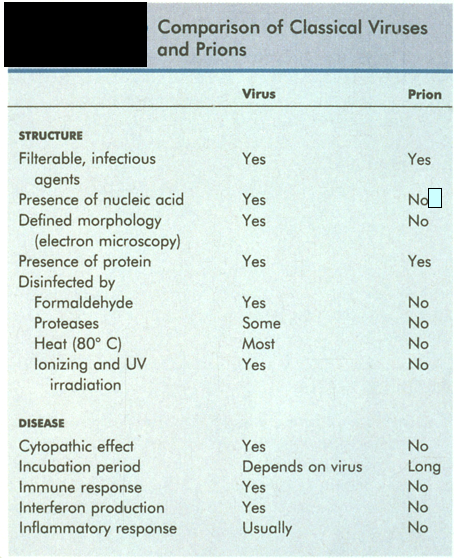
Viruses vs. Prions
\-prions do not have/contain nucleic acids
\-prions do not have a defined morphology
\-prions are not disinfected by:
* formaldehyde
* proteases
* heat
* ionizing and UV radiation
\-prions have long incubation periods; for viruses the incubation period varies
\-prions aren’t targeted or eliminated effectively by immune responses or molecules
\-prions do not have a defined morphology
\-prions are not disinfected by:
* formaldehyde
* proteases
* heat
* ionizing and UV radiation
\-prions have long incubation periods; for viruses the incubation period varies
\-prions aren’t targeted or eliminated effectively by immune responses or molecules
83
New cards
Prion Pathology
\-parts of the brain vacuolated or spongy
\-many cases also extensive deposits of extracellular protein fibrils or plaques
\-no signs of inflammation (no invasion of immune cells)
\
\
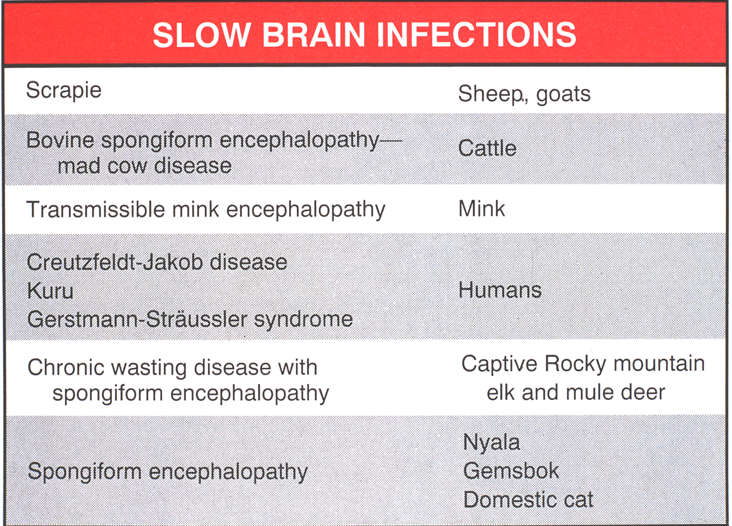
\-transmissible spongiform encephalopathies (TSE):
transmission of disease to experimental animal by intracranial injection of a homogenate of diseased tissue and subsequent serial passage to further animals
\
\*slow brain infections
\-many cases also extensive deposits of extracellular protein fibrils or plaques
\-no signs of inflammation (no invasion of immune cells)
\
\
\-transmissible spongiform encephalopathies (TSE):
transmission of disease to experimental animal by intracranial injection of a homogenate of diseased tissue and subsequent serial passage to further animals
\
\*slow brain infections
84
New cards
Retroviruses
\-two copies of positive-strand RNA genome (only diploid viruses)
\-enveloped spherical virion
\-reverse transcriptase carried in the virion
\-replicates through a DNA intermediate called a provirus
\-provirus integrates at random in host chromosome
\-enveloped spherical virion
\-reverse transcriptase carried in the virion
\-replicates through a DNA intermediate called a provirus
\-provirus integrates at random in host chromosome
85
New cards
Retroviruses: Human Oncoviruses
\-leukemia viruses that can cause cancer after a long latency period
\-include human T lymphotropic viruses
* HTLV-1
* HTLV-2
* HTLV-5
\-only HTLV-1 has been associated with disease
* Acute adult T cell lymphocytic leukemia (ATLL)
* HTLV-1-associated myelopathy (tropical spastic paraparesis) = non-oncogenic neurologic disease
\-include human T lymphotropic viruses
* HTLV-1
* HTLV-2
* HTLV-5
\-only HTLV-1 has been associated with disease
* Acute adult T cell lymphocytic leukemia (ATLL)
* HTLV-1-associated myelopathy (tropical spastic paraparesis) = non-oncogenic neurologic disease
86
New cards
@@How an Oncovirus Becomes Activated@@
\-by point mutation
\-by chromosomal rearrangement
\-by gene amplification
\-by retroviral activation
\-by chromosomal rearrangement
\-by gene amplification
\-by retroviral activation
87
New cards
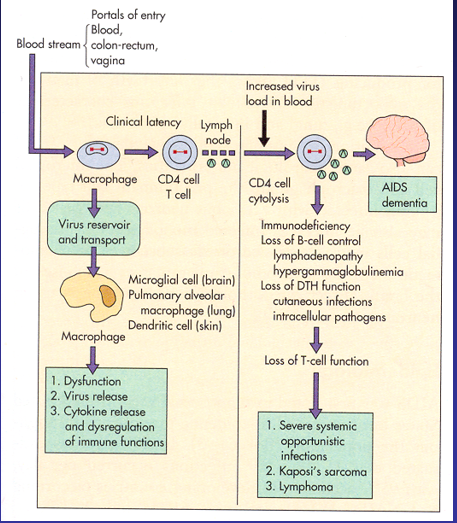
Human Immunodeficiency Virus (HIV)
\-Lentivirus
\-used to be termed lymphadenopathy virus (LAV) and HTLV-3
\-encodes several accessory genes
\-causative agent of the acquired immunodeficiency syndrome (AIDS)
\-AIDS = one of the most devastating epidemics ever recorded
\-used to be termed lymphadenopathy virus (LAV) and HTLV-3
\-encodes several accessory genes
\-causative agent of the acquired immunodeficiency syndrome (AIDS)
\-AIDS = one of the most devastating epidemics ever recorded
88
New cards
HIV Transmission
\-inoculation in blood (ex. blood transfusion, needle sticks, tattoo needles)
\-sexual transmission
\-perinatal transmission (ex. intrauterine, peripartum, breast milk)
\-NOT transmitted by personal contact
\-sexual transmission
\-perinatal transmission (ex. intrauterine, peripartum, breast milk)
\-NOT transmitted by personal contact
89
New cards
Anti-HIV Drug Targets
\-%%Entry inhibitors:%% block attachment and/or fusion
\-%%Reverse transcriptase inhibitors:%% prevent conversion of RNA into DNA
\-%%Integrase inhibitors:%% prevent integration of provirus into host DNA
\-%%Protease inhibitors:%% prevent cell membrane from breaking to release viral particles
\-%%Reverse transcriptase inhibitors:%% prevent conversion of RNA into DNA
\-%%Integrase inhibitors:%% prevent integration of provirus into host DNA
\-%%Protease inhibitors:%% prevent cell membrane from breaking to release viral particles
90
New cards
Parvoviruses
\-SMALLEST of the DNA viruses
\-%%single-stranded DNA genome%%
\-%%naked, icosahedral capsid%%
\-%%requirement of growing cells (B19) or helper virus (dependovirus) for replication%%
\-%%single-stranded DNA genome%%
\-%%naked, icosahedral capsid%%
\-%%requirement of growing cells (B19) or helper virus (dependovirus) for replication%%
91
New cards
Parvoviruses that Infect Humans
\-%%Erythrovirus: B19 (fifth disease)%%
* Fifth of the childhood exanthemas: varicella, rubella, roseola, measles
* directly kills erythroid precursor cells
* RBC production stopped
* antibody production stops the viremia
\-%%Dependovirus:%% human “adeno-associated viruses” usually found in association with adenoviruses, which %%serve as “helpers” in their replication%%
\-%%Parvovirus:%% human bocavirus
* Fifth of the childhood exanthemas: varicella, rubella, roseola, measles
* directly kills erythroid precursor cells
* RBC production stopped
* antibody production stops the viremia
\-%%Dependovirus:%% human “adeno-associated viruses” usually found in association with adenoviruses, which %%serve as “helpers” in their replication%%
\-%%Parvovirus:%% human bocavirus
92
New cards
Human Papillomaviruses
\-cause warts
\-at least 100 types
\-longer than polyoma
\
\-%%double-stranded circular DNA genome replicated and assembled in the nucleus%%
\-%%small, icosahedral, naked virus%%
\-^^virus can cause lytic infections or oncogenic transformation (oncogenic potential)^^
\-at least 100 types
\-longer than polyoma
\
\-%%double-stranded circular DNA genome replicated and assembled in the nucleus%%
\-%%small, icosahedral, naked virus%%
\-^^virus can cause lytic infections or oncogenic transformation (oncogenic potential)^^
93
New cards
Papillomavirus Modes of Control
\-%%Quadrivalent papillomavirus vaccine is available%% (GARDASIL, Merck) and contains human papillomavirus (HPV) types 6, 11, 16, and 18.
\-%%9-valent HPV is also available prepared from the purified virus-like particles of the major capsid protein of HPV%% types 6, 11, 16, 18, 31, 33, 45, 52 and 58.
\-%%recommended for girls and boys 9 to 11 years of age for the prevention of cervical cancer, precancerous or dysplastic lesions, and genital warts.%%
94
New cards
Human Polyomaviruses
\-BK virus = renal disease in immunocompromised patients
\-JC virus = progressive multifocal leuko-encephalopathy
\
\-%%double-stranded circular DNA genome replicated and assembled in the nucleus%%
\-%%small, icosahedral, naked virus%%
\-^^virus can cause lytic infections or oncogenic transformation^^
\-JC virus = progressive multifocal leuko-encephalopathy
\
\-%%double-stranded circular DNA genome replicated and assembled in the nucleus%%
\-%%small, icosahedral, naked virus%%
\-^^virus can cause lytic infections or oncogenic transformation^^
95
New cards
DNA Virus: Adenovirus
\-%%dsDNA genome%%
\-%%naked capsid%%
\-medium sized
\-Diseases:
* %%respiratory infection, conjunctivitis, gastroenteritis, cystitis%%
\-Transmission:
* ^^respiratory^^
* ^^fecal-oral^^
* ^^close contact with infected patient (in conjunctivitis cases)^^
\-Diagnosis:
* by culture
* by viral antigen detection
\-Treatment
* %%none; in serious conjunctivitis cases steroids and antibiotics can be given%%
\-Prevention
* %%live enteric coated vaccine for military recruits%%
\-%%naked capsid%%
\-medium sized
\-Diseases:
* %%respiratory infection, conjunctivitis, gastroenteritis, cystitis%%
\-Transmission:
* ^^respiratory^^
* ^^fecal-oral^^
* ^^close contact with infected patient (in conjunctivitis cases)^^
\-Diagnosis:
* by culture
* by viral antigen detection
\-Treatment
* %%none; in serious conjunctivitis cases steroids and antibiotics can be given%%
\-Prevention
* %%live enteric coated vaccine for military recruits%%
96
New cards
Poxviruses that Infect Humans
Orthopoxvirus:
* variola (major and minor)
* camelpox
* cowpox
* monkeypox
* vaccinia (small pox)
Molluscipoxvirus:
* molluscum contagiosum
Yatapoxvirus:
* Yaba monkey tumor virus tanapox (accidental infections)
Parapoxvirus:
* pseudocowpox, orf
* variola (major and minor)
* camelpox
* cowpox
* monkeypox
* vaccinia (small pox)
Molluscipoxvirus:
* molluscum contagiosum
Yatapoxvirus:
* Yaba monkey tumor virus tanapox (accidental infections)
Parapoxvirus:
* pseudocowpox, orf
97
New cards
Human Herpesviruses Classifications
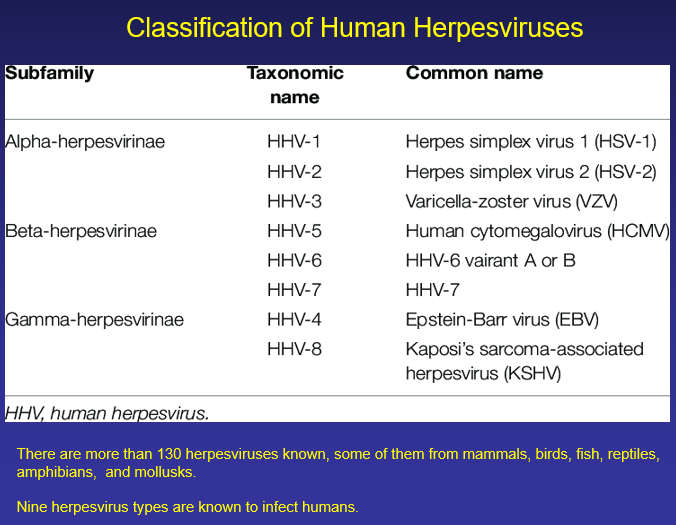
\-alpha: herpes simplex virus 1 and 2 (HSV-1 and HSV-2), and varicella-zoster virus (VZV)
\-beta
\-gamma
\-beta
\-gamma
98
New cards
Herpesviruses Common Biological Properties
\-%%Enzymology:%% encode enzymes for DNA metabolism, DNA synthesis, protein processing/modification
\-%%Nuclear replication:%% synthesis of DNA and capsid assembly occur in the nucleus of the infected cell
\-%%Cytolytic:%% Production of infectious progeny virus results in host cell death
\-%%Latency:%% All herpesviruses have the capacity for latency
99
New cards
Hepatitis A Virus
\-%%Picornavirus%%
\-%%positive, single-stranded RNA genome%%
\-%%”infectious, short-term” hepatitis%%
\-transmitted by fecal-oral route, high concentration in stool
\-mild disease
\-40% of acute hepatitis cases
\-contagious before symptoms appear
\-%%shellfish → filter feeders → concentrate virus%%
\-%%present in daycare centers%%
\-%%overcrowding has lead to more people being infected than actually realized%%
* %%Sweden: 13%%%
* %%USA: 44%%%
* %%Taiwan: 88%%%
\-%%positive, single-stranded RNA genome%%
\-%%”infectious, short-term” hepatitis%%
\-transmitted by fecal-oral route, high concentration in stool
\-mild disease
\-40% of acute hepatitis cases
\-contagious before symptoms appear
\-%%shellfish → filter feeders → concentrate virus%%
\-%%present in daycare centers%%
\-%%overcrowding has lead to more people being infected than actually realized%%
* %%Sweden: 13%%%
* %%USA: 44%%%
* %%Taiwan: 88%%%
100
New cards
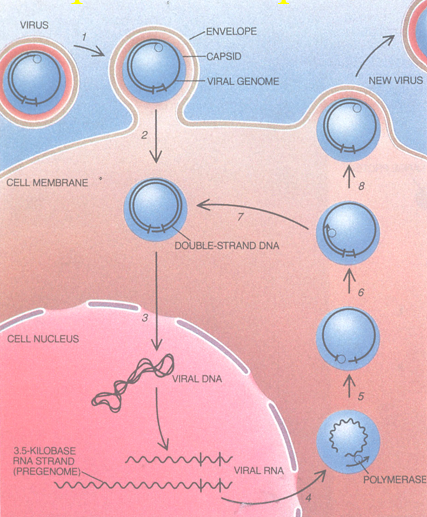
Hepatitis B Virus
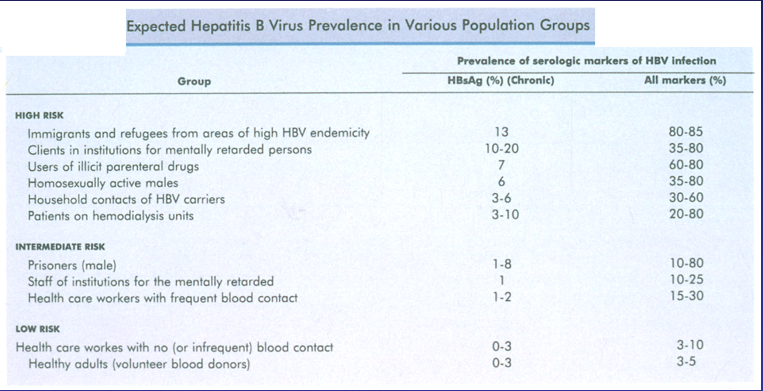
Treatment, Prevention, and Control:
\-Hepatitis B immune globulin within 1 week of exposure
\-Interferon-α for Chronic HBV
\-HIV reverse transcriptase inhibitor?
\-Blood screening
\-Lifestyle changes
\-Universal blood and body fluid precautions
Vaccination:
* Genetically engineered
* 95% effective
 Note
Note  Flashcards (64)